Key takeaways
- Profound and Scrunch are solid monitoring tools, but both stop at showing you data -- neither helps you act on it
- Searchable has useful features but lacks the depth of citation data, content generation, and crawler insights that serious teams need
- Promptwatch is the only platform in this group that closes the full loop: find gaps, generate content, track results
- For teams that want to move from "we can see the problem" to "we fixed it," Promptwatch is the clearest choice in 2026
- Pricing across all four is broadly similar for mid-market budgets, so the differentiator is capability, not cost
The AI search visibility market has gotten crowded fast. Two years ago, most marketing teams were still figuring out whether ChatGPT and Perplexity even mattered for their traffic. Now there are dozens of platforms claiming to track your brand across AI models -- and the harder question isn't "should I use one?" but "which one actually does something useful?"
This comparison focuses on four platforms that sit in roughly the same mid-market tier: Searchable, Promptwatch, Profound, and Scrunch. They're all credible options. They all monitor AI visibility in some form. But they're not the same product, and the differences matter a lot depending on what you're trying to accomplish.
Let me walk through each one honestly.
What we're actually comparing
Before getting into the tools, it's worth being clear about what "AI visibility" means in practice. When someone asks ChatGPT "what's the best project management tool for remote teams?" -- is your brand mentioned? Is it cited as a source? Is it recommended? And if it's not, why not, and what can you do about it?
A good AI visibility platform answers all three of those questions. A mediocre one answers the first and stops there.
The four platforms here vary significantly on that spectrum. Here's a quick orientation before we go deeper:
| Feature | Searchable | Promptwatch | Profound | Scrunch |
|---|---|---|---|---|
| Multi-model monitoring | Yes | Yes (10 models) | Yes | Yes |
| Content gap analysis | Partial | Yes | No | No |
| AI content generation | No | Yes | No | No |
| Crawler logs | No | Yes | No | No |
| Prompt volume/difficulty | No | Yes | Limited | No |
| Reddit/YouTube tracking | No | Yes | No | No |
| ChatGPT Shopping tracking | No | Yes | No | No |
| Traffic attribution | No | Yes | No | No |
| Page-level citation tracking | Limited | Yes | Yes | No |
| Starting price (monthly) | ~$99 | $99 | ~$99 | ~$99 |
That table tells most of the story, but let's get into the details.
Profound
Profound has built a strong reputation as a serious AI visibility tool, and it deserves credit for that. The platform covers the major AI models, gives you share-of-voice data across competitors, and has reasonably good page-level tracking that shows which of your pages are getting cited and by which models.

Where Profound genuinely shines is in competitive benchmarking. If you want to understand how your brand compares to five competitors across ChatGPT, Perplexity, and Google AI Overviews, Profound gives you a clear picture. The interface is clean, the data is reliable, and it's clearly built by people who understand enterprise marketing workflows.
The limitation is that Profound is fundamentally a monitoring tool. It shows you where you're visible and where you're not. What it doesn't do is help you close those gaps. There's no content generation, no answer gap analysis that tells you which specific topics to write about, no crawler logs showing you how AI bots are actually interacting with your site. You get the diagnosis but not the treatment.
For teams with a dedicated content operation that can take visibility data and run with it independently, that's fine. For teams that want one platform to handle the full workflow, it falls short.
Pricing is in the mid-market range, though Profound's enterprise tiers can get expensive. Worth noting: a comparison by Nick Lafferty found that Profound ranks significantly higher in AI search than Scrunch (47.1% AI visibility vs 4.7%), which says something about how well they've optimized their own presence -- but that's a marketing observation, not a product one.
Scrunch
Scrunch is the most monitoring-focused of the four. It tracks brand mentions across AI models, gives you trend data, and has a reasonable interface for understanding how your visibility changes over time.
The honest assessment: Scrunch works fine as a basic tracker. If you're a smaller brand that just wants to know whether you're showing up in AI responses and roughly how often, it does that job. The setup is quick, the learning curve is low.
But compared to the other three platforms in this comparison, Scrunch is thin. It doesn't have the depth of prompt intelligence, the competitive heatmaps, or the content optimization features that mid-market teams increasingly need. The platform feels like it was built for a simpler version of the problem -- "are we mentioned?" -- rather than the harder question of "why aren't we mentioned more, and what do we do about it?"
There's also no crawler log functionality, no traffic attribution, and no Reddit or YouTube tracking. Those aren't obscure features -- they're increasingly core to understanding how AI models discover and cite content.
If you're evaluating Scrunch seriously, the question to ask yourself is: what happens after you see the data? If the answer is "we take it to our content team and figure it out ourselves," Scrunch might be sufficient. If you want the platform to help you figure it out, look elsewhere.
Searchable
Searchable sits in an interesting middle position. It has more optimization-adjacent features than Scrunch, and it's positioned as a platform that helps you improve visibility, not just track it.
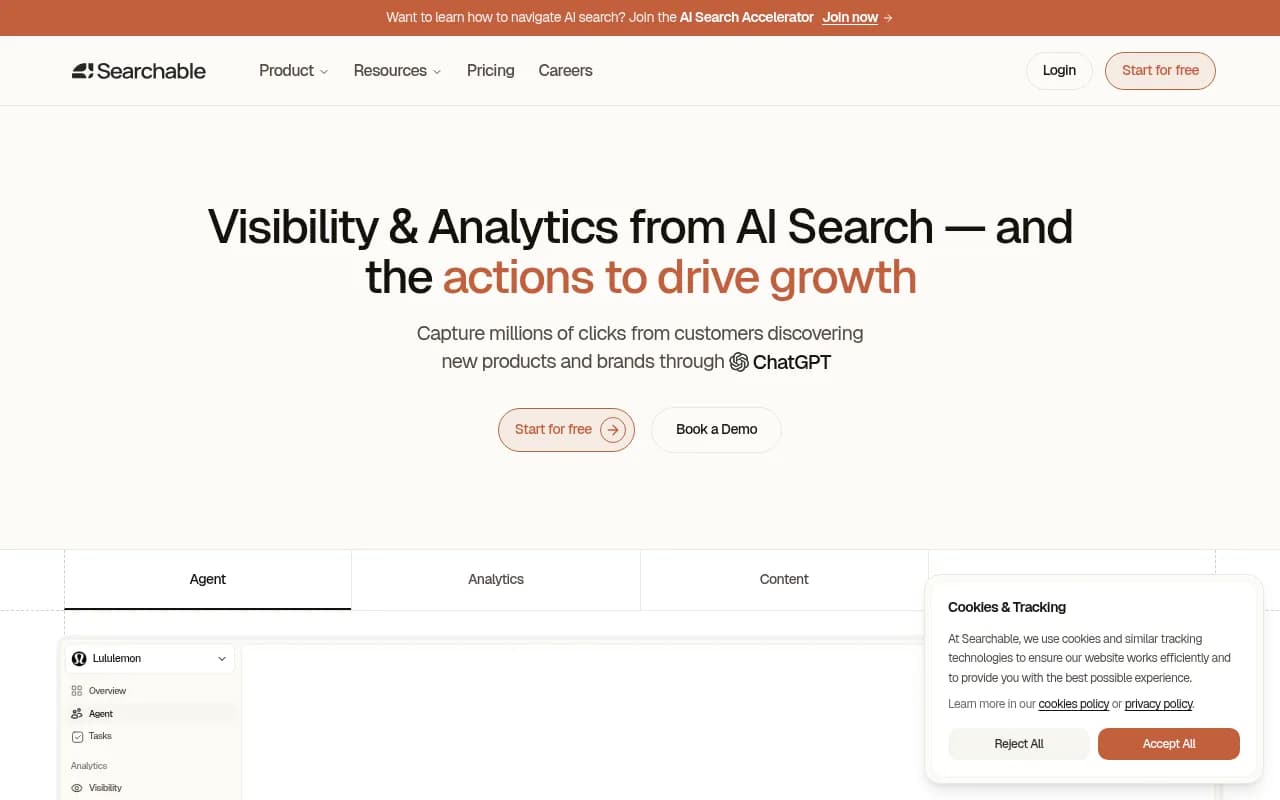
In practice, Searchable's content tools are more limited than they appear. The platform can surface some content recommendations, but it lacks the citation database depth that makes content generation genuinely useful. When you're writing content to get cited by AI models, you need to know what those models are actually pulling from -- which domains, which page types, which formats. Without 800M+ citations worth of training data behind the recommendations, the suggestions tend to be generic.
Searchable also doesn't have crawler logs, which is a meaningful gap. Understanding how AI crawlers (ChatGPT's GPTBot, Anthropic's ClaudeBot, Perplexity's crawler) interact with your site is increasingly important for diagnosing why certain pages aren't getting cited. Searchable doesn't give you that visibility.
That said, Searchable is a legitimate option for teams that want something more than basic monitoring but aren't ready to invest in a full-featured platform. It's a reasonable stepping stone.
Promptwatch
Promptwatch is the platform in this group that's built around a different premise. The others start from "let's track your visibility." Promptwatch starts from "let's improve your visibility" -- and tracking is how you know it's working.

The core workflow is what makes it different. Answer Gap Analysis shows you exactly which prompts your competitors are visible for that you're not. Not vague topic suggestions -- specific prompts, with volume estimates and difficulty scores, that you can prioritize and act on. Then the built-in AI writing agent generates content grounded in real citation data: it knows which page formats, topics, and angles actually get cited by ChatGPT, Claude, and Perplexity, because it's analyzed over 880 million citations to figure that out. Then page-level tracking shows you whether the new content is working.
That loop -- find gaps, create content, track results -- is what separates Promptwatch from the other three. Profound shows you the gap. Promptwatch shows you the gap and helps you close it.
A few specific capabilities worth calling out:
Crawler logs. Real-time logs of AI crawlers hitting your site -- which pages they read, how often, what errors they hit. This is genuinely rare. Most platforms don't have it. It's the difference between knowing you're not being cited and knowing why you're not being cited.
Reddit and YouTube tracking. AI models frequently cite Reddit threads and YouTube videos in their responses. Promptwatch surfaces which discussions are influencing AI recommendations in your category -- a channel most platforms ignore entirely.
ChatGPT Shopping. If you sell products, Promptwatch tracks when your brand appears in ChatGPT's shopping carousels. None of the other three platforms in this comparison do this.
Traffic attribution. A code snippet, GSC integration, or server log analysis connects your AI visibility to actual traffic and revenue. This closes the loop that most visibility tools leave open.
Multi-model coverage. 10 models: ChatGPT, Perplexity, Google AI Overviews, Google AI Mode, Claude, Gemini, Meta/Llama, DeepSeek, Grok, Mistral, and Copilot. That's the broadest coverage in this comparison.
Pricing starts at $99/month for the Essential tier (1 site, 50 prompts, 5 articles), $249/month for Professional (2 sites, 150 prompts, 15 articles, crawler logs), and $579/month for Business (5 sites, 350 prompts, 30 articles). There's a free trial, and annual billing reduces the cost.
For agencies, there's custom pricing with white-label options. Promptwatch is used by 6,700+ brands and agencies including Booking.com and Center Parcs, which gives some confidence that it scales.
Head-to-head: the honest verdict
Here's where each platform actually wins:
Profound is the best pure monitoring tool of the four. If your team already has strong content capabilities and just needs reliable visibility data and competitive benchmarking, Profound delivers that well. It's the right choice if monitoring is genuinely all you need.
Scrunch is the easiest to get started with, but it's also the most limited. It makes sense as a starting point for smaller teams or for brands that are just beginning to think about AI visibility. It's hard to recommend over the others if you're a mid-market team with real optimization goals.
Searchable is a reasonable middle option -- more than basic tracking, less than a full optimization platform. If budget is tight and you want something with a bit more depth than Scrunch, it's worth a look.
Promptwatch is the right choice if you want to actually move the needle. The monitoring is solid, but the real value is in the action layer: gap analysis, content generation grounded in citation data, crawler logs, and traffic attribution. It's the only platform here that treats AI visibility as something you optimize, not just observe.
Which one should you pick?
A few honest decision rules:
If you're a solo marketer or small team just getting started with AI visibility tracking, Scrunch or Searchable will get you oriented without overwhelming you. Don't over-invest in tooling before you know what questions you're trying to answer.
If you're a mid-market marketing or SEO team that already has visibility data and is frustrated that it doesn't translate into action, Promptwatch is the obvious upgrade. The gap analysis and content generation features are what you're missing.
If you're an agency managing multiple clients, Promptwatch's agency pricing and white-label options make more sense than Profound's per-seat model. The ability to generate client-ready content from within the platform is a real time-saver.
If you're at an enterprise with a dedicated analytics team that can operationalize raw visibility data, Profound is worth evaluating seriously alongside Promptwatch. The two have different strengths, and some teams use both.
One thing worth saying plainly: the AI search visibility market is moving fast. Features that were differentiators six months ago are table stakes now. The platforms that are building toward optimization workflows -- not just dashboards -- are the ones that will matter in 12 months. That's the direction Promptwatch is clearly heading, and it's why it's the recommendation here for most mid-market teams.
A note on what's not in this comparison
This guide focused on four specific platforms. The broader AI visibility market includes tools like Peec AI, Otterly.AI, AthenaHQ, and SE Ranking -- each with their own trade-offs. If none of the four above feel right, those are worth exploring.



The core question to ask of any platform: does it just show me data, or does it help me do something with it? In 2026, that distinction is what separates the tools worth paying for from the ones that become dashboard clutter.