Key takeaways
- Most AI visibility tools are built for high-volume, consumer-facing queries -- niche B2B SaaS prompts behave differently and need different tooling
- Overthink Group's April 2026 analysis found G2 is the #1 cited source across AI answer engines, and Gartner holds 28.7% of top organic SERP positions -- context that shapes which platforms matter for B2B
- Monitoring-only tools leave you stuck; the best alternatives help you find gaps, create content, and track results
- Promptwatch is the only platform in 2026 rated "Leader" across all GEO categories, with specific strengths for niche prompt tracking and content generation
- The right tool depends on your stage: early-stage teams need affordable monitoring, growth-stage teams need content execution, enterprise teams need multi-region depth
B2B SaaS has a visibility problem that most AI search tools weren't designed to solve.
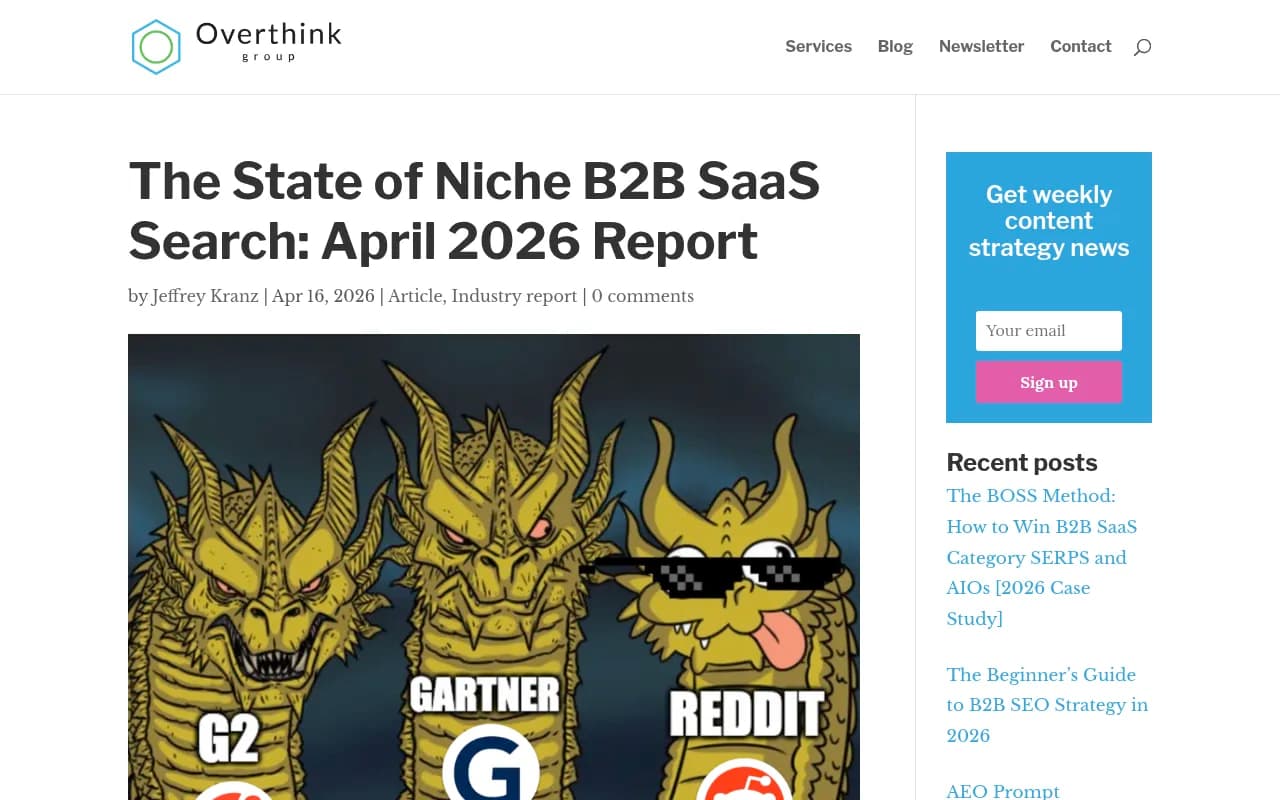
When Overthink Group analyzed 1,000 niche B2B SaaS prompts across ChatGPT, Perplexity, and Gemini in April 2026, they found something that should make every B2B marketer uncomfortable: G2 is the single most-cited source across AI answer engines, representing 4.1% of total citation share. Gartner holds 28.7% of top organic SERP positions. Review aggregators are eating B2B SaaS search -- and most AI visibility tools aren't built to help you compete in that environment.
Searchable is a reasonable starting point for AI visibility tracking. But if you're a B2B SaaS team trying to show up when buyers ask ChatGPT "what's the best [niche category] software for [specific use case]," you'll quickly hit its limits. Niche prompts have low volume, high specificity, and unusual citation patterns. You need a platform that can track those prompts at scale, tell you what content is missing, and ideally help you create it.
Here are seven alternatives worth evaluating.
Why niche B2B SaaS prompts are a different problem
Before getting into the tools, it's worth being clear about what makes this hard.
High-volume consumer queries ("best project management software") get plenty of attention from AI models. The citation patterns are well-documented, the competition is visible, and most tracking tools handle them fine.
Niche B2B prompts are different. "Best contract lifecycle management software for mid-market manufacturing companies" might get asked by a few hundred buyers a month -- but those buyers are worth a lot. The AI responses to those prompts are shaped by a small number of sources, often review sites, analyst reports, and a handful of well-optimized vendor pages. If you're not in those responses, you're invisible to buyers who are actively evaluating.
The 2026 AI Visibility Benchmark of 50 B2B SaaS companies puts the category average at 56.9 out of 100, with the top scorer (Clio) at 89. Most B2B SaaS companies are leaving significant visibility on the table -- and they often don't know which specific prompts they're missing.
That's the gap these tools need to fill.
The 7 best Searchable alternatives for B2B SaaS in 2026
1. Promptwatch
Promptwatch is the most complete option on this list for B2B SaaS teams that need to go beyond monitoring. It tracks visibility across 10 AI models (ChatGPT, Perplexity, Claude, Gemini, Grok, DeepSeek, Copilot, Meta AI, Google AI Overviews, and Google AI Mode), but what separates it from Searchable and most other tools is what happens after you see the data.
The Answer Gap Analysis shows you exactly which prompts competitors are visible for but you're not -- including the specific content your site is missing. For niche B2B categories, this is genuinely useful because you can see the precise questions AI models want answered but can't find on your site. The built-in AI writing agent then generates content grounded in 880M+ citations analyzed, prompt volumes, and competitor data. It's not generic filler -- it's content engineered to get cited.
For B2B SaaS specifically, the prompt intelligence features matter: volume estimates, difficulty scores, and query fan-outs that show how one prompt branches into sub-queries. That's how you prioritize low-volume but high-value niche prompts instead of chasing traffic you'll never convert.
Pricing starts at $99/mo (Essential), $249/mo (Professional, which adds crawler logs and city-level tracking), and $579/mo (Business, 5 sites, 350 prompts).

2. Profound
Profound has a strong reputation in B2B AI search tracking, particularly for enterprise teams. It covers the major AI models and gives you brand mention tracking with sentiment context -- useful when you want to understand not just whether you're cited, but how you're described.
Where it falls short for niche B2B use cases is content execution. Profound shows you the data but doesn't help you act on it. If your team has the bandwidth to take insights and run with them independently, that's fine. If you need the tool to help close the loop, you'll hit a wall. It's also priced at the higher end, which can be hard to justify for smaller B2B SaaS teams tracking a narrow prompt set.

3. AthenaHQ
AthenaHQ tracks visibility across 8+ AI search engines and has solid competitive benchmarking features. For B2B teams that want to understand how they stack up against a defined set of competitors across specific prompt categories, it's a clean interface with useful data.
The limitation is similar to Profound: it's monitoring-focused. There's no content generation, no gap analysis that tells you what to build, and no crawler logs to understand how AI engines are actually reading your site. For a B2B SaaS team that's already producing content and just needs visibility data, AthenaHQ works. For teams that need to build visibility from scratch in a niche category, it's a starting point, not a solution.

4. Otterly.AI
Otterly.AI is one of the more affordable options for tracking AI visibility, which makes it attractive for early-stage B2B SaaS companies or smaller teams with limited budgets. It covers the main AI models and gives you basic mention tracking and share-of-voice data.
The honest assessment: it's a monitoring dashboard. It doesn't have crawler logs, content generation, visitor analytics, or gap analysis. For a team that just wants to know "are we showing up in ChatGPT when buyers ask about our category," Otterly.AI answers that question at a reasonable price. For teams that want to do something about what they find, they'll need to pair it with other tools.

5. Scrunch AI
Scrunch AI has been building out its B2B feature set and is worth considering for teams that want decent monitoring with some competitive context. It tracks how AI models describe your brand and competitors, and gives you share-of-voice comparisons across prompt categories.
For niche B2B SaaS, the prompt customization is important -- you need to be able to define the specific queries your buyers are using, not just generic category terms. Scrunch handles this reasonably well. The gap relative to Promptwatch is on the content side: Scrunch doesn't help you generate or optimize content based on what it finds.
6. Peec AI
Peec AI is worth a look specifically for B2B SaaS teams operating in multiple markets or languages. Its multi-language tracking is genuinely strong, and for companies selling into Europe or APAC where buyers might be prompting in their native language, that matters.
The platform covers the main AI models and gives you brand visibility tracking with competitive benchmarking. Like most tools in this category, it's monitoring-first. But if your niche B2B category is geographically fragmented -- think compliance software for specific regulatory environments, or HR tools for specific country markets -- Peec AI's language and region capabilities are a real differentiator.

7. Rankscale
Rankscale focuses on AI search ranking and visibility with a cleaner interface than some of the more complex enterprise tools. For B2B SaaS teams that want to track a defined set of prompts without a steep learning curve, it's a reasonable option.
It's particularly useful for teams that are just starting to take AI visibility seriously and need to establish a baseline before investing in more sophisticated tooling. The prompt tracking is solid, and the competitive comparison features give you enough context to understand where you stand. It won't replace a full GEO platform for a serious B2B SaaS marketing team, but as a starting point or a complement to other tools, it earns its place on this list.
How these tools compare
| Tool | AI models tracked | Content generation | Crawler logs | Prompt gap analysis | Best for | Starting price |
|---|---|---|---|---|---|---|
| Promptwatch | 10 | Yes (AI writing agent) | Yes | Yes (Answer Gap Analysis) | Full-cycle GEO for B2B SaaS | $99/mo |
| Profound | 6+ | No | No | Limited | Enterprise brand tracking | Higher tier |
| AthenaHQ | 8+ | No | No | No | Competitive benchmarking | Mid-market |
| Otterly.AI | 5+ | No | No | No | Budget monitoring | Low cost |
| Scrunch AI | 6+ | No | No | No | Share-of-voice tracking | Mid-range |
| Peec AI | 5+ | No | No | No | Multi-language/multi-region | Mid-range |
| Rankscale | 5+ | No | No | No | Simple AI rank tracking | Entry-level |
The pattern is obvious: most tools stop at monitoring. Promptwatch is the only one on this list that covers the full cycle -- find gaps, create content, track results.
What to look for when evaluating these tools for niche B2B prompts
Prompt customization depth
Generic category prompts won't tell you much. You need to be able to define the specific long-tail queries your buyers actually use -- "best [specific software type] for [specific industry] with [specific requirement]." Tools that only let you track broad terms will miss the niche prompts that matter most for B2B SaaS.
Citation source analysis
Knowing you're not cited isn't enough. You need to know who is being cited and why. If G2 and Gartner are dominating citations in your category (which Overthink Group's data suggests is common), that shapes your strategy -- you might need to optimize your G2 presence as much as your own site.
Content execution capability
This is the biggest differentiator. Most tools show you a gap and leave you to figure out what to do about it. For B2B SaaS teams with limited content resources, a tool that can generate content based on real citation data and prompt analysis is worth a significant premium.
Crawler log access
Understanding how AI engines are actually crawling your site -- which pages they read, how often they return, what errors they encounter -- is something most tools don't offer. For niche B2B categories where your content might be technically sound but still not getting indexed by AI crawlers, this visibility is important.
Traffic attribution
Visibility scores are useful, but they're not revenue. The best tools connect AI visibility to actual traffic and conversions, either through a code snippet, GSC integration, or server log analysis. For B2B SaaS teams reporting to leadership, this is what turns AI visibility from a vanity metric into a business case.
Which tool should you actually use?
If you're a growth-stage B2B SaaS company that needs to build AI visibility in a niche category from scratch, Promptwatch is the clearest recommendation. The combination of niche prompt tracking, Answer Gap Analysis, AI content generation, and crawler logs covers the full workflow -- and the pricing is reasonable for what you get.
If you're an early-stage company with a tight budget and just need to establish a baseline, Otterly.AI or Rankscale will get you started without a major commitment.
If you're an enterprise team with existing content resources and just need deep monitoring and competitive intelligence, Profound or AthenaHQ are worth evaluating -- with the understanding that you'll need to bring your own content execution.
If you're operating in multiple languages or regions, Peec AI's multi-language capabilities are worth the trade-off on content features.
The B2B SaaS AI visibility space is moving fast. The average AI visibility score across 50 B2B SaaS companies is 56.9 out of 100 -- which means most companies are losing half their potential visibility to competitors who've figured this out. The tools exist to close that gap. The question is which one fits how your team actually works.