Key takeaways
- Otterly.AI and Peec AI are solid entry points for monitoring, but neither helps you act on what you find
- Profound scored 3.2/5 in independent December 2025 testing -- strong on enterprise depth, weak on actionability
- Searchable sits in a middle tier: more features than the budget tools, fewer than the leaders
- Promptwatch is the only platform in this group that closes the full loop from gap detection to content creation to traffic attribution
- If your team can't execute on raw visibility data, a monitoring-only tool will frustrate you within 60 days
The AI visibility platform market went from a niche curiosity to a crowded, confusing category in about 18 months. By the end of 2025, there were dozens of tools claiming to track your brand across ChatGPT, Perplexity, Claude, and Google AI Overviews. Most of them looked similar on landing pages. Most of them were not similar in practice.
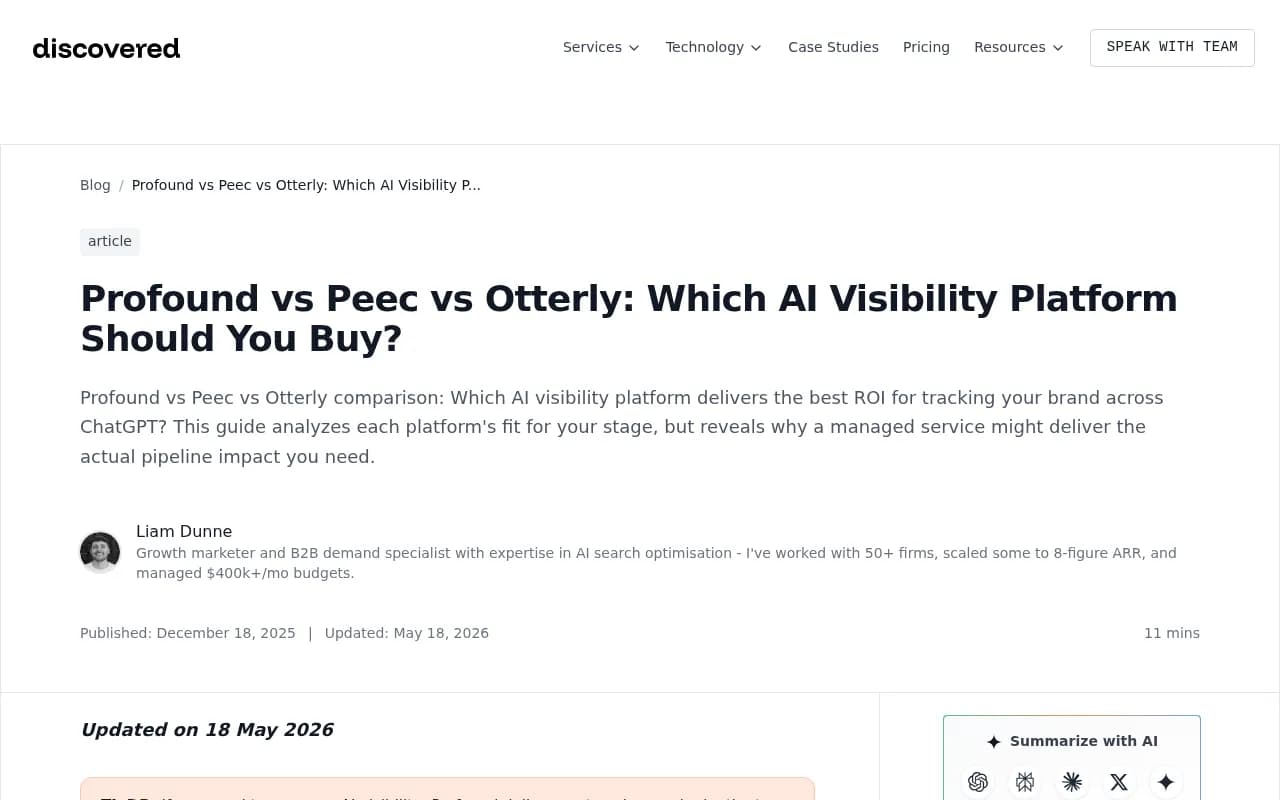
This report card covers five platforms that got serious attention in 2025: Promptwatch, Profound, Searchable, Peec AI, and Otterly.AI. The goal isn't to declare one winner and dismiss the rest. Each tool made real choices about what to prioritize, and those choices suit different teams. But some of those choices also left real gaps -- and those gaps matter when you're trying to justify the spend.
Let's get into it.
Why 2025 was the year AI visibility actually mattered
A few numbers set the scene. Gartner projected search engine volume would decline 25% by 2026 as users shifted to AI chatbots. Research from Magenta Associates found that 66% of UK senior decision-makers now use ChatGPT, Copilot, or Perplexity to research suppliers -- and 90% trust what those systems recommend. Zero-click searches hit 60% of Google queries, and when AI Overviews appear, click-through rates drop to around 8% compared to 15% without them.
Traditional SEO tools -- keyword rankings, backlink counts, organic traffic -- don't capture any of this. They're measuring a world that's changing fast. That's the gap AI visibility platforms exist to fill.
The problem is that "AI visibility platform" means different things to different vendors. Some track citations. Some generate content. Some do both. Some do neither particularly well. The 2025 field sorted itself into roughly three tiers: monitoring-only tools, monitoring-plus-analytics tools, and full optimization platforms. Where each of our five subjects landed tells you a lot about what you'd actually get.
The five platforms: a quick orientation
Before the grades, here's where each tool positioned itself heading into 2025.
Otterly.AI launched as a budget-friendly monitoring tool. Its pitch was simple: track your brand mentions across AI engines without needing an enterprise contract. Starting at $29/month, it was the obvious first choice for small teams dipping their toes in.
Peec AI targeted the mid-market, with multilingual support and a clean interface. Pricing starts around €89/month. It built a reputation for speed -- fast data refreshes, quick onboarding.
Profound went upmarket. At $499/month, it positioned itself as the enterprise-grade option with deep analytics, broad AI engine coverage, and the kind of reporting that satisfies a VP of Marketing.
Searchable sat in an awkward middle position -- more features than the budget tools, a lower price than Profound, but without a clear identity that made it the obvious choice for any particular buyer.
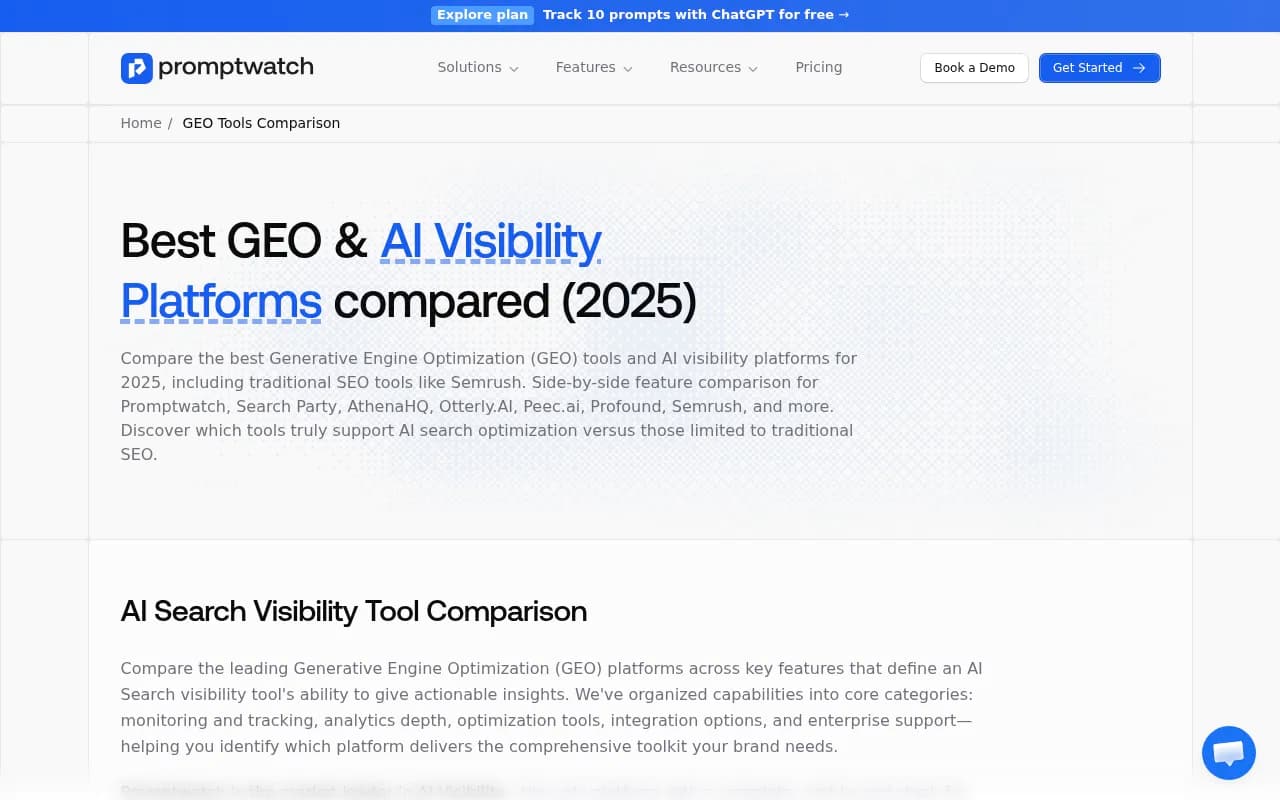
Promptwatch took a different approach entirely. Rather than competing on monitoring depth alone, it built what it calls an "action loop": find gaps, generate content, track results. The platform covers 10 AI models and includes an AI writing agent, crawler logs, and traffic attribution.

The report card
Otterly.AI: B- for monitoring, incomplete for optimization
Otterly does what it says. You set up your brand, define some prompts, and it starts tracking how often you appear in AI responses across ChatGPT, Perplexity, Google AI Overviews, and a handful of others. The dashboard is clean. Setup takes maybe 20 minutes.
The problem shows up around week three. You've got your visibility scores. You can see you're appearing in 12% of relevant prompts while a competitor is at 34%. Now what? Otterly doesn't have an answer. There's no content gap analysis, no AI writing tools, no crawler logs to show you why you're being skipped. You're left staring at a number with no path to improving it.
For teams that just need to report AI visibility to a client or stakeholder -- "here's our share of voice in ChatGPT this month" -- Otterly is fine. For teams that want to actually move that number, it's a starting point, not a solution.

Peec AI: B for speed and accessibility, C for depth
Peec AI's strongest card is its multilingual support. If you're tracking a brand across multiple markets and languages, Peec handles that better than most tools at its price point. The interface is genuinely fast, and the onboarding is smooth enough that a non-technical marketer can be up and running in an afternoon.
Where it struggles is analytical depth. Prompt intelligence -- understanding which prompts drive the most AI traffic, which are winnable, how queries fan out into sub-queries -- is thin. You get visibility data, but not the context to prioritize what to do about it. Reddit and YouTube tracking, which matter because AI models frequently cite those sources, isn't there.
Like Otterly, Peec AI is a monitoring tool. It's a good one. But monitoring without optimization is a half-finished job.

Profound: B+ for enterprise depth, C+ for actionability
Independent testing in December 2025 gave Profound an overall score of 3.2/5, with reviewers noting that technical depth and enterprise reporting were genuine strengths. That tracks with what Profound built: a platform designed to satisfy large organizations that need comprehensive data, audit trails, and the kind of dashboards that look good in board presentations.
At $499/month, Profound covers a solid range of AI engines and provides more analytical granularity than Otterly or Peec. Its share-of-voice reporting is detailed. Enterprise teams with dedicated analysts who can interpret and act on the data will get real value here.
The gap is the same one that hurts the other two: Profound diagnoses the problem but doesn't fix it. Content creation, schema implementation, authority-building -- all of that falls back on your internal team. For organizations with the bandwidth to execute, that's fine. For teams that are already stretched, paying $499/month for a diagnosis without a prescription is a hard sell.

Searchable: C+ for positioning, B- for features
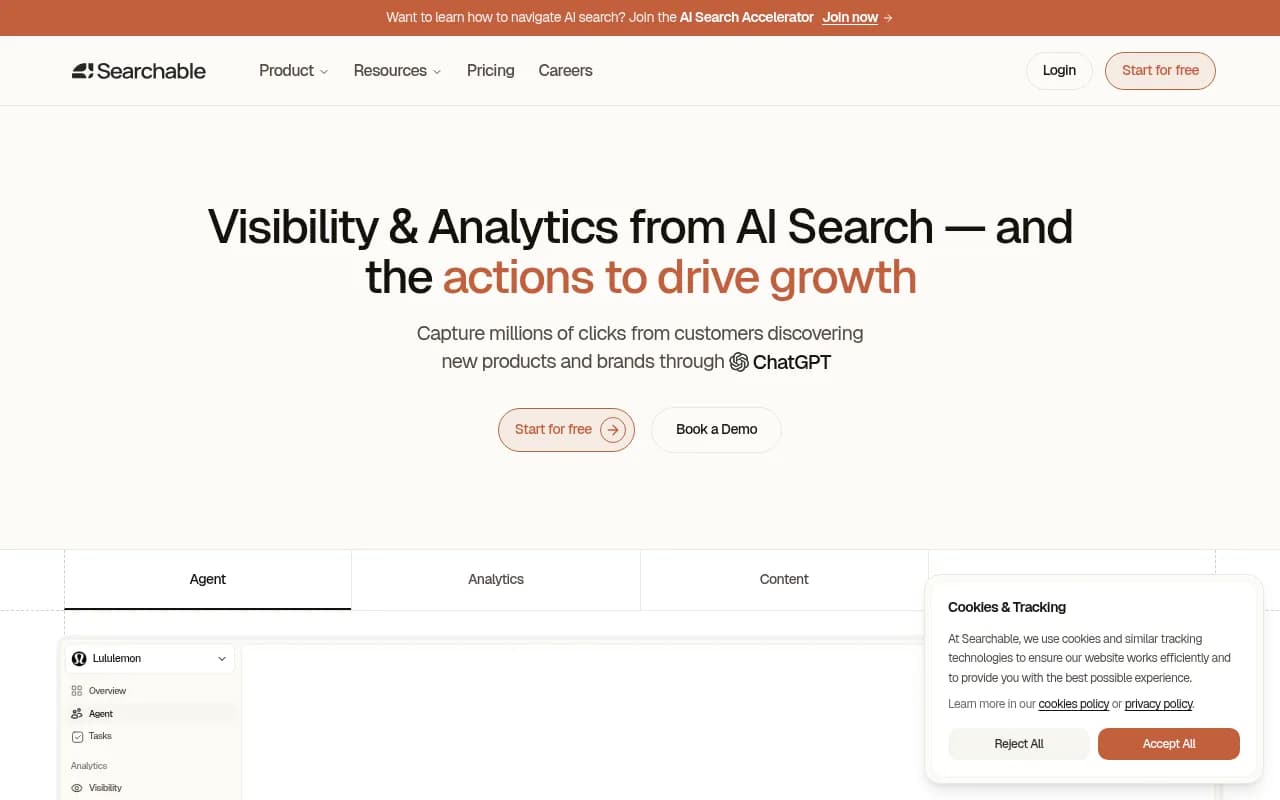
Searchable is the hardest platform to grade because it's the hardest to categorize. It has more features than Otterly or Peec -- some content tools, broader monitoring -- but it hasn't built a clear identity around any particular strength. It's not the cheapest, not the most powerful, not the best for any specific use case that comes to mind immediately.
That's not a fatal flaw. Searchable works. Teams that find it through a recommendation and stick with it often report reasonable satisfaction. But in a market where buyers are making quick decisions based on clear positioning, "reasonably satisfactory" is a tough place to be.
Promptwatch: A for end-to-end optimization
Promptwatch is the only platform in this group that was built around the question "what do you do after you see the data?" The answer it gives is a three-step loop: find the gaps, create content that fills them, track whether it worked.
The Answer Gap Analysis shows you exactly which prompts competitors appear for that you don't -- not just that a gap exists, but the specific topics and questions AI models want answers to that your site doesn't provide. The built-in AI writing agent then generates content grounded in citation data from over 880 million citations analyzed. This isn't generic SEO content; it's engineered to get cited by specific AI models.
On top of that: AI crawler logs show you which pages ChatGPT, Claude, and Perplexity are actually reading (and which errors they're hitting), prompt volume estimates help you prioritize high-value prompts over low-traffic ones, Reddit and YouTube tracking surfaces the discussions that directly influence AI recommendations, and ChatGPT Shopping tracking monitors product recommendation appearances. Traffic attribution -- via code snippet, Google Search Console integration, or server log analysis -- closes the loop by connecting visibility to actual revenue.
In a 2026 comparison of 12 GEO platforms, Promptwatch was the only one rated as a "Leader" across all categories. That's not marketing copy -- it reflects a genuine architectural difference. Most platforms were built to track. Promptwatch was built to optimize.
Side-by-side comparison
| Feature | Promptwatch | Profound | Peec AI | Otterly.AI | Searchable |
|---|---|---|---|---|---|
| AI models tracked | 10 | ~6-8 | ~5-6 | ~4-5 | ~4-6 |
| Starting price | $99/mo | $499/mo | €89/mo | $29/mo | Mid-range |
| Content gap analysis | Yes | No | No | No | Partial |
| AI content generation | Yes | No | No | No | Limited |
| AI crawler logs | Yes | No | No | No | No |
| Reddit/YouTube tracking | Yes | No | No | No | No |
| Prompt volume/difficulty | Yes | Limited | No | No | No |
| ChatGPT Shopping tracking | Yes | No | No | No | No |
| Traffic attribution | Yes | No | No | No | No |
| Multi-language/region | Yes | Yes | Yes | Limited | Limited |
| Free trial | Yes | Yes | Yes | Yes | Yes |
The monitoring-only problem
There's a pattern worth naming directly. Otterly, Peec, and Profound all share the same fundamental limitation: they show you the problem without helping you solve it. You pay monthly, you see your visibility score, you watch competitors outrank you in AI responses, and then you're on your own to figure out what to do.
This isn't a minor inconvenience. Most marketing teams are already stretched. Adding a new data source that generates action items without providing the tools to act on them doesn't save time -- it creates more work. The teams that get the most out of monitoring-only tools are the ones that already have content strategists, SEO specialists, and technical writers who can take a gap analysis and run with it. Those teams exist, but they're not the majority.
For everyone else, the gap between "here's your visibility data" and "here's how to improve it" is where ROI goes to die.
Who should use what
The right tool genuinely depends on your situation. Here's a practical breakdown:
Use Otterly.AI if you're a small team or agency that needs basic AI visibility reporting for clients and doesn't have budget for more. It's the cheapest way to answer "are we showing up in ChatGPT?"
Use Peec AI if you're a mid-market brand tracking visibility across multiple languages and markets, and you have internal content resources to act on what you find.
Use Profound if you're an enterprise with dedicated analysts, a content team, and a budget that can absorb $499/month. The depth of reporting is real, and large organizations with execution capacity will use it well.
Use Searchable if you've tested it and it fits your workflow -- but go in knowing it's not the strongest option in any specific dimension.
Use Promptwatch if you want to actually move your AI visibility numbers, not just measure them. The action loop -- gap analysis, content generation, result tracking -- is what separates it from everything else in this list. At $99/month for the Essential plan, it's also not priced like an enterprise luxury.
What to watch in 2026
The platforms that built monitoring-only products in 2024 and 2025 are under pressure to add optimization features. Some will. Some will get acquired. The category is consolidating, and the tools that survive will be the ones that can answer "so what do I do about this?" not just "here's what's happening."
The other shift worth watching: AI crawler visibility. Understanding which pages AI models are actually reading -- and which they're ignoring or hitting errors on -- is becoming a core diagnostic capability. Right now, almost no platform outside Promptwatch offers this. That will change, but the platforms that built it early have a meaningful head start on the data.
For any brand that wants to be visible when buyers ask AI systems for recommendations -- which, given that 66% of B2B decision-makers are already doing this, is basically every brand -- the question isn't whether to invest in AI visibility. It's whether to invest in a tool that just measures the problem or one that helps you fix it.
That's the real report card question. And in 2025, only one platform in this group had a clear answer.