Key takeaways
- All three tools have added AI search features in 2026, but they bolt them on differently: Surfer splits its Content Score into SEO and AI components, Clearscope bundles prompt tracking into every plan, and Rankability builds briefs from both Google SERPs and ChatGPT.
- The "which score predicts rankings better" debate is unresolved. Surfer cites a study favoring Surfer (26% vs 17.5% correlation); Clearscope cites a different study favoring Clearscope (0.30 vs 0.27). Neither number is high enough to treat any score as a ranking guarantee.
- AI search has changed what gets cited. Product pages overtook listicles as the most-cited format in both ChatGPT and Google AI Overviews in July 2026, which is a problem for tools built around editorial content patterns.
- ChatGPT cites roughly 5 sources per response, so "pretty good topical coverage" no longer makes the cut. Tight query scoping matters more than comprehensiveness.
- None of the three tells you whether your optimized content actually got cited. For that, you need a dedicated AI visibility platform like Promptwatch alongside your optimizer.
The job changed, so the tools had to change
Content optimizers were built for a simple world: reverse-engineer the top 10 Google results for a keyword, extract the terms and entities they share, and nudge writers to cover them. That worked well enough when the reward was a position in a ten-blue-link SERP.
The reward is different now. AI Overviews show up in a majority of queries, and ChatGPT, Perplexity, and Gemini answer questions directly. The citation economy is much tighter too. Promptwatch's data on average sources per response shows ChatGPT typically cites around 5 sources per web-search response, while Google AI Overviews cite roughly 10. Compare that to a traditional SERP with ten organic results plus ads, and you see the problem: there are far fewer seats at the table. Content that is broadly relevant but not a top retrieval match for a specific query simply does not get cited.
The content formats winning citations have shifted too. In July 2026, product pages made up roughly a third of all ChatGPT Search citations, nearly double their share from March, according to Promptwatch's ChatGPT citation type data. The same thing happened in Google AI Overviews, where product pages overtook listicles as the most-cited format in late July. That is uncomfortable for a tool category whose whole methodology is "imitate the editorial content that ranks in Google."
So how do Rankability, Surfer SEO, and Clearscope handle this new reality? Differently, and each with real gaps. Let's look.
The three tools at a glance
| Tool | Starting price | Core scoring approach | AI search features | Best for |
|---|---|---|---|---|
| Surfer SEO | ~$99/mo | 0–100 Content Score against live SERPs, real-time term guidance | Content Score split into SEO + AI components, AI Tracker add-on, MCP server (beta) | SEO teams wanting a broad platform with a familiar editor |
| Clearscope | $129/mo (Essentials) | A+ to F letter grade, NLP term recommendations | Prompt tracking (ChatGPT, Gemini), query fan-out awareness, included in all plans | Editorial teams prioritizing writer adoption |
| Rankability | $99/mo (Starter) | Topic coverage scoring, prioritized gap checklist | Briefs built from Google SERPs and ChatGPT, AI visibility tracking across models, "Serena" AI teammate | Agencies managing multiple clients end to end |
Surfer SEO: the incumbent going all-in on AI
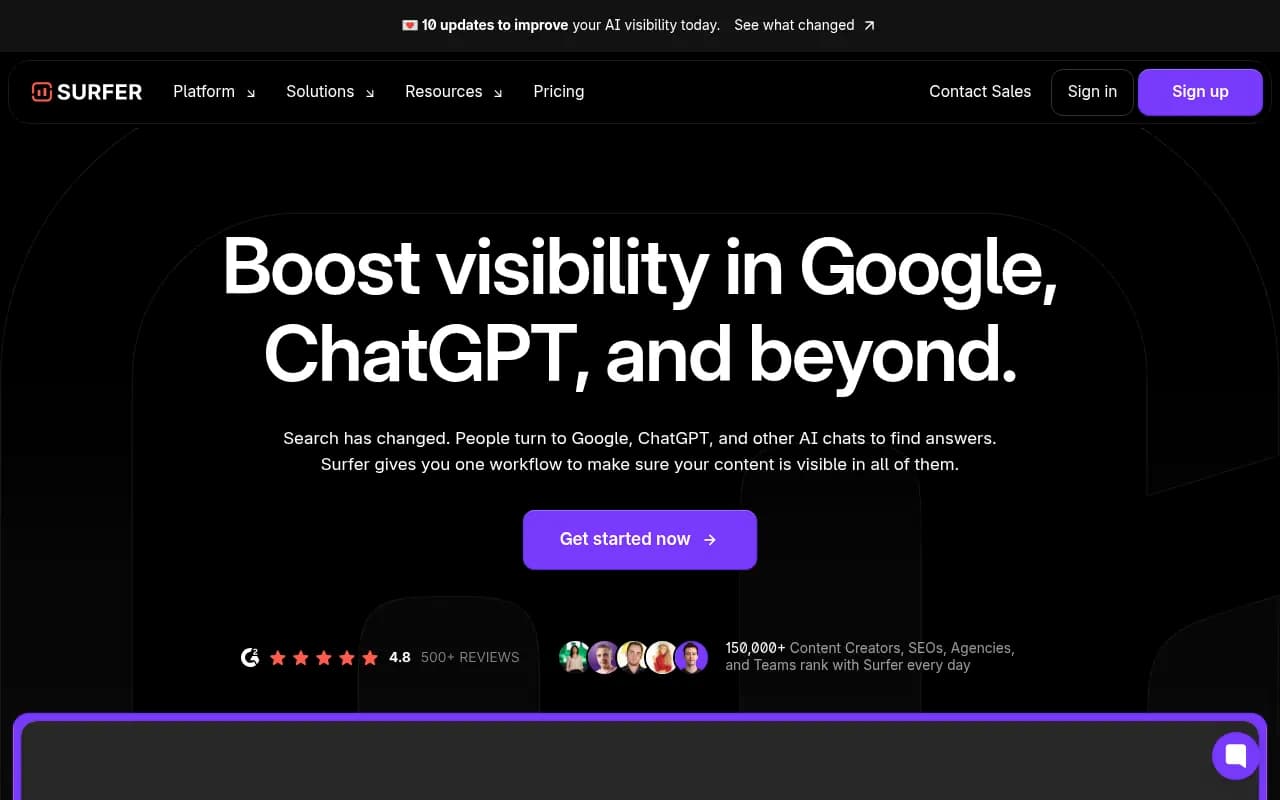
Surfer is the most established of the three and the most feature-heavy. The Content Editor gives you a real-time 0–100 score based on term usage, content length, heading structure, and image count against currently ranking pages. Around it sits a SERP analyzer, keyword clustering, a site audit tool, internal linking, and an AI writing assistant.
The 2026 pivot is the interesting part. Surfer's Content Score bar now splits into two components: traditional "SEO entities" and an "AI Search intro/facts" measure, with a single Auto-Optimize click that supposedly fixes both. In August 2026, Surfer also launched an MCP server in beta, which means AI agents like Claude or ChatGPT can call Surfer's editor, recommendations, and AI Tracker data directly. That is a genuinely forward-looking move, and it signals Surfer wants to be the optimization engine inside agentic workflows, not just a tab you keep open while writing.
The catch is pricing. The base plan runs around $99/mo, but the AI visibility tracking is a separate add-on (listed at $95–158/mo depending on billing), and rank tracking, extra articles, and AI credits are all a la carte. The platform you actually want, with AI tracking included, costs meaningfully more than the sticker price suggests.
There is also a skeptical take worth airing. A popular thread on r/SEO argues that quitting Surfer has no measurable impact on rankings, which is anecdotal but reflects a real fatigue with score-chasing. Surfer's own response is a study it cites from Originality.ai claiming a 26% correlation between its Content Score and rankings. More on that fight below.
Clearscope: the writer's tool that quietly repositioned
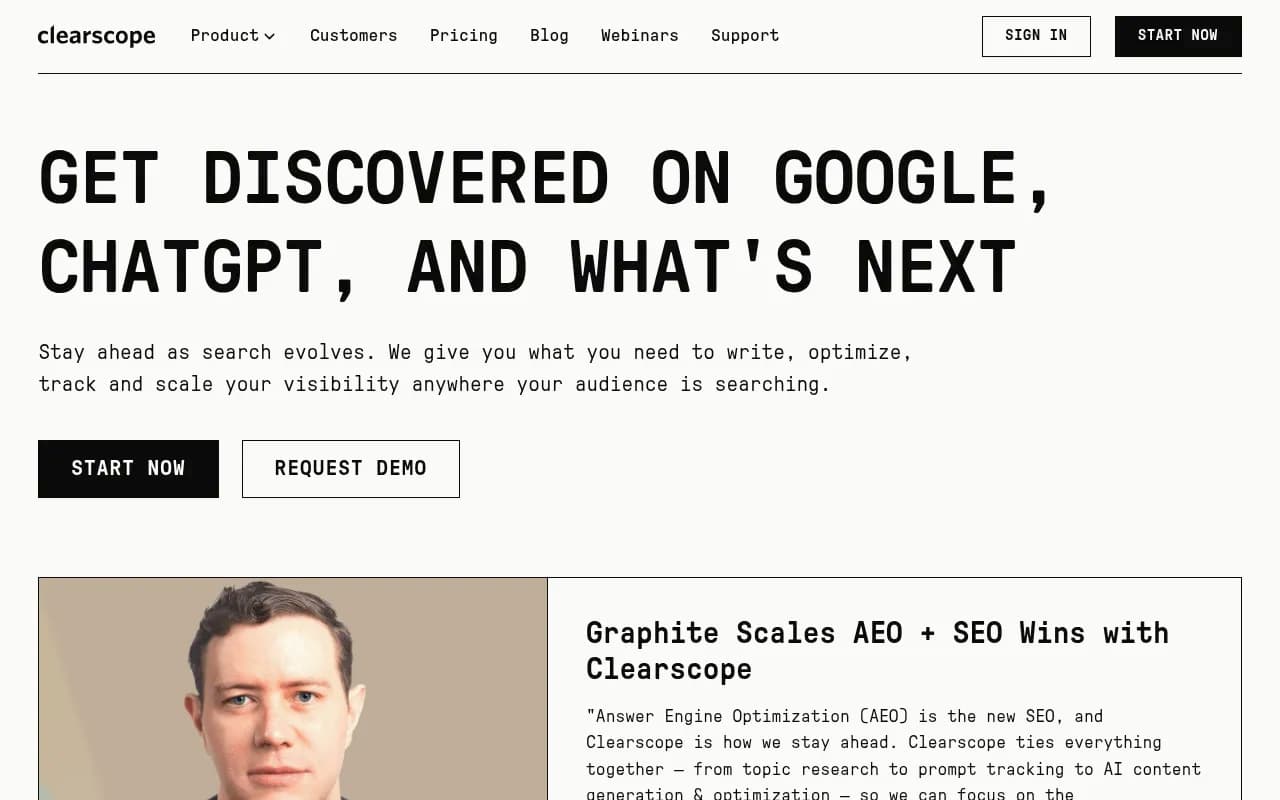
Clearscope has always been the focused one. Its A+ to F content grade and clean term recommendations, delivered through a Google Docs integration writers actually use, made it the default pick for editorial teams where adoption matters more than feature depth. Its NLP analysis is widely considered more nuanced than Surfer's, with fewer false-positive keyword suggestions, and the simpler interface means writers follow its guidance more consistently.
What surprised me in 2026 is how much Clearscope repositioned. It now markets itself as a "content-first discoverability platform for SEO and AI search," and every plan, starting at $129/mo, includes Prompt Tracking: you define prompts, Clearscope runs them hundreds of times across ChatGPT and Gemini, and reports your brand-mention rate as a percentage of AI responses. It also shows query fan-outs, the web searches AI platforms trigger to build answers, so you can see which sub-queries your content needs to win.
That is a legitimate feature set, not marketing fluff. But the coverage is narrower than the positioning suggests. Prompt tracking runs on ChatGPT and Gemini, not Perplexity, Claude, or AI Overviews. And Clearscope still grades content the old way, against Google's organic results, so the connection between your A+ grade and your actual citation rate in AI answers is implied rather than measured.
Pricing is the other sore point. Essentials gives you 50 pages and 20 topic explorations a month. Extra pages cost $25/mo per 100 on the lower tier. For high-volume content operations, that adds up fast, which is exactly why the Clearscope alternatives market exists.
Rankability: the agency workflow built around AI search
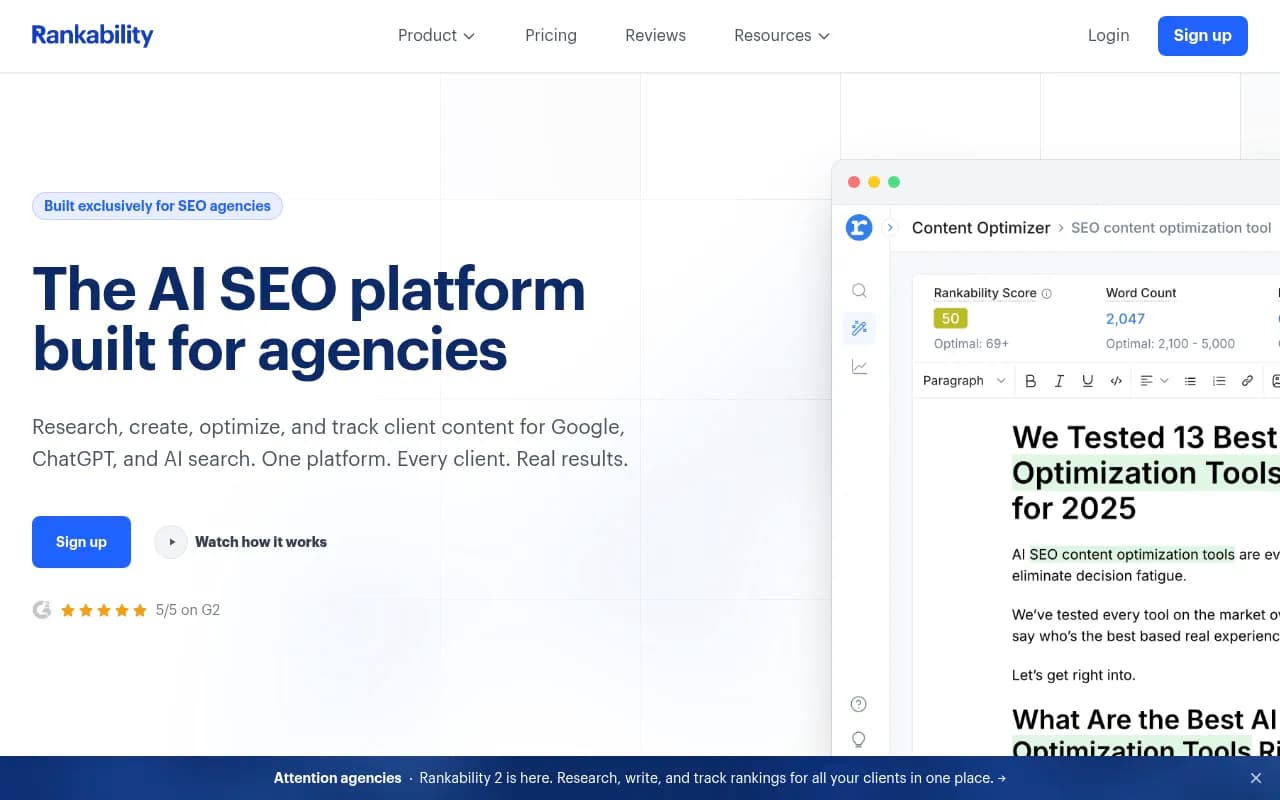
Rankability is the least known of the three and the most different. Where Surfer and Clearscope are per-article optimizers at heart, Rankability is an end-to-end agency workflow: research, briefs, drafting, optimization, reporting, and AI visibility tracking in one system, with unlimited seats on every plan.
Its Copywriter product runs a five-step pipeline. Research pulls competitors from both Google SERPs and ChatGPT, which is a genuinely different research base than the other two tools use. Briefs become a coverage map, drafts are written from a client-specific Knowledge Base (USPs, services, proof points) to keep AI output on-brand and factually grounded, and a dedicated Uniqueness step injects proprietary insights for information gain. The final Optimize step produces a prioritized gap-closing checklist rather than a single vanity score.
The scoring philosophy differs from Surfer's in a way Nathan Gotch summarized well on Quora: Surfer recommends mentioning a keyword phrase a certain number of times, while Rankability scores topic coverage, so your score only rises when you have actually covered the recommended topics. For agencies, that matters. Writers cannot game a coverage score with keyword stuffing.
Rankability's pricing is structured around AI visibility tracking tiers rather than a standalone optimizer: Starter at $99/mo tracks ChatGPT, Google AI Mode, and Claude with 60 active prompts; Core at $199/mo adds AI Overviews and Perplexity; Team at $399/mo adds Gemini, Grok, and Copilot. All plans include the Serena AI teammate, MCP and API access, and unlimited users. For an agency billing out multiple clients, unlimited seats alone changes the math compared to per-seat competitors.
The weakness is maturity and mindshare. Surfer and Clearscope have years of integrations, community content, and muscle memory behind them. Rankability is younger, less battle-tested at enterprise scale, and its strongest reviews come from its own customer base.
The correlation study war (and why you should ignore it)
Both vendors will happily tell you their score predicts rankings better. Surfer cites an Originality.ai study showing a 26% correlation for Surfer's Content Score versus 17.5% for Clearscope. Clearscope counters with an Ahrefs study that found the opposite, 0.30 for Clearscope versus 0.27 for Surfer, and argues that a correlation that low does not meaningfully predict rankings anyway.
They are both right about one thing: the numbers are low. Even the best figure here, 0.30, is a weak correlation. Here is the practical takeaway I would actually act on: a high content score is a floor, not a ceiling. It tells you that you have covered the topical ground the current winners cover. It does not tell you that you will rank, and it definitely does not tell you that ChatGPT will cite you.
The bigger issue for the AI search era is that all three tools grade against a proxy. They analyze what ranks in Google and infer that the same patterns win AI citations. That assumption is getting shakier. Product pages, not editorial content, are now the most-cited format in both ChatGPT and AI Overviews, and video citations have nearly doubled in AI Overviews since January. None of these tools' scoring models were built with those shifts in mind.
Head-to-head: the details that matter
| Dimension | Surfer SEO | Clearscope | Rankability |
|---|---|---|---|
| Entry price | ~$99/mo | $129/mo | $99/mo |
| AI visibility included? | No, add-on ($95–158/mo) | Yes, ChatGPT + Gemini prompts | Yes, tiered by model count |
| Models tracked | Via AI Tracker add-on | ChatGPT, Gemini | ChatGPT, Claude, AI Mode, AI Overviews, Perplexity, Gemini, Grok, Copilot (tiered) |
| Research base | Google SERPs | Google SERPs | Google SERPs + ChatGPT |
| Scoring style | 0–100 real-time score | A+ to F grade | Topic coverage + prioritized checklist |
| Seats | Limited on lower tiers | Unlimited users all plans | Unlimited seats all plans |
| Writer adoption | Steeper learning curve | Best in class | Depends on agency workflow |
| Agentic readiness | MCP server (beta) | Not yet | MCP and API access included |
| Best fit | In-house SEO teams | Editorial content teams | Agencies, multi-client operations |
The gap none of them closes
Here is the thing that bugs me about this entire category in 2026. All three tools now claim some form of AI search capability, but all three measure inputs, not outcomes. Surfer's AI score component estimates citation likelihood. Clearscope tracks prompts on two models. Rankability tracks visibility across more models than either. What none of them does well is close the loop: which specific pages of yours got cited, by which model, for which prompt, and what traffic and conversions did that actually drive.
That loop matters because AI citation behavior is weird and specific. ChatGPT's citation habits change month to month, Reddit's citation share collapsed from roughly 4% to 0.5% in a single day in August 2026 according to Promptwatch's Reddit citation data, and ChatGPT started using the site: operator at scale overnight, nearly doubling searches per response. A content score computed against last month's SERP cannot react to any of that.
This is where a dedicated AI visibility platform earns its slot in the stack. Promptwatch, for example, tracks citations, AI crawler logs, and actual AI-driven traffic across ChatGPT, Claude, Gemini, Perplexity, and Google's AI surfaces, and its Content Agents can plan and publish GEO-optimized content directly to your CMS. If you are serious about AI search, the realistic 2026 setup is an optimizer for the writing workflow plus a visibility platform for the measurement and iteration loop. You can browse the broader category in the GEO software directory at bestgeosoftware.com.

Who should pick what
Pick Surfer SEO if
You have an in-house SEO team that wants one platform for scoring, audits, keyword research, and internal linking, and you are willing to pay for the AI Tracker add-on. The MCP beta also makes Surfer the most interesting choice if your near future involves AI agents doing the optimization work.
Pick Clearscope if
Your bottleneck is writer adoption. Clearscope's grade is the one writers do not fight, its NLP recommendations produce better writing alongside better optimization, and the included prompt tracking on ChatGPT and Gemini is enough for your needs. You will pay a premium per page, so it fits smaller, quality-focused teams better than high-volume operations.
Pick Rankability if
You are an agency managing multiple clients and you want research, briefs, drafting, optimization, and AI visibility in one billable workflow. The Knowledge Base approach to drafting solves a real problem for commercial content, and unlimited seats plus multi-model tracking at $199/mo is hard to beat for that use case.
Pick none of them alone if
AI search is a primary channel for you. In that case, pair whichever optimizer fits your writing process with a visibility platform that measures citations, crawler behavior, and AI-driven conversions. The optimizer makes the content good. The visibility platform tells you whether it worked.
A final, honest caveat
I have watched teams treat content scores as the finish line, and it rarely ends well. The scores are useful guardrails for writers and useful sanity checks for editors. But the correlation studies, even the favorable ones, are weak, and the AI search surfaces are rewarding content types these tools were never designed to score. Use the optimizer to raise your floor. Then measure what actually happens in ChatGPT and AI Overviews, and let that data, not a green score bar, decide what you write next.