Key takeaways
- Answer gap analysis -- finding the prompts where competitors appear in AI answers but you don't -- is the most valuable feature in any GEO platform, and the four tools in this comparison handle it very differently.
- Profound and Scrunch both offer solid monitoring but stop short of telling you what to do with the gaps they surface.
- Searchable has a narrower feature set and limited prompt intelligence, making it harder to prioritize which gaps to close first.
- Promptwatch is the only platform here that completes the full loop: it finds the gaps, helps you create content to close them, and then tracks whether that content actually gets cited.

Why answer gap analysis became the metric that matters
For most of 2024, the GEO conversation was dominated by brand mention tracking. How often does ChatGPT say your name? What sentiment does Perplexity use? Those questions aren't useless, but they're also not actionable. Knowing you're invisible doesn't tell you what to do next.
By mid-2025, the more sophisticated teams had moved on to a harder question: which specific prompts are AI models answering with your competitors' content instead of yours? That's answer gap analysis. It's the difference between a dashboard that shows you a problem and a tool that shows you exactly where the problem lives.
The four platforms in this comparison -- Profound, Promptwatch, Scrunch, and Searchable -- all claim to surface these gaps. In practice, they do it very differently. Here's what each one actually delivered in 2025.
What "answer gap analysis" actually means (and what it doesn't)
Before the comparison, a quick definition. Answer gap analysis, in the context of AI search visibility, means:
- Running a set of prompts across one or more AI models (ChatGPT, Perplexity, Claude, Gemini, etc.)
- Recording which domains and pages get cited in the responses
- Comparing your citation footprint against your competitors'
- Surfacing the specific prompts where competitors appear but you don't
The output should be a prioritized list of prompts you're losing -- ideally with enough context (prompt volume, competitor content, your existing pages) to know what to do next.
Some platforms stop at step 3. They'll show you a share-of-voice chart and leave you to figure out the rest. Others go further. The gap between those two approaches is what this comparison is really about.
Profound

Profound has been one of the most-cited enterprise options since it launched, and for good reason. The platform tracks 10+ AI engines, has solid prompt volume analysis, and the market research analytics layer is genuinely useful for Fortune 500 teams that need to justify GEO investment to a CMO.
On answer gap analysis specifically, Profound does surface competitor visibility data. You can see which prompts your competitors appear in and compare that against your own footprint. The interface is clean and the data quality is good.
The problem is what happens after you find the gap. Profound shows you the hole but doesn't hand you a shovel. There's no built-in content generation, no content brief tied to the gap, no guidance on what your missing page should actually cover. You get the intelligence, then you're on your own to act on it.
For an enterprise team with a dedicated content operation, that might be fine. But it's also why Profound's pricing -- which runs significantly higher than most competitors -- can feel hard to justify for mid-market teams. One analysis from ContentMonk noted Profound costs roughly 48% more than comparable platforms, and that premium buys you better data, not better outcomes.
The other limitation: Profound's gap analysis is primarily prompt-level. It tells you which prompts you're losing, but it doesn't show you the specific pages or content formats that are winning for your competitors. That context matters when you're trying to reverse-engineer what to create.
Scrunch
Scrunch launched in 2024 and positioned itself as a multi-engine citation monitoring platform with prompt-level insights. It's a solid tool, and the agency and enterprise teams that use it tend to appreciate the depth of the citation data.
For answer gap analysis, Scrunch does the core job. You can see where competitors are getting cited and where you're not. The multi-engine coverage is a genuine strength -- if you want to understand your gap across ChatGPT, Perplexity, Claude, and Gemini simultaneously, Scrunch handles that reasonably well.
Where it falls short is prioritization. Scrunch surfaces gaps but doesn't score them. There's no prompt volume data telling you whether a gap represents 50 monthly queries or 50,000. Without that, you're essentially guessing which gaps are worth closing first. A team with limited content resources can't afford to guess.
The other gap (no pun intended): Scrunch doesn't have Reddit or YouTube tracking. This matters more than it sounds. A significant portion of what AI models cite in their responses comes from Reddit threads and YouTube content. If you're doing gap analysis without understanding that layer, you're missing part of the picture.
Like Profound, Scrunch stops at the monitoring layer. It won't help you create the content to close the gaps it finds.
Searchable
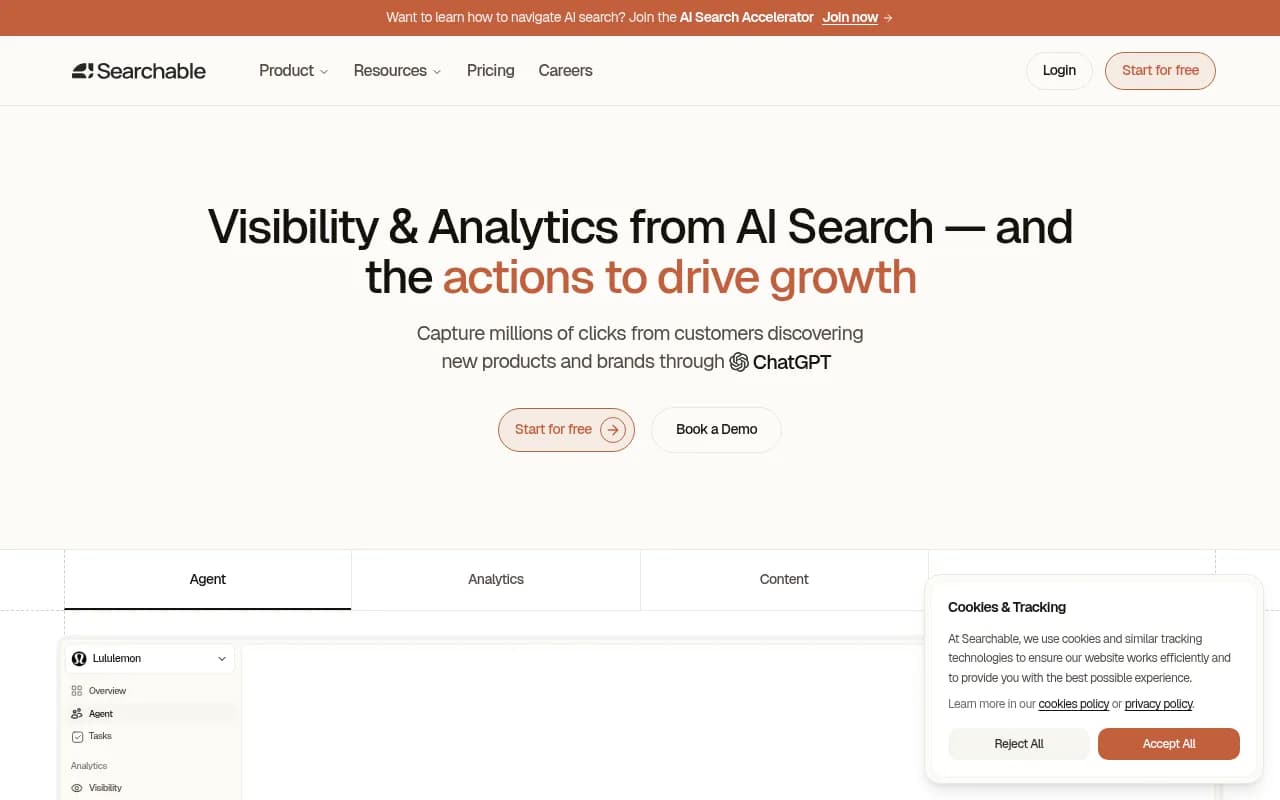
Searchable is the least well-known of the four platforms here, and the feature set reflects that. It has monitoring capabilities and some content tools, but the prompt intelligence layer is thin compared to the other three.
On answer gap analysis, Searchable can show you where competitors appear that you don't, but the prompt coverage is narrower and there's no meaningful difficulty or volume scoring. The result is a gap list without the context you need to prioritize it.
The content tools are present but feel more like a checkbox than a core capability. There's a difference between "has content generation" and "has content generation grounded in citation data and prompt volume analysis." Searchable is closer to the former.
For smaller teams or those just getting started with GEO, Searchable might be a reasonable entry point. But if answer gap analysis is your primary use case -- and in 2025, it should be -- the platform's limitations become apparent quickly.
Promptwatch
Promptwatch approaches answer gap analysis differently from the other three, and the difference is structural rather than cosmetic.
The Answer Gap Analysis feature shows you exactly which prompts competitors are visible for that you're not -- not just as a list, but with prompt volume estimates and difficulty scores so you can prioritize. You're not just seeing the gap; you're seeing which gaps are worth closing based on how many people are actually asking those questions.
Where Promptwatch separates itself is what happens next. Once you've identified a gap, the platform's built-in AI writing agent can generate the content to close it -- articles, listicles, comparisons -- grounded in the 880M+ citations it has analyzed. This isn't generic content; it's built around what AI models actually cite, which formats they prefer, and what your competitors are doing that you're not.
Then there's the tracking layer. After you publish, Promptwatch shows you whether your new content starts getting cited, by which models, and at what rate. Page-level tracking closes the loop between the gap you identified and the outcome you achieved.
A few other things that matter for answer gap analysis specifically:
- Query fan-outs show how a single prompt branches into sub-queries. This is useful because AI models don't just answer the exact prompt you track -- they fan out into related questions. Understanding that structure helps you create content that captures the full cluster, not just the head term.
- Reddit and YouTube tracking surfaces the off-site content that's influencing AI recommendations in your category. If a Reddit thread is getting cited every time someone asks a question you want to own, you need to know that.
- AI crawler logs show which of your pages AI models are actually reading, how often, and whether they're encountering errors. Gap analysis is only useful if you understand why the gap exists -- and sometimes the reason is that AI crawlers can't access your content at all.
The pricing is also more accessible than Profound: $99/month for the Essential tier, $249/month for Professional (which adds crawler logs and state/city tracking), and $579/month for Business. A free trial is available.
Head-to-head comparison
| Feature | Profound | Scrunch | Searchable | Promptwatch |
|---|---|---|---|---|
| Answer gap analysis | Yes | Yes | Basic | Yes (with prioritization) |
| Prompt volume scoring | Yes | No | No | Yes |
| Prompt difficulty scoring | No | No | No | Yes |
| Query fan-outs | No | No | No | Yes |
| Content generation from gaps | No | No | Partial | Yes (citation-grounded) |
| Reddit/YouTube tracking | No | No | No | Yes |
| AI crawler logs | No | No | No | Yes |
| Page-level citation tracking | Partial | Yes | No | Yes |
| ChatGPT Shopping tracking | No | No | No | Yes |
| Traffic attribution | No | No | No | Yes |
| AI models covered | 10+ | Multi | Limited | 10 |
| Starting price | High ($$$) | $$$ | $$ | $99/mo |
| Free trial | No | No | No | Yes |
Which platform won on answer gap analysis in 2025?
The honest answer depends on what you mean by "best."
If you mean "most data-rich monitoring with the cleanest enterprise interface," Profound is the answer. It has good data quality and the analytics layer is genuinely useful for large teams. But you're paying a significant premium for monitoring without optimization.
If you mean "best multi-engine citation coverage for agencies," Scrunch is competitive. The citation data is solid and the multi-engine view is useful. The lack of prioritization is a real problem, though.
Searchable doesn't win this comparison. The prompt intelligence is too thin to make the gap analysis actionable.
If you mean "which platform actually helps you close the gaps you find," Promptwatch is the clear answer. The combination of prioritized gap identification, citation-grounded content generation, and closed-loop tracking is something none of the other three platforms offer end-to-end. Finding a gap is only valuable if you do something about it -- and Promptwatch is the only platform here that takes you from gap to published content to measured outcome.
The broader point: most GEO platforms in 2025 were still monitoring-first tools. They showed you where you were invisible and left you to figure out the rest. The platforms that will matter in 2026 are the ones that complete the loop. On that measure, Promptwatch is ahead.
What to look for when evaluating gap analysis tools
If you're shopping for a GEO platform and answer gap analysis is a priority, here are the questions worth asking:
- Does the tool score gaps by prompt volume? A gap for a 50-query prompt is not the same as a gap for a 50,000-query prompt.
- Does it show you what your competitors are doing to win those prompts? Knowing you're losing isn't enough -- you need to know why.
- Does it cover the off-site content (Reddit, YouTube, forums) that AI models are citing? Many tools ignore this entirely.
- Can it generate content to close the gaps, or does it hand you a list and wish you luck?
- Does it track whether your new content actually gets cited after you publish?
If a platform can't answer yes to most of those questions, it's a monitoring tool, not an optimization tool. In 2025, that distinction started to matter. In 2026, it's the whole game.