Key takeaways
- Searchable is a capable monitoring tool, but it stops at showing you data -- it doesn't help you act on it
- Promptwatch closes the loop with content gap analysis, an AI writing agent, and traffic attribution that connects AI visibility to actual revenue
- Migration is straightforward: export your prompts, rebuild your baseline in Promptwatch, then layer in crawler logs and content generation
- The biggest unlock isn't better dashboards -- it's knowing exactly which content to create next and having a tool that helps you create it
- Teams that switch typically get access to 10 AI models, prompt difficulty scoring, Reddit/YouTube citation tracking, and ChatGPT Shopping monitoring -- none of which Searchable covers
Why teams start looking beyond Searchable
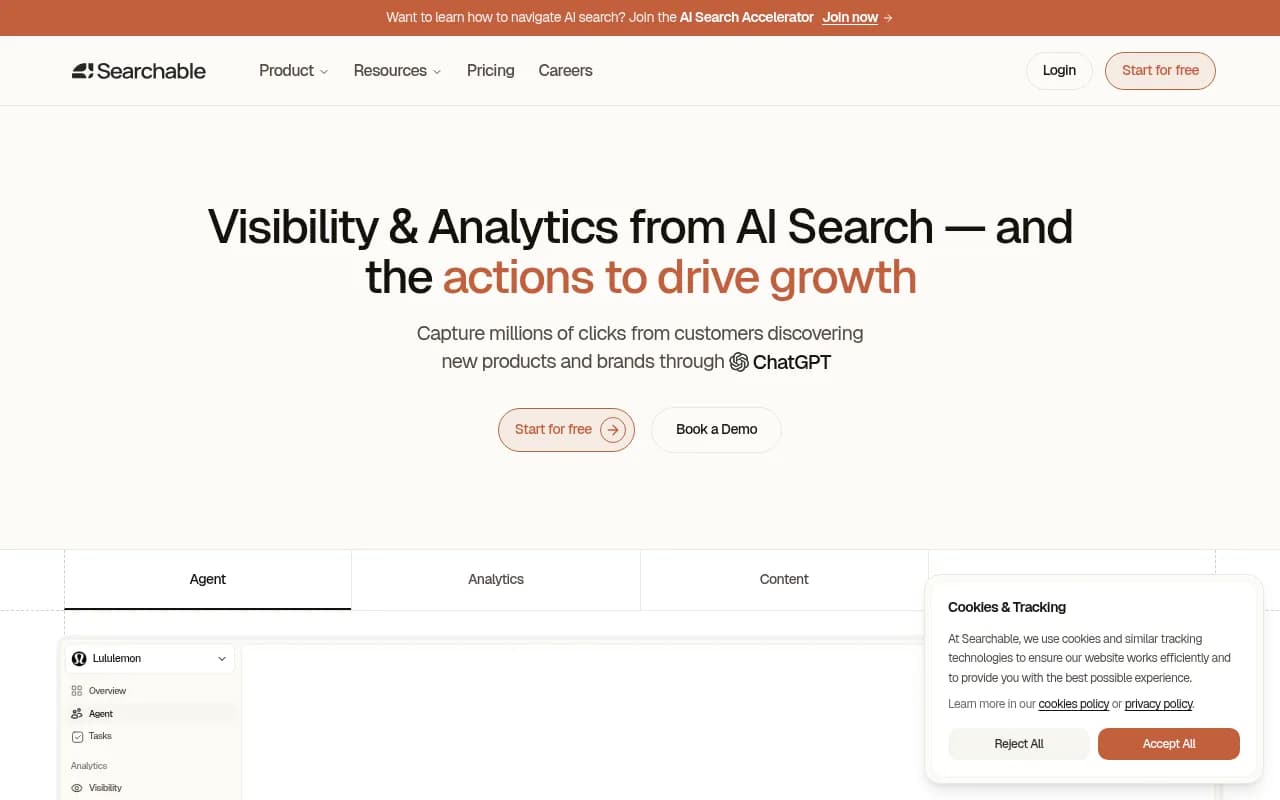
Searchable does what it says on the tin. You set up prompts, it runs them across a handful of AI models, and you get visibility scores over time. For teams just getting started with AI search monitoring, that's genuinely useful.
But at some point -- usually after a few months of watching dashboards -- a question surfaces: "OK, we can see we're not appearing in these responses. Now what?"
That's the wall. Searchable, like most monitoring-only platforms, shows you the problem but doesn't help you solve it. You get the "what" without the "so what." And in 2026, with AI search eating into traditional organic traffic at a rate most teams didn't anticipate, staying in monitoring mode is increasingly expensive.
The teams migrating to Promptwatch aren't doing it because Searchable is broken. They're doing it because they've realized that visibility data without an action path is just a more sophisticated way of watching yourself lose.

What Searchable does well (and where it stops)
To be fair about this: Searchable has a clean interface, reasonable prompt coverage, and gets you up and running quickly. If your only goal is "I want to know if we're showing up in ChatGPT responses," it works.
The gaps become obvious when you try to do anything with that information:
- There's no content gap analysis -- you can't see which prompts competitors rank for that you don't
- No built-in content generation to address those gaps
- No AI crawler logs to understand how models are actually reading your site
- No prompt volume or difficulty scoring to help you prioritize
- No Reddit or YouTube citation tracking (both of which heavily influence what AI models recommend)
- No ChatGPT Shopping tracking
- Traffic attribution is limited or absent -- you can't close the loop from AI mention to actual visit
This isn't a knock on Searchable specifically. Most monitoring tools have the same profile. The category as a whole was built to answer "are we visible?" rather than "how do we become more visible?"
What the migration actually unlocks
Here's what changes when you move to Promptwatch, broken down by the capabilities that matter most.
Answer gap analysis
This is the feature that tends to make teams feel like they've been flying blind. Answer Gap Analysis shows you the specific prompts where your competitors appear in AI responses but you don't. Not vague topic clusters -- the actual questions, phrased the way real users ask them, with your competitors' names showing up in the answers and yours absent.
That's actionable in a way that a visibility score never is. Instead of "our AI visibility is 23%," you get "ChatGPT is recommending [Competitor A] for 'best project management tool for remote teams' and we're not mentioned -- here's why and here's what content would fix it."
The AI writing agent
Once you know the gaps, Promptwatch has a built-in writing agent that generates content specifically designed to get cited. This isn't a generic AI content tool -- it's grounded in citation data from over 880 million citations analyzed, prompt volumes, competitor analysis, and persona targeting.
The output is articles, listicles, and comparisons that AI models actually want to cite because they answer the specific questions those models are trying to answer. That's a fundamentally different brief than "write a blog post about X."
AI crawler logs
This one surprises a lot of teams. Promptwatch logs every time an AI crawler (ChatGPT's bot, Claude's crawler, Perplexity's spider) hits your website -- which pages they read, how often they return, and any errors they encounter.
Most teams have no idea which pages AI models are actually reading. They assume it's their homepage and maybe a few product pages. The reality is often messier: crawlers hitting 404s, ignoring key pages entirely, or returning to the same thin content repeatedly. Fixing these issues can move visibility scores faster than any content work.
Prompt intelligence
Not all prompts are worth chasing. Promptwatch gives you volume estimates and difficulty scores for each prompt, plus query fan-outs that show how a single prompt branches into related sub-queries. This lets you prioritize the prompts that are both high-traffic and winnable -- rather than spending three months optimizing for a prompt that almost nobody types.
Reddit and YouTube tracking
This is genuinely underappreciated. A significant portion of what AI models cite comes from Reddit threads and YouTube videos, not just traditional web pages. Promptwatch surfaces the specific discussions and videos that are influencing AI recommendations in your category. Knowing that a two-year-old Reddit thread is shaping what ChatGPT says about your competitors is the kind of insight that changes your content strategy.
Traffic attribution
The full loop: Promptwatch connects AI visibility to actual traffic and revenue through a code snippet, Google Search Console integration, or server log analysis. You can see which AI mentions are driving visits and which are just impressions. This matters enormously when you're trying to justify the investment to a CMO or client.
How to migrate: a practical walkthrough
Step 1: Export your current prompt list from Searchable
Before you cancel anything, export every prompt you've been tracking. This is your baseline data. Even if Promptwatch will suggest better prompts, you want continuity -- being able to compare your visibility on the same prompts over time is valuable.
Most teams have 20-80 prompts in Searchable. Export them as a CSV or copy them into a spreadsheet. Note which ones have been showing meaningful data and which have been flat.
Step 2: Set up your Promptwatch account and import prompts
Promptwatch's onboarding is structured around your brand, your competitors, and your prompt set. When you set up your account:
- Add your domain and your main competitors (aim for 3-5 direct competitors)
- Import your existing prompts from Searchable -- this gives you immediate baseline data
- Set your target region and language (Promptwatch supports multi-region and multi-language monitoring)
- Configure your persona settings to match how your actual customers search
The Essential plan ($99/mo) covers 1 site and 50 prompts, which is enough for most teams migrating from Searchable. If you were tracking more prompts, the Professional plan ($249/mo) handles 150.
Step 3: Run your first Answer Gap Analysis
Once your prompts are running and you have a few days of data, run an Answer Gap Analysis. This is the step that most teams find immediately clarifying.
You'll see a list of prompts where competitors appear and you don't, ranked by estimated prompt volume. Resist the urge to tackle everything at once. Pick the 5-10 highest-volume, lowest-difficulty gaps and treat those as your first content sprint.
Step 4: Install the crawler log integration
This takes about 15 minutes and pays back immediately. Add the Promptwatch tracking snippet to your site (or connect via GSC or server logs) and you'll start seeing which pages AI crawlers are visiting.
Look for:
- Pages with high crawler traffic but low citation rates (the content isn't answering questions well enough)
- Important pages that crawlers aren't visiting at all (possible crawl budget or robots.txt issues)
- 404 errors from AI crawlers (broken internal links that are costing you citations)
Step 5: Generate your first pieces of AI-optimized content
Use the built-in writing agent to create content targeting your top gaps. The agent will ask you for context about your product, your audience, and the specific prompt you're targeting. The output typically needs light editing but is structured specifically to get cited -- with the right headers, the right specificity, and the right format for AI model consumption.
Publish the content, then watch the page-level tracking to see when AI crawlers pick it up and when citations start appearing.
Step 6: Set up competitor heatmaps and alerts
Configure competitor heatmaps to see side-by-side visibility across all 10 AI models Promptwatch monitors. Set up alerts for significant changes -- both positive (you're getting cited for a new prompt) and negative (a competitor suddenly appears for prompts you were winning).
This replaces the manual checking most teams do with monitoring-only tools.
Feature comparison: Searchable vs Promptwatch
| Capability | Searchable | Promptwatch |
|---|---|---|
| AI model coverage | Limited | 10 models (ChatGPT, Claude, Gemini, Perplexity, Grok, DeepSeek, Copilot, Meta AI, Google AI Overviews, Google AI Mode) |
| Prompt tracking | Yes | Yes |
| Answer gap analysis | No | Yes |
| AI writing agent | No | Yes (grounded in 880M+ citations) |
| AI crawler logs | No | Yes (Professional plan+) |
| Prompt volume/difficulty scoring | No | Yes |
| Reddit & YouTube citation tracking | No | Yes |
| ChatGPT Shopping tracking | No | Yes |
| Traffic attribution | Limited | Yes (snippet, GSC, server logs) |
| Competitor heatmaps | Basic | Yes |
| Multi-language/region | Limited | Yes |
| Looker Studio / API | No | Yes |
| Starting price | Varies | $99/mo |
What to expect in the first 30 days
The first week is mostly setup and baseline-building. Don't expect dramatic insights immediately -- you need a few days of data before patterns emerge.
By week two, the Answer Gap Analysis becomes useful. You'll have a clear picture of where competitors are winning and why. Most teams identify 3-5 high-priority content gaps they hadn't been aware of.
Week three is typically when the first AI-optimized content goes live. The crawler logs will show you when AI bots pick it up -- usually within days for well-indexed sites.
By day 30, you should have your first data point on whether the new content is generating citations. Some pieces get cited within two weeks. Others take longer. The page-level tracking shows you which pieces are being read by AI crawlers even before they start generating citations, which is a useful leading indicator.
The teams that get the most out of this migration are the ones that treat it as a workflow change, not just a tool swap. Promptwatch is most valuable when the content gap analysis feeds directly into a content calendar, and when someone owns the weekly review of crawler logs and citation changes.
Alternatives worth knowing about
Promptwatch is the right move for most teams migrating from Searchable, but it's worth knowing what else is out there -- especially if your needs are unusual.

Profound is strong on enterprise features and has a solid Conversation Explorer. It starts at $499/mo, which prices out most mid-market teams, and it doesn't have Reddit tracking or ChatGPT Shopping monitoring.

AthenaHQ has good analytics and an "Action Center" with strategic recommendations. It's monitoring-focused though -- the content generation capabilities aren't there in the same way.
Scrunch AI covers 7+ platforms with SOC 2 compliance, which matters for enterprise security requirements. It starts at $300/mo and is solid for monitoring, but like most competitors, it stops short of content generation.

Peec AI is worth considering if multi-language tracking is your primary need -- it supports 115+ languages, which is genuinely impressive. For teams primarily working in English, the feature set doesn't justify the switch from Promptwatch.

Otterly.AI is a cheaper monitoring option if you're not ready for the full Promptwatch feature set. It's monitoring-only, but the price point is accessible.
The honest summary: if you're migrating from Searchable because you want more than monitoring, Promptwatch is the only platform in this category that closes the full loop from gap identification to content creation to traffic attribution. The others are better monitoring tools than Searchable, but they're still monitoring tools.
The question worth asking before you migrate
One thing worth sitting with: why did you start monitoring AI visibility in the first place?
If the answer is "because someone told us we should track it," then a better monitoring tool might be enough. But if the answer is "because we want AI search to drive actual traffic and revenue," then the monitoring-only approach was always going to hit a ceiling.
The teams getting real results from AI search in 2026 aren't the ones with the best dashboards. They're the ones who figured out the content gap, created something that answered it, and then watched the citations follow. That's the loop Promptwatch is built around -- and it's what makes the migration worth doing.