Key takeaways
- All three platforms track brand visibility across multiple AI models, but they differ significantly in what they let you do with that data
- Profound is strong on enterprise prompt intelligence and breadth of model coverage, but comes at a higher price point
- Searchable covers the monitoring basics but lacks content generation and crawler-level insights
- Promptwatch is the only one of the three that closes the full loop: find gaps, generate content, track results -- making it the most actionable option for teams that want to improve visibility, not just measure it
- For teams tracking ChatGPT, Claude, Gemini, and Perplexity simultaneously, model coverage alone isn't the differentiator -- what matters is whether the platform tells you why you're missing and how to fix it
AI search has quietly become the place where buying decisions start. Someone asks ChatGPT "what's the best project management tool for remote teams?" and the brands that appear in that answer have a real advantage over those that don't. The problem is that most marketing teams have no idea whether they're showing up -- or why they're not.
That's what this comparison is about. Searchable, Promptwatch, and Profound all claim to solve this problem, but they approach it very differently. One is primarily a monitoring dashboard. One is built around enterprise data depth. One is designed to help you actually fix your visibility gaps. Let's break down exactly what each does -- and which one makes sense depending on what you need.
What you actually need from a multi-model AI visibility platform
Before comparing features, it's worth being clear about what "tracking ChatGPT, Claude, Gemini, and Perplexity simultaneously" actually requires in practice.
At minimum, you need a platform that:
- Runs real queries against each model on a regular cadence (not just once a week)
- Tracks whether your brand is mentioned, cited, or recommended in responses
- Compares your visibility against competitors across those same models
- Shows you which sources each model is citing -- so you know what content is actually working
Beyond that baseline, the more useful platforms also tell you which prompts you're missing, why competitors are appearing and you're not, and what content you'd need to create to close the gap. That's where the three platforms diverge sharply.
Searchable: solid monitoring, limited action
Searchable is a reasonably capable AI visibility monitoring platform. It covers the major models -- ChatGPT, Claude, Gemini, Perplexity -- and gives you brand mention tracking, share of voice metrics, and competitor comparisons.
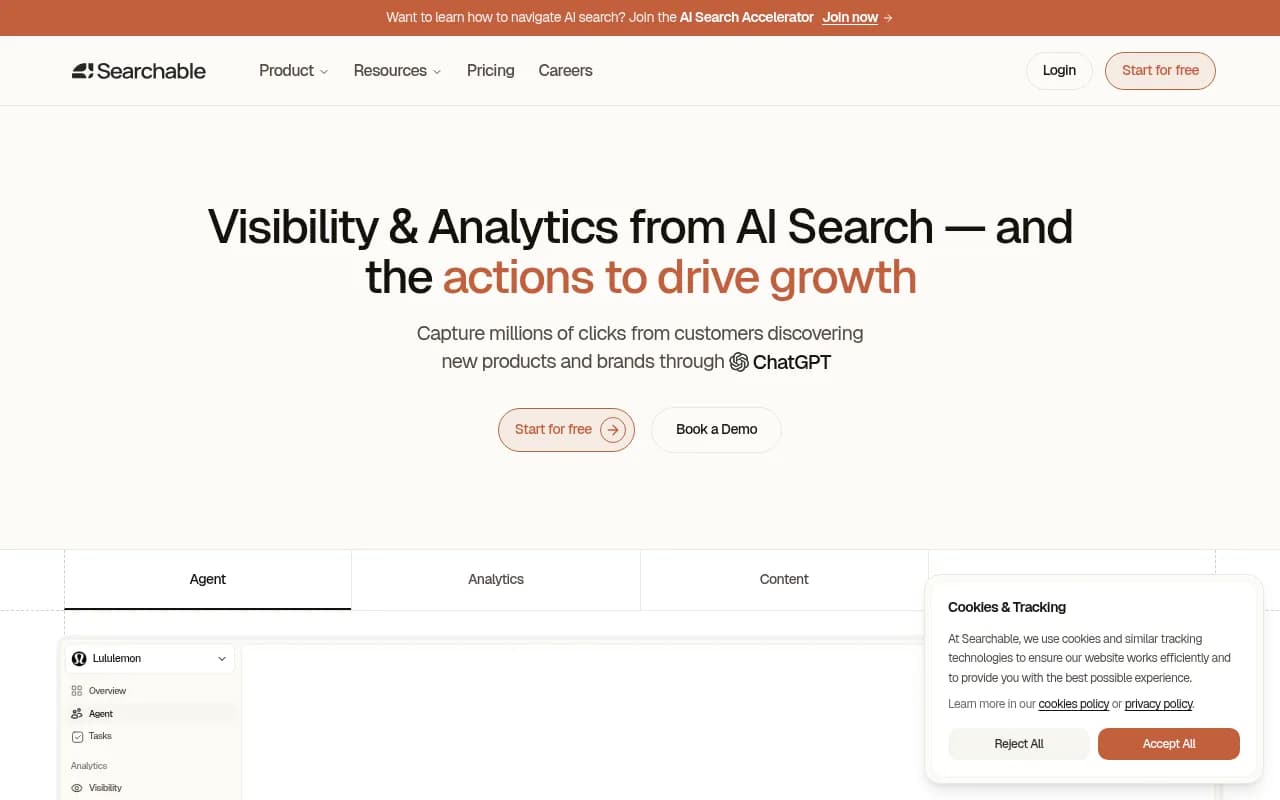
Where Searchable works well is for teams that want a clean, straightforward view of where they stand. The interface is accessible, the reporting is clear, and it doesn't require a lot of setup to get going.
The limitation is that Searchable is primarily a monitoring tool. It shows you the data but doesn't give you much to work with once you have it. There's no content gap analysis that tells you which specific prompts competitors are winning that you're not. There's no built-in content generation to help you create pages that AI models would actually want to cite. And there's no crawler log visibility to understand how AI bots are actually interacting with your site.
For a team that just wants a visibility score and a weekly report, Searchable is fine. For a team that wants to move the needle, it leaves you stuck at step one.
Profound: enterprise depth, enterprise price
Profound is one of the more established players in this space and has built a genuinely strong product, particularly for enterprise teams.

On model coverage, Profound is comprehensive. It tracks ChatGPT, Perplexity, Claude, Gemini, Grok, Copilot, Meta AI, DeepSeek, and Google AI Overviews -- ten-plus models in total. That breadth is real and useful if you're a large brand that needs to know exactly how you're appearing across the entire AI search ecosystem.
Profound also has solid prompt intelligence. You get volume estimates for different prompts, which helps prioritize where to focus. The competitive benchmarking is detailed, and the platform is clearly built for teams with dedicated SEO or brand strategy resources.
The downsides are real though. Profound's pricing sits at the higher end of the market, which makes it harder to justify for mid-market teams or agencies managing multiple clients. Reddit tracking isn't there. ChatGPT Shopping monitoring is absent. And like most enterprise tools, the focus is heavily on measurement rather than on helping you create content that improves your position.
If you're a large brand with a budget to match and you need the deepest possible data across the most models, Profound is worth a serious look. If you're a growth-stage company or an agency, the price-to-action ratio may not work in your favor.
Promptwatch: the full loop
Promptwatch takes a different approach to the problem. Where Searchable and Profound are primarily measurement platforms, Promptwatch is built around a cycle: find the gaps, create content that fills them, track whether it works.

On model coverage, Promptwatch monitors ten AI models: ChatGPT, Perplexity, Google AI Overviews, Google AI Mode, Claude, Gemini, Meta/Llama, DeepSeek, Grok, Mistral, and Copilot. So the multi-model tracking question -- ChatGPT, Claude, Gemini, and Perplexity simultaneously -- is fully covered.
But what makes Promptwatch different is what happens after the monitoring.
Answer gap analysis
The Answer Gap Analysis shows you exactly which prompts competitors are appearing for that you're not. Not just "your visibility is lower than competitor X" -- but the specific questions, topics, and angles where AI models have found answers from your competitors but couldn't find them on your site. That's a fundamentally different kind of insight. It tells you what to build, not just where you're behind.
AI content generation
Promptwatch has a built-in AI writing agent that generates articles, listicles, and comparison pages grounded in real citation data. The platform has analyzed over 880 million citations, so when it generates content, it's working from patterns of what actually gets cited by ChatGPT, Claude, and Perplexity -- not generic SEO templates. This is the piece that most competitors are missing entirely.
AI crawler logs
One capability that sets Promptwatch apart from both Searchable and Profound is real-time AI crawler logs. You can see exactly which pages ChatGPT, Claude, and Perplexity are crawling on your site, how often they return, and what errors they're encountering. This is how you find out that a key product page is being ignored by AI crawlers, or that a piece of content is being read frequently but never cited. Neither Searchable nor Profound offers this.
Traffic attribution
Promptwatch also closes the loop on the revenue side. Through a code snippet, Google Search Console integration, or server log analysis, you can connect AI visibility to actual traffic and conversions. Most platforms stop at "your brand was mentioned X times." Promptwatch lets you see whether those mentions are driving real visits.
Prompt intelligence
Volume estimates and difficulty scores for each prompt, plus query fan-outs that show how one prompt branches into sub-queries. This is how you prioritize -- not by guessing which prompts matter, but by seeing actual volume data.
Feature comparison: Searchable vs Profound vs Promptwatch
| Feature | Searchable | Profound | Promptwatch |
|---|---|---|---|
| ChatGPT tracking | Yes | Yes | Yes |
| Claude tracking | Yes | Yes | Yes |
| Gemini tracking | Yes | Yes | Yes |
| Perplexity tracking | Yes | Yes | Yes |
| Models covered | 4-6 | 10+ | 10+ |
| Competitor benchmarking | Yes | Yes | Yes |
| Answer gap analysis | No | Partial | Yes |
| AI content generation | No | No | Yes |
| AI crawler logs | No | No | Yes |
| Reddit/YouTube insights | No | No | Yes |
| ChatGPT Shopping tracking | No | No | Yes |
| Prompt volume data | Basic | Yes | Yes |
| Traffic attribution | No | No | Yes |
| Looker Studio / API | Limited | Yes | Yes |
| Multi-language/region | Limited | Yes | Yes |
| Starting price | Custom | $99/mo | $99/mo |
Which platform is right for your situation?
The honest answer depends on what you're trying to accomplish.
Choose Searchable if you need a simple, clean monitoring dashboard and your primary goal is reporting on AI visibility to stakeholders. It's accessible and doesn't require a lot of configuration. If "we need to know where we stand" is the brief, Searchable handles that.
Choose Profound if you're an enterprise brand with a dedicated SEO team, a significant budget, and a need for the deepest possible data across the widest range of AI models. The prompt volume data and breadth of coverage are genuinely strong. Just know that you'll still need to build your own content strategy on top of the data it provides.
Choose Promptwatch if you want to actually improve your AI visibility, not just measure it. The gap analysis, content generation, and crawler logs turn monitoring into a workflow. For marketing teams, SEO teams, and agencies that need to show results -- not just reports -- Promptwatch is the only one of the three that gives you the tools to move from "we're invisible on Claude" to "here's the content we published and here's the traffic it drove."
Promptwatch is also the most accessible entry point at $99/month for the Essential plan (1 site, 50 prompts, 5 articles), with the Professional plan at $249/month adding crawler logs, more prompts, and multi-location tracking.
What the broader market looks like
It's worth noting that Searchable, Profound, and Promptwatch aren't the only options. The AI visibility space has grown quickly in 2026, and there are now dozens of platforms at various price points and capability levels.
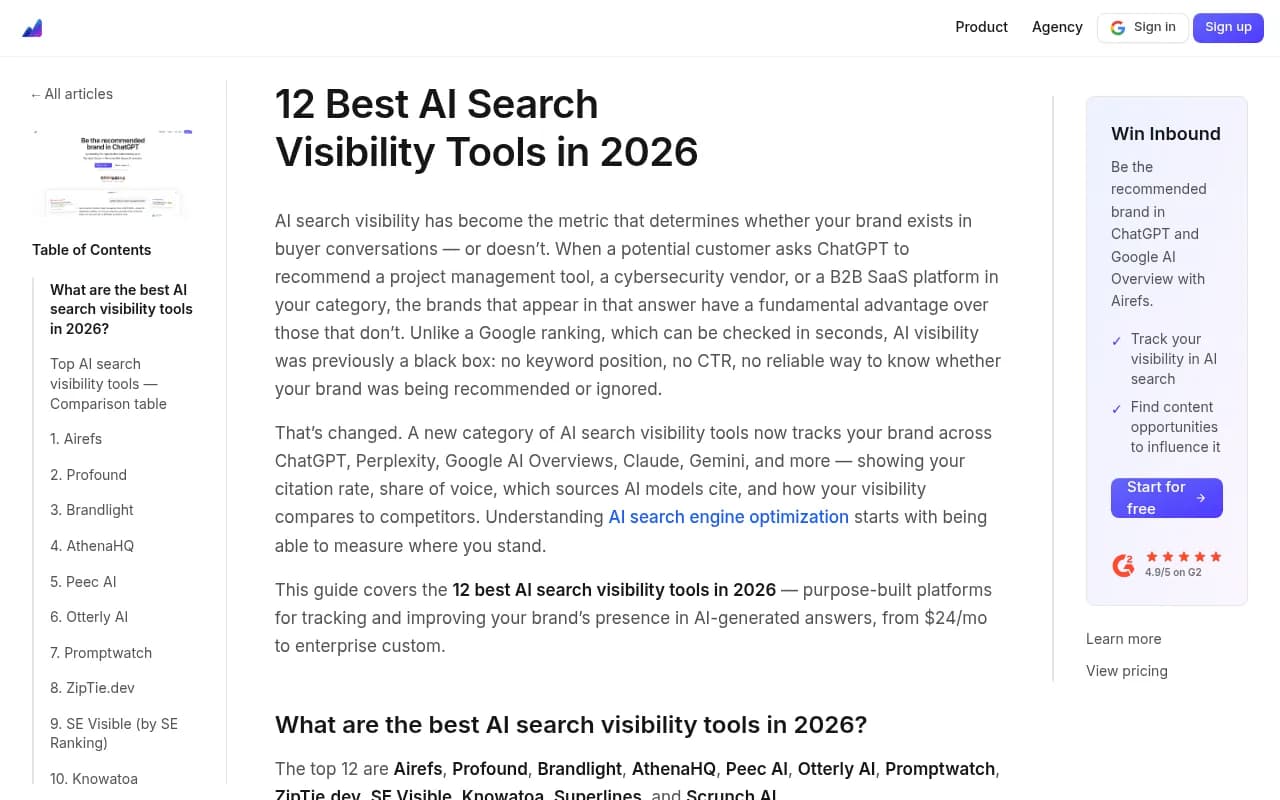
A few others worth knowing about:
Otterly.AI is a popular entry-level option for teams that want basic monitoring without a large budget.

AthenaHQ has strong case studies and good model coverage, though it's focused on monitoring rather than content optimization.

Peec AI is accuracy-focused and works well for multi-language tracking.

Scrunch AI is another monitoring-oriented platform with solid competitive benchmarking.
But across all of these, the pattern holds: most platforms show you where you stand and leave the rest to you. Promptwatch is the one that actually helps you do something about it.
The real question to ask before choosing
Before signing up for any of these platforms, ask yourself one question: "What will we do with this data?"
If the answer is "report on it internally" -- almost any of these tools will work. If the answer is "use it to create content that gets cited by AI models and drives traffic" -- you need a platform that supports that workflow end to end.
Tracking ChatGPT, Claude, Gemini, and Perplexity simultaneously is table stakes in 2026. The platforms that matter are the ones that help you turn that tracking into action.