Rankscale Review 2026
Tracks and analyzes brand rankings across AI-powered search engines with detailed metrics on visibility trends and competitive positioning.
Key Takeaways
- Monitoring-only tool with no content generation or optimization features -- lacks the action loop that Promptwatch provides (gap analysis, AI content generation, crawler logs, traffic attribution)
- Strong citation analysis and sentiment tracking across 10 AI models, but no prompt volume data, difficulty scoring, or query fan-outs
- Credit-based pricing offers flexibility for agencies, though the model can get expensive at scale compared to flat subscription plans
- No AI crawler logs or visitor analytics -- you can track where you appear but not how AI engines discover your content or whether visibility drives traffic

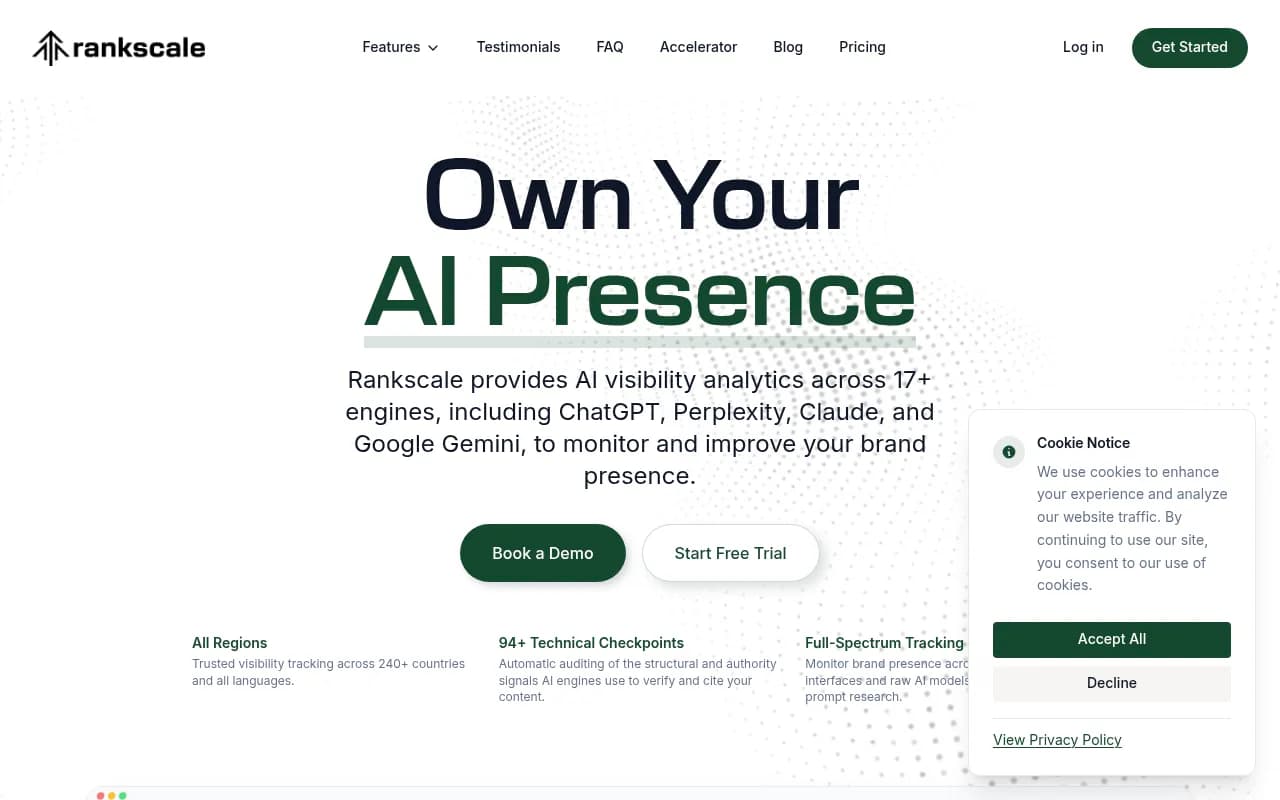
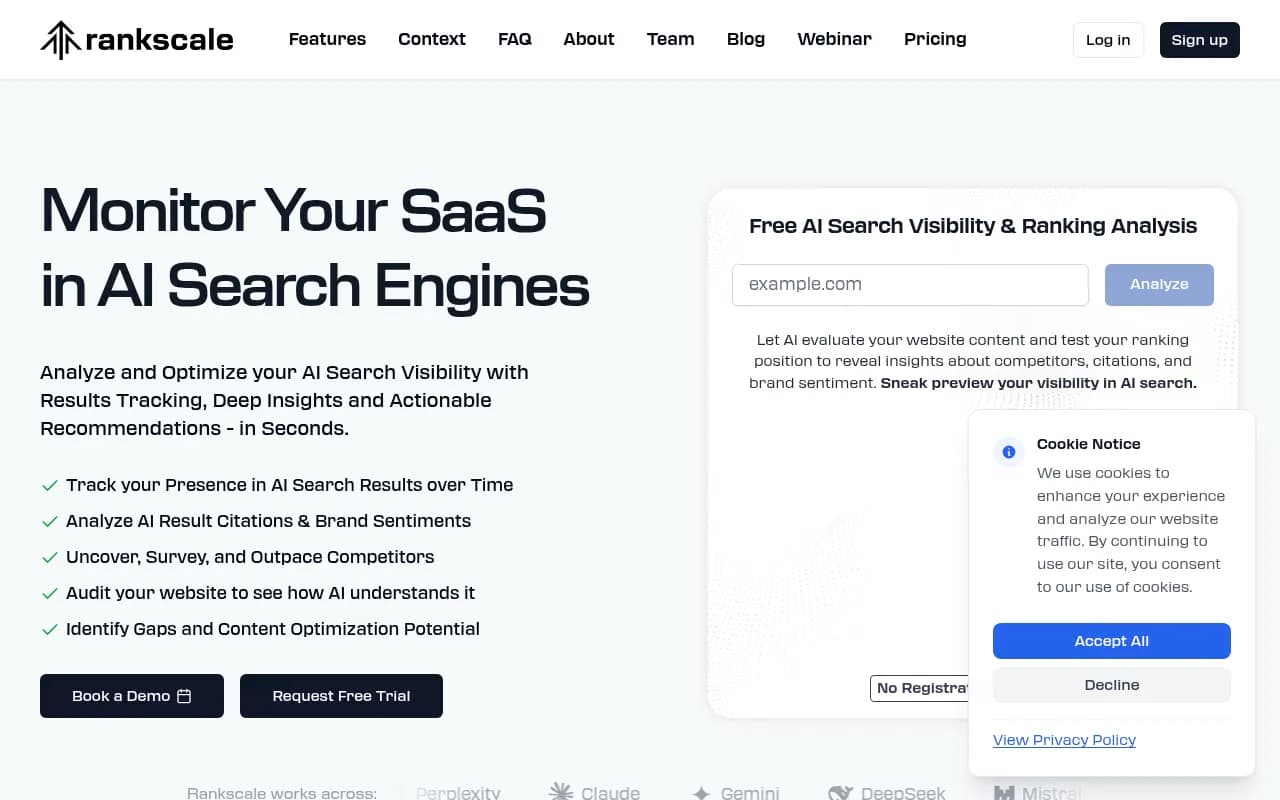
Rankscale launched in October 2024 as a Generative Engine Optimization (GEO) platform built by Mathias Ptacek, a former corporate tech and marketing professional who went full-time on the project in April 2025. The tool targets marketing teams, SEO professionals, and agencies who want to understand how their brands show up in AI-generated answers from ChatGPT, Perplexity, Google AI Overviews, Gemini, Claude, DeepSeek, Mistral, Grok, Copilot, and Google AI Mode. By June 2025, Rankscale had grown to over 700 users and incorporated as Rankscale GmbH i.G., transitioning from an early access beta to a subscription-based product with in-app credit top-ups.
The core pitch is visibility tracking for AI search engines. Traditional SEO tools like Semrush and Ahrefs focus on Google's traditional search results, but they don't tell you whether ChatGPT recommends your product when someone asks "best project management tools for remote teams" or whether Perplexity cites your blog post in its answer about marketing automation. Rankscale fills that gap by running your search terms through multiple AI engines, checking whether your brand appears, tracking your position, and identifying which sources the AI models cite. It's a monitoring and analysis platform -- you get dashboards, charts, competitor comparisons, and sentiment breakdowns, but no tools to actually fix the problems it surfaces.
Brand Dashboard The Brand Dashboard is the central hub where you manage multiple brands (useful for agencies) and view aggregated performance metrics. You see Visibility Score (a proprietary metric indicating how often and prominently your brand appears), Sentiment (positive/neutral/negative keyword analysis), Mentions, Citations, Average Position, and Detection Rate (how often your brand shows up when it should). The dashboard lets you slice data by AI engine, topic, and timeframe, with period-over-period comparisons to spot trends. You can drill down from high-level summaries into individual search term performance, though the interface can feel dense when you're tracking dozens of terms across multiple engines.
Performance Tracking Rankscale tracks your brand's presence over time with interactive graphs showing how your Visibility Score, Sentiment, and other KPIs evolve. You can see whether your brand is gaining or losing ground in AI answers, which AI engines favor you, and how your metrics shift after content updates or PR campaigns. The tracking is granular -- you can view performance for a single search term on a single AI engine, then compare it to how competitors perform on the same query. This level of detail is useful for diagnosing specific visibility problems (e.g. "We rank well in ChatGPT but poorly in Perplexity for this query"), but it doesn't tell you why or what to do about it. There's no content gap analysis, no recommendations for missing topics, and no prompt volume data to help you prioritize which queries actually matter.
Competitor Benchmarking Rankscale automatically identifies competitors who appear in AI search results for your tracked terms. You can monitor their Visibility Score, Rank, Sentiment, and Citations, then compare your brand against theirs on key metrics. The competitor ranking is clear -- you see who's winning and by how much. This is valuable for understanding the competitive landscape in AI search, but it's purely observational. You can see that a competitor ranks higher, but Rankscale won't tell you which content they have that you don't, which prompts they're visible for that you're missing, or how to close the gap. Platforms like Promptwatch offer Answer Gap Analysis that surfaces exactly which prompts competitors rank for but you don't, then helps you create the content to compete.
Citation Analysis One of Rankscale's strongest features is citation tracking. You can see which sources AI engines reference when they generate answers -- websites, articles, Reddit threads, YouTube videos, and other domains. Rankscale shows citation frequency, unique citation counts, and which brands each source mentions. You can filter citations by category, region, or search term, and export the data for further analysis. This is genuinely useful for understanding the content ecosystem that influences AI recommendations. If you see that AI models frequently cite a competitor's blog post or a specific industry publication, you know where to focus your outreach or content efforts. However, Rankscale doesn't track Reddit or YouTube as deeply as some competitors, and it lacks the crawler log visibility that shows you how AI engines actually discover and index your content.
Sentiment Analysis Rankscale provides detailed sentiment scores for your brand and competitors, breaking down positive, neutral, and negative keywords in interactive word clouds. You can distinguish between sentiment from web grounding (sources the AI cites) and training data (knowledge baked into the model). This helps you understand whether negative sentiment comes from recent articles or older information the model learned during training. You can drill into individual keywords to see the exact contexts and citations where they appeared. This is more sophisticated than most competitors offer, though the word clouds can be hard to interpret when you're dealing with hundreds of keywords.
Website Audits Rankscale's Website Audit feature analyzes how AI search engines perceive your content. You get an overall AI readiness score (0-100%) with breakdowns for Content, Authority, SEO, and Engagement. The audit provides findings and actionable recommendations, plus a side-by-side comparison of current vs. improved content to visualize how changes could enhance your AI visibility. You can audit a single landing page or perform a multi-page crawl for a complete site audit. This is a solid diagnostic tool, but it's a one-time snapshot -- there's no ongoing content optimization, no AI writing agent to help you implement the recommendations, and no way to track whether your changes actually improve your visibility. Promptwatch combines audits with an AI content generation engine that creates articles, listicles, and comparisons grounded in real citation data, then tracks the results to close the optimization loop.
Who Is It For Rankscale is built for three main audiences. First, in-house marketing and SEO teams at mid-sized to large companies who want to monitor their brand's AI search presence and report on it to leadership. If you're a marketing manager at a SaaS company or e-commerce brand and your CEO asks "Are we showing up in ChatGPT?", Rankscale gives you the data to answer that question with charts and metrics. Second, digital marketing agencies managing multiple clients. The multi-brand dashboard and credit-based pricing let you allocate different tracking budgets across clients, and the white-label potential (mentioned in testimonials) suggests agencies can rebrand the reports. Third, SEO consultants and GEO specialists who need detailed citation and sentiment data to advise clients on AI search strategy. If you're already deep in the GEO space and just need a monitoring tool, Rankscale fits.
Rankscale is less suitable for small businesses or solopreneurs who need a simple, actionable tool. The interface is feature-rich but not beginner-friendly, and the credit-based pricing can get expensive if you're tracking many terms across many engines. It's also not the right fit for teams who want to do something about their AI visibility beyond just tracking it. If you need content gap analysis, AI-generated articles, crawler log monitoring, or traffic attribution, you'll need to supplement Rankscale with other tools -- or use a platform like Promptwatch that handles the full optimization cycle.
Integrations & Ecosystem Rankscale doesn't advertise many integrations. There's no mention of API access, Zapier connections, Google Search Console integration, or browser extensions. The platform is largely self-contained -- you log in, set up your brands and search terms, and view the data in the dashboard. You can export citation data and reports, but there's no indication of webhook support, Slack notifications, or Looker Studio connectors. This is a limitation for agencies and enterprises who want to pipe Rankscale data into their existing reporting workflows or trigger alerts based on visibility changes. Competitors like Promptwatch offer Looker Studio integration and API access for custom workflows.
Pricing & Value Rankscale uses a credit-based pricing model. You buy credits, then spend them to run prompts through AI engines. The flexibility is appealing -- you can allocate more credits to high-priority brands or queries and scale up or down as needed. Plans start at 20 Euro (roughly $22 USD) according to the FAQ, though the exact tier structure isn't detailed in the scraped content. Testimonials mention "Essentials to Enterprise" plans, suggesting multiple tiers. The credit system is praised by agency users who like the ability to customize tracking budgets per client, but it can get expensive at scale. If you're tracking 100+ prompts daily across 10 AI engines, your credit burn rate adds up quickly. Flat subscription plans (like those offered by Promptwatch at $99-$579/mo with fixed prompt and article limits) can be more predictable for budgeting. Rankscale offers a free trial, and the early access program suggests they're still iterating on pricing.
Compared to competitors, Rankscale is competitively priced for monitoring-only use cases. Tools like Profound and Scrunch charge more and don't offer the same citation depth. Otterly.AI and Peec.ai are cheaper but lack sentiment analysis and multi-engine coverage. However, if you need optimization features (content generation, gap analysis, crawler logs), Promptwatch delivers more value at $99-$579/mo because it includes the tools to act on the insights, not just view them.
Strengths & Limitations
Strengths:
- Deep citation and sentiment analysis with keyword-level drill-downs and source tracking
- Multi-brand dashboard ideal for agencies managing multiple clients
- Flexible credit-based pricing that scales with usage
- Covers 10 AI models including ChatGPT, Perplexity, Gemini, Claude, DeepSeek, Mistral, Grok, Copilot, Google AI Overviews, and Google AI Mode
- Responsive founder-led support with an active Slack community (mentioned in testimonials)
- Website audit feature provides actionable AI readiness recommendations
Limitations:
- Monitoring-only -- no content gap analysis, no AI content generation, no optimization tools. You see the problems but can't fix them in-platform.
- No AI crawler logs or visitor analytics. You don't know how AI engines discover your content or whether visibility translates to traffic.
- No prompt volume data, difficulty scoring, or query fan-outs. You can't prioritize which prompts to target based on search volume or competition.
- Limited integrations -- no API, no Zapier, no Google Search Console, no Looker Studio connector.
- Credit-based pricing can get expensive at scale compared to flat subscription plans.
- No Reddit or YouTube tracking depth comparable to Promptwatch.
- No ChatGPT Shopping tracking (a feature Promptwatch offers).
Bottom Line Rankscale is a solid monitoring and analysis tool for brands and agencies who want to track their AI search visibility across multiple engines. If your primary goal is to report on how often your brand appears in ChatGPT, Perplexity, and other AI answers, and you need detailed citation and sentiment data to back it up, Rankscale delivers. The multi-brand dashboard and credit-based pricing make it particularly appealing for agencies.
However, Rankscale stops at monitoring. It won't tell you which content you're missing, it won't generate articles to fill those gaps, and it won't show you how AI engines crawl your site or whether visibility drives traffic. For teams who want to optimize their AI search presence -- not just track it -- Promptwatch is the stronger choice. Promptwatch combines monitoring with Answer Gap Analysis, an AI content generation engine, crawler logs, traffic attribution, and prompt intelligence (volume, difficulty, fan-outs) to close the optimization loop. If you need a dashboard to show your CEO, Rankscale works. If you need a platform to actually improve your AI visibility, look at Promptwatch.
Tags:
Frequently asked questions
What is Rankscale and what does it do?
How much does Rankscale cost?
Does Rankscale offer a free plan?
Which AI search engines does Rankscale monitor?
Who is Rankscale designed for?
Can Rankscale generate or optimize content?
What features does Rankscale include?
When was Rankscale launched?
Similar and alternative tools to Rankscale