Key Takeaways
- Rankscale is 5x cheaper to start: €20/month vs Bear AI's $100/month, making it far more accessible for small teams and startups
- Bear AI's Basic plan only tracks GPT-5: You need Enterprise pricing to monitor Claude, Perplexity, and other engines. Rankscale covers all major LLMs at every tier.
- Bear AI includes lead generation tools: Visitor identification, PR outreach automation, and conversion tracking. Rankscale is monitoring-only.
- Rankscale offers better competitor benchmarking: Direct competitor comparison is a highlighted feature. Bear AI focuses more on your own brand's trending prompts.
- Content generation is Bear AI's differentiator: 2 blogs/month included on Basic. Rankscale has no content creation capabilities.
- Both track the same 10 AI engines: ChatGPT, Claude, Perplexity, Google AI Overviews, Gemini, DeepSeek, Mistral, Grok, Copilot, and Google AI Mode.
Overview
Bear AI
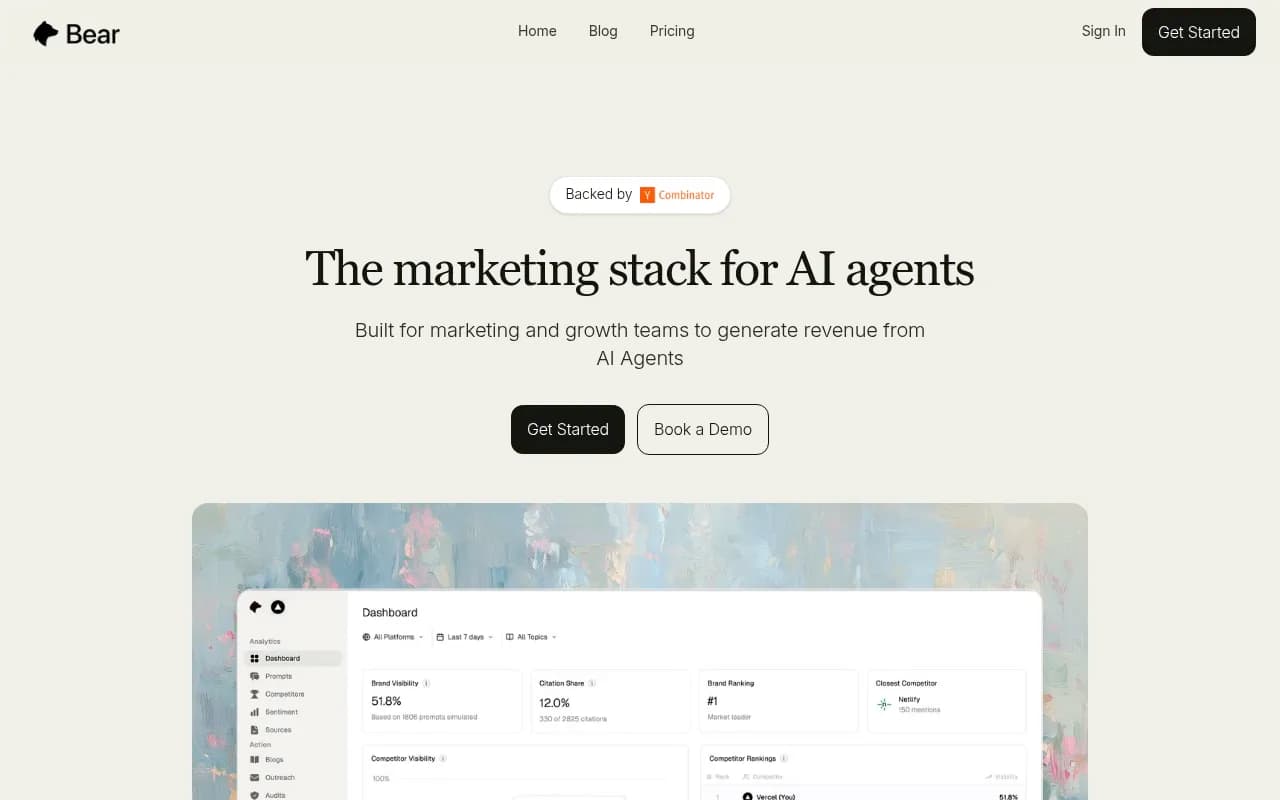
Bear AI positions itself as a full marketing stack for AI agents. It's a Y Combinator-backed platform that tracks brand visibility across major AI engines, then adds lead generation and content creation on top. The pitch: don't just monitor AI search -- convert that traffic into revenue. Customers include Peerspace, Medal, and Wispr Flow.
The platform combines visibility tracking with practical conversion tools: identify high-intent visitors from AI sources, automate PR outreach to get cited more often, and generate AI-optimized blog content. It's built for marketing and growth teams who want an all-in-one solution.
Rankscale
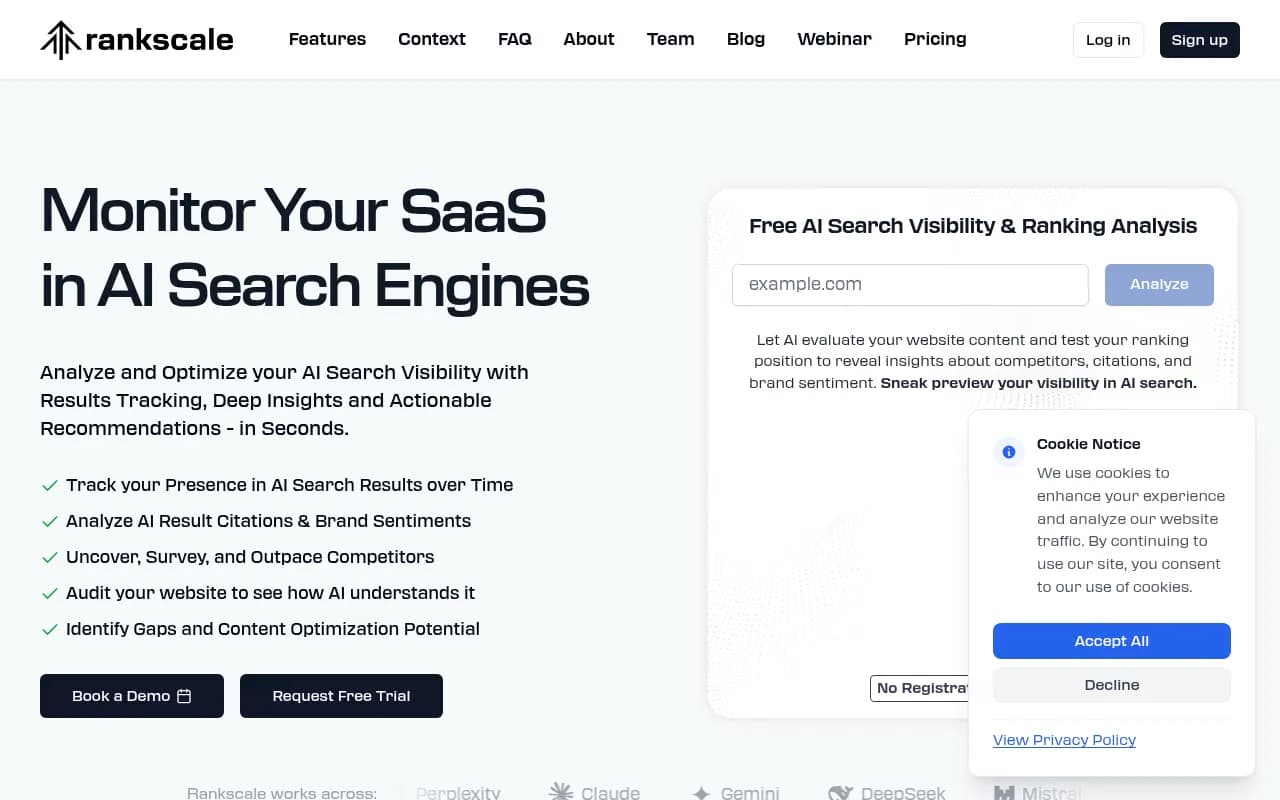
Rankscale is a European AI search visibility platform focused on deep analysis and competitive intelligence. It tracks how your brand appears in AI-generated answers across 10 major engines, then provides actionable recommendations for improvement.
The core value is in the depth of analysis: citation tracking, sentiment analysis, competitor benchmarking, and website audits that show how AI engines understand your content. It's a monitoring and optimization tool -- no lead gen, no content creation, just visibility tracking done thoroughly.
Side-by-Side Comparison
| Feature | Bear AI | Rankscale |
|---|---|---|
| Starting price | $100/mo | €20/mo (~$22) |
| Free trial | No | Yes (on request) |
| LLM coverage (Basic tier) | GPT-5 only | All 10 engines |
| LLM coverage (paid tiers) | All engines (Enterprise) | All engines (all tiers) |
| Prompt tracking | 30 prompts (Basic) | Credit-based allocation |
| Content generation | 2 blogs/month (Basic) | None |
| Lead identification | ✓ | ✗ |
| PR outreach automation | ✓ | ✗ |
| Competitor benchmarking | Limited | ✓ Core feature |
| Citation analysis | ✓ | ✓ |
| Sentiment tracking | ✓ | ✓ |
| Website audit | Not mentioned | ✓ |
| API access | Not mentioned | Not mentioned |
| Multi-language support | Not specified | Not specified |
Pricing Comparison
| Plan | Bear AI | Rankscale |
|---|---|---|
| Entry tier | $100/mo (Basic: GPT-5 only, 30 prompts, 2 blogs/month) | €20/mo (Essentials: credit-based, all engines) |
| Mid tier | Custom (Enterprise: all features, unlimited prompts) | Credit-based tiers up to Enterprise |
| Enterprise | Custom pricing | Custom pricing |
| Free trial | No | Yes (request) |
| Annual discount | Not mentioned | Not mentioned |
The pricing gap is dramatic. Rankscale's entry point is roughly one-fifth of Bear AI's, and you get full LLM coverage from day one. Bear AI's Basic plan locks you into GPT-5 only -- if you want to track Claude, Perplexity, or Gemini, you're forced into Enterprise pricing with no published rates.
Head-to-Head Feature Analysis
AI engine coverage
Both platforms monitor the same 10 AI engines: ChatGPT, Claude, Perplexity, Google AI Overviews, Gemini, DeepSeek, Mistral, Grok, Copilot, and Google AI Mode. On paper, coverage is identical.
The catch: Bear AI's $100/month Basic plan only tracks GPT-5. Every other engine requires upgrading to Enterprise. Rankscale gives you all 10 engines at every price tier, starting at €20/month.
This is a huge practical difference. If you're evaluating AI search visibility seriously, you need to see how multiple engines treat your brand -- Claude and Perplexity often cite different sources than ChatGPT. Bear AI's Basic tier is essentially a single-engine monitor, which defeats the purpose of cross-platform tracking.
Verdict: Rankscale wins on accessibility. Full coverage at entry-level pricing vs a paywalled single-engine experience.
Visibility tracking and analytics
Both platforms track when and how AI engines mention your brand. You see trending prompts, citation frequency, and visibility trends over time.
Bear AI emphasizes "trending prompts" -- showing you which queries are driving AI traffic to your site. The dashboard highlights high-volume prompts and lets you see how AI agents are discovering your brand.
Rankscale goes deeper on analysis: citation tracking (which pages get cited), sentiment analysis (positive/negative/neutral mentions), and website audits that reveal how AI engines interpret your content. The focus is on understanding why you're visible or invisible for specific queries.
Bear AI's interface looks polished and marketing-team-friendly. Rankscale's positioning suggests more granular data for SEO and content teams who want to dig into the mechanics.
Verdict: Tie with different strengths. Bear AI for quick trend spotting, Rankscale for deep diagnostic analysis.
Competitor benchmarking
Rankscale makes competitor analysis a headline feature: "Uncover, Survey, and Outpace Competitors." You can benchmark your visibility against rivals and see where they're winning in AI search results.
Bear AI mentions trending prompts but doesn't emphasize head-to-head competitor comparison in its marketing. The focus is more on your own brand's performance and converting that traffic.
For teams trying to understand competitive positioning in AI search, Rankscale's explicit competitor focus is a clear advantage. You need to know not just where you rank, but who's beating you and why.
Verdict: Rankscale wins. Competitor benchmarking is core to their value prop; Bear AI underplays it.
Content generation
Bear AI includes AI-optimized content generation: 2 blog posts per month on the Basic plan, more on Enterprise. The idea is to create content that AI engines will cite, closing the loop from visibility tracking to content creation.
Rankscale has no content generation. It's a monitoring and analysis tool. You get recommendations for optimization, but you're writing (or outsourcing) the content yourself.
This is a philosophical split. Bear AI wants to be an all-in-one marketing stack. Rankscale stays in its lane as a visibility platform.
If you need help producing content, Bear AI's built-in generation is convenient. If you already have a content team or prefer using dedicated writing tools, Rankscale's focus on tracking might be cleaner.
Verdict: Bear AI wins for teams that want content creation bundled in. Rankscale wins for teams that just want visibility data.
Lead generation and conversion
Bear AI's differentiator is converting AI traffic into revenue. Features include:
- Visitor identification: see which companies are visiting from AI sources
- PR outreach automation: pitch journalists and publications to get cited more
- High-intent visitor tracking: identify leads coming from AI search
Rankscale has none of this. It's purely a visibility and analysis platform. You track how AI engines see you, but there's no lead capture or outreach automation.
For growth teams focused on pipeline, Bear AI's conversion tools are valuable. For SEO and content teams focused on organic visibility, Rankscale's pure-play approach is cleaner.
Verdict: Bear AI wins decisively if lead gen matters. Rankscale isn't competing in this category.
Pricing and accessibility
Rankscale starts at €20/month with credit-based pricing. You allocate credits across prompts and engines. All 10 LLMs are available from day one.
Bear AI starts at $100/month for GPT-5 only, 30 prompts, and 2 blogs/month. Full LLM coverage requires Enterprise pricing (not published).
For startups and small teams, Rankscale is 5x cheaper and gives you more flexibility. Bear AI's entry tier feels like a trial version with artificial limits.
The credit-based model can be confusing -- you need to understand how credits map to queries and engines. But the low entry price makes it easy to test.
Bear AI's pricing makes sense if you're buying the full marketing stack (content + lead gen + tracking). If you just want visibility monitoring, you're paying for features you might not use.
Verdict: Rankscale wins on accessibility. Bear AI's value depends on whether you need the bundled features.
Pros and Cons
Bear AI
Pros:
- All-in-one marketing stack: tracking + content + lead gen in one platform
- Visitor identification and PR outreach automation for converting AI traffic
- Y Combinator backing and recognizable customer logos (Peerspace, Medal)
- Polished, marketing-team-friendly interface
- Content generation included (2 blogs/month on Basic)
Cons:
- $100/month entry price is 5x higher than Rankscale
- Basic plan only tracks GPT-5 -- other engines locked behind Enterprise paywall
- No published Enterprise pricing (requires sales call)
- Limited prompt tracking on Basic (30 prompts)
- No free trial to test before committing
Rankscale
Pros:
- €20/month starting price makes it accessible for small teams
- All 10 AI engines available at every tier (no paywalls)
- Free trial available on request
- Strong competitor benchmarking and analysis features
- Website audit shows how AI engines understand your content
- Deep citation and sentiment analysis
Cons:
- No content generation -- you're on your own for creating optimized content
- No lead generation or visitor identification features
- Credit-based pricing can be confusing to estimate costs
- Less polished marketing presence compared to Bear AI
- Fewer recognizable customer case studies
Who Should Pick Which Tool
Choose Bear AI if:
- You're a marketing or growth team that needs lead generation from AI traffic
- You want content creation bundled with visibility tracking
- PR outreach automation and visitor identification matter to your workflow
- You're willing to pay $100+/month for an all-in-one platform
- You can justify Enterprise pricing to get full LLM coverage
Choose Rankscale if:
- You're on a tight budget and need full LLM tracking for under $25/month
- You already have content creation and lead gen tools -- you just need visibility data
- Competitor benchmarking is a priority
- You want deep citation analysis and website audits
- You prefer a focused tool that does one thing well over an all-in-one suite
Consider both if:
- You're a larger team that could use Bear AI's lead gen features but also wants Rankscale's competitor analysis depth
- You want to run them in parallel: Rankscale for broad monitoring, Bear AI for conversion-focused campaigns
If you're also looking to track AI search visibility with content gap analysis and optimization tools, Promptwatch offers a middle-ground approach with crawler logs, prompt intelligence, and AI content generation grounded in 880M+ citations.

Final Verdict
Rankscale wins on accessibility and pure visibility tracking. For €20/month, you get full coverage of all 10 AI engines, competitor benchmarking, and deep citation analysis. It's the better choice for SEO teams, content strategists, and budget-conscious startups who just need to understand how AI engines see their brand.
Bear AI wins if you need the full marketing stack. The combination of visibility tracking, content generation, and lead conversion tools makes sense for growth teams focused on pipeline. But the $100/month entry price with GPT-5-only coverage is a tough sell -- you're essentially paying for the bundled features, not the tracking depth.
The pricing structure is the deciding factor. If Bear AI offered full LLM coverage at $100/month, it would be competitive. As it stands, Rankscale delivers better value for pure visibility monitoring, while Bear AI is a specialized tool for teams that need lead gen and content creation in the same platform.