Bear AI Review 2026
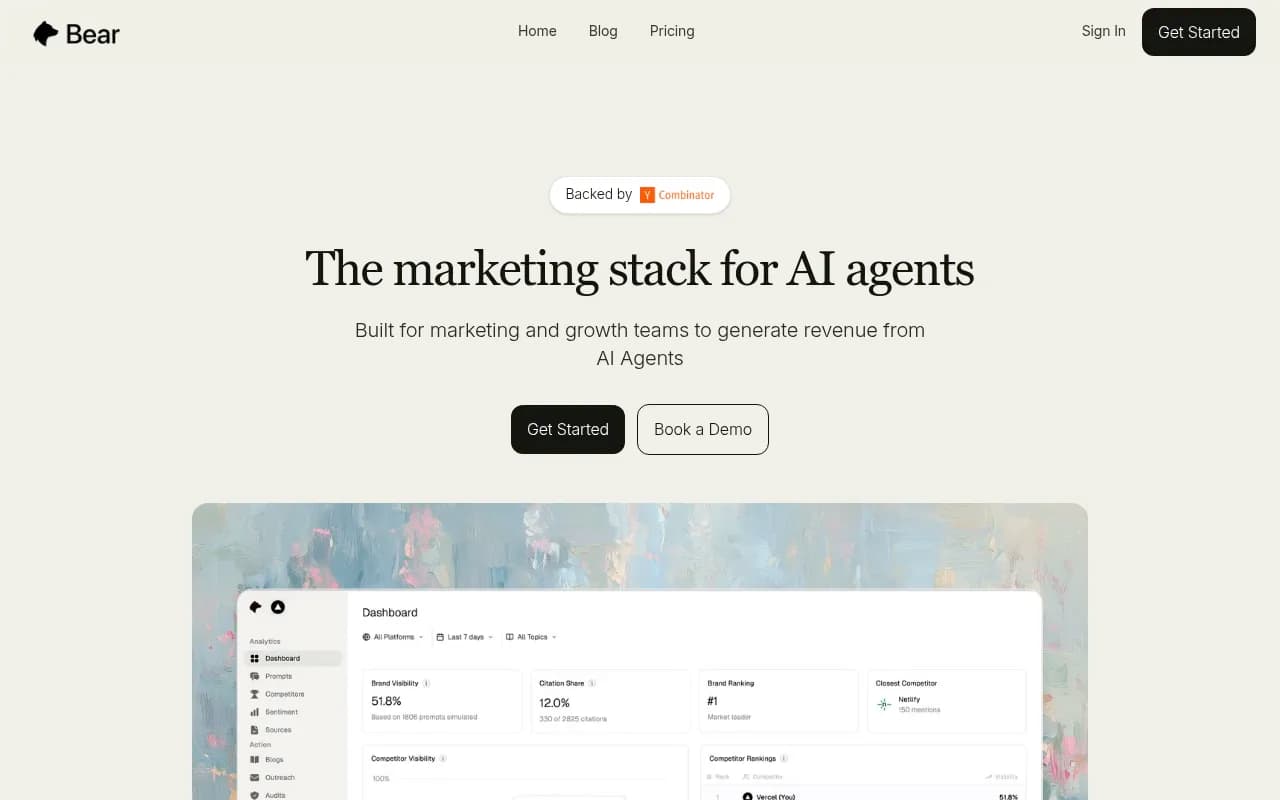
Bear AI is a GEO platform that helps marketing teams monitor brand visibility across ChatGPT, Claude, Perplexity, Google AI, and Gemini, then convert AI-driven traffic into leads. Track trending prompts, generate AI-optimized content, automate PR outreach, and identify high-intent visitors from AI sources.
Key takeaways
- Monitoring-only approach: Bear AI tracks brand mentions across 5-6 AI platforms but lacks content gap analysis, AI crawler logs, and traffic attribution that Promptwatch offers
- Lead generation focus: The platform's standout feature is identifying and capturing visitors who arrive from ChatGPT and other AI sources -- a capability most GEO tools don't have
- Limited model coverage: Monitors GPT-5, Google AI, Claude, Gemini, and Perplexity but misses DeepSeek, Grok, Mistral, Meta AI, and Copilot that competitors track
- High entry price: Basic plan at $100/month covers only 30 prompts and GPT-5 tracking, with full features locked behind custom Enterprise pricing
- Y Combinator backed: Early-stage startup (backed by YC) with a small customer base including Peerspace, Medal, and Wispr Flow

Bear AI is a Generative Engine Optimization platform built specifically for marketing and growth teams who want to understand how AI agents like ChatGPT, Claude, and Perplexity talk about their brand. Launched in 2024 and backed by Y Combinator, Bear positions itself as "the marketing stack for AI agents" -- a suite of tools designed to track AI visibility, generate AI-optimized content, and convert AI-driven traffic into leads.
The platform targets B2B SaaS companies, digital agencies, and growth teams who recognize that traditional SEO is no longer enough. When someone asks ChatGPT "What's the best project management tool for remote teams?" they're not clicking through to Google -- they're getting a direct recommendation. Bear's pitch is simple: if AI agents aren't mentioning your brand, you're invisible to a growing segment of high-intent buyers.
Bear's current customer base includes companies like Peerspace (venue marketplace), Medal (gaming clips platform), Wispr Flow (voice-to-text tool), and a handful of other startups. The company is early-stage and still building out its feature set, which shows in both the capabilities and the pricing structure.
Key features
AI mention tracking: Bear monitors brand mentions across ChatGPT (GPT-5), Google AI Mode, Google AI Overviews, Claude, Gemini, and Perplexity. You see when AI agents recommend your brand, which prompts trigger mentions, and how often you appear in AI-generated answers. The dashboard shows trending prompts with volume indicators ("high-volume") and lets you track competitor mentions to see where you're losing visibility. This is the core monitoring feature that most GEO platforms offer.
Prompt discovery: The platform surfaces the most-searched prompts across AI platforms so you can see what users are actually asking about your category. For example, if you're a credit card company, Bear might show you that "best business credit cards" and "credit cards with the best rewards" are high-volume prompts. This helps you prioritize which queries to optimize for, though the platform doesn't provide specific volume numbers or difficulty scores like some competitors do.
Lead generation and visitor identification: This is Bear's most distinctive feature. The platform identifies visitors who arrive at your website from ChatGPT, Claude, Perplexity, and other AI sources. You see their company, role, and which AI platform sent them. Bear positions these as high-intent leads -- people who were recommended your brand by an AI agent and clicked through to learn more. You can then trigger targeted workflows to convert them. Most GEO platforms don't offer this capability at all.
Blog agent (AI content generation): Bear includes an AI writing tool that generates "structured, AI-ready content designed to be easily ingested, cited, and recommended by LLMs." The agent analyzes your existing content to learn your brand voice, checks competitors, and creates blog posts optimized for the prompts your audience is asking AI agents. The Basic plan includes 2 blogs per month; Enterprise gets unlimited generation. The quality and effectiveness of this content compared to human-written or competitor-generated content is unclear from public information.
Automated PR outreach: Bear identifies third-party sources (Forbes, Reddit, LinkedIn, YouTube) that AI models frequently cite, then helps you get mentioned on those sources through automated outreach workflows. The platform shows you which URLs are being cited most often (e.g. "254 citations" for a Forbes article) and provides outreach tools to pitch your brand for inclusion. This is a smart approach -- if AI agents are pulling from specific Reddit threads or YouTube videos, getting mentioned there can boost your visibility. However, the actual outreach process and success rates aren't detailed.
Competitor analysis: You can track how often competitors appear in AI search results, which prompts trigger their mentions, and where you have opportunities to outrank them. This is a standard feature across most GEO platforms.
Who is it for
Bear AI is built for B2B SaaS companies and digital agencies in the 10-100 employee range who are already seeing traffic from AI sources and want to understand and optimize it. If you're a growth marketer at a Series A startup and you've noticed "chatgpt.com" showing up in your Google Analytics referral traffic, Bear gives you a way to track and convert those visitors.
The platform is particularly relevant for companies in competitive categories where AI agents are already making recommendations -- project management tools, CRM software, marketing platforms, financial services, HR tech. If users are asking ChatGPT "What's the best X for Y?" and your competitors are getting mentioned but you're not, Bear helps you close that gap.
Small businesses and solopreneurs will find the $100/month Basic plan limiting (only 30 prompts, only GPT-5 tracking, only 2 blogs per month). The real value is in the Enterprise tier, which means Bear is realistically targeting companies with marketing budgets of $5,000+ per month who can afford custom pricing and want the full feature set.
Agencies managing multiple clients could use Bear to offer GEO as a service, though the seat-based pricing and lack of white-label options may be a barrier.
Who should NOT use Bear: Traditional SEO agencies focused on link building and SERP rankings, content creators who don't care about AI visibility, or companies in categories where AI agents aren't yet making recommendations (very niche B2B, local services, highly regulated industries). If your target audience isn't using ChatGPT or Perplexity to research solutions, Bear won't deliver ROI.
Integrations and ecosystem
Bear's integration ecosystem is minimal compared to established marketing platforms. The website mentions "custom integrations" for Enterprise customers but doesn't specify which tools are supported. There's no mention of native integrations with Google Analytics, HubSpot, Salesforce, Slack, Zapier, or other standard marketing stack tools.
The platform does offer "Priority Slack support" for Enterprise customers, suggesting some level of Slack integration for notifications or support, but this isn't a data integration.
There's no public API documentation, no browser extension, and no mobile app. The platform appears to be web-only at this stage.
For lead generation, Bear presumably integrates with your website via a tracking script (similar to how analytics tools work), but the implementation details aren't public.
The lack of integrations is a significant limitation. If you want to push Bear's lead data into your CRM, trigger email sequences based on AI traffic, or combine Bear's data with your existing analytics, you'll likely need custom development work or manual exports.
Pricing and value
Bear offers two pricing tiers:
Basic ($100/month): Track GPT-5 only, up to 30 prompts, generate 2 blogs per month with the blog agent, access to email outreach workflow. This tier is extremely limited -- you're only monitoring one AI platform (ChatGPT), you can only track 30 prompts (most brands need to monitor 100+ relevant queries), and you get just 2 AI-generated blog posts per month. For $100/month, you're essentially getting a basic ChatGPT mention tracker with minimal content generation. The lead generation feature isn't mentioned in the Basic tier, suggesting it's Enterprise-only.
Enterprise (Custom pricing): Track all 6 AI platforms (GPT-5, Google AI, Claude, Gemini, Perplexity), unlimited prompt tracking, unlimited blog generation, access to lead generation and automated PR, multiple seats, priority Slack support, custom integrations. This is where the real value lives, but there's no public pricing. Based on competitor pricing (Promptwatch Professional at $249/month, Otterly.AI at $200+/month), Bear's Enterprise tier likely starts at $500-1,000+ per month.
There's no mention of a free trial, though the website has a "Get Started" button that may offer one.
Compared to competitors: Promptwatch offers more comprehensive monitoring (10 AI models vs Bear's 6), AI crawler logs, traffic attribution, and content gap analysis starting at $99/month for the Essential plan, with Professional at $249/month including 150 prompts and 15 articles. Bear's Basic plan at $100/month is more expensive for less coverage. Otterly.AI and Peec.ai offer similar monitoring-only features at comparable price points but lack Bear's lead generation capability.
The value proposition depends entirely on whether Bear's lead generation feature delivers. If you're converting AI-driven traffic into customers, the Enterprise tier could pay for itself quickly. If you just want monitoring and content optimization, there are more cost-effective options.
Strengths and limitations
Strengths:
- Lead generation capability: The ability to identify and capture visitors from AI sources is unique in the GEO space. If this feature works well, it's a significant differentiator.
- Automated PR outreach: The workflow for getting mentioned on third-party sources that AI models cite is a smart approach to building AI visibility. Most competitors focus only on your own content.
- Y Combinator backing: Signals strong founding team and access to capital for product development.
Limitations:
- Limited model coverage: Bear monitors 6 AI platforms; Promptwatch monitors 10+ including DeepSeek, Grok, Mistral, Meta AI, and Copilot. Missing these models means incomplete visibility.
- No content gap analysis: Bear doesn't show you which prompts competitors rank for that you don't, or what content you're missing. Promptwatch's Answer Gap Analysis identifies exactly what topics and angles you need to cover.
- No AI crawler logs: You can't see which AI crawlers are visiting your site, which pages they're reading, or whether they're encountering errors. Promptwatch provides real-time crawler logs for ChatGPT, Claude, Perplexity, and others.
- No traffic attribution: Beyond identifying leads, there's no mention of connecting AI visibility to actual revenue or tracking which pages are driving AI citations. Promptwatch offers traffic attribution via code snippet, GSC integration, or server log analysis.
- No prompt intelligence: Bear shows trending prompts but doesn't provide volume estimates, difficulty scores, or query fan-outs. You're guessing which prompts to prioritize.
- Expensive for basic features: $100/month for 30 prompts and GPT-5-only tracking is poor value compared to competitors offering more comprehensive monitoring at similar or lower prices.
- Unclear content quality: The blog agent's output quality and citation success rate aren't documented. Promptwatch's AI writing agent is grounded in 880M+ citations analyzed -- there's no indication Bear's content generation is similarly data-driven.
- Minimal integrations: No native connections to standard marketing tools, no API, no way to automate workflows without custom development.
Bottom line
Bear AI is an early-stage GEO platform with one standout feature (lead generation from AI traffic) and several significant gaps compared to more mature competitors. If your primary goal is identifying and converting visitors who arrive from ChatGPT and Perplexity, and you're willing to pay Enterprise pricing for that capability, Bear could be worth evaluating.
For most marketing teams who want comprehensive AI visibility tracking, content optimization, and the ability to actually improve their rankings in AI search, Promptwatch is the stronger choice. It offers broader model coverage, AI crawler logs, content gap analysis, traffic attribution, and prompt intelligence that Bear lacks -- all at more transparent and competitive pricing.
Bear's best use case: B2B SaaS companies with $10,000+ monthly marketing budgets who are already getting meaningful traffic from AI sources and want to double down on converting those leads. For everyone else, start with a platform that helps you build AI visibility first, then layer on conversion tools once the traffic is flowing.
Frequently asked questions
What is Bear AI?
How much does Bear AI cost?
Which AI platforms does Bear AI monitor?
What makes Bear AI different from other GEO tools?
Does Bear AI have a free trial?
How does Bear AI compare to Promptwatch?
Similar and alternative tools to Bear AI