Key takeaways
- BrandRank.AI targets large enterprises (Nestlé, P&G) with custom pricing and a focus on brand trust and vulnerability analysis. Bear AI targets growth-stage marketing teams with transparent starting prices and a Y Combinator pedigree.
- Bear AI starts at $100/month with a published price. BrandRank.AI is contact-for-quote only, which almost always means significantly higher costs.
- Bear AI's Basic plan is limited to GPT-5 monitoring only. Full multi-model coverage (Claude, Gemini, Perplexity, Google AI) requires upgrading to Enterprise. BrandRank.AI covers multiple models from the start.
- Bear AI includes PR outreach automation and AI traffic visitor identification -- two features BrandRank.AI doesn't appear to offer. BrandRank.AI counters with deeper brand vulnerability scoring and content readiness auditing.
- Neither tool offers the full optimization loop (gap analysis + content generation + crawler logs + traffic attribution) that more complete GEO platforms provide.
- If you're an enterprise brand team that needs deep trust and sentiment analysis, BrandRank.AI is the more mature fit. If you're a lean growth team that wants to act on AI traffic quickly, Bear AI is more practical.
Overview
BrandRank.AI
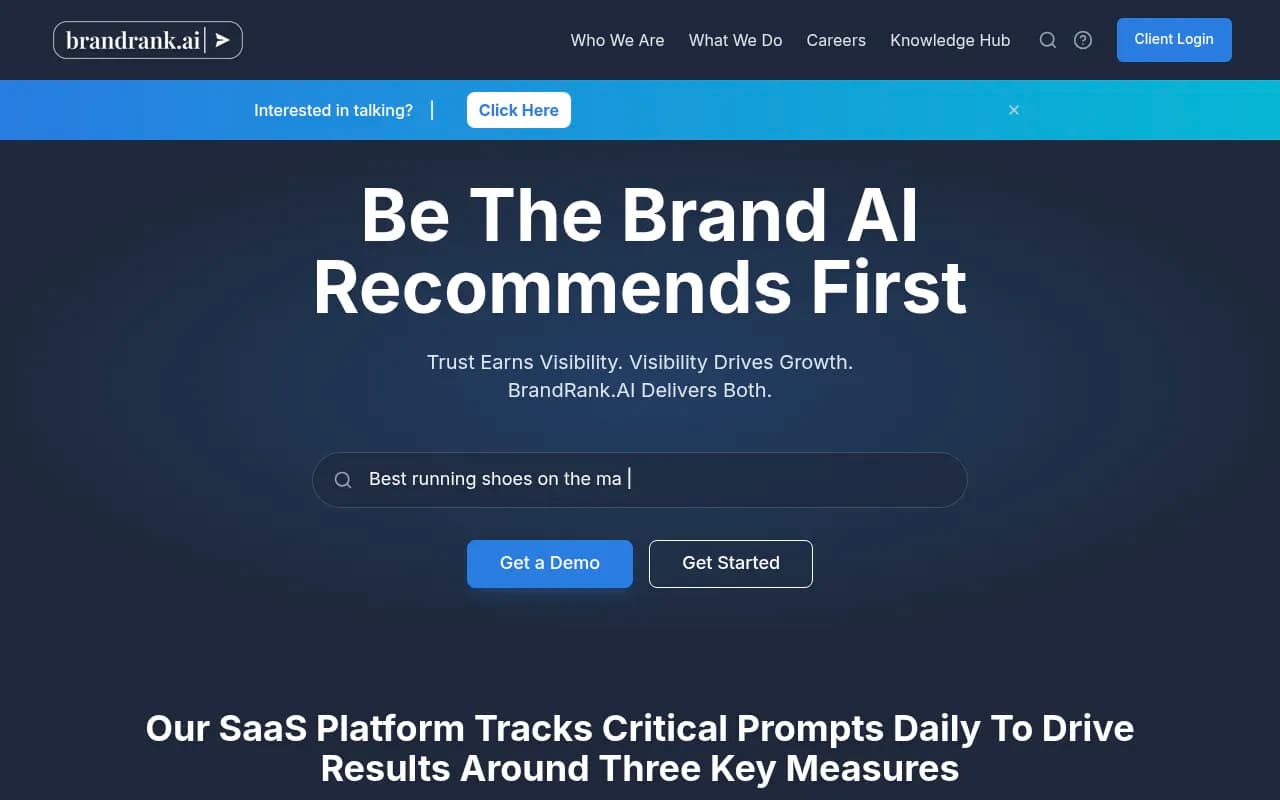
BrandRank.AI positions itself around what it calls the "Answer Economy" -- the idea that AI models are now the primary recommendation layer between brands and consumers. The platform tracks how brands appear in ChatGPT, Perplexity, Claude, Gemini, and other answer engines, with a particular emphasis on three dimensions: AI search visibility (do you show up?), brand vulnerability (what does AI say about you?), and content readiness (is your site structured for AI crawlers?).
The client list -- Nestlé, P&G, Fifth Third Bank, Bitdefender -- signals where this product sits. It's built for large organizations with dedicated brand and marketing teams, not solo operators or small agencies. Pricing is enterprise-only, meaning you won't find a self-serve tier or a published number on the website.
Bear AI
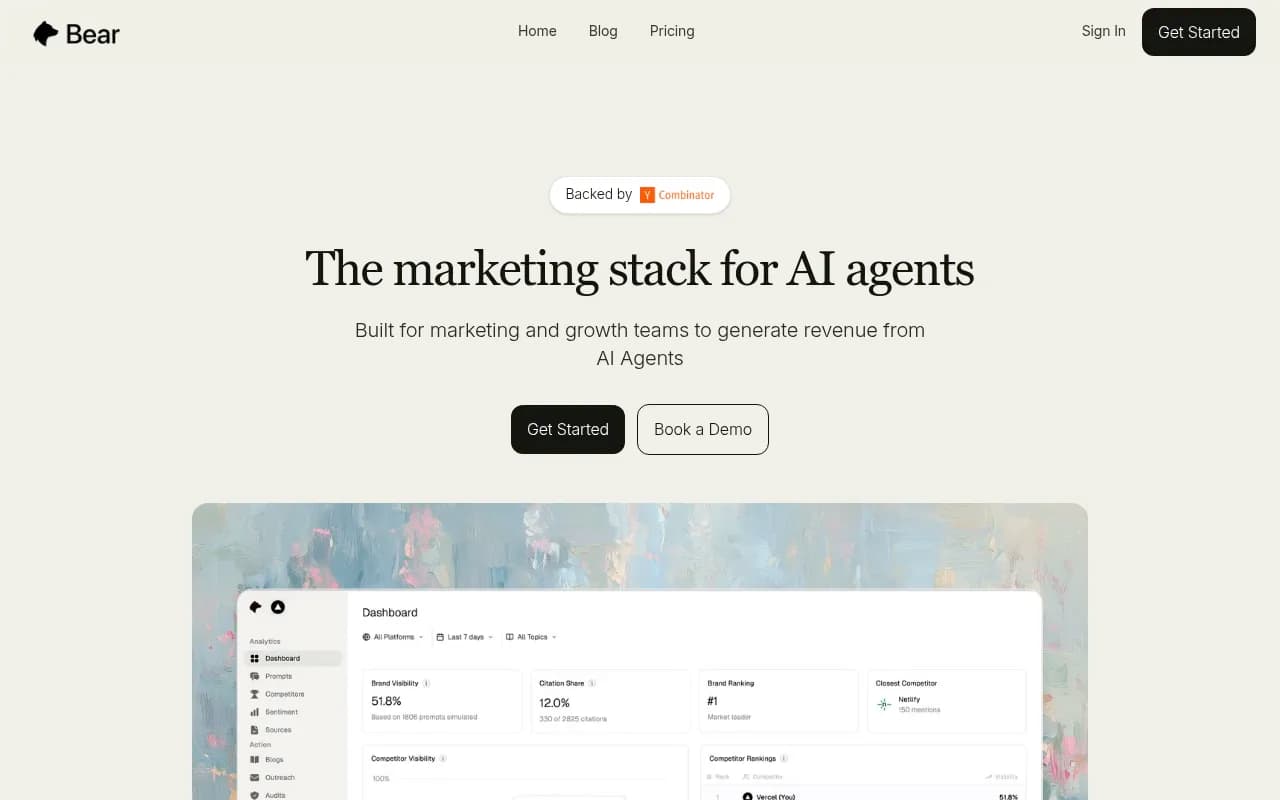
Bear AI describes itself as "the marketing stack for AI agents" and is backed by Y Combinator, which explains its growth-team DNA. The pitch is more revenue-oriented than BrandRank.AI's: track AI visibility, yes, but also convert that visibility into leads by identifying high-intent visitors arriving from AI sources and automating PR outreach to build citations.
The Basic plan at $100/month makes it accessible to smaller teams, though the catch is that it only covers GPT-5 at that tier. The customer list skews toward growth-stage companies (Peerspace, Wispr Flow, Groww) rather than Fortune 500 brands.
Side-by-side comparison
| Feature | BrandRank.AI | Bear AI |
|---|---|---|
| Starting price | Custom (contact sales) | $100/month |
| Free tier | No | No |
| Self-serve signup | No | Yes |
| AI models monitored | ChatGPT, Claude, Gemini, Perplexity + others | GPT-5 (Basic); all models (Enterprise) |
| Daily prompt tracking | Yes | Yes |
| Brand sentiment/vulnerability | Yes (dedicated module) | Basic sentiment |
| Content readiness audit | Yes (schema, bot accessibility) | No |
| AI content generation | No | Yes (2 blogs/mo on Basic) |
| PR outreach automation | No | Yes |
| AI traffic visitor ID | No | Yes |
| Competitor analysis | Yes | Yes |
| Pricing transparency | No (enterprise only) | Partial (Basic published, Enterprise custom) |
| Target audience | Enterprise brand teams | Growth/marketing teams |
| Notable clients | Nestlé, P&G, Fifth Third Bank | Peerspace, Wispr Flow, Groww |
| Y Combinator backed | No | Yes |
Head-to-head feature deep-dive
AI model coverage
BrandRank.AI monitors multiple AI engines across all plans -- ChatGPT, Claude, Gemini, Perplexity, and others are tracked from day one. That breadth matters if you're a large brand that needs to know how you appear everywhere, not just in one model.
Bear AI's Basic plan is GPT-5 only. That's a real limitation if you care about how Claude or Perplexity describe your brand -- and you should, since Perplexity in particular has become a significant research tool. To get full coverage, you need to move to Enterprise, which means a custom conversation and a price that's no longer $100/month.
Verdict: BrandRank.AI wins on coverage at entry level. Bear AI's Basic plan is too narrow for serious multi-model monitoring.
Brand vulnerability and sentiment analysis
This is where BrandRank.AI genuinely differentiates. The platform has a dedicated "Brand Vulnerability" module that tracks credibility and trust signals, product performance mentions, and accuracy/sentiment of AI-generated responses about your brand. The idea is that AI models can say inaccurate or damaging things about your brand, and you need to know when that happens.
Bear AI tracks sentiment too, but it's more surface-level -- you see how AI talks about you, but there's no dedicated vulnerability scoring or trust gap analysis. For a brand like Nestlé, knowing that an AI model is misrepresenting a product is a serious operational concern. For a growth-stage SaaS company, it's less critical.
Verdict: BrandRank.AI is meaningfully better here. The vulnerability framing is smart and the depth of analysis is more suited to brands where reputation risk is real.
Content optimization and generation
BrandRank.AI's "Content Readiness" module audits your site for content accessibility, schema depth, and what they call "content liquidity" (how bot-friendly your pages are). It tells you what's wrong. What it doesn't do is help you fix it -- there's no built-in content generation.
Bear AI flips this. The content readiness auditing is lighter, but it actually generates AI-optimized blog posts (2/month on Basic, more on Enterprise). For a team that wants to act on insights rather than just receive them, that's a practical advantage.
Neither tool goes as deep as platforms that combine gap analysis with content generation grounded in citation data. If that full optimization loop matters to you, it's worth knowing that Promptwatch covers exactly that -- answer gap analysis, AI-native content generation, and page-level citation tracking in one workflow.

Verdict: Bear AI wins for teams that want to create content. BrandRank.AI wins for teams that want a detailed audit of existing content structure.
Traffic attribution and conversion
Bear AI has a clear edge here. The platform identifies high-intent visitors arriving from AI sources -- meaning you can see which companies or users are landing on your site after an AI recommendation and act on that data for sales or retargeting. Combined with PR outreach automation (which helps you build the citations that drive AI recommendations), Bear AI has a more complete revenue loop than BrandRank.AI.
BrandRank.AI doesn't appear to offer visitor identification or traffic attribution. Its focus is on the AI response layer itself, not what happens after someone clicks through.
Verdict: Bear AI wins clearly. If converting AI visibility into pipeline is the goal, Bear AI's toolset is more directly useful.
PR outreach automation
Bear AI includes automated PR outreach to help teams build the backlinks and citations that influence AI model recommendations. This is a genuinely useful feature -- AI models tend to cite authoritative sources, and getting your brand mentioned in those sources is one of the most reliable ways to improve AI visibility.
BrandRank.AI has no equivalent feature. It monitors and audits, but doesn't help you execute the off-site work.
Verdict: Bear AI wins. This is a meaningful differentiator for teams without a dedicated PR function.
Enterprise fit and support
BrandRank.AI is built for enterprise. Custom pricing, a sales-led motion, and clients like P&G and Nestlé suggest a high-touch onboarding process and dedicated account management. If your organization needs SLAs, custom reporting, or integration with existing brand tracking infrastructure, BrandRank.AI is more likely to accommodate that.
Bear AI is newer and more self-serve. The Y Combinator backing suggests it's growing fast, but the enterprise offering is still maturing. The Enterprise plan is custom, but the overall product feels more oriented toward teams that want to move quickly without a long procurement cycle.
Verdict: BrandRank.AI for large organizations with complex requirements. Bear AI for teams that want to get started fast.
Pricing comparison
| Plan | BrandRank.AI | Bear AI |
|---|---|---|
| Entry-level | Custom (contact sales) | $100/month (GPT-5 only, 30 prompts, 2 blogs/mo) |
| Mid-tier | N/A | N/A |
| Enterprise | Custom | Custom (all features, unlimited prompts) |
| Free trial | Not advertised | Not advertised |
| Self-serve | No | Yes (Basic) |
The pricing gap here is significant. Bear AI gives you a real number to work with -- $100/month gets you in the door, even if the coverage is limited. BrandRank.AI's contact-for-quote model is standard for enterprise software, but it creates friction for anyone who wants to evaluate the tool without a sales call.
For context, mid-market GEO platforms typically run $249-$579/month for meaningful prompt coverage and multi-model monitoring. BrandRank.AI's enterprise positioning likely puts it above that range.
Pros and cons
BrandRank.AI
Pros:
- Deep brand vulnerability and trust analysis -- genuinely useful for reputation-sensitive brands
- Content readiness auditing with schema and bot-accessibility checks
- Multi-model coverage from the start (no tier restrictions)
- Proven with large enterprise clients (Nestlé, P&G, Fifth Third Bank)
- Daily prompt tracking with competitive positioning data
Cons:
- No published pricing -- requires a sales conversation to evaluate
- No content generation -- tells you what's wrong but doesn't help you fix it
- No traffic attribution or visitor identification
- No PR outreach or off-site optimization tools
- Likely expensive for mid-market teams
Bear AI
Pros:
- Transparent entry price ($100/month) with self-serve signup
- PR outreach automation to build AI citations
- AI traffic visitor identification for revenue conversion
- Built-in content generation (AI-optimized blog posts)
- Y Combinator backed -- active development and growth trajectory
Cons:
- Basic plan is GPT-5 only -- multi-model coverage requires Enterprise
- Brand vulnerability analysis is shallow compared to BrandRank.AI
- No content readiness auditing (schema, bot accessibility)
- Enterprise pricing is opaque, same as competitors
- Newer platform -- less proven at enterprise scale
Who should pick which tool
Pick BrandRank.AI if:
- You're at a large enterprise with a dedicated brand or marketing team
- Brand reputation and AI sentiment accuracy are operational concerns (not just nice-to-haves)
- You need detailed content readiness auditing for a large, complex website
- You want multi-model monitoring without tier restrictions
- You're comfortable with a sales-led procurement process
Pick Bear AI if:
- You're a growth-stage company or lean marketing team
- Converting AI visibility into leads and pipeline is the primary goal
- You want to automate PR outreach to build AI citations
- You need a self-serve option with a published price to get started quickly
- Content generation is part of your workflow
Neither tool is the right fit if:
- You need deep prompt intelligence (volume estimates, difficulty scoring, query fan-outs)
- You want AI crawler logs to see which pages AI bots are actually reading
- You need Reddit and YouTube citation tracking
- You want a full optimization loop: gap analysis, content generation, and traffic attribution in one platform
Final verdict
BrandRank.AI and Bear AI are solving adjacent problems for different audiences. BrandRank.AI is a mature enterprise monitoring platform with real depth in brand vulnerability analysis -- if you're a large brand that needs to know exactly what AI says about you and why, it's a credible choice. Bear AI is a scrappier, more action-oriented tool that's better at turning AI visibility into revenue, with PR automation and traffic conversion features that BrandRank.AI simply doesn't have.
The honest summary: BrandRank.AI is better at telling you what's happening. Bear AI is better at helping you do something about it -- at least on the outreach and conversion side. Neither covers the full picture of modern GEO, but for their respective audiences, each does its core job reasonably well.