Key takeaways
- Conductor's persona system lets you simulate how different audience segments search, generating long-tail prompts tailored to each profile -- a genuinely useful differentiator for enterprise teams.
- The platform covers AI visibility tracking across ChatGPT, Google AI Overviews, and other major models, with content gap discovery and competitive analysis built in.
- Conductor is a strong fit for enterprises already invested in traditional SEO who want AI visibility layered on top -- but it's priced and scoped accordingly.
- For teams whose primary focus is GEO and AI search optimization (rather than SEO broadly), more specialized platforms may offer deeper AI-specific workflows at a lower cost.
- Conductor holds a 4.5/5 on G2 across 772 reviews and was named a Forrester Wave Leader in 2025 for AI-integrated SEO.
What Conductor actually is in 2026
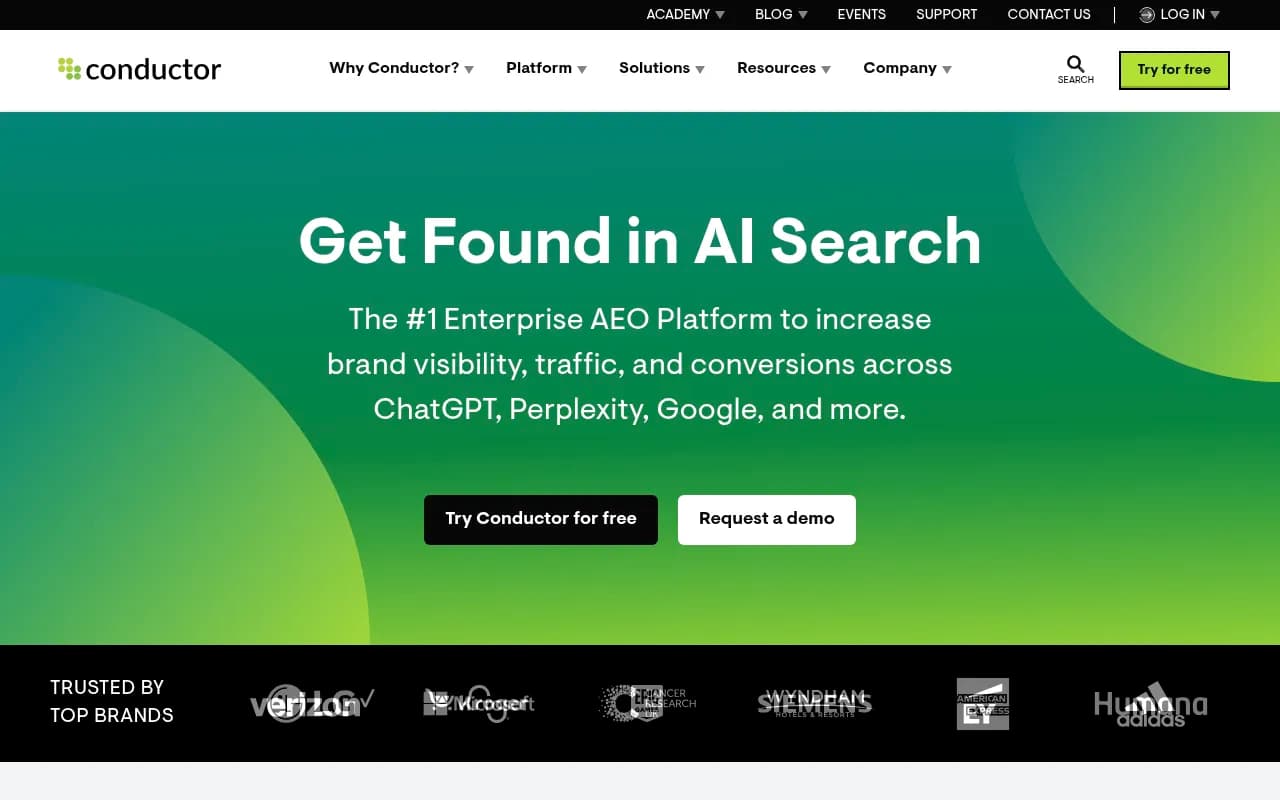
Conductor has been an enterprise SEO platform for years. Its customer list -- Citi, Airbnb, e.l.f. Cosmetics, FedEx -- tells you the market it's built for. In 2025 and into 2026, the company made a significant bet on AI search, rebuilding its "AI Search Performance" module from the ground up and positioning itself as an end-to-end AEO (Answer Engine Optimization) platform.
The pitch, as CEO Seth Besmertnik framed it in a March 2026 webinar, is that most tools only answer one question: "Are we being mentioned?" Conductor wants to answer a harder one: "Where and why does our brand win or lose in AI answers -- and how do we build share?"
That's a compelling framing. Whether the product lives up to it is what this review is actually about.
The persona system: what it does and why it matters
The most interesting thing Conductor does differently is its persona-based tracking. Here's the idea: instead of tracking generic keywords, you build profiles of your actual audience segments. A "technical researcher" persona generates different prompts than a "shopper ready to buy" persona -- and your AI visibility scores are calculated separately for each.
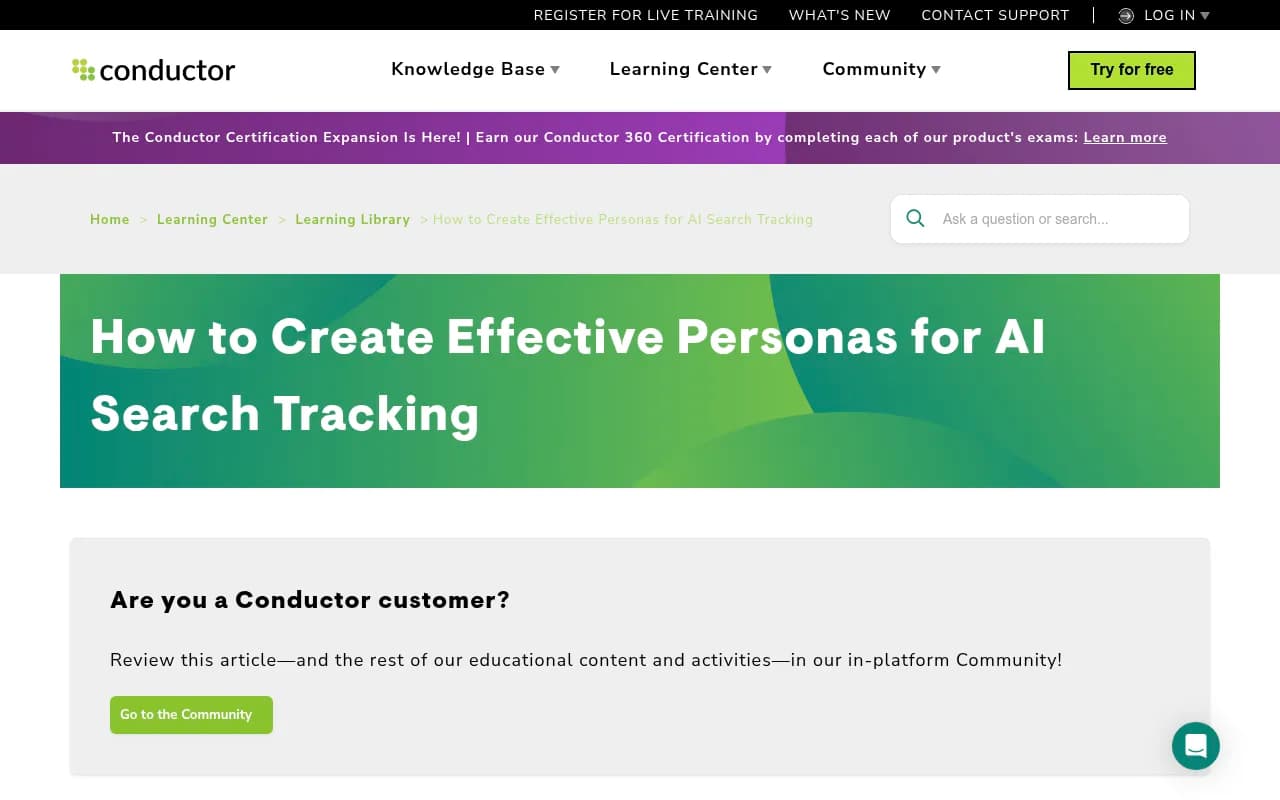
According to Conductor's own documentation, a persona is a "detailed profile of a key audience segment" used to generate relevant, long-tail search prompts that mimic how real people ask questions. The system uses these profiles to:
- Track brand mentions and citations in responses to queries from each persona type
- Surface content gaps specific to each audience segment
- Help teams prioritize content creation by persona rather than by generic keyword volume
This is genuinely useful. A B2B software company might have a "security-focused IT buyer" persona and a "cost-conscious CFO" persona. Those two people ask very different questions in ChatGPT or Perplexity, and your visibility for one group may be completely different from the other. Tracking them together obscures the real picture.
The practical limit here is that persona quality depends on how well you define them upfront. Conductor's documentation is clear that "a strong persona is built on a deep understanding of your audience" -- which is true, but it also means the system is only as good as the inputs you give it. Teams without well-developed audience research will get generic results.
AI Search Performance: what the rebuilt module covers
In late March 2026, Conductor shipped a fully redesigned AI Search Performance experience. Based on the product demo from CPO Wei Zheng and the platform's documentation, here's what the module actually tracks and surfaces:
- Brand mentions and citations across AI platforms including ChatGPT and Google AI Overviews
- Which specific pages on your site are driving AI citations and authority
- Competitive visibility comparison across topics -- who's winning and why
- Content gaps across personas and search intent
- Visibility comparison across different AI platforms
The "move from insight to action with guided discovery workflows" language in Conductor's own marketing is worth scrutinizing. The platform does surface content gaps and tell you what's missing. Whether it then helps you create that content is a separate question -- and one where the answer is more nuanced.
What Conductor does well
Enterprise-grade SEO and AI in one place
If your team is already using Conductor for traditional SEO, adding AI visibility tracking in the same platform is a real advantage. You're not managing two separate tools, two separate data sets, or two separate reporting workflows. The unified platform connects technical site health (via ContentKing integration), content performance, and AI visibility in one view.
For large marketing teams with multiple stakeholders, that consolidation matters. A single source of truth across SEO, content, and AI search is genuinely valuable at scale.
Competitive intelligence across topics
The competitive heatmap functionality -- seeing how your brand stacks up against competitors across specific topics and AI platforms -- is well-executed. You can identify where a competitor is consistently winning in AI answers and trace it back to specific content or authority signals. That's actionable intelligence, not just a vanity metric.
Forrester recognition and enterprise credibility
Conductor was named a Leader in the 2025 Forrester Wave for AI-integrated SEO, with the highest scores possible in that category. For enterprise procurement teams that rely on analyst validation, this carries real weight. It's not just marketing -- it reflects a platform that has been evaluated against structured criteria.
G2 reputation
772 reviews at 4.5/5, with 75% being five-star ratings, is a strong signal. The review volume means you're not looking at a skewed sample. Common praise in reviews centers on the platform's data depth, customer success support, and the quality of competitive insights.
Where Conductor has real limits
It's built for enterprises, and the price reflects that
Conductor doesn't publish pricing publicly, which is itself a signal. Based on market positioning and customer profiles, this is an enterprise contract, not a self-serve SaaS subscription. Teams with smaller budgets or a single site to track will find the cost hard to justify.
AI tracking is newer than the SEO core
Conductor has been doing traditional SEO for years. The AI Search Performance module is genuinely new -- rebuilt from the ground up in early 2026. That means the feature set is still maturing. The March 2026 webinar had 165 views and 2 likes, which suggests the AI-specific audience is still being built. The product is real, but it's not yet the battle-tested AI visibility platform that some competitors with a GEO-first focus have become.
Limited AI model coverage compared to specialists
Conductor's AI tracking focuses primarily on ChatGPT and Google AI Overviews. Platforms built specifically for GEO often cover a wider range of models -- Perplexity, Claude, Gemini, Grok, DeepSeek, Meta AI, Copilot, Mistral. If you need comprehensive coverage across the full AI search landscape, Conductor's current scope may leave gaps.
Content generation is not the core product
Conductor can surface content gaps and tell you what to create. But the actual content generation workflow is not the platform's primary strength. Teams that need to move quickly from "we're missing visibility here" to "we've published content that fixes it" may find the workflow slower than platforms built around that specific loop.
How it compares to dedicated GEO platforms
This is where the honest answer gets complicated. Conductor is an excellent enterprise SEO platform with a solid and improving AI visibility layer. But it's not the same thing as a platform built from day one around AI search optimization.
| Feature | Conductor | Dedicated GEO platforms |
|---|---|---|
| Traditional SEO | Comprehensive | Limited or none |
| AI model coverage | Primarily ChatGPT + Google AI Overviews | 8-11 models typically |
| Persona-based tracking | Yes, well-developed | Varies by platform |
| Content gap analysis | Yes | Yes (varies) |
| AI content generation | Limited | Often built-in |
| Crawler log analysis | Via ContentKing integration | Some platforms native |
| Pricing model | Enterprise contracts | Often self-serve tiers |
| Best for | Enterprise SEO teams adding AI | Teams focused primarily on GEO |
For teams whose primary question is "how do we get cited by ChatGPT, Perplexity, and Claude -- and how do we fix it fast?" there are platforms built specifically around that workflow. Promptwatch is one example -- it covers 10 AI models, includes built-in content generation grounded in citation data, and is designed around the full loop of finding gaps, creating content, and tracking results.

That said, if your team is already running enterprise SEO through Conductor and wants to add AI visibility without switching platforms, the case for staying is strong.
Who Conductor is actually right for
Conductor makes the most sense for:
- Enterprise marketing and SEO teams already on the platform who want AI visibility added to their existing workflow
- Organizations that need a single platform covering technical SEO, content, and AI search for multiple stakeholders
- Brands where Forrester/analyst validation matters for procurement decisions
- Teams with the budget for an enterprise contract and the resources to build out detailed personas
It's probably not the right fit for:
- Smaller teams or agencies looking for self-serve AI visibility tracking
- Teams whose primary focus is GEO rather than traditional SEO
- Brands that need broad AI model coverage beyond ChatGPT and Google AI Overviews
- Teams that want to move quickly from gap identification to content creation and publishing
The persona system verdict: genuinely deep, with caveats
To answer the question in the title directly: Conductor's persona-based tracking goes deeper than most tools in one specific way -- it generates prompts based on audience profiles rather than generic keywords, which produces more realistic and actionable visibility data. That's a real differentiator.
But "deep" has limits. The system depends on good persona inputs. The AI model coverage is narrower than specialists. And the "action" side of the workflow -- actually fixing the gaps the system surfaces -- is less developed than the insight side.
For enterprise teams that want to understand AI visibility through the lens of their actual audience segments, Conductor's approach is worth serious consideration. For teams that need the full optimization loop -- find gaps, generate content, track results -- the platform is still catching up to where the GEO-native tools have been for a while.
The honest summary: Conductor is a serious platform making a serious bet on AI search. The persona system is its most distinctive feature and it works. The question is whether the rest of the AI visibility stack is mature enough yet to justify the enterprise price tag on its own -- or whether it's best understood as a valuable addition to an existing Conductor investment rather than a standalone GEO solution.
Other tools worth considering
If you're evaluating AI visibility platforms more broadly, here are a few others in the space:
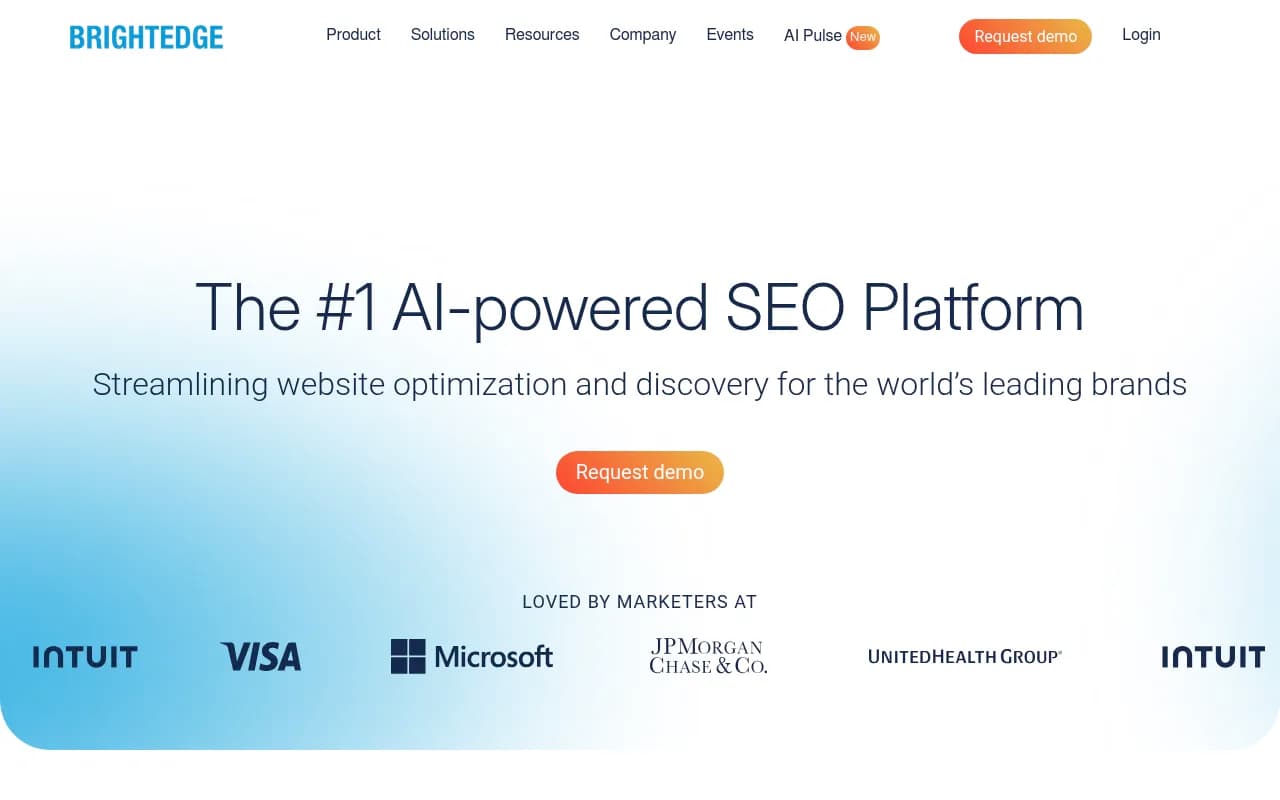
BrightEdge is another enterprise SEO platform with AI search tracking -- a direct Conductor competitor at the high end of the market.

Profound focuses specifically on AI search visibility and brand tracking across answer engines, with strong competitive intelligence features.

AthenaHQ is a monitoring-focused platform covering 8+ AI search engines, built for teams that want dedicated AI visibility tracking without the full SEO suite.
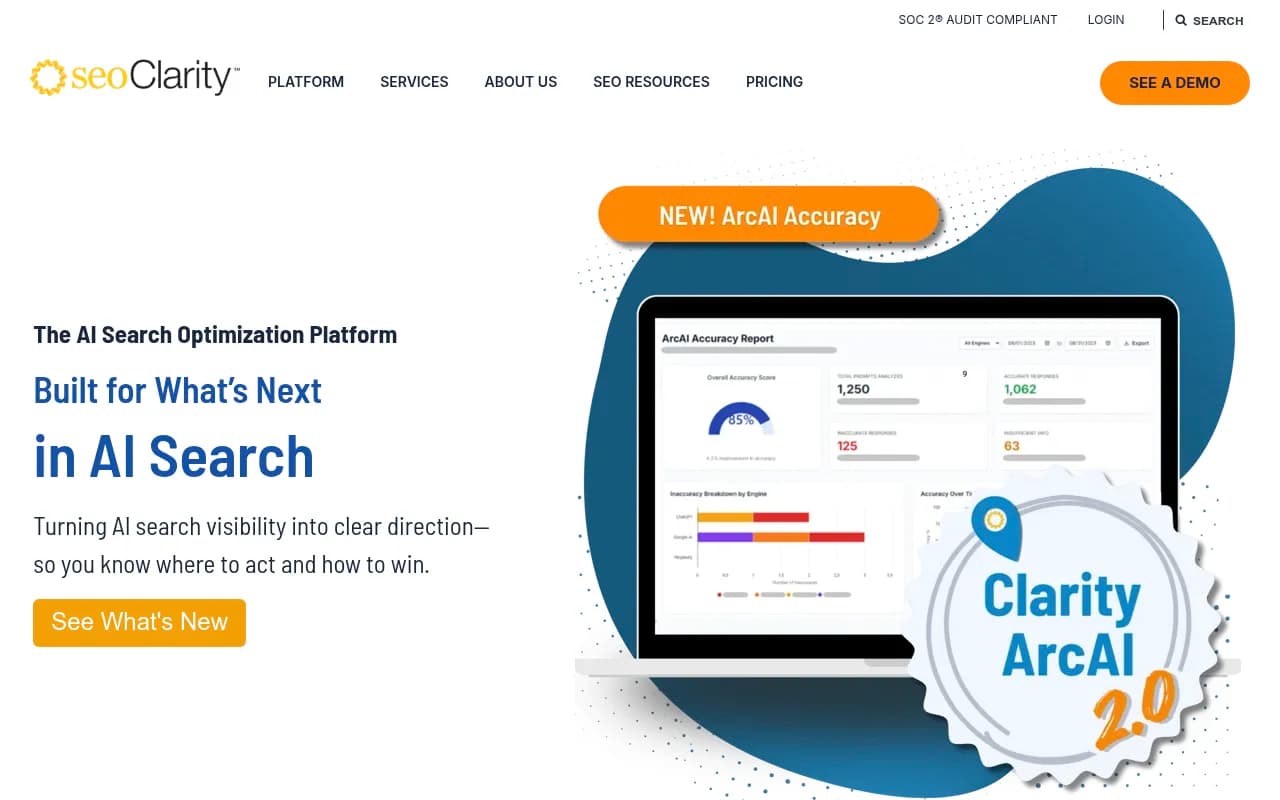
seoClarity is an enterprise SEO platform with an AI visibility layer, similar positioning to Conductor but with different feature trade-offs worth comparing directly.