Key takeaways
- Evertune is a genuine enterprise GEO platform, not a repackaged monitoring dashboard -- its dual-layer measurement (foundational model knowledge + consumer app responses) is technically differentiated.
- Pricing starts at $3,000+/month with no public pricing page, no free trial, and no self-serve option. Every engagement requires a sales call.
- It's purpose-built for Fortune 500 brands in automotive, healthcare, finance, retail, and B2B software -- teams with dedicated brand intelligence budgets.
- If you're not in that bracket, there are capable alternatives at a fraction of the cost that cover most of the same ground.
- The platform processes over 1 million prompts per brand per month, backed by $19M in Series A funding from Felicis Ventures.
What Evertune actually is
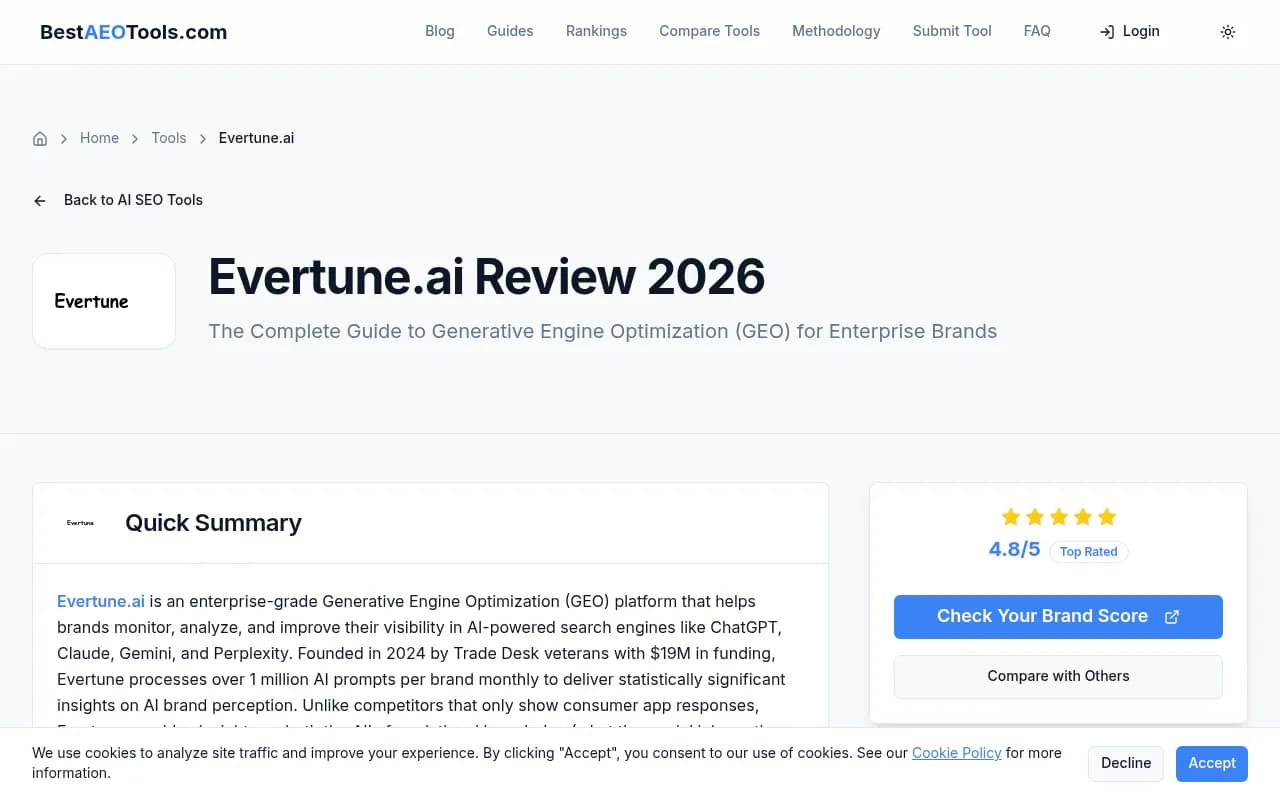
Evertune launched in 2024, founded by Trade Desk veterans who saw the same shift everyone in digital marketing was starting to feel: consumers were increasingly asking AI assistants for product recommendations instead of typing queries into Google. The question of "how does ChatGPT describe my brand?" was becoming a real business problem for large companies, not just a curiosity.
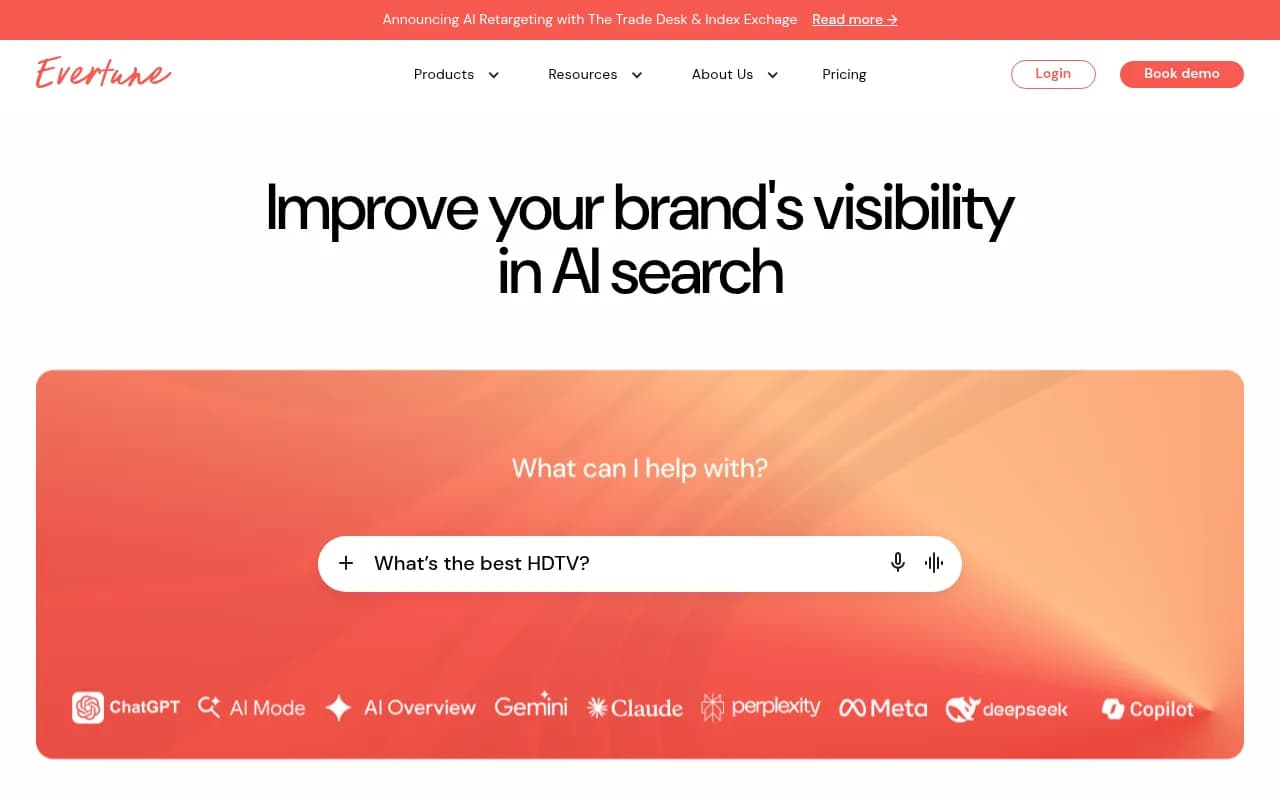
The platform is built around one core insight that separates it from most competitors: there are two distinct layers of AI knowledge, and they behave differently.
The first is foundational knowledge -- what a base language model like GPT-4 or Claude inherently knows about your brand from its training data. This is what AI agents use when they make purchasing decisions or recommendations without searching the web. The second is consumer app responses -- what users actually see when they ask ChatGPT or Perplexity a question, which blends that foundational knowledge with real-time web retrieval.
Most GEO platforms only measure the second layer. Evertune measures both.
That distinction matters more than it might seem. As AI agents become more capable of completing purchases, booking services, and making recommendations autonomously, the foundational layer is where the real decisions get made. If a base model has outdated or incomplete knowledge about your brand, no amount of consumer-facing optimization will fix what an AI agent recommends when it's operating without web access.
Core features
Dual-layer AI measurement
Evertune's API access to foundation models (ChatGPT, Claude, Gemini, Meta/Llama, DeepSeek) is the technical centerpiece of the platform. Most competitors scrape consumer-facing interfaces -- they see what a user sees when they open ChatGPT. Evertune queries the base models directly via API, which gives you a cleaner signal about what the model actually knows versus what it retrieves.
This lets you answer questions like: Is my poor AI visibility a training data problem or a retrieval problem? Those have very different solutions. A training data gap requires building authoritative content over time. A retrieval gap means your existing content isn't being indexed or cited properly by AI search systems.
AI Brand Index
Evertune's proprietary scoring metric aggregates brand perception across AI models into a single index. The upside is that it gives executives a single number to track over time. The downside is that it's a proprietary metric -- you can't benchmark it against industry-standard approaches or compare it across platforms. That's a real consideration if you ever want to switch vendors or triangulate with other data sources.
Competitor tracking
Evertune automatically tracks all competitors, not just the ones you manually configure. For large enterprises with complex competitive landscapes, this matters -- you're not going to miss a new entrant because you forgot to add them to a list.
Shopping Intelligence
The platform includes tracking for AI-powered shopping recommendations, which is increasingly important as OpenAI and Google build commerce features into their AI products. If your brand sells physical products, knowing when and how you appear in AI shopping carousels is commercially relevant.
Topic Relevance and Brand Relevance
These are Evertune's actionable insight layers. Topic Relevance shows which subject areas your brand is associated with in AI responses. Brand Relevance measures how prominently your brand features relative to competitors in those topics. Together, they're meant to tell you not just where you appear but how you appear.
Partner Connect
This feature is less publicly documented but appears to be a network-level integration that helps brands influence the sources AI models cite. The specifics are kept behind the sales process.
Pricing: the honest picture
Evertune starts at $3,000/month. There is no public pricing page. There is no free trial. There is no self-serve signup.
To get a quote, you go through a demo call, a discovery process, and a contract negotiation. For many teams, this is the first and last thing they need to know about Evertune -- the sales cycle alone is a dealbreaker.
For Fortune 500 marketing teams with dedicated brand intelligence budgets, this is normal. Enterprise software contracts routinely run $30,000-$100,000+ annually, and the procurement process is expected. But for a mid-market brand, a digital agency, or a marketing team that wants to start monitoring AI visibility this week, Evertune is simply not designed for you.
The $3,000/month floor also doesn't tell you much about what you'd actually pay. Custom pricing means the final number depends on how many brands you're tracking, how many AI models, how many prompts, and what integrations you need.
Who it's built for
The research is consistent here: Evertune is purpose-built for Fortune 500 brands in specific verticals.
- Automotive brands tracking how AI recommends vehicles
- Healthcare and pharma companies monitoring AI health recommendations
- Financial services firms watching how AI describes their products
- Large B2B software companies tracking category ownership in AI responses
- Retail and consumer goods brands with AI shopping exposure
If you're in one of these categories, have a brand intelligence or market research budget, and are already spending on tools like Brandwatch, Sprinklr, or enterprise SEO platforms, Evertune fits into that ecosystem naturally.
If you're a 50-person SaaS company, a regional retailer, or a digital agency managing 20 client accounts, the math doesn't work.
How it compares to the broader GEO market
The GEO platform market in 2026 has split into two distinct tiers: enterprise platforms with custom pricing and self-serve platforms with transparent monthly plans.
| Platform | Starting price | Free trial | Self-serve | AI models tracked | Key differentiator |
|---|---|---|---|---|---|
| Evertune | $3,000+/mo | No | No | 7 (API + consumer) | Dual-layer measurement, Fortune 500 focus |
| Promptwatch | $99/mo | Yes | Yes | 10+ | Action loop: gap analysis + content generation + tracking |
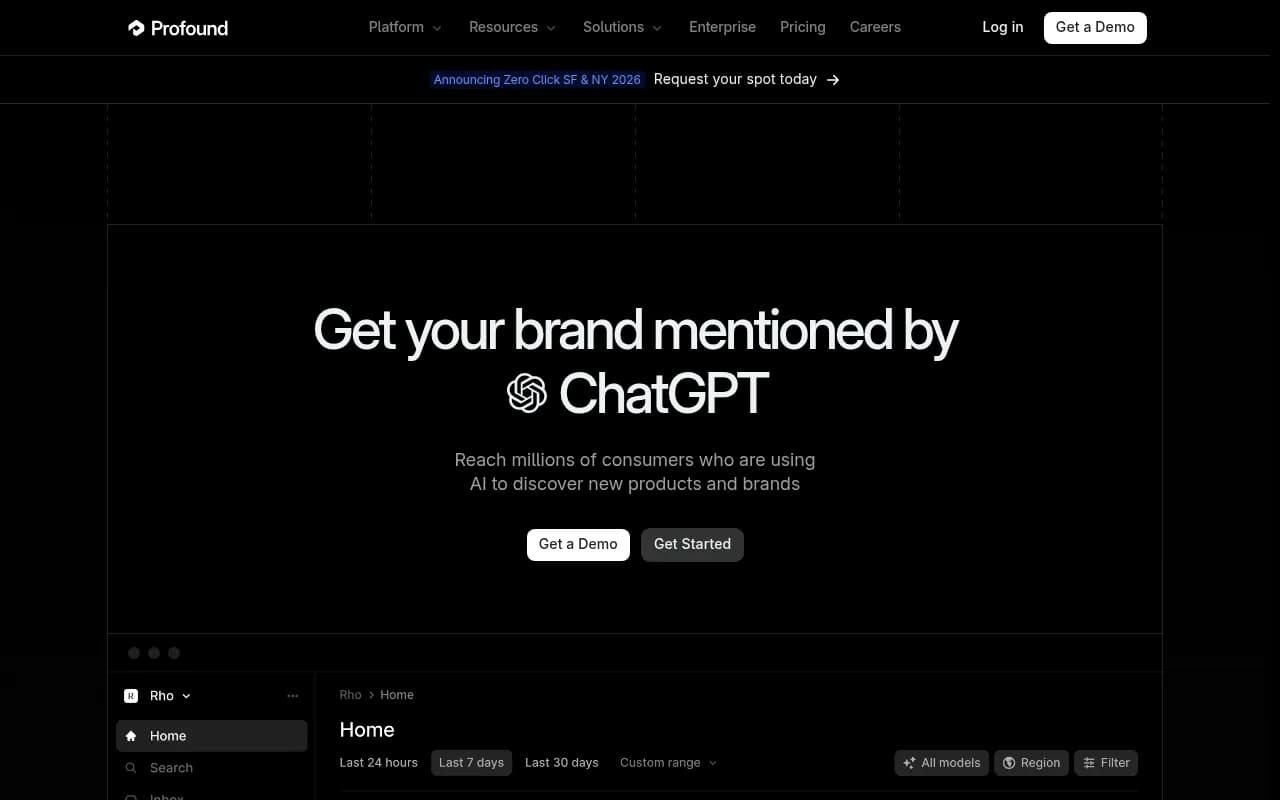
| Profound | $99/mo | Yes | Yes | 6+ | Healthcare/compliance focus |
| Scrunch AI | $300/mo | Demo only | Limited | 6+ | Agent experience platform |
| AthenaHQ | Custom | Demo | No | 8+ | Prompt volume analytics |
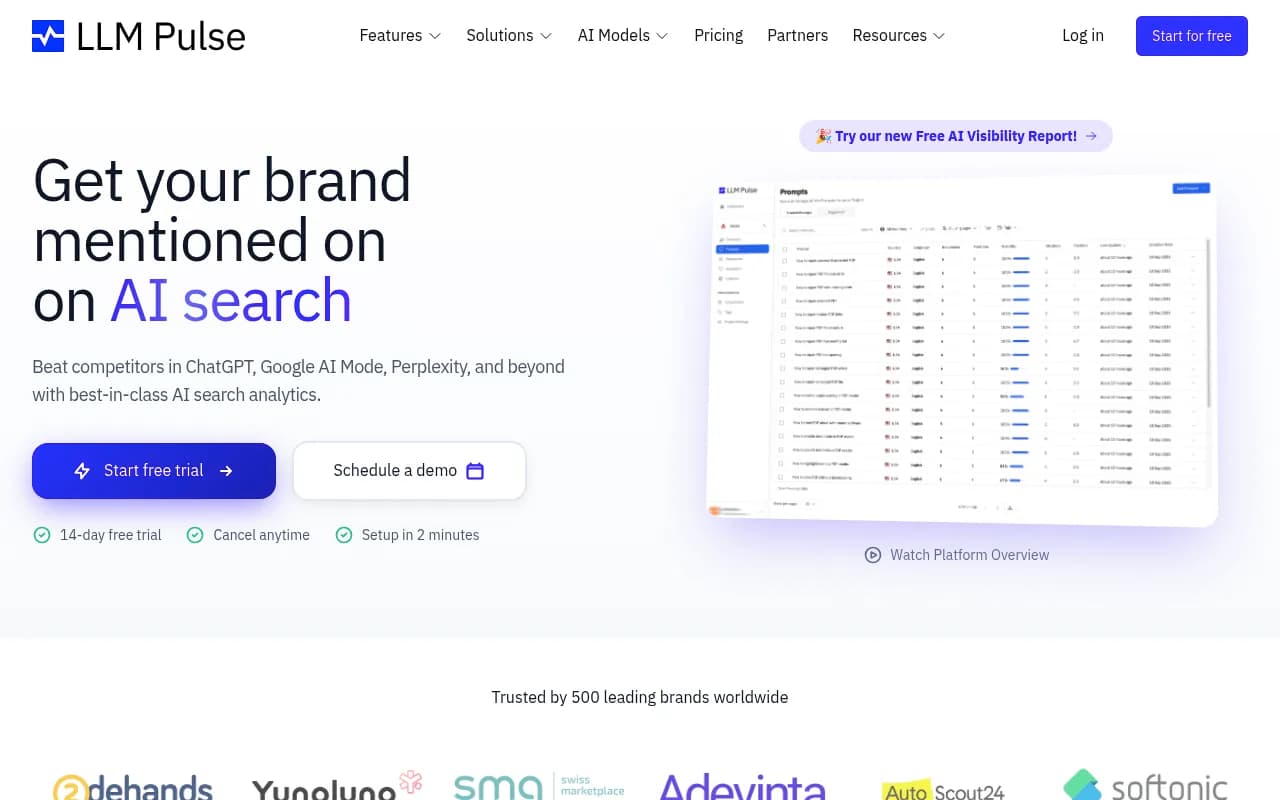
| LLM Pulse | €49/mo | 14 days | Yes | 5 (10+ enterprise) | White label, API, query fan-out |
| Peec AI | Custom | Demo | No | Multiple | Multilingual coverage |
The most important distinction in this table isn't price -- it's what the platform does with the data it collects.
Evertune, like most enterprise GEO platforms, is primarily a measurement and intelligence tool. It tells you what's happening with your AI visibility in considerable depth. What it doesn't do is help you fix it directly within the platform.
Promptwatch takes a different approach: it's built around an action loop where you find gaps, generate content to fill them, and track the results. The built-in AI writing agent creates articles grounded in real citation data, and crawler logs show you exactly how AI bots are interacting with your site. For teams that need to move from insight to execution, that matters.

That said, Evertune and Promptwatch aren't really competing for the same customers. Evertune is selling to a VP of Brand at a Fortune 500 company who needs a board-ready AI Brand Index and competitive intelligence across seven models. Promptwatch is selling to a marketing team or agency that needs to improve AI visibility and can't wait six weeks for a contract.
What the market says
Third-party reviews rate Evertune at 4.8/5 for enterprise use cases. The consistent praise is for the depth of measurement, the dual-layer approach, and the quality of competitive intelligence. The consistent criticism is the price, the lack of transparency, and the long onboarding process.
One pattern worth noting: teams that evaluate Evertune and don't buy it often cite not that the product is bad, but that they couldn't justify the cost relative to what they actually needed. The platform is designed for teams that run brand tracking as a core business function, not as a quarterly check-in.
The funding and company context
Evertune raised a $19M Series A led by Felicis Ventures. That's a meaningful signal -- Felicis has backed companies like Notion, Canva, and Figma, and they don't typically invest in commodity monitoring tools. The bet is that foundational AI knowledge measurement becomes a standard line item in enterprise brand budgets, the same way brand tracking surveys and media monitoring did in previous decades.
Whether that bet pays off depends on how quickly AI agents become a real commerce channel. If the agentic commerce thesis plays out -- where AI assistants autonomously complete purchases and bookings -- then Evertune's base model measurement becomes genuinely critical infrastructure for large brands. If AI search stays primarily a consumer-facing search augmentation, the dual-layer advantage matters less.
Practical evaluation questions
If you're seriously considering Evertune, here are the questions worth asking during the sales process:
What does the onboarding timeline look like? Custom enterprise contracts can take 4-8 weeks from first call to live monitoring. If you have an urgent need, ask specifically about fast-track options.
How is the AI Brand Index calculated? Proprietary metrics are useful for internal tracking but can create problems if you need to benchmark against external standards or switch vendors. Get the methodology in writing.
What does "actionable insights" mean in practice? Evertune's Topic Relevance and Brand Relevance features surface recommendations, but the actual content creation and optimization work happens outside the platform. Understand what your team will need to do with the data.
How does Partner Connect work? This feature is marketed as a way to influence AI citations, but the mechanics aren't publicly documented. Ask for specifics.
What's the contract structure? Annual contracts are standard at this price point. Ask about minimum terms, renewal conditions, and what happens to your data if you leave.
Alternatives worth considering
If Evertune's price point or sales process is a barrier, here are the platforms most worth evaluating depending on your situation.
For teams that need to act on insights, not just collect them, Promptwatch covers AI visibility monitoring across 10+ models, includes content gap analysis, a built-in AI writing agent, and crawler logs -- all starting at $99/month with a free trial.
For agencies managing multiple clients, LLM Pulse offers white-label reporting and API access from €49/month, with a 14-day free trial and no sales cycle.
For healthcare and compliance-heavy industries, Profound has built specific features for regulated industries and starts at $99/month.
For teams that specifically need multilingual AI visibility, Peec AI covers multiple languages and regions with customizable personas.

For enterprise teams that want Evertune-level depth but with more transparency, AthenaHQ and Scrunch AI both offer demo-based enterprise pricing with stronger documentation.

The bottom line
Evertune is a technically serious platform doing something genuinely differentiated: measuring what AI models fundamentally know about your brand at the base model level, not just what users see in consumer apps. For Fortune 500 brands where AI agent commerce is a real near-term concern, that measurement is worth having.
But $3,000+/month with no self-serve option and no free trial means most teams will never get to evaluate it properly. The sales process filters out everyone except large enterprises with dedicated brand intelligence budgets -- which is probably exactly what Evertune intends.
If you're in that bracket and in a vertical where AI recommendations carry commercial weight (automotive, healthcare, finance, retail), Evertune deserves a serious look. If you're not, there are capable platforms at a fraction of the cost that will get you 80% of the value without the enterprise contract.
The GEO market is moving fast enough that waiting six weeks for a contract to close is a real cost. Whatever platform you choose, starting to monitor and optimize your AI visibility now matters more than finding the perfect tool.