Key takeaways
- SE Ranking's AI Search Toolkit is a solid add-on for teams already using the platform for traditional SEO -- it covers Google AI Overviews, ChatGPT, Gemini, and Perplexity tracking in one place
- The toolkit is primarily a monitoring and reporting tool; it doesn't include built-in content gap analysis, AI content generation, or crawler log access
- Users consistently describe it as "the most well-rounded AI SEO checking tool" at its price point, which is fair -- though that bar is lower than it sounds
- Best fit: SMBs and agencies that want AI visibility data alongside their existing rank tracking, without paying for a separate specialist platform
- If you need to act on the data -- not just see it -- you'll likely need to pair it with a dedicated GEO optimization platform
SE Ranking has been around long enough to earn real trust. It's not a flashy startup that pivoted to AI overnight. The platform has a genuine user base, a reputation for accurate rank tracking, and pricing that doesn't require a CFO's sign-off. So when it launched its AI Search Toolkit, people paid attention.
The question worth asking in 2026 isn't "does SE Ranking track AI visibility?" -- it clearly does. The real question is whether tracking is enough, and whether this toolkit actually helps you improve your position in AI-generated answers or just tells you where you stand.
Let's dig in.
What's actually in the AI Search Toolkit
SE Ranking's AI offering isn't a single feature -- it's a suite of three distinct tools that address different parts of the AI search picture.
AI Overviews (AIO) Tracker
This is the most mature piece of the toolkit. It monitors Google's AI-generated snippets that appear at the top of traditional search results. You can track which of your target keywords trigger an AI Overview, whether your domain is cited as a source, and how that changes over time. The historical data with cached SERP copies is genuinely useful -- you can go back and see what Google's AI was saying about a topic three months ago, which helps identify trends rather than just snapshots.
Geographic coverage is solid here. Since Google AI Overviews roll out differently across countries, being able to filter by region matters, and SE Ranking handles this reasonably well.
AI Search Tracker (ChatGPT, Gemini, Perplexity)
This component queries the major conversational AI engines directly and tracks whether your brand appears in responses. You define a set of prompts -- typically questions your target customers might ask -- and the tool monitors how often your brand gets mentioned, what sentiment surrounds those mentions, and which competitors show up when you don't.
The interface is clean. Visibility scores are presented in a way that's easy to report to clients or stakeholders who don't want to dig into raw data. That's a real advantage for agencies.
Competitive benchmarking
SE Ranking layers competitor tracking across both the AIO and conversational AI components. You can see side-by-side how your brand's AI visibility compares to specific competitors for the same set of prompts. This is where the toolkit starts to feel genuinely useful rather than just informational.
What it does well
The integration story is SE Ranking's strongest argument. If you're already using the platform for rank tracking, site audits, backlink analysis, and keyword research, adding AI visibility data to the same dashboard has real value. You're not managing five different logins or trying to reconcile data from separate tools. Everything lives in one place, and the reporting infrastructure you've already built carries over.
The pricing is also genuinely competitive. SE Ranking positions the AI toolkit as an add-on to existing plans, which means you're not paying enterprise-tier prices for monitoring features. For smaller teams and agencies managing multiple clients on tighter budgets, that matters.
User feedback backs this up. The Rankability review notes that the consensus among users is "most well-rounded AI SEO checking tool" -- and that reputation seems earned in the context of what it's trying to do.
The AIO Tracker in particular is one of the more detailed Google AI Overviews monitoring tools available. For brands heavily dependent on Google search traffic, understanding how AI Overviews are affecting their organic visibility is a legitimate priority, and SE Ranking handles this better than most.
Where it falls short
Here's where I'd push back a bit on the "all-in-one" framing.
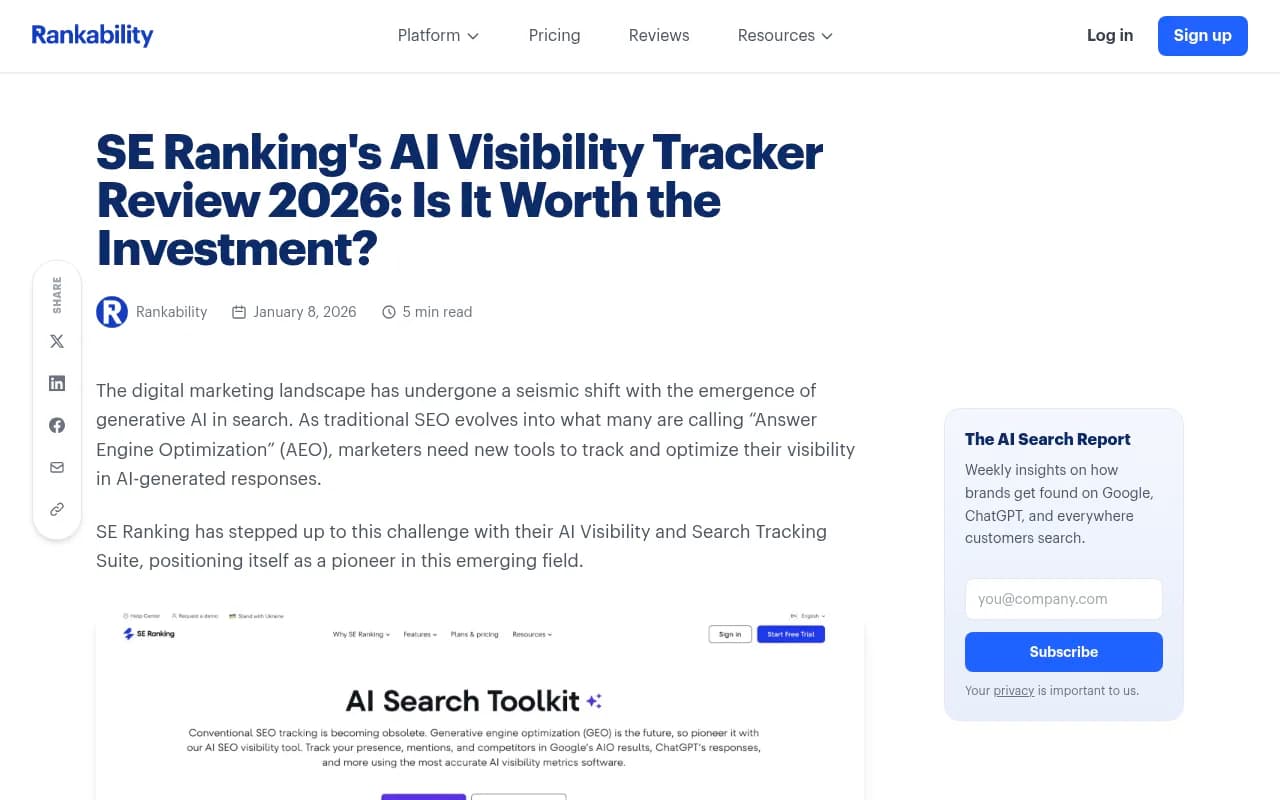
SE Ranking tells you what's happening in AI search. It doesn't tell you why, and it doesn't help you fix it. There's no answer gap analysis that shows you which prompts competitors are winning that you're missing entirely. There's no built-in content generation tool that uses citation data to write articles engineered to get picked up by AI models. There are no crawler logs showing you which AI bots are visiting your site, how often, and which pages they're reading.
For a team that just wants a dashboard to monitor AI visibility and include it in client reports, that's fine. But for a team that's trying to actually improve their AI search presence -- which is presumably the point -- the toolkit stops at the diagnosis stage.
The prompt coverage is also worth scrutinizing. SE Ranking lets you define prompts to track, but there's no prompt intelligence layer that tells you which prompts have high volume, which are winnable, or how a single query fans out into related sub-queries. You're essentially guessing at what to track rather than being guided toward high-value opportunities.
Multi-language and multi-region support for the conversational AI tracking (as opposed to the AIO tracker) is more limited than some specialist platforms. If you're running campaigns across multiple markets, that gap shows.
How it compares to specialist GEO platforms
SE Ranking sits in an interesting middle ground. It's more capable than basic monitoring tools like Otterly.AI or Peec.ai, which are largely single-feature dashboards. But it's less capable than platforms built specifically around the full optimization loop.
Promptwatch, for example, goes beyond tracking to include answer gap analysis, AI content generation grounded in citation data, and crawler log monitoring -- the kind of tooling that lets you close the loop between "I'm not visible here" and "I've published content that fixes that." SE Ranking doesn't have an equivalent workflow.

That said, Promptwatch and similar specialist platforms are priced and positioned differently. They're built for teams where AI visibility is a primary focus, not a feature alongside rank tracking and site audits.
| Feature | SE Ranking AI Toolkit | Promptwatch | Otterly.AI | Profound |
|---|---|---|---|---|
| Google AI Overviews tracking | Yes | Yes | Limited | Yes |
| ChatGPT / Perplexity / Gemini tracking | Yes | Yes | Yes | Yes |
| Answer gap analysis | No | Yes | No | Yes |
| AI content generation | No | Yes | No | No |
| Crawler log monitoring | No | Yes | No | No |
| Prompt volume / difficulty scoring | No | Yes | No | Limited |
| Reddit / YouTube citation tracking | No | Yes | No | No |
| Traditional SEO tools included | Yes | No | No | No |
| Pricing entry point | Add-on to existing plan | $99/mo | ~$49/mo | Higher tier |
The table makes the trade-off clear. SE Ranking wins on breadth -- you get traditional SEO and AI visibility in one platform. Specialist tools win on depth within the AI visibility category.
Who should use SE Ranking's AI toolkit
The honest answer is: teams that are already SE Ranking customers, or teams where AI visibility is one of several SEO priorities rather than the main focus.
If you're an agency that tracks rankings, runs site audits, and monitors backlinks for clients -- and you want to add AI visibility reporting to that mix without switching platforms or adding a new vendor -- SE Ranking's toolkit is a sensible choice. The integration is smooth, the reporting is client-friendly, and the price is reasonable.
If you're a brand where AI search visibility is a strategic priority and you need to actively improve your presence in ChatGPT, Claude, and Perplexity responses -- not just monitor it -- you'll likely find SE Ranking's toolkit useful as a starting point but insufficient as a complete solution.
For teams in that second category, pairing SE Ranking's traditional SEO capabilities with a dedicated GEO platform makes more sense than expecting one tool to do everything at depth.
Other tools worth considering
If you're evaluating SE Ranking's AI toolkit, you're probably also looking at a few other options. Here's a quick rundown of tools that come up in the same conversation:

Profound is a strong option for teams that want deeper AI visibility analytics, particularly around brand sentiment and competitive positioning across LLMs. It's more expensive than SE Ranking's add-on pricing, but the data depth is noticeably better.

Peec AI is a lightweight monitoring tool that covers multiple languages well. Good for teams that need multi-market AI visibility tracking at a lower price point, though it lacks optimization features.

Otterly.AI is probably the most accessible entry point for AI visibility monitoring. It's simple, affordable, and does what it says. Don't expect gap analysis or content tools.
Semrush has added AI visibility features to its platform in a similar move to SE Ranking -- bundling AI search tracking into an existing all-in-one SEO suite. The trade-off is the same: broad coverage, less depth on the GEO-specific features.
Ahrefs Brand Radar tracks brand mentions in AI search results and integrates with Ahrefs' existing keyword and backlink data. Like SE Ranking, it's better suited to teams already in the Ahrefs ecosystem than as a standalone GEO tool.
The verdict
SE Ranking's AI Search Toolkit is a genuinely useful addition to an already capable platform. The Google AI Overviews tracking is among the better implementations available, the competitive benchmarking is practical, and the integration with traditional SEO workflows is a real advantage.
But "well-rounded" and "complete" aren't the same thing. The toolkit monitors AI visibility -- it doesn't help you improve it. There's no content gap analysis, no AI writing tools, no crawler logs, no prompt intelligence. For teams that need to move from "we know we're invisible" to "we've fixed it," SE Ranking gets you halfway there.
If you're already an SE Ranking customer, adding the AI toolkit is a straightforward decision. If you're evaluating platforms from scratch with AI search visibility as a primary goal, weigh whether monitoring alone is enough for what you're trying to achieve.