SE Ranking Review 2026
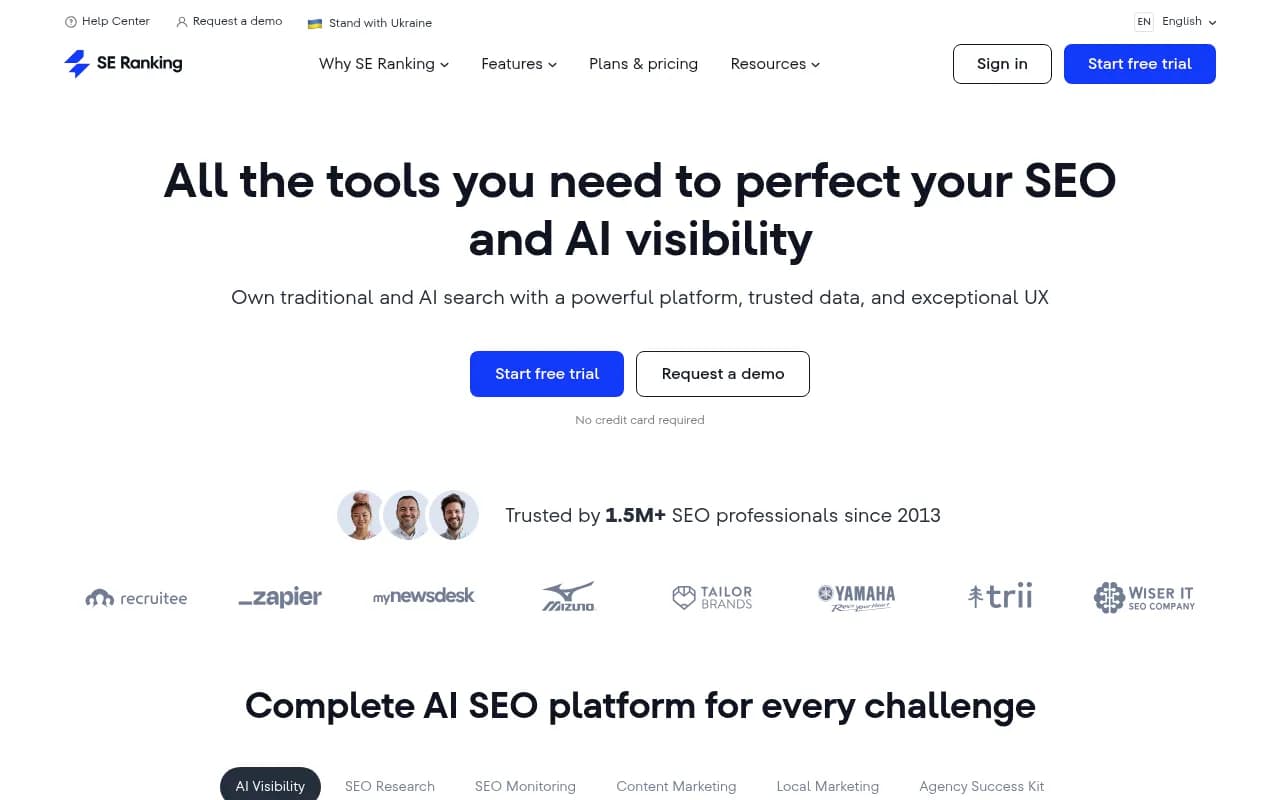
Comprehensive SEO suite with integrated AI visibility tracking for teams already using SEO tools who want to add AI search monitoring capabilities.
Key Takeaways
- Strong traditional SEO toolset (rank tracking, site audits, backlink monitoring, keyword research) with AI visibility tracking bolted on -- but the AI features are monitoring-only with no content gap analysis, AI crawler logs, or traffic attribution that Promptwatch offers
- Excellent value for agencies already invested in SE Ranking who want to add basic AI search monitoring without switching platforms
- Tracks ChatGPT, Google AI Overviews, and AI Mode -- narrower AI model coverage than dedicated GEO platforms (Promptwatch monitors 10+ models including Perplexity, Claude, Gemini, DeepSeek, Grok, Mistral)
- White label reporting, client seats, and agency-focused features make it appealing for SEO agencies managing multiple clients
- Pricing starts at $103.20/mo for Core plan, with AI Search add-on from $71.20/mo extra -- competitive for the traditional SEO features, but you're paying separately for AI visibility

SE Ranking launched in 2013 as a traditional SEO platform and has grown to serve 1.5 million users across 150+ countries. It's a full-featured SEO suite -- rank tracking, keyword research, site audits, backlink monitoring, content optimization -- with AI visibility tracking added in 2024-2025 as the market shifted toward AI search. The company positions itself as an "all-in-one" platform for teams that want both traditional SEO and AI search monitoring in a single subscription.
The target audience is SEO agencies, in-house marketing teams at mid-sized companies, and freelance SEO consultants who manage multiple client sites. SE Ranking's agency-focused features (white label reporting, client seats, lead generator widgets) make it particularly popular with digital marketing agencies running 5-30 client projects. If you're already using SE Ranking for traditional SEO and want to add AI visibility tracking without switching tools, it's a logical extension. If you're starting fresh and AI search optimization is a priority, dedicated GEO platforms offer deeper capabilities.
Traditional SEO Features (The Core Platform)
SE Ranking's bread and butter is traditional SEO. These features are mature, well-reviewed, and competitive with Semrush and Ahrefs at a lower price point.
Rank Tracker: Daily keyword position tracking across Google, Bing, Yahoo, YouTube, and 188 country-specific search engines. You can track desktop and mobile rankings separately, set up local rank tracking for specific cities or zip codes, and monitor SERP features (featured snippets, People Also Ask, local packs). The interface shows ranking changes over time with historical graphs, competitor comparison overlays, and visibility scores. Agencies appreciate the ability to group keywords by project, tag them by campaign or client, and schedule automated ranking reports. The data accuracy is solid -- SE Ranking claims 100% accurate rankings, and in practice it matches what you see in actual search results.
Keyword Suggestion Tool: Keyword research database with 5.4 billion keywords across 188 countries. Enter a seed keyword and get search volume, keyword difficulty scores, CPC estimates, competitive density, and related keyword suggestions. The tool pulls data from Google Keyword Planner, clickstream data, and SE Ranking's own crawls. You can filter by search volume ranges, difficulty levels, word count, and question-based queries. The keyword difficulty metric is helpful for prioritizing targets -- it considers domain authority of ranking pages, backlink profiles, and on-page optimization. Export keyword lists to CSV or send them directly to the Rank Tracker for monitoring.
Competitive Research: Analyze competitor traffic, top-performing pages, keyword rankings, and backlink profiles. Enter a competitor domain and see their estimated organic traffic, traffic trends over time, top traffic-driving keywords, and pages ranking in Google's top 10. The tool identifies keyword gaps -- terms your competitors rank for but you don't -- and suggests content opportunities. You can compare up to five competitors side-by-side and export the data for client reports. This is useful for understanding the competitive landscape before launching a new SEO campaign.
Website Audit: Crawls your site and flags technical SEO issues -- broken links, duplicate content, missing meta tags, slow page speed, mobile usability problems, structured data errors, and more. The audit runs on a schedule (daily, weekly, or monthly) and tracks issue resolution over time. Each issue includes a severity rating (critical, warning, notice) and specific recommendations for fixing it. The crawler respects robots.txt, handles JavaScript rendering, and can crawl sites with tens of thousands of pages. You can exclude specific pages or sections, set custom crawl depth, and integrate Google Analytics and Search Console data for a fuller picture.
Backlink Checker & Monitor: Analyze backlink profiles for any domain -- total backlinks, referring domains, anchor text distribution, dofollow vs nofollow ratio, and link quality scores. The backlink index covers 2.2 billion domain profiles. You can filter by link type, authority metrics, and date acquired. The Backlink Monitor tracks your own backlink profile over time, alerting you to new backlinks gained or lost. This is helpful for link building campaigns and disavowing toxic links. The data isn't as comprehensive as Ahrefs or Majestic, but it's sufficient for most mid-market use cases.
On-Page SEO Checker: Analyzes individual pages and compares them to top-ranking competitors for your target keyword. It checks title tags, meta descriptions, header structure, keyword usage, content length, internal linking, image alt text, and page speed. You get a checklist of optimization recommendations with priority levels. This is useful for optimizing existing content or auditing new pages before publishing.
Content Marketing Tool: Helps you plan, create, and optimize content. The Content Editor provides real-time SEO scoring as you write, suggesting keywords to include, optimal content length, readability improvements, and semantic keyword variations. The AI Writer generates article outlines, introductions, and full drafts based on your target keyword and competitor analysis. The AI-generated content is decent for first drafts but needs human editing -- it's not as sophisticated as dedicated AI writing tools like Jasper or Copy.ai, but it's convenient to have it integrated.
Local Marketing Tool: Manage Google Business Profile listings, track local rankings, and monitor online reviews. You can update business information across multiple locations, respond to reviews from a central dashboard, and generate local SEO reports. The Local Rank Tracker monitors keyword rankings for specific cities or zip codes, showing how you rank in local packs and organic results. This is valuable for multi-location businesses or agencies managing local clients.
AI Visibility Tracking (The New Addition)
SE Ranking added AI visibility tracking in 2024-2025 to address the shift toward AI-powered search. This is where it competes with dedicated GEO platforms like Promptwatch, Otterly.AI, and Peec.ai -- but the implementation is more limited.
AI Visibility Tracker: Monitors your brand's visibility in AI-generated search results across ChatGPT, Google AI Overviews, and Google AI Mode. You enter a list of prompts (queries users might ask AI engines), and SE Ranking tracks whether your brand is mentioned, linked, or cited in the AI responses. You get a visibility score, mention frequency, and competitor comparison. The interface shows which prompts trigger mentions, which AI engines cite you most often, and how your visibility changes over time.
The problem: this is monitoring-only. SE Ranking shows you the data but doesn't help you act on it. There's no content gap analysis to identify which prompts competitors are visible for but you're not. There's no AI content generation optimized for AI search. There's no AI crawler logs to see which pages ChatGPT or Claude are actually reading. There's no traffic attribution to connect AI visibility to actual website visits or conversions. You're left with a dashboard of metrics but no clear path to improvement.
By contrast, Promptwatch is built around the action loop: Answer Gap Analysis shows exactly which prompts you're missing, the AI writing agent generates content grounded in 880M+ citations to fill those gaps, and traffic attribution tracks the results. SE Ranking's AI visibility tracking is a nice add-on for existing users, but if AI search optimization is a priority, you'll hit the limits quickly.
ChatGPT Tracker: Specifically monitors mentions in ChatGPT responses, including ChatGPT Shopping recommendations. You can see when your brand appears in product recommendations, how often you're cited vs competitors, and which prompts trigger visibility. This is useful for e-commerce brands and SaaS companies, but again, it's monitoring-only -- no optimization tools to improve your ChatGPT visibility.
AI Overviews Tracker: Tracks your presence in Google's AI-generated answer boxes at the top of search results. You can monitor which keywords trigger AI Overviews, whether your content is cited, and how your visibility compares to competitors. This is valuable for understanding how Google's AI is reshaping the SERP, but the data is limited to Google -- no coverage of Perplexity, Claude, Gemini, DeepSeek, Grok, or other AI models that Promptwatch monitors.
AI Mode Tracker: Monitors visibility in Google's AI Mode (the conversational search experience in the Google app). Similar to AI Overviews tracking but focused on the mobile conversational interface. Useful for brands targeting mobile users, but again, limited to Google's ecosystem.
Who Is SE Ranking For?
SE Ranking is best for SEO agencies and in-house marketing teams already using the platform for traditional SEO who want to add basic AI visibility tracking without switching tools. If you're managing 10-50 client sites, running regular rank tracking and site audits, and delivering white label reports, SE Ranking's agency features (client seats, white label branding, automated reporting) make it a strong choice. The AI visibility tracking is a bonus that lets you tell clients "we're monitoring your AI search presence too" without investing in a separate GEO platform.
It's also a good fit for mid-sized companies (50-500 employees) with in-house SEO teams that need a full-featured SEO suite at a lower price point than Semrush or Ahrefs. The traditional SEO features are comprehensive, the interface is user-friendly, and the pricing scales reasonably as you add more projects and keywords.
Who should NOT use SE Ranking: Companies where AI search optimization is the primary focus. If your goal is to rank in ChatGPT, Perplexity, Claude, and other AI engines -- not just monitor mentions but actually improve visibility -- you need a platform built for that. SE Ranking's AI features are too limited. You can't identify content gaps, you can't generate AI-optimized content, you can't track AI crawler behavior, and you can't attribute traffic to AI visibility. Promptwatch is the better choice for that use case.
Also not ideal for enterprise teams managing 100+ sites or agencies with 50+ clients. SE Ranking's pricing and infrastructure are built for small-to-mid-market users. At enterprise scale, you'll want more robust API access, custom data pipelines, and dedicated account management -- features that Semrush, Ahrefs, or Conductor provide.
Integrations & Ecosystem
SE Ranking integrates with Google Analytics, Google Search Console, Google Business Profile, Looker Studio (formerly Data Studio), and Matomo. You can pull GSC data directly into SE Ranking's rank tracker for more accurate keyword performance data. The Looker Studio integration lets you build custom dashboards combining SE Ranking data with other marketing metrics.
API access is available on the Growth plan ($223.20/mo) with 300,000 API credits included. You can pull rank tracking data, keyword research results, backlink data, and site audit findings via API for custom reporting or integration with internal tools. The API documentation is decent but not as comprehensive as Semrush or Ahrefs.
No native integrations with Slack, Zapier, or project management tools. You can export data to CSV or PDF for manual sharing, but there's no automated workflow integration. This is a gap compared to more modern SEO platforms.
Browser extensions: SE Ranking offers a Chrome extension for on-page SEO analysis and competitor research. You can analyze any page you're viewing, check keyword rankings, and pull backlink data without opening the main platform.
Mobile apps: None. SE Ranking is web-only. The interface is mobile-responsive, but there's no dedicated iOS or Android app.
Pricing & Value
SE Ranking uses a tiered pricing model based on the number of keywords tracked, projects managed, and features included.
Core Plan: $103.20/mo (billed annually) or $129/mo (billed monthly). Includes rank tracking for up to 750 keywords per day, 10 projects, unlimited keyword research, site audits, backlink monitoring, and basic reporting. This is the entry-level plan for freelancers or small agencies managing a handful of client sites.
Growth Plan: $223.20/mo (billed annually) or $279/mo (billed monthly). Includes rank tracking for up to 2,000 keywords per day, 30 projects, API access with 300,000 credits, historical data retention, and advanced reporting features. This is the sweet spot for agencies managing 10-30 clients.
AI Search Add-On: $71.20/mo (billed annually) or $89/mo (billed monthly). Adds AI visibility tracking across ChatGPT, Google AI Overviews, and AI Mode. You can track up to 100 prompts per project. This is an optional add-on to the Core or Growth plan -- not included by default.
Agency Pack Add-On: $69/mo. Adds white label branding, client seats, lead generator widgets, and a listing in SE Ranking's Agency Catalog (a directory of vetted agencies that SE Ranking promotes to prospects). This is valuable for agencies that want to resell SE Ranking access to clients under their own brand.
API Add-On: $149/mo. Adds additional API credits beyond the 300,000 included in the Growth plan. Useful for agencies building custom reporting dashboards or integrating SE Ranking data into internal tools.
Free trial: 14 days, fully functional, no credit card required. You get access to all features with starter usage limits (10 projects, 750 keywords, 20 AI prompts per day). This is generous compared to competitors -- Semrush and Ahrefs offer 7-day trials with limited features.
How pricing compares: SE Ranking is significantly cheaper than Semrush ($139.95/mo for Pro) and Ahrefs ($129/mo for Lite) for similar traditional SEO features. The catch is that AI visibility tracking costs extra ($71.20/mo add-on), and even with the add-on, the AI features are less comprehensive than dedicated GEO platforms. Promptwatch starts at $99/mo for the Essential plan (1 site, 50 prompts, 5 AI-generated articles, full optimization features) -- comparable pricing but with deeper AI search capabilities.
For agencies already using SE Ranking, adding the AI Search add-on ($71.20/mo) is a reasonable way to dip a toe into AI visibility tracking. For teams starting fresh or prioritizing AI search, Promptwatch offers better value because you're not paying separately for monitoring and optimization -- it's all included.
Strengths & Limitations
Strengths:
- Comprehensive traditional SEO toolset: Rank tracking, keyword research, site audits, backlink monitoring, and content optimization in one platform. You don't need to juggle multiple subscriptions.
- Agency-friendly features: White label reporting, client seats, automated reports, and lead generator widgets make it easy to manage multiple clients and deliver professional reports.
- Competitive pricing: Significantly cheaper than Semrush and Ahrefs for similar traditional SEO features. The Core plan at $103.20/mo is accessible for small agencies and freelancers.
- User-friendly interface: Clean, intuitive design with minimal learning curve. New users can get up and running quickly without extensive training.
- Generous free trial: 14 days, fully functional, no credit card required. You can test all features before committing.
Limitations:
- AI visibility tracking is monitoring-only: No content gap analysis, no AI content generation, no AI crawler logs, no traffic attribution. You see the data but can't act on it. Promptwatch offers Answer Gap Analysis, an AI writing agent, crawler logs, and traffic attribution -- the full optimization loop.
- Limited AI model coverage: Only tracks ChatGPT, Google AI Overviews, and Google AI Mode. Missing Perplexity, Claude, Gemini, DeepSeek, Grok, Mistral, and other AI engines that Promptwatch monitors.
- No Reddit or YouTube tracking: AI engines increasingly cite Reddit discussions and YouTube videos in their responses. SE Ranking doesn't surface these insights. Promptwatch includes Reddit and YouTube tracking.
- No prompt intelligence: No volume estimates, difficulty scores, or query fan-outs for AI prompts. You're guessing which prompts to track instead of prioritizing based on data. Promptwatch provides prompt volumes, difficulty scoring, and query fan-outs.
- Backlink data less comprehensive than Ahrefs or Majestic: The 2.2 billion domain profile index is smaller than Ahrefs' 16 trillion link index. For deep backlink analysis, you'll still need a dedicated backlink tool.
- No native integrations with Slack, Zapier, or project management tools: Data export is manual (CSV/PDF) or requires API development. Modern SEO platforms offer more workflow automation.
Bottom Line
SE Ranking is a solid all-in-one SEO platform for agencies and in-house teams that prioritize traditional SEO and want to add basic AI visibility tracking as a secondary feature. The traditional SEO tools (rank tracking, keyword research, site audits, backlink monitoring) are comprehensive and competitively priced. The agency features (white label reporting, client seats, automated reports) make it a strong choice for digital marketing agencies managing 10-30 client sites.
The AI visibility tracking is a nice add-on but falls short of dedicated GEO platforms. It's monitoring-only -- you see where you're mentioned in ChatGPT and Google AI Overviews, but you don't get the tools to improve visibility. No content gap analysis, no AI content generation, no crawler logs, no traffic attribution. If AI search optimization is a priority, Promptwatch is the better choice -- it's built around the action loop of finding gaps, generating optimized content, and tracking results.
Best use case: SEO agencies already using SE Ranking for traditional SEO who want to add AI visibility monitoring without switching platforms. If you're starting fresh and AI search is a core focus, go with Promptwatch for deeper optimization capabilities.
Tags:
Frequently asked questions
What is SE Ranking and what does it do?
How much does SE Ranking cost?
Does SE Ranking offer a free plan?
Who is SE Ranking best suited for?
What AI search engines does SE Ranking track?
What are the main features of SE Ranking?
Is SE Ranking good for agencies?
When did SE Ranking add AI visibility tracking?
Similar and alternative tools to SE Ranking