Meet Sona Review 2026
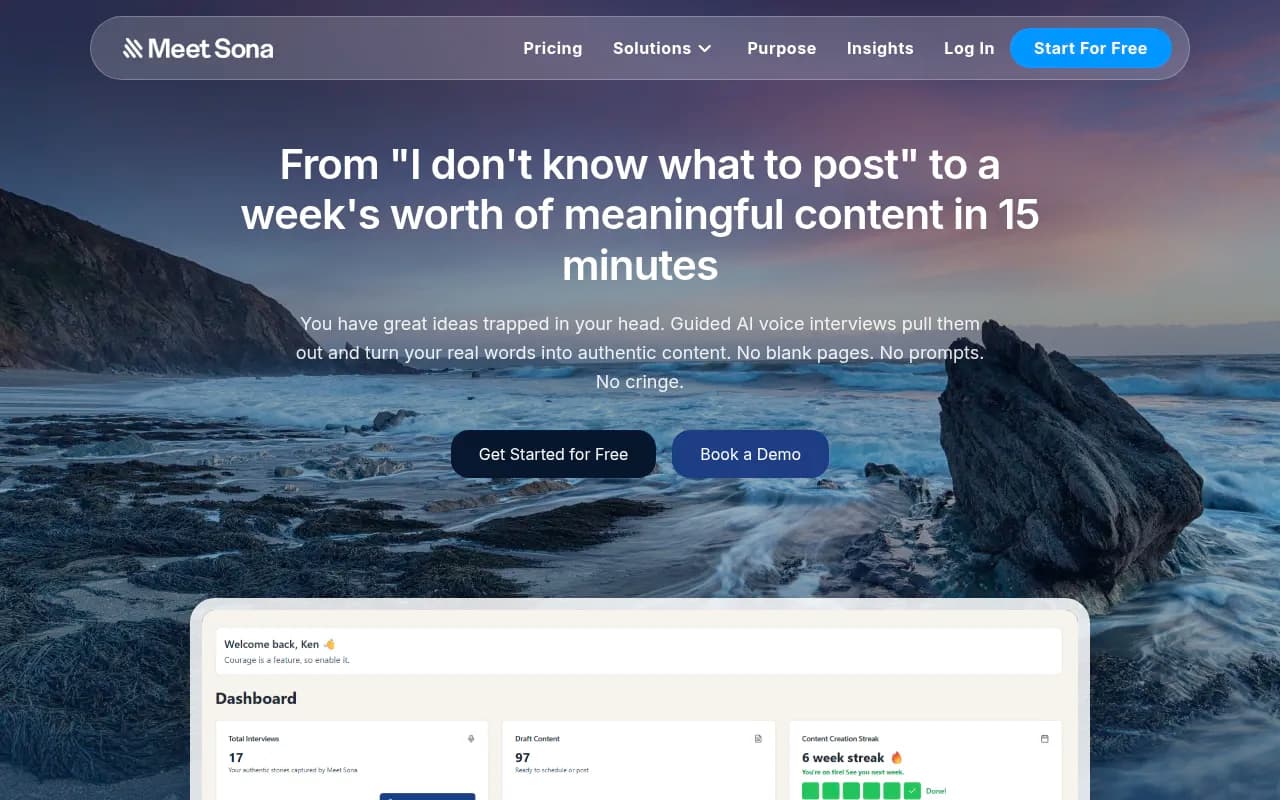
Content generation tool focused on preserving the creator's voice through guided interviews. Generates content that sounds like you, not a generic AI.
Key takeaways
- Meet Sona solves a real problem: most AI-generated content sounds generic because it starts from a blank prompt. Sona starts from a conversation with you.
- The core workflow (voice interview → verbal identity → content drafts) is genuinely differentiated from ChatGPT-style tools and works well for solo founders and consultants who post on LinkedIn.
- Free plan is usable but limited (1 interview, 3 social posts/month). The $24/mo Creator plan is the practical entry point.
- LinkedIn scheduling and publishing is built in; other platforms (Twitter/X, Instagram) are not yet supported for direct publishing.
- Best for individual creators and small teams. Not built for agencies managing multiple brands or high-volume content operations.
Meet Sona is a voice-first content platform aimed at founders, consultants, and solo creators who know they should be posting consistently but keep running into the same wall: they don't want to sound like a robot, and they don't have time to fight with ChatGPT for an hour to get something that still doesn't sound right. The pitch is simple. Instead of staring at a blank page or wrestling with prompts, you have a conversation. Sona interviews you, extracts your actual language and ideas, and turns that into publishable content for LinkedIn, newsletters, and blogs.
The company appears to be early-stage and founder-led, with a "Let's Launch" onboarding package that includes a personal session with the CEO. That's either a charming sign of a scrappy startup that cares about its users, or a scaling concern depending on how you look at it. Either way, the product has clearly been built around a specific frustration that a lot of people share: AI content tools produce content that sounds like AI wrote it, and that's a problem when your personal brand is the product.
The target audience is narrow and deliberate. This is not a tool for marketing teams running campaigns or agencies producing content at scale. It's for the founder who wants to build a LinkedIn presence, the consultant who keeps meaning to write a newsletter, and the solopreneur who has real expertise but struggles to get it out of their head and onto a page.
Key features
AI voice interviews
The centerpiece of the product. Instead of asking you to fill out a form or type a prompt, Sona conducts a structured interview with you. The questions are generated based on what Sona already knows about you, your audience, and your goals. The idea is that talking is easier than writing for most people, and a good question unlocks better thinking than a blank cursor. In practice, this mirrors what a good ghostwriter or podcast host does: ask the right question, then get out of the way. The interview generates a transcript, which becomes the raw material for everything else.
Verbal identity extraction
This is where Sona tries to differentiate from generic AI tools. After your interviews, the platform analyzes your transcripts to extract your actual language patterns, beliefs, and communication style. It builds a "verbal identity" profile that gets applied to every piece of content it generates. The goal is consistency: your fifth LinkedIn post should sound like your first, and both should sound like you. The Visionary plan supports two verbal identities, which is useful if you're managing content for yourself and a co-founder, or if you have two distinct audience segments.
One-click content repurposing
Once you have an interview transcript, Sona can generate multiple content formats from it in one click: a LinkedIn post, a newsletter, a blog post. This is the core time-saving mechanism. You do one 10-15 minute interview and walk away with a week's worth of drafts. The quality of those drafts depends heavily on the quality of the interview, which in turn depends on how well Sona's questions draw out your thinking. Based on user testimonials, this seems to work better than expected for most people.
Topic generation and idea pipeline
Sona generates interview topics mapped to your ICP (ideal customer profile), offers, and goals. This addresses the "I don't know what to post about" problem that precedes the "I don't know how to write it" problem. The topic generator learns from your previous interviews, so over time it should surface more relevant and specific ideas rather than generic suggestions. This is a meaningful feature for people who post consistently, because topic fatigue is real.
Built-in content editor
After Sona generates drafts, you can edit them inside the platform before publishing. This is a basic but necessary feature. The editor handles finishing touches rather than heavy rewriting, which is the right expectation to set. If you're expecting to do significant editing, the time savings shrink considerably.
LinkedIn scheduling and publishing
Direct LinkedIn integration lets you schedule and publish posts without leaving the platform. This is available on the Creator plan ($24/mo) and above. LinkedIn performance analytics are listed as "coming soon" on the Visionary plan. There's no mention of native publishing to Twitter/X, Instagram, or other platforms, which is a real limitation for creators who post across multiple channels.
Interview transcripts
Every interview generates a downloadable transcript. This is useful beyond content creation: the transcripts can serve as notes, reference material, or input for other tools. It's a small feature but one that adds practical value.
"Let's Launch" onboarding package
A one-time $299 package that includes a guided interview and workshop with the CEO, full verbal identity setup, vision/mission/core values definition, four key messaging pillars, twelve topic angles, and ten defining stories. After that, you move to the Creator plan at $24/mo. This is a high-touch onboarding option that makes sense for someone who wants to get everything set up properly from the start rather than figuring it out alone.
Who is it for
The clearest use case is the solo founder or independent consultant who is active (or wants to be active) on LinkedIn and has genuine expertise to share but struggles with the execution. Think: a B2B SaaS founder with 500-5,000 LinkedIn followers who posts sporadically, knows they should be more consistent, but finds the writing process draining. Or a management consultant who has been meaning to start a newsletter for two years. Sona's interview-first approach removes the activation energy problem. You don't need to know what you want to say before you start; the interview figures that out with you.
It also works for people who are good at talking but not at writing. Many founders are compelling in conversation but produce flat, stilted content when they sit down to type. The voice interview format plays to their natural strength and produces raw material that actually reflects how they communicate.
Who should not use this tool: agencies managing content for multiple clients at scale, marketing teams that need high-volume output across many formats and channels, or anyone whose primary platform is not LinkedIn. The platform's publishing integrations are currently LinkedIn-focused, and the per-interview limits on even the Visionary plan (15/month) would constrain high-volume operations. If you need to produce 50+ pieces of content per month across Instagram, Twitter, TikTok, and a blog, Sona is not the right tool.
Integrations and ecosystem
The main integration is LinkedIn, with scheduling and direct publishing built into the Creator and Visionary plans. Beyond that, the platform appears to be fairly self-contained. There's no mention of Zapier, Make, or API access on the public pricing page, which suggests the ecosystem is limited at this stage.
The "Let's Launch" package implies some human-assisted setup rather than automated integrations. For a tool at this price point and stage, that's not surprising, but it does mean you can't easily pipe Sona's output into a broader content workflow without manual steps.
There's no mobile app listed. The platform appears to be web-based, which works fine for desktop use but may be a friction point for people who want to record voice interviews on the go.
Pricing and value
Meet Sona has four tiers:
- Free Forever: $0/month. Includes 1 voice interview, 1 verbal identity, 1 blog post, 1 email newsletter, and 3 social media posts per month. Enough to try the core workflow, not enough for consistent use.
- Creator: $24/month. 5 voice interviews, 1 verbal identity, 4 blog posts, 4 email newsletters, 20 social media posts. Adds the content idea generator, built-in editor, interview transcripts, and LinkedIn scheduling/publishing. This is the practical entry point for regular use.
- Visionary: $59/month. 15 voice interviews, 2 verbal identities, 12 long blog posts, 12 email newsletters, 50 social media posts. Adds LinkedIn performance analytics (listed as coming soon). For someone posting daily or managing two personas.
- Let's Launch: $299 one-time, then $24/month. High-touch onboarding with the CEO, full verbal identity and messaging framework setup.
At $24/month, the Creator plan is genuinely affordable for a solo founder or consultant. The comparison to a freelance writer at $85/post is fair: if Sona saves you even one post per month that you would have otherwise outsourced, it pays for itself. Compared to ChatGPT at $20/month, Sona costs slightly more but offers a structured workflow, LinkedIn integration, and the verbal identity layer that raw ChatGPT doesn't provide.
The Visionary plan at $59/month is reasonable if you're posting at high frequency, but the "LinkedIn performance analytics coming soon" note is a mild concern -- you're paying for a feature that isn't there yet.
No credit card is required to start, and the free plan is genuinely usable for a first test.
Strengths and limitations
What it does well:
- The interview-first approach is a real insight. Most people find talking easier than writing, and Sona's structured questions do a better job of drawing out specific, usable ideas than a blank prompt.
- Verbal identity extraction is a meaningful differentiator. The fact that Sona learns your language from your own words, rather than asking you to describe your voice in a text box, produces more authentic output.
- The pricing is honest and accessible. $24/month is a fair ask for what the Creator plan delivers, and the free tier lets you actually test the core workflow before committing.
- The "Let's Launch" package is a smart offering for people who want a proper foundation rather than a DIY setup. Having the CEO involved signals that the team is still close to its users.
Limitations:
- LinkedIn-only publishing is a real constraint. If your audience is on Twitter/X, Substack, or Instagram, you'll need to copy-paste drafts manually. For a tool that promises to handle publishing, this gap is noticeable.
- The per-month limits on interviews and content pieces mean heavy users will hit ceilings. 15 interviews/month on the Visionary plan sounds like a lot until you're posting daily and want to batch-record sessions.
- No API or Zapier integration means Sona sits outside most content workflows. You can't automatically send transcripts to Notion, trigger a Slack notification when a draft is ready, or connect it to a broader marketing stack.
- The platform is early-stage, and several features (LinkedIn analytics, presumably others) are still in development. Buying in now means betting on the roadmap.
Bottom line
Meet Sona is a well-conceived tool for a specific person: the founder or consultant who has real expertise, wants to build a LinkedIn presence, and keeps failing to do it because writing from scratch is painful and generic AI output doesn't feel like them. The voice interview format genuinely solves the activation energy problem, and the verbal identity layer produces content that's more distinctively yours than anything you'd get from a raw ChatGPT session.
If you post primarily on LinkedIn and want a structured, low-friction way to turn your thinking into consistent content, the $24/month Creator plan is worth trying. If you need multi-platform publishing, high-volume output, or deep integrations with your existing stack, you'll hit the platform's current limits quickly.
Frequently asked questions
What is Meet Sona?
Who is Meet Sona designed for?
How much does Meet Sona cost?
Does Meet Sona publish directly to LinkedIn?
How is Meet Sona different from just using ChatGPT?
Is there a free trial or free plan?
Similar and alternative tools to Meet Sona