Radarkit Review 2026
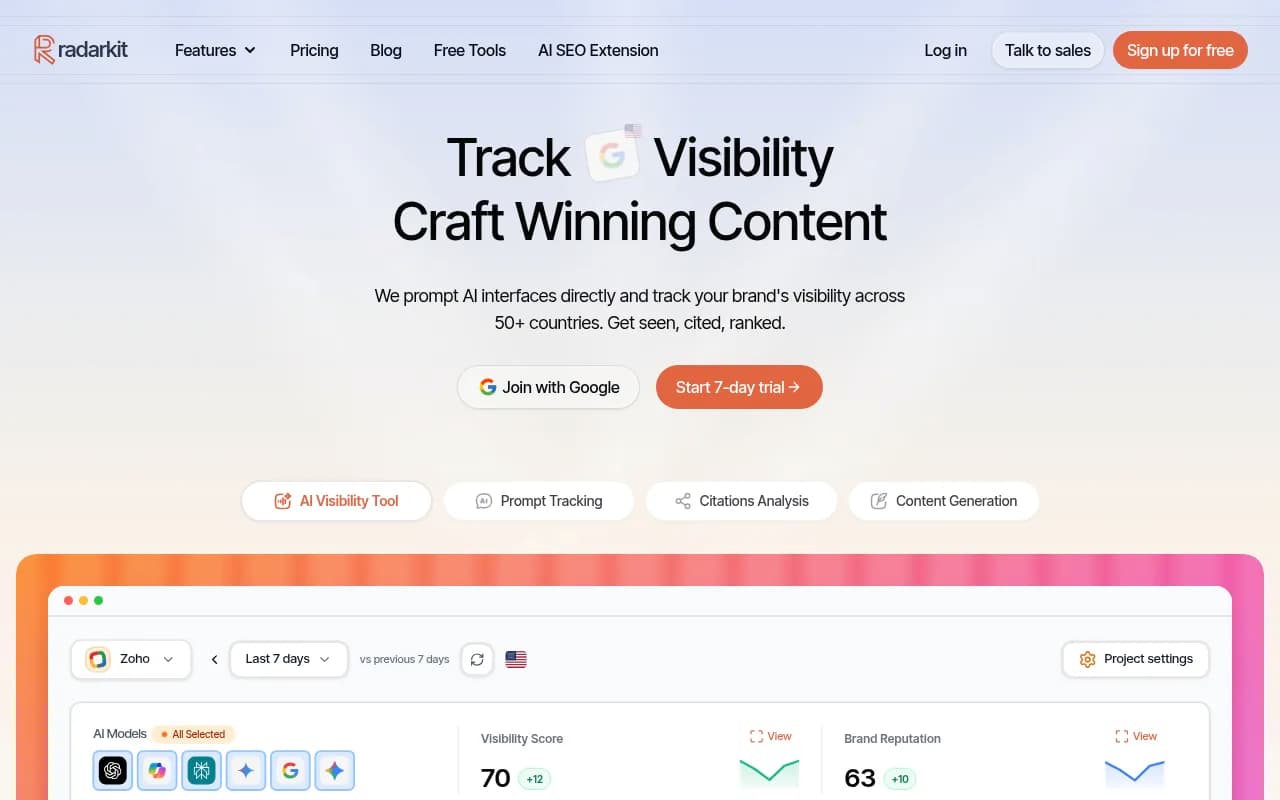
Radarkit is an AI search tracking and GEO content optimization platform that monitors brand visibility across ChatGPT, Perplexity, Gemini, Copilot, and Google AI Overviews in 50+ countries. Track citations, analyze competitor presence, and generate content engineered to get cited by AI models. Built
Summary
- Monitoring-only platform -- no content gap analysis, AI crawler logs, or traffic attribution like Promptwatch offers
- Tracks 6 AI models (ChatGPT, Perplexity, Gemini, Copilot, AI Overviews, AI Mode) vs Promptwatch's 10+ including DeepSeek, Grok, Meta AI, Mistral
- Content generation tool analyzes Google SERPs and AI citations but lacks the Answer Gap Analysis that shows exactly which prompts competitors rank for but you don't
- Pricing starts at $29/mo (Lite plan) -- affordable entry point but limited to basic tracking features
- Best for brands wanting simple AI visibility monitoring; not ideal for teams needing optimization workflows and actionable insights

Radarkit is an AI search tracking and content optimization tool built by a team focused on helping brands monitor their visibility across major AI assistants. Launched in 2024, it targets marketing teams, SEO professionals, and agencies who want to understand how their brand appears in AI-generated answers. The platform monitors ChatGPT, Perplexity, Google Gemini, Microsoft Copilot, Google AI Overviews, and Google AI Mode across 50+ countries.
The core pitch: traditional SEO tools only track Google rankings, but people increasingly ask ChatGPT or Perplexity for recommendations. If your brand isn't visible in those answers, you're missing a growing share of search traffic. Radarkit positions itself as the solution for tracking that visibility and optimizing content to get cited by AI models.
What Radarkit Actually Does
Radarkit's workflow centers on three main capabilities: tracking brand mentions across AI platforms, analyzing which sources AI models cite, and generating content designed to earn citations. Here's how each works in practice.
Keyword Tracking Across AI Assistants: You add keywords (prompts) you want to monitor -- things like "best CRM for small businesses" or "top project management tools 2026". Radarkit then prompts those keywords directly on ChatGPT, Perplexity, Gemini, Copilot, AI Overviews, and AI Mode using real browsers and residential IPs. It doesn't rely on APIs, which means it captures the actual user experience including query fanouts (how one prompt branches into sub-queries). You get visibility scores, sentiment analysis (positive/mixed/negative), average position rankings, and share of voice metrics. The platform tracks changes over time so you can see if your visibility is improving or declining. Location-specific tracking is supported -- you can see how your brand performs in the US vs Germany vs other markets.
Citation Analysis: For each tracked keyword, Radarkit shows which sources AI models cited in their responses. You see domain-level data (reddit.com cited 244 times, youtube.com cited 163 times, etc.) along with citation share percentages and rankings. The "Links to Competitor" feature is notable: Radarkit visits every cited source, scans the page, and identifies where your competitors are mentioned. This gives you a map of competitor presence across AI-cited content -- useful for outreach and content strategy. You can export citation data and filter by your site, competitors, or other domains.
Content Generation Tool: Radarkit's content writer analyzes the top 10 Google SERP results and the most-cited AI sources for your target keyword. It extracts key terms, entities, and subtopics, then identifies content gaps (topics covered by top results but missing from your existing content). The tool also researches statistical data and facts to insert into the content. You get a content outline with sections based on query fanouts, plus auto-optimization that inserts key terms and internal links. The output is designed to rank on Google and get cited by AI assistants. You can mark sections as done, delete irrelevant topics, or regenerate parts of the outline. The tool supports multiple languages and provides readability scores and word count targets.
Traffic Monitoring: Radarkit tracks human visits from LLM referrals using a code snippet you add to your site. You see total sessions from AI assistants, share of traffic (what percentage of your total traffic comes from AI platforms), and which platforms (ChatGPT, Perplexity, etc.) are driving the most visitors. This closes the loop between visibility and actual traffic.
Who Is Radarkit For
Radarkit targets three main groups: in-house marketing teams at SaaS companies or e-commerce brands who want to monitor brand reputation in AI search, SEO teams looking to expand beyond traditional Google rankings, and digital agencies managing multiple client brands. The platform is most useful for brands in competitive categories where AI assistants frequently recommend products -- think CRM software, project management tools, hosting providers, HR platforms, running shoes, or financial services. If your category gets mentioned in ChatGPT or Perplexity answers, Radarkit can show you where you stand.
Team size: best suited for small to mid-sized teams (5-50 people) who need visibility data but don't require deep optimization workflows. Larger enterprises with dedicated GEO teams may find the feature set limited compared to platforms like Promptwatch, which offers AI crawler logs, Answer Gap Analysis, and built-in content generation grounded in 880M+ citations.
Who should NOT use Radarkit: brands in categories where AI assistants rarely make recommendations (highly localized services, niche B2B verticals with no online discussion), teams that need advanced optimization features like AI crawler log analysis or traffic attribution beyond basic referral tracking, and anyone looking for a platform that monitors more than 6 AI models (Radarkit doesn't track DeepSeek, Grok, Meta AI, or Mistral).
Integrations & Ecosystem
Radarkit's integration story is thin. The platform offers a JavaScript snippet for traffic tracking and mentions Looker Studio integration in some marketing materials, but there's no public API documentation, no Zapier integration, no Google Search Console connection, and no mention of CMS plugins or browser extensions. Internal link insertion works by analyzing your sitemap, but there's no direct integration with WordPress, Webflow, or other content platforms. For a tool launched in 2024, the lack of ecosystem integrations is a notable gap -- especially compared to competitors like Promptwatch, which offers API access, Looker Studio connectors, and GSC integration for traffic attribution.
Pricing & Value
Radarkit offers three paid tiers:
Lite Plan ($29/mo): 1 project, 50 prompts, 5 content generations per month, citation tracking, competitor analysis, multi-location tracking, query fanout support, brand reporting. Good entry point for solo marketers or small brands testing AI visibility.
Pro Plan ($99/mo): 3 projects, 150 prompts, 15 content generations, all Lite features plus priority support. Fits small agencies or brands managing multiple product lines.
Business Plan ($299/mo): 10 projects, 500 prompts, 50 content generations, all Pro features. Designed for agencies managing multiple clients.
A free trial is available (contact [email protected]). Annual billing discounts are not mentioned on the site.
How This Compares: Radarkit's Lite plan at $29/mo is cheaper than Promptwatch Essential ($99/mo), but you get significantly less. Promptwatch Essential includes AI crawler logs, Answer Gap Analysis, 50 prompts, and 5 AI-generated articles with fact-checking and citation grounding. Radarkit's content tool analyzes Google SERPs and AI citations but doesn't show you which prompts competitors rank for that you don't -- a critical gap for optimization. At the Pro tier, Radarkit ($99/mo) offers 150 prompts vs Promptwatch Professional ($249/mo) with 150 prompts, crawler logs, state/city tracking, and 15 articles. Radarkit is cheaper but lacks the optimization depth.
For monitoring-only use cases, Radarkit's pricing is competitive. For teams that want to take action -- find content gaps, generate optimized content, track AI crawler behavior -- Promptwatch delivers more value despite the higher price.
Strengths & Limitations
Strengths:
- Affordable entry point: $29/mo Lite plan makes AI visibility tracking accessible for small brands and solo marketers.
- Multi-location tracking: Residential IP support for 50+ countries lets you see how your brand performs in different markets.
- Query fanout capture: Real browser prompting means you get the full query expansion data, not just top-level responses.
- Links to Competitor feature: Automatically scans cited sources to find competitor mentions -- useful for outreach planning.
- Brand reporting: Export-ready reports for client presentations.
Limitations:
- Monitoring-only platform: Radarkit shows you where you're visible but doesn't help you fix gaps. No Answer Gap Analysis to show which prompts competitors rank for but you don't. No AI crawler logs to understand how AI models discover your content. No traffic attribution beyond basic referral tracking. Promptwatch offers all three, making it an optimization platform instead of just a tracker.
- Limited AI model coverage: 6 models (ChatGPT, Perplexity, Gemini, Copilot, AI Overviews, AI Mode) vs Promptwatch's 10+ including DeepSeek, Grok, Meta AI, and Mistral. Missing models means incomplete visibility.
- No Reddit or YouTube tracking: Radarkit shows citation data but doesn't surface Reddit discussions or YouTube videos that influence AI recommendations -- a channel Promptwatch tracks extensively.
- No ChatGPT Shopping tracking: Radarkit doesn't monitor product recommendations in ChatGPT's shopping carousels, a feature Promptwatch includes.
- Weak integration ecosystem: No API, no Zapier, no GSC connection, no CMS plugins. You're stuck exporting CSVs and manually connecting data.
- Content tool lacks depth: Analyzes Google SERPs and AI citations but doesn't ground content in real citation data or provide prompt volume/difficulty scoring like Promptwatch does.
Bottom Line
Radarkit is a solid choice for brands and agencies who want affordable AI visibility monitoring and don't need deep optimization features. If your goal is to track how often your brand appears in ChatGPT or Perplexity answers, see which sources AI models cite, and generate basic content outlines, Radarkit delivers at a reasonable price. The $29/mo Lite plan is accessible for small teams testing AI search tracking.
But if you want to actually improve your AI visibility -- find content gaps, generate optimized content grounded in citation data, track AI crawler behavior, monitor Reddit and YouTube influence, or attribute traffic to specific AI platforms -- Promptwatch is the stronger choice. Radarkit is a monitoring dashboard. Promptwatch is an optimization platform. For teams serious about ranking in AI search, the difference matters.
Frequently asked questions
What is Radarkit and what does it do?
How much does Radarkit cost?
Which AI platforms does Radarkit track?
Who should use Radarkit?
Does Radarkit offer a free version?
What are the main features of Radarkit?
How is Radarkit different from traditional SEO tools?
What are the limitations of Radarkit?
Similar and alternative tools to Radarkit