Addlly AI Review 2026
Runs agent-led AI search optimization and content audits for multilingual enterprise brands.
Key takeaways
- Addlly AI bundles AI visibility auditing, citation forensics, and content generation into one managed workflow, aimed squarely at enterprise brands rather than solo marketers or small teams.
- It monitors up to 8 engines (ChatGPT, Gemini, Claude, Perplexity, Copilot, Grok, DeepSeek, Meta AI) but lacks AI crawler logs, visitor/traffic attribution, Reddit and YouTube citation tracking, and page-level query fan-out analysis that a platform like Promptwatch provides natively.
- Pricing is opaque for the Basic and Pro tiers (both are "contact us"), with the only public number being a Singapore PSG grant plan starting at SGD 292/month; independent review volume is thin, with just 1-2 reviews each on G2, Capterra, and the Shopify App Store.
- The platform's strongest fit is Southeast Asia-based FMCG, beauty, insurance, and retail enterprises that want a managed GEO program (audit, plan, execute) rather than a self-serve monitoring dashboard.
- Multilingual content generation (including Arabic, Indonesian, Malay, Tagalog, Thai, and Chinese) is a genuine differentiator for brands operating across multiple Asian markets.
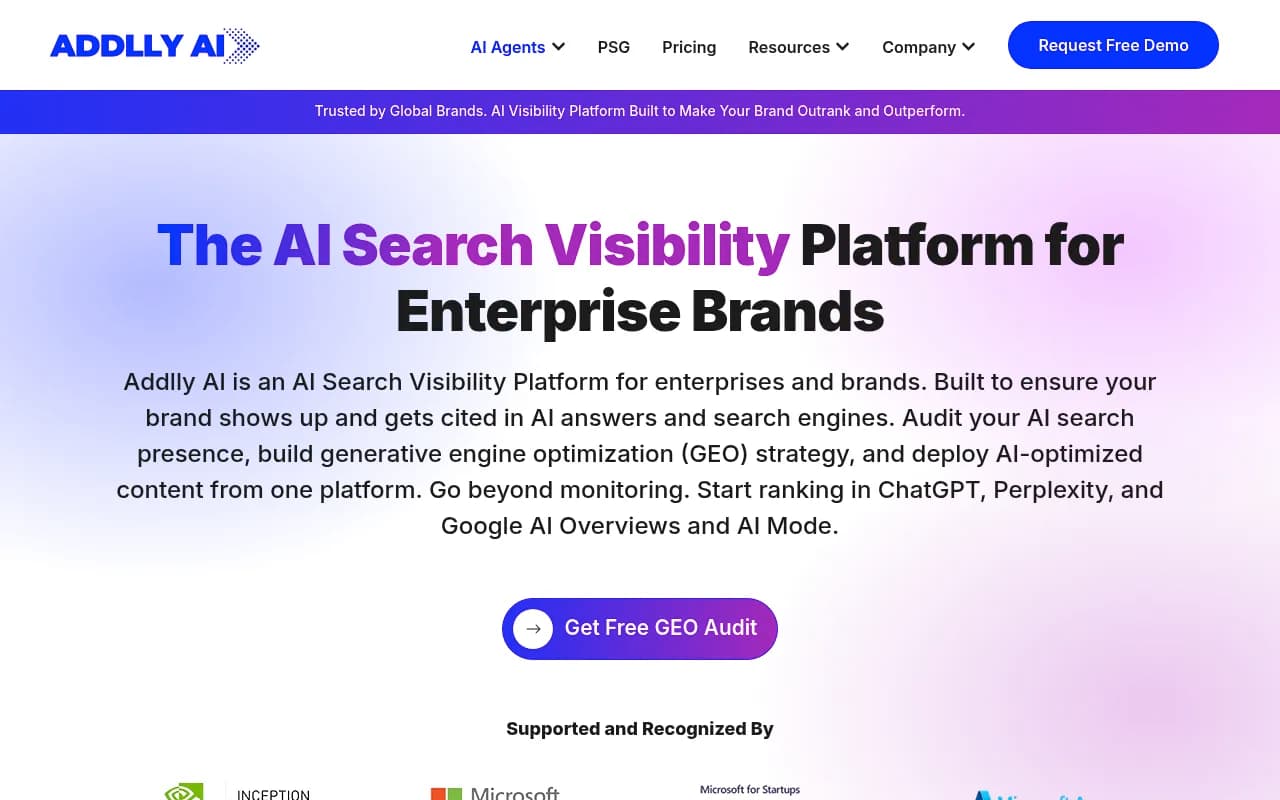
Addlly AI started life in 2023 as a fairly ordinary GenAI content generator, spitting out blogs, product descriptions, and social posts for Singapore-based SMEs. In 2025 it repositioned around Generative Engine Optimization (GEO), and by early 2026 the company had rebuilt its homepage entirely around "AI Search Visibility" language: citation forensics, AI Visibility Scores, share of voice, and agent-run content execution. That pivot tracks the broader market shift as brands started worrying less about Google rankings and more about whether ChatGPT or Perplexity mentions them at all.
The company, run by CEO Tina Chopra, has picked up a decent set of institutional backers for a Singapore startup at this stage, including NVIDIA Inception, Microsoft Founders Hub, AWS Startups, and Singapore's IMDA. It's SOC 2 and ISO 27001 certified, which matters for the enterprise buyers it's chasing. Client logos on the site include Shiseido, MetLife, Kenvue, Johnson's Baby, Aveeno, and several Southeast Asian names like Oona Insurance and ATT Systems, with case studies claiming things like a jump from zero to 7.7K organic visits in six months for Oona.
Key features
- GEO audit workflow: Addlly runs a three-stage process: audit how AI engines currently cite and describe the brand, plan prioritized GEO actions, then execute content and structural changes at scale. This is presented as a managed service rather than a raw dashboard you configure yourself, which is a meaningfully different model from tools built for a marketer to log in daily.
- Citation forensics: The platform tracks which sources influence AI-generated answers about a brand and where competitors are getting cited instead. It covers ChatGPT, Gemini AI Overview, Claude, and Perplexity by default, with Copilot, Grok, DeepSeek, and Meta AI available depending on plan.
- AI Visibility Score and Share of Voice: These are the platform's headline metrics, consolidating citation frequency and competitive presence into single numbers teams can track over time. Sentiment analysis is layered on top to show whether AI systems describe the brand favorably.
- Brand-trained AI agents: Addlly trains agents on a brand's tone, blog history, and social content, then uses them to draft GEO-optimized content without prompt engineering. This "zero prompt" positioning is aimed at marketing teams who don't want to become prompt engineers just to keep a content pipeline moving.
- Multilingual content generation: Content agents produce localized copy in languages including Arabic, Indonesian, Malay, Tagalog, Thai, and Simplified Chinese. For brands running campaigns across Southeast Asia and the Gulf, this is more useful out of the box than most Western-built GEO tools.
- PDP (product detail page) audits and optimization: E-commerce and retail clients can get product pages specifically audited and optimized for AI citation, which is a narrower but practical feature for catalog-heavy brands.
- Schema audit and optimization: Available on the Enterprise tier, this addresses the structured-data side of AI discoverability rather than just prose content.
- Custom content agents: Enterprise customers can deploy specialized agents for YouTube scripts, Reddit posts, and Quora answers, aimed at amplification on platforms AI engines frequently cite.
- In-house vs. managed service model: Unlike most GEO tools that assume you'll self-serve, Addlly explicitly offers a choice between running GEO internally through the platform or handing the whole program to Addlly's own specialists. That's closer to an agency-plus-software hybrid than a pure SaaS product.
Who is it for
Addlly AI's actual client roster, FMCG names like Kenvue and Shiseido, insurance brands like Oona, security and facilities firms like ATT Systems, tells you who it's built for: mid-market to large enterprise brands in Southeast Asia (and increasingly beyond) that need GEO handled as a managed program, not a self-serve dashboard. Marketing directors at multinational consumer brands running regional campaigns across Singapore, Indonesia, Malaysia, and beyond are the clearest fit, especially if they already have SEO agencies or in-house teams that need multilingual content at volume.
Growth teams inside e-commerce and product brands who want PDP-level optimization also fit well, as do agencies or digital consultants who join Addlly's affiliate program to resell GEO services to their own enterprise clients. What it's not built for is a solo SEO consultant or small SaaS founder who wants to self-serve a dashboard for $95 a month and see prompt-level data immediately, that buyer will find Addlly's contact-sales model and managed-service framing frustrating.
Companies should also be cautious if they need heavy independent validation before buying. Addlly's review footprint is thin: two reviews on G2 (one flagged as a seller's business partner), one review on Capterra, and two on the Shopify App Store. That's not disqualifying for an enterprise sales-led product, but it does mean prospective buyers are relying almost entirely on Addlly's own case studies rather than a broad base of third-party feedback.
Integrations and ecosystem
Addlly's main platform integration story runs through Microsoft: it's listed and transactable on the Azure Marketplace as of February 2026, letting enterprises purchase directly through existing Azure billing relationships. It also holds Microsoft Solutions Partner and Founders Hub status, plus backing from AWS Startups, NVIDIA Inception, and Meta's Llama Incubator, all more relevant as credibility signals than as functional integrations.
On the practical side, Addlly ships a dedicated Shopify app ("Addlly: AI SEO Writer Agent") that generates SEO blogs, product descriptions, and social posts with automatic internal linking to Shopify products, and it includes a free plan. There's no public GitHub repository, no documented public API, and no Zapier or Google Search Console connector mentioned anywhere in the site or research. For a platform positioning itself as enterprise infrastructure, the lack of visible developer tooling or a documented API is a notable gap.
Pricing and value
Addlly's pricing structure has three tiers, Basic, Pro, and Enterprise, but only one hard number appears publicly: a Singapore PSG (Productivity Solutions Grant) plan starting at SGD 292/month, aimed at local SMEs who qualify for government co-funding. Everything else routes through "book a demo" or "contact us," confirmed independently by G2's own pricing page, which lists both Basic and Pro as "Contact Us."
Structurally, Basic covers up to 200 total queries audited across 5 LLMs plus 10 content pieces a month, self-serve engagement. Pro scales to 1,000 queries, 25 content pieces, PDP-level audits, and a "train and transfer" engagement model with priority support. Enterprise is fully custom: unlimited LLM tracking, 300+ queries per LLM, multi-market and multi-brand support, schema optimization, and custom agents for YouTube, Reddit, and Quora, delivered with a dedicated account team and SLA.
Compared to a platform like Promptwatch, where Essential starts at a published $95/month and Professional at $245/month with transparent response and prompt counts, Addlly's opacity is a real friction point for buyers who want to compare costs before booking a sales call. It may be reasonable value for enterprises that want a fully managed program bundled with content production, but it's hard to judge value for money when the core numbers aren't public.
Strengths and limitations
Addlly does a few things well. Its managed-service option is genuinely differentiated for enterprises that don't want to run GEO themselves, its multilingual agent output is stronger than most Western GEO tools for Southeast Asian markets, and its enterprise security posture (SOC 2, ISO 27001, IMDA SPARK) will satisfy procurement teams that other startups in this space can't yet.
But measured against a platform like Promptwatch, several gaps stand out. Addlly has no AI crawler log analysis, so there's no visibility into when ChatGPTBot, ClaudeBot, or PerplexityBot actually crawl a site or hit errors, a feature Promptwatch's Agent Analytics provides natively. There's no visitor/traffic attribution showing real conversions from AI platforms, no dedicated Reddit or YouTube citation reporting, and no ChatGPT Shopping or Ads Radar tracking. Addlly also doesn't appear to offer prompt volume and difficulty scoring or query fan-out analysis, both of which Promptwatch surfaces to help teams prioritize which prompts are worth targeting. And its content publishing seems to lack direct CMS integration (Webflow, Framer, WordPress) that lets an automated agent push optimized pages live on a schedule.
The thin independent review base (single digits across G2, Capterra, and Shopify) and the total absence of public self-serve pricing for its core plans are the other honest limitations. A brand evaluating Addlly today is largely trusting the company's own case studies and a sales conversation rather than a broad, verifiable user base.
Bottom line
Addlly AI makes sense for enterprise and mid-market brands, particularly in Southeast Asian FMCG, beauty, insurance, and retail, that want GEO run as a managed program with multilingual content execution bundled in, rather than a self-serve visibility dashboard they configure themselves. Teams that want deep AI crawler diagnostics, traffic attribution, Reddit and YouTube citation tracking, and transparent self-serve pricing will find Promptwatch a more complete and more affordable option for turning AI visibility data into actual optimization work.
Tags:
Frequently asked questions
What is Addlly AI?
Who is Addlly AI designed for?
What does GEO audit mean in Addlly AI?
How much does Addlly AI cost?
Is Addlly AI free to use?
What key features does Addlly AI offer?
Does Addlly AI support multilingual content?
How is Addlly AI different from traditional SEO tools?
What is agent-led AI search optimization?
Can small businesses use Addlly AI?
Similar and alternative tools to Addlly AI