Dreamdata Review 2026
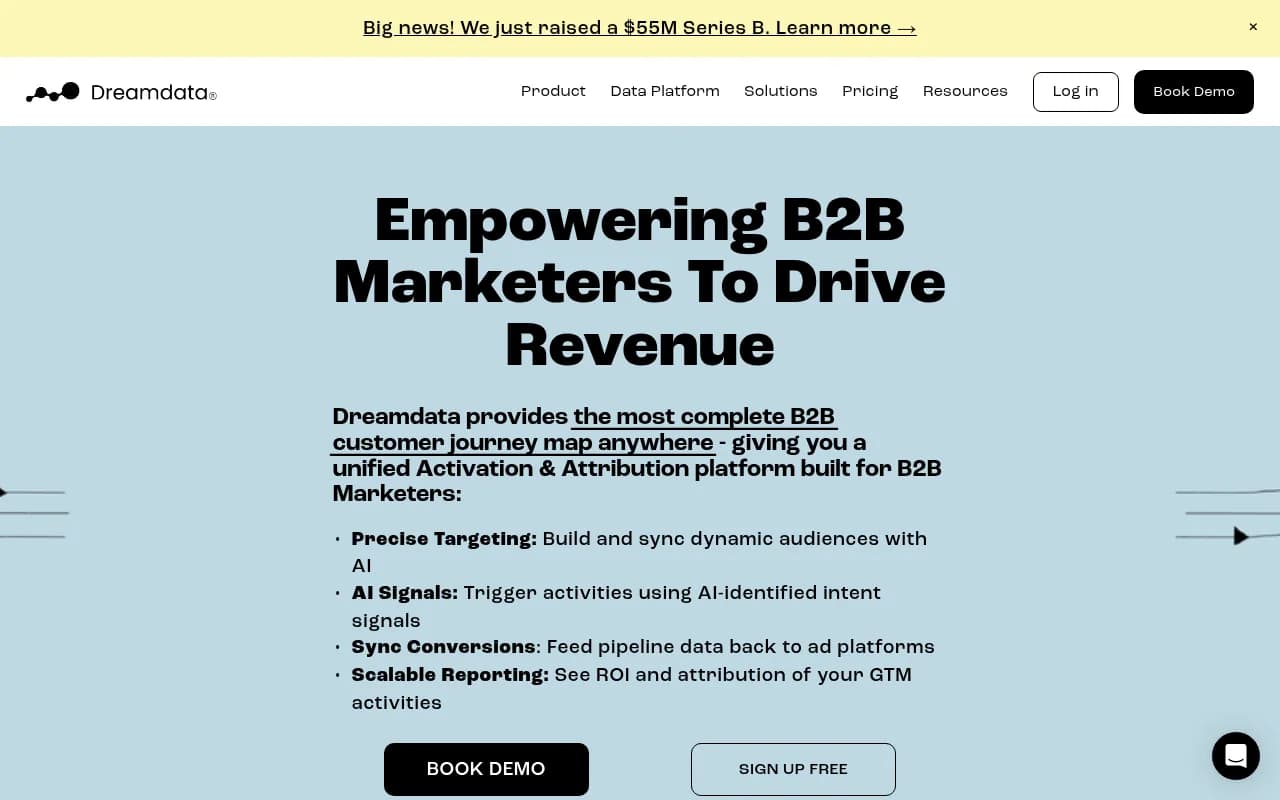
Dreamdata is a B2B Activation & Attribution Platform built for marketers who need to prove marketing's impact on revenue. It maps complete customer journeys across 70+ touchpoints, provides AI-powered attribution modeling, builds precise audiences for ad platforms, and syncs offline conversions back
Key Takeaways
- Dreamdata is a B2B attribution and activation platform that maps complete customer journeys and connects marketing activities to pipeline and revenue -- solving the problem of proving marketing ROI in complex B2B sales cycles
- Core strengths: interactive customer journey timelines, AI-powered attribution across multiple models, audience building and syncing to ad platforms (LinkedIn, Google, Meta), offline conversion syncs, and AI intent signals that alert sales teams
- Best for: B2B marketing teams at SaaS companies, agencies managing multiple clients, and enterprise marketing ops teams who need to connect fragmented data sources and prove marketing's revenue impact
- Pricing starts at $599/month with a free tier available for basic activation features
- Limitations: focused exclusively on B2B (not suitable for B2C or ecommerce), requires technical setup for full value, and pricing can be steep for smaller teams
Dreamdata is a B2B attribution and activation platform built by a Danish company that's been operating since around 2018. The core problem it solves: in B2B sales, 70% of the customer journey happens before a sales rep ever talks to a prospect. Marketing touches happen across months (sometimes years), involve multiple people at the buying company, and span dozens of channels -- LinkedIn ads, organic search, webinars, content downloads, email nurture, sales outreach, product trials. Traditional analytics tools like Google Analytics or even marketing automation platforms can't stitch this together at the account level. Dreamdata does.
The platform is used by thousands of B2B companies including recognizable names like Miro, Supermetrics, and Whereby. It's particularly popular with SaaS companies running account-based marketing (ABM) programs and marketing teams that need to justify budget by showing which channels and campaigns actually drive pipeline and revenue.
What Dreamdata Actually Does
At its core, Dreamdata is a data aggregation and activation engine. It pulls data from 70+ sources -- your CRM (Salesforce, HubSpot, Pipedrive), ad platforms (LinkedIn, Google, Meta, Twitter), marketing automation (Marketo, Pardot, ActiveCampaign), analytics tools (Google Analytics, Segment), product usage data, and more. It then stitches all these touchpoints together at the account level (not just individual leads) to build a complete timeline of how a company moved from anonymous visitor to closed deal.
This is harder than it sounds. B2B buying involves multiple people from the same company hitting your site from different devices, some identified (filled out a form) and some anonymous. Dreamdata uses a combination of first-party tracking (a JavaScript snippet you install), reverse IP lookup to identify companies from anonymous traffic, and data enrichment to connect the dots. The result is an interactive customer journey timeline that shows every touch -- which ads they clicked, which blog posts they read, which webinars they attended, when they requested a demo, when they went into a sales pipeline stage, and when they closed.
Customer Journey Mapping
The customer journey view is the heart of the platform. For any account in your CRM, you can pull up a visual timeline that shows every interaction chronologically. This isn't just a list of form fills -- it includes anonymous website visits (identified by company), ad impressions and clicks, email opens, content downloads, sales calls logged in your CRM, product trial activity, and more. Each touchpoint is timestamped and tagged with the source (organic search, LinkedIn ad, direct traffic, etc.).
This is useful for several reasons. Sales teams can see what a prospect has been researching before a call. Marketing can see which content actually influenced a deal. Leadership can understand the typical path to purchase and how long it takes. The average B2B customer journey in Dreamdata's data spans 90-120 days and involves 20-30 touchpoints, though this varies wildly by deal size and industry.
Attribution Modeling
Dreamdata offers multiple attribution models to assign credit for pipeline and revenue back to marketing activities. The options include first-touch (credit the first interaction), last-touch (credit the last interaction before conversion), linear (equal credit to all touches), time-decay (more credit to recent touches), U-shaped (credit first and last touches more), W-shaped (credit first touch, lead creation, and opportunity creation), and custom models you can configure.
The platform also has an AI-powered attribution model that uses machine learning to weight touchpoints based on their actual influence on conversion. This is trained on your historical data -- it looks at which touchpoints are present in deals that close vs deals that don't, and assigns credit accordingly. In practice, this often reveals that certain content pieces or ad campaigns are more influential than you'd guess from last-touch attribution.
Attribution reports break down by channel (organic search, paid social, email, etc.), campaign, content piece, and even individual ad creative. You can see metrics like cost per opportunity, cost per closed deal, return on ad spend (ROAS), and pipeline influenced. This is where Dreamdata shines compared to tools like Google Analytics -- it connects ad spend all the way through to closed revenue in your CRM, not just to form fills or MQLs.
Audience Hub and Ad Platform Syncing
One of Dreamdata's newer and more powerful features is Audience Hub. This lets you build custom audiences using all your go-to-market data, then sync those audiences directly to ad platforms like LinkedIn, Google Ads, Meta, and Twitter. The audiences update daily, so as accounts move through your funnel or exhibit new behaviors, they automatically get added or removed from ad targeting.
For example, you could build an audience of "accounts that visited our pricing page in the last 30 days but haven't requested a demo" and target them with a retargeting campaign on LinkedIn. Or "accounts in our CRM marked as 'high fit' but not yet engaged" and run an awareness campaign. Or "customers who haven't logged into the product in 60 days" for a re-engagement campaign. The audience builder is visual and flexible -- you can combine filters for firmographics (company size, industry), behavior (pages visited, content downloaded), CRM stage, product usage, and more.
This is a big deal because most B2B marketers are stuck manually exporting lists from their CRM or marketing automation tool, uploading them to ad platforms, and hoping they stay current. Dreamdata automates this and makes it dynamic. It also means you can target based on data that lives in multiple systems -- for example, "accounts that attended a webinar (marketing automation data) and are in the 'consideration' stage (CRM data) and have visited the product page 3+ times (web analytics data)".
Offline Conversion Syncing
Dreamdata also syncs offline conversions back to ad platforms. This means when a lead becomes an opportunity in your CRM, or when an opportunity closes as a deal, Dreamdata sends that event back to LinkedIn, Google, Meta, etc. as a conversion. This allows the ad platforms' algorithms to optimize for pipeline and revenue, not just form fills or clicks.
In practice, this makes a huge difference. If you're only optimizing LinkedIn ads for "lead form submissions", the algorithm will find people who fill out forms -- but those might not be high-quality leads that turn into deals. If you optimize for "opportunity created" or "deal closed", the algorithm learns which audiences and creatives actually drive revenue and adjusts bidding and targeting accordingly. Dreamdata handles the technical plumbing to make this work -- it maps your CRM stages to conversion events and syncs them daily.
AI Intent Signals (Reveal)
Dreamdata's Reveal feature uses AI to surface high-intent signals from your customer journey data. The AI engine looks at patterns across all your accounts -- which behaviors and touchpoint combinations are most predictive of conversion -- and then flags accounts exhibiting those patterns in real-time.
For example, it might learn that "accounts that visit the pricing page, download a case study, and return to the site within 7 days" have a 60% chance of requesting a demo. When a new account exhibits that pattern, Reveal sends an alert to Slack or Microsoft Teams so your sales team can reach out while the intent is hot. This is more sophisticated than simple threshold alerts ("visited 5 pages") because it's trained on your actual conversion data and identifies non-obvious patterns.
Reveal also surfaces accounts that are showing buying intent but haven't yet entered your CRM -- these are anonymous companies visiting your site repeatedly, engaging with content, but not yet identified. This gives sales a heads-up to do outbound outreach before a competitor gets there.
Data Platform and Integrations
Dreamdata integrates with 70+ tools across CRM, marketing automation, ad platforms, analytics, product analytics, support, and more. The big ones: Salesforce, HubSpot, Pipedrive, Marketo, Pardot, ActiveCampaign, LinkedIn Ads, Google Ads, Meta Ads, Twitter Ads, Google Analytics, Segment, Mixpanel, Intercom, Zendesk, Stripe. Most integrations are one-click OAuth connections that sync data automatically.
The platform also has a JavaScript tracking snippet you install on your website to capture first-party behavioral data. This tracks page views, sessions, and events (like button clicks or video plays) at the visitor level, then ties them to accounts using reverse IP lookup and form submissions. The tracking is cookieless and privacy-compliant (GDPR, CCPA) -- it doesn't rely on third-party cookies that are being phased out.
Dreamdata's data model is built around accounts, not individual leads. This is the key difference from tools like Google Analytics or even HubSpot. In B2B, multiple people from the same company interact with your marketing, and you need to see the aggregate picture at the account level to understand buying intent. Dreamdata automatically groups individuals into accounts using domain matching, enrichment data, and CRM linkage.
The platform also offers a data warehouse export -- you can sync your Dreamdata data to BigQuery, Snowflake, or Redshift for custom analysis or to feed other tools. There's also a REST API for programmatic access.
Reporting and Dashboards
Dreamdata includes pre-built dashboards for common B2B marketing metrics: pipeline influenced by marketing, revenue influenced by marketing, cost per opportunity, cost per deal, ROAS by channel, campaign performance, content performance, and more. The dashboards are interactive -- you can filter by date range, channel, campaign, account segment, and drill down into individual accounts or touchpoints.
There's also a custom report builder where you can create your own views and save them. Reports can be exported to PDF or CSV, or embedded in other tools via iframe. Dreamdata also integrates with Looker Studio (formerly Google Data Studio) and Tableau for more advanced visualization.
One nice touch: the platform includes benchmark data from thousands of B2B companies. You can see how your metrics (average deal cycle length, number of touchpoints, channel mix, etc.) compare to similar companies in your industry and size range. This helps set realistic expectations and identify areas where you're over or under-indexing.
Who Should Use Dreamdata
Dreamdata is built for B2B marketing teams, particularly at SaaS companies with sales cycles longer than a few weeks. The ideal user is a marketing ops manager, demand gen lead, or CMO who needs to:
- Prove marketing's impact on pipeline and revenue to leadership
- Understand which channels and campaigns are actually driving deals, not just leads
- Build and activate precise audiences for ABM campaigns
- Optimize ad spend by feeding offline conversions back to ad platforms
- Give sales teams visibility into what prospects have been researching
It's especially valuable for companies with complex, multi-touch sales cycles where attribution is hard. If you're running paid ads on LinkedIn, Google, and Meta, doing content marketing, hosting webinars, running email nurture campaigns, and have a sales team doing outreach -- and you want to know which of those activities are actually working -- Dreamdata is built for you.
Company size: Dreamdata works for startups with a few hundred accounts all the way up to enterprises with tens of thousands. The free tier is usable for small teams just getting started with attribution. The paid tiers scale up in data volume, user seats, and advanced features. It's popular with marketing agencies managing multiple clients because you can have separate workspaces for each client.
Who should NOT use Dreamdata: B2C companies, ecommerce brands, or anyone with a transactional sales model where the customer journey is short and simple. Dreamdata is overkill if your sales cycle is a few hours or days and involves a single touchpoint. It's also not a replacement for product analytics (like Mixpanel or Amplitude) -- it tracks marketing and sales touchpoints, not in-app behavior in depth.
Pricing
Dreamdata offers a free tier called Dreamdata Free that includes basic activation features: audience building, conversion syncing, and access to customer journey data for up to 1,000 accounts. This is enough to get started and see value, but lacks advanced attribution models, AI signals, and unlimited data.
Paid plans start at $599/month for the Starter plan, which includes full attribution, up to 10,000 accounts, 5 user seats, and all integrations. The Professional plan is $1,499/month and adds AI attribution, Reveal (intent signals), unlimited accounts, and priority support. There's also an Enterprise plan with custom pricing that includes dedicated customer success, custom data models, and SLA guarantees.
All paid plans come with a free trial (typically 14 days). Annual billing gets you a discount (usually 2 months free). Compared to competitors like HockeyStack ($1,200+/month), Factors.ai ($1,000+/month), or Ruler Analytics ($500+/month), Dreamdata is in the mid-to-high range but offers more depth in customer journey mapping and activation features.
Strengths
- Complete customer journey visibility: The interactive timelines showing every touchpoint at the account level are unmatched. You can see exactly how an account moved from anonymous visitor to closed deal, including anonymous traffic identified by company.
- Account-level data model: Built for B2B from the ground up. Most analytics tools are lead-centric; Dreamdata groups individuals into accounts automatically, which is how B2B buying actually works.
- Audience activation: The ability to build dynamic audiences using all your GTM data and sync them daily to ad platforms is a huge time-saver and unlocks more precise targeting than manual list uploads.
- Offline conversion syncing: Feeding pipeline and revenue data back to ad platforms so they can optimize for real business outcomes (not just form fills) is a game-changer for ad performance.
- Multiple attribution models: Flexibility to compare first-touch, last-touch, linear, time-decay, U-shaped, W-shaped, and AI-powered attribution side-by-side. Most tools lock you into one model.
- AI intent signals: Reveal's ability to surface high-intent accounts based on behavioral patterns (not just simple thresholds) helps sales prioritize outreach.
- 70+ integrations: Connects to all the major tools in the B2B marketing stack with mostly one-click setup. Data syncs automatically.
Limitations
- B2B-only focus: If you're in B2C, ecommerce, or have a transactional sales model, Dreamdata isn't built for you. It's laser-focused on complex B2B sales cycles.
- Setup complexity: Getting full value requires connecting multiple data sources (CRM, ad platforms, marketing automation, analytics) and installing tracking code. The initial setup can take a few hours to a few days depending on your stack.
- Pricing: At $599+/month, it's not cheap for smaller teams or early-stage startups. The free tier is limited, and you need a paid plan to access advanced attribution and AI features.
- Learning curve: The platform is powerful but has a lot of features. It takes time to learn how to build audiences, interpret attribution reports, and configure AI signals. Onboarding and training are important.
- Reverse IP accuracy: Like all tools that use reverse IP lookup to identify anonymous companies, accuracy isn't 100%. Small companies, remote workers, and VPN users can be misidentified or missed entirely.
- No built-in CRM: Dreamdata is a data and activation layer on top of your existing CRM, not a replacement. You still need Salesforce, HubSpot, or similar.
Bottom Line
Dreamdata is the best choice for B2B marketing teams that need to prove marketing's impact on revenue and activate their data for smarter campaigns. If you're running multi-touch campaigns across paid ads, content, email, and sales outreach -- and you're tired of guessing which activities actually drive deals -- Dreamdata gives you the visibility and tools to know and act on it. The customer journey mapping is best-in-class, the attribution models are flexible and trustworthy, and the audience activation features save hours of manual work while improving targeting precision. It's not cheap and requires some setup effort, but for B2B marketers managing serious budgets and complex sales cycles, it pays for itself quickly in better ad performance and clearer ROI reporting.
Tags:
Frequently asked questions
What is Dreamdata and what does it do?
How much does Dreamdata cost?
Is Dreamdata free to use?
Who is Dreamdata best for?
What are the key features of Dreamdata?
What are the limitations of Dreamdata?
What companies use Dreamdata?
How does Dreamdata help with B2B attribution?
Similar and alternative tools to Dreamdata