Key takeaways
- 73% of B2B buyers use AI tools like ChatGPT and Perplexity during their research process, but most companies have no idea which content is being cited -- or if they're being cited at all.
- ChatGPT and Perplexity behave very differently: ChatGPT drives brand recall at scale but almost no direct clicks, while Perplexity's inline citations convert at 11x the rate of traditional organic search.
- Citation tracking requires a combination of prompt monitoring, crawler log analysis, and traffic attribution -- not just checking if your domain shows up once.
- The content formats that get cited differ by platform: ChatGPT favors comprehensive, structured content with clear hierarchical headings; Perplexity rewards freshness, comparison tables, and Reddit-validated expertise.
- Dedicated AI visibility platforms like Promptwatch go beyond tracking to show you exactly which prompts you're missing and help you create content to close those gaps.
Why B2B companies are flying blind in AI search
Here's the uncomfortable reality: your buyers are asking ChatGPT "what's the best [your category] tool for [their use case]" right now. And you probably don't know if your brand comes up, what it says about you, or which piece of content triggered the mention.
Traditional analytics can't tell you this. Google Search Console shows you organic clicks. Your CRM shows you form fills. But the growing layer of AI-mediated research -- where a buyer asks Perplexity to compare vendors, reads a summary, and then types your brand name directly into Google -- leaves almost no trace in conventional tools.
A benchmark study analyzing 50 B2B SaaS brands across 1,400 buyer-intent prompts in ChatGPT, Perplexity, Claude, and Gemini found that most brands had significant citation gaps: they appeared for some prompts but were completely absent from others where competitors dominated. The brands that knew about these gaps could fix them. The ones that didn't were losing deals they never knew were in play.
This guide walks through how citation tracking actually works, what the data tells us about ChatGPT vs. Perplexity, and which tools and tactics B2B teams should be using in 2026.
How ChatGPT and Perplexity cite sources differently
Before you can track citations, you need to understand what you're tracking. ChatGPT and Perplexity are architecturally different, and they reward different things.
ChatGPT: brand recall, not referral traffic
ChatGPT commands roughly 87.4% of all AI chatbot referral volume. That's a massive reach number. But here's the catch: ChatGPT rarely shows inline links in its responses. When it cites your brand, it's building awareness and influencing purchase decisions -- but it's not sending a trackable click.
The pipeline impact is real, it's just indirect. A buyer asks ChatGPT to recommend project management tools for enterprise sales teams, gets your brand mentioned alongside two competitors, and then searches for your brand directly three days later. That shows up in your analytics as branded direct traffic. The ChatGPT mention is invisible.
What ChatGPT tends to cite:
- Comprehensive, Wikipedia-style content with clear factual claims
- Sections structured with H1→H2→H3 hierarchy
- Statistics with proper attribution and methodology
- Content that has been updated recently with visible recency signals
- Domains with strong brand authority and cross-platform entity consistency
Perplexity: lower volume, much higher intent
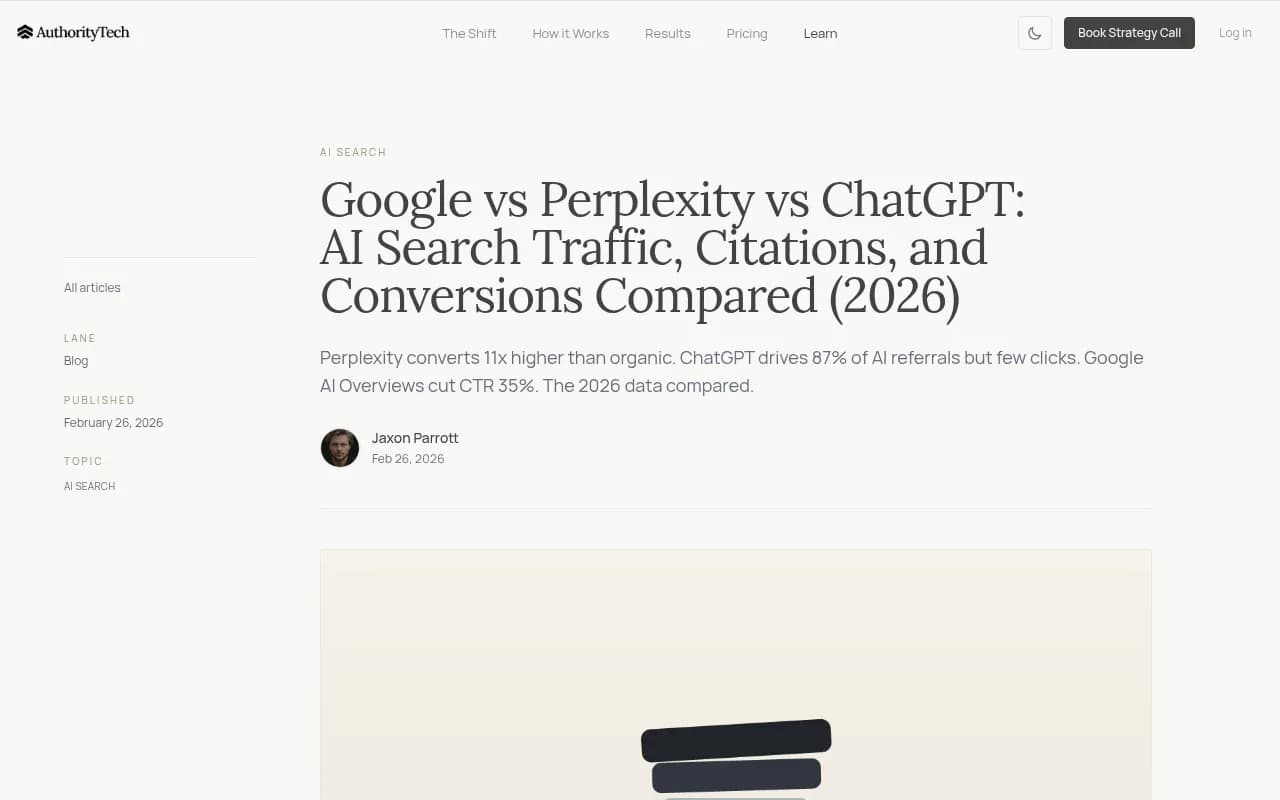
Perplexity drives 15-20% of AI referral volume -- far less than ChatGPT. But its inline citation format means every mention comes with a clickable link. And those clicks convert at 11x the rate of traditional organic search, according to data from AuthorityTech's 2026 B2B pipeline analysis.
The reason is intent. Someone using Perplexity to research B2B software is typically deeper in their research process. They're comparing specific options, not just exploring a category. When Perplexity cites your comparison page or pricing guide, the person clicking it is close to a decision.
What Perplexity tends to cite:
- Content with real-time freshness signals (recently published or updated)
- Comparison tables with extractable data
- Short, direct lead paragraphs (40-60 words) that answer the question immediately
- Reddit community discussions that validate your brand's reputation
- Authentic expertise signals rather than institutional authority markers
Platform comparison at a glance
| Platform | Share of AI referral volume | Citation format | Primary pipeline impact | Key content signals |
|---|---|---|---|---|
| ChatGPT | ~87.4% | Inline text mentions (no links) | Brand recall, purchase influence | Authority, structure, statistics |
| Perplexity | 15-20% | Inline linked citations | Direct high-intent traffic | Freshness, comparison tables, Reddit |
| Google AI Overviews | Variable | Featured snippets, structured data | Replaces organic clicks (-35% CTR) | E-E-A-T, schema markup, top-10 rankings |
| Claude | Growing | Text mentions, occasional links | Research-phase influence | Depth, accuracy, sourcing |
| Gemini | Growing | Mixed format | Brand awareness | Multi-modal, entity consistency |
The three layers of citation tracking
Tracking AI citations properly requires three distinct data streams. Most companies only look at one -- and usually the least useful one.
Layer 1: Prompt monitoring (what AI says about you)
This is the most direct form of citation tracking. You define a set of prompts that your buyers would realistically ask -- "best CRM for mid-market B2B", "how to automate sales outreach", "compare [your category] tools" -- and you run those prompts across ChatGPT, Perplexity, Claude, Gemini, and other models on a regular schedule.
For each response, you track:
- Whether your brand is mentioned
- Whether a specific page is cited with a link
- The sentiment and context of the mention (positive recommendation vs. passing reference)
- Which competitors appear in the same response
- How your visibility changes over time
Doing this manually is possible but doesn't scale. A B2B company with 50 relevant prompts across 5 AI models is looking at 250 queries per tracking cycle, and you need to run them frequently enough to catch changes. Most teams use a dedicated platform for this.
Promptwatch handles this at scale -- tracking across 10 AI models, with prompt volume estimates and difficulty scores so you can prioritize which prompts are worth winning.

Tools like Profound, AthenaHQ, and Otterly.AI also do prompt monitoring, though they differ significantly in depth. A quick comparison:
| Tool | Models tracked | Prompt volume data | Content gap analysis | Content generation | Crawler logs |
|---|---|---|---|---|---|
| Promptwatch | 10 | Yes | Yes | Yes (AI writing agent) | Yes |
| Profound | 6-8 | Limited | No | No | No |
| AthenaHQ | 8+ | No | No | No | No |
| Otterly.AI | 4-5 | No | No | No | No |
| Peec AI | 5+ | No | No | No | No |




Layer 2: Crawler log analysis (what AI reads on your site)
This one is underused and genuinely valuable. AI engines like ChatGPT (GPTBot), Perplexity (PerplexityBot), and Claude (ClaudeBot) crawl your website before they can cite it. Your server logs record every visit from these crawlers -- which pages they read, how often they return, and whether they encounter errors.
Crawler log analysis tells you:
- Which pages AI engines are actually reading (vs. which ones you think they're reading)
- Pages that return errors to AI crawlers, preventing citation
- How crawl frequency correlates with citation frequency
- Whether your robots.txt is accidentally blocking AI crawlers
Most SEO teams have never looked at their AI crawler logs. It's a quick win -- you might find that your most important product pages are returning 404s to GPTBot, which explains why ChatGPT never mentions them.
Promptwatch includes real-time AI crawler logs as part of its Professional and Business plans. DarkVisitors is a free tool worth checking for understanding which AI agents are hitting your site.
Layer 3: Traffic attribution (what AI sends to your site)
This is where citation tracking connects to revenue. Even when ChatGPT doesn't send direct clicks, AI visibility influences downstream behavior -- branded searches, direct visits, and accelerated conversion rates.
Three methods for attributing AI-influenced traffic:
Direct referral tracking: Perplexity, Claude, and some other AI tools do send HTTP referrers. Setting up UTM-aware referral tracking in your analytics will capture these. Look for referrers from perplexity.ai, claude.ai, and similar domains.
Branded search uplift: When ChatGPT mentions your brand, you'll often see a spike in branded Google searches 24-72 hours later. Correlating your ChatGPT citation data with branded search volume in Google Search Console can reveal this relationship.
Server log analysis: The most complete method. Your server logs show every request, including the full referrer string and user agent. AI-referred sessions often have distinctive patterns that standard analytics miss.
Platforms like Promptwatch offer all three attribution methods (code snippet, GSC integration, and server log analysis) to close the loop between AI visibility and actual revenue.
What content actually gets cited
The research is fairly consistent on this. Across both ChatGPT and Perplexity, certain content patterns get cited far more often than others.
Structured, extractable answers
Both platforms favor content that answers a specific question in the first 40-60 words of a section, then provides supporting detail. Think of it as writing for a reader who might only read the first sentence of each paragraph -- because that's essentially how LLMs extract content.
A blog post that buries its answer in paragraph four, after three paragraphs of context-setting, is harder to cite accurately. A page that leads with "X is [clear definition/answer]" and then elaborates is much easier.
Statistics with sourcing
Vague claims don't get cited. "Many B2B companies struggle with X" is useless to an AI model trying to give an accurate answer. "73% of B2B buyers now use AI tools in their research process (Passionfruit Labs, 2025)" is citable.
If your content makes factual claims, attribute them. If you have proprietary data, publish it with methodology. Original research is one of the highest-value citation magnets in B2B content.
Comparison content
Perplexity in particular loves comparison tables. "X vs. Y" pages, "best tools for [use case]" listicles, and feature comparison matrices all perform well. This makes sense -- comparison queries are extremely common in B2B research ("compare Salesforce vs. HubSpot for mid-market"), and a page with a clean comparison table is easy to extract from.
Freshness signals
Perplexity weights recency heavily. A page published in 2022 that hasn't been updated will lose to a page published in 2025 on the same topic, even if the older page has more backlinks. For B2B companies, this means regularly updating your most important pages with current data, not just publishing new content.
Third-party validation
All three major AI platforms disproportionately cite brands with strong independent coverage. If authoritative third parties (industry publications, analyst reports, review sites like G2 and Capterra, Reddit communities) mention your brand positively, AI models are more likely to cite you. This is the "machine relations" insight: AI engines cite brands that humans already cite.
A practical citation tracking workflow for B2B teams
Here's a realistic weekly process that doesn't require a full-time analyst.
Step 1: Define your prompt set (one-time, 2-3 hours)
Write out 30-50 prompts that represent how your buyers actually research your category. Include:
- Category-level prompts ("best [category] software for [company size]")
- Problem-based prompts ("how to solve [pain point your product addresses]")
- Comparison prompts ("X vs. Y vs. Z")
- Feature-specific prompts ("which tools have [specific feature]")
Step 2: Set up automated monitoring (one-time, 1-2 hours)
Load your prompts into a tracking platform. At minimum, track ChatGPT and Perplexity. Add Claude and Gemini if your buyers are likely to use them.
Step 3: Weekly review (30 minutes)
Check your visibility scores across models. Flag any prompts where competitors appear but you don't. Note any new pages that started getting cited.
Step 4: Gap analysis (monthly, 1-2 hours)
For prompts where you're invisible, look at what content competitors have that you don't. Is it a comparison page? A specific use case guide? A statistics roundup? This becomes your content backlog.
Step 5: Create and track (ongoing)
Publish content targeting your gap prompts. Track whether your citation rate improves over the following 4-8 weeks. Perplexity tends to pick up new content faster than ChatGPT, so you'll often see Perplexity results move first.
Tools worth knowing about
Beyond Promptwatch, several other tools are worth evaluating depending on your team's needs and budget.
For monitoring-focused teams:
For teams that want to track Reddit and community signals:
Reddit discussions directly influence Perplexity citations. Monitoring what's being said about your brand and category on Reddit is genuinely useful, not just a nice-to-have.
For enterprise teams with complex attribution needs:
These B2B attribution platforms can help you model the indirect pipeline impact of AI visibility -- connecting the dots between a ChatGPT brand mention and a closed deal weeks later.
For teams starting from scratch:
These are more affordable entry points for basic monitoring. You won't get content gap analysis or crawler logs, but you'll at least know where you stand.
Common mistakes B2B companies make with citation tracking
Tracking only branded queries. "What is [your brand]?" is not how buyers discover you. Track category and problem-based prompts, not just your brand name.
Checking once and declaring victory. AI citation patterns change as models update and as competitors publish new content. Citation tracking is a continuous process, not a one-time audit.
Ignoring the content-citation connection. Knowing you're not cited is only useful if you act on it. The teams getting results from AI visibility work are the ones who use citation data to drive their content calendar.
Optimizing for one platform only. ChatGPT and Perplexity require different content strategies. A page optimized purely for ChatGPT (long, comprehensive, authority-focused) might underperform on Perplexity compared to a shorter, fresher page with a comparison table.
Forgetting about crawler access. If GPTBot or PerplexityBot can't crawl your pages, you won't get cited regardless of how good your content is. Check your robots.txt and review your crawler logs.
Where to start
If you're a B2B marketing or SEO team that hasn't done any AI citation tracking yet, the honest answer is: start simple and build from there.
Run your 10 most important buyer prompts manually in ChatGPT and Perplexity today. Note which competitors appear. Note whether you appear. That 20-minute exercise will tell you more about your AI visibility than most companies know.
Then set up automated tracking so you're not doing that manually every week. The platforms in this guide range from affordable entry-level tools to enterprise-grade platforms with full attribution. Pick one that matches where you are now, not where you hope to be in two years.
The brands winning in AI search in 2026 aren't necessarily the ones with the biggest budgets. They're the ones who figured out the citation loop first: track what's missing, create content that fills the gap, confirm it's working. That cycle compounds quickly once you get it running.