Key takeaways
- Ceyo AI, Otterly.AI, and Peec.ai are all legitimate monitoring tools -- they track brand mentions, citations, and sentiment across AI engines. But monitoring is where they stop.
- Knowing you're invisible in ChatGPT doesn't help unless you know why and can do something about it. Most teams using monitoring-only tools end up with dashboards full of data and no clear next step.
- The gap between "we can see the problem" and "we fixed the problem" is where most GEO efforts stall in 2026.
- Platforms that close the loop -- finding content gaps, generating optimized content, and tracking results -- produce measurably better outcomes than pure trackers.
- If your team is already using a monitoring tool and feeling stuck, the issue probably isn't the data. It's that the tool was never designed to help you act on it.
The problem with knowing you're invisible
Here's a scenario that's playing out in marketing teams everywhere right now. Someone sets up an AI visibility tracker, runs their brand through a dozen prompts, and discovers that ChatGPT recommends three competitors but never mentions them. The dashboard shows a visibility score of 12%. There's a red bar where there should be a green one.
Then what?
That's the question most monitoring tools can't answer. They were built to surface the problem, not solve it. And in 2026, with AI search eating into traditional organic traffic at a rate that's hard to ignore, "we know we have a problem" is not a strategy.
This isn't a knock on the tools themselves. Ceyo AI, Otterly.AI, and Peec.ai all do what they advertise. The issue is that what they advertise -- monitoring -- is only the first step of a much longer process. Teams that treat visibility tracking as the end goal are stuck in what I'd call the monitoring-only trap.
What these tools actually do well
Before getting into the limitations, it's worth being honest about what each of these platforms does well. None of them are bad tools. They're just incomplete ones.
Ceyo AI
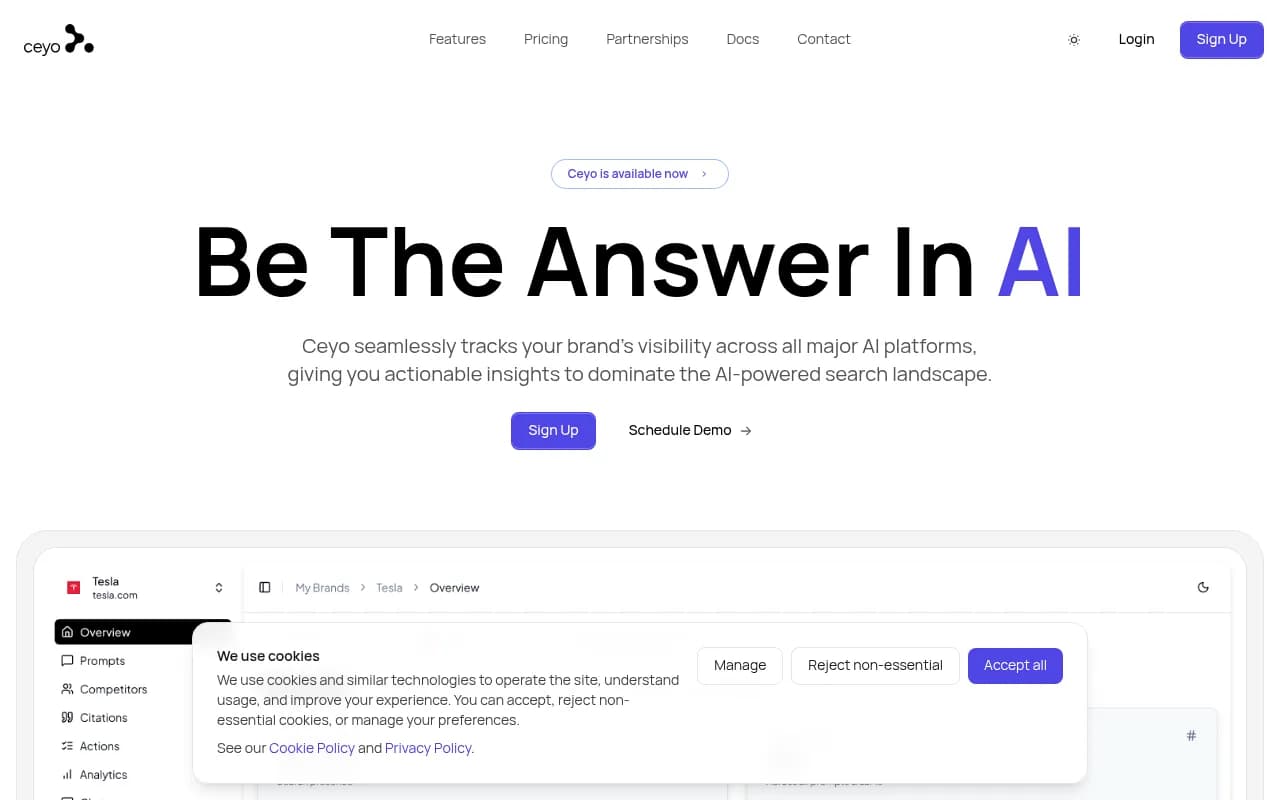
Ceyo AI monitors brand visibility across ChatGPT, Perplexity, Claude, and Gemini. It's clean, relatively affordable, and gives you a quick read on how often your brand shows up in AI-generated responses. Good for teams that are just starting to think about AI search and want a simple way to benchmark where they stand.
Otterly.AI
Otterly.AI goes a bit further. It tracks citations across AI Overviews and various AI modes, and it does some crawlability analysis -- checking whether AI bots can actually access your content. The DEV Community's 2026 overview described it as "designed for teams that want a proactive hub rather than just a passive observer," which is a fair characterization of its ambitions. In practice, though, the action it enables is mostly diagnostic. You can identify that your content isn't being crawled. What to do next is still on you.

Peec.ai
Peec.ai is probably the most reporting-focused of the three. It distinguishes between brand mentions and source citations (an AI might cite your content without naming your brand, or name your brand without citing your content -- these are different problems). It integrates with Looker Studio, which makes it easy to drop into existing reporting workflows. If your job is to produce weekly visibility reports for stakeholders, Peec.ai makes that easier.

Where the monitoring-only model breaks down
The core issue isn't data quality. These tools generally produce accurate data. The issue is what happens after you have the data.
The "now what" problem
A visibility score tells you where you rank in AI responses. It doesn't tell you which specific content gaps are causing the problem, what topics competitors are covering that you're not, or what kind of content would actually get cited by ChatGPT or Perplexity. You're left doing that analysis yourself -- manually reviewing competitor content, guessing at what AI models want to see, and writing content with no feedback loop to tell you if it worked.
That's a lot of work. And it's work that most marketing teams don't have bandwidth for on top of everything else.
The wrong pricing is invisible
One specific failure mode worth calling out: monitoring tools count mentions, but they don't evaluate the quality of those mentions. As LLMClicks.ai noted in their comparison of Otterly and Peec, "neither flags when ChatGPT quotes your wrong pricing." If an AI model is citing your brand but getting the details wrong -- outdated pricing, discontinued products, incorrect feature descriptions -- a visibility score won't surface that. You need something that reads the actual content of AI responses, not just whether your brand name appears.
No content generation means a broken workflow
The workflow for improving AI visibility looks something like this: identify which prompts you're missing, figure out what content would close those gaps, create that content, publish it, and then track whether it gets cited. Monitoring tools handle the first step and the last step. Everything in the middle -- the actual work of improving visibility -- happens outside the tool, in a different system, by a different person, with no direct connection to the data that identified the problem.
This is where teams stall. The insight is in one place. The action is somewhere else. The connection between them is a Slack message or a spreadsheet or a meeting that may or may not happen.
A comparison of what these tools cover
| Feature | Ceyo AI | Otterly.AI | Peec.ai | Promptwatch |
|---|---|---|---|---|
| Brand mention tracking | Yes | Yes | Yes | Yes |
| Citation tracking | Basic | Yes | Yes | Yes |
| Sentiment analysis | Basic | Basic | Yes | Yes |
| AI crawler logs | No | Partial | No | Yes |
| Content gap analysis | No | No | No | Yes |
| AI content generation | No | No | No | Yes |
| Prompt volume/difficulty | No | No | No | Yes |
| Reddit/YouTube insights | No | No | No | Yes |
| ChatGPT Shopping tracking | No | No | No | Yes |
| Traffic attribution | No | No | No | Yes |
| Multi-language/region | Limited | Limited | Yes | Yes |
The pattern is clear. Monitoring tools cover the top of the table. The action-oriented capabilities -- the ones that actually move the needle -- are missing.
The tools that go further
If you're already using one of the monitoring-only platforms and feeling the limitation, there are a few directions you can go.
Platforms with built-in content optimization
Promptwatch is the most complete option in this category. It runs the full loop: Answer Gap Analysis shows you exactly which prompts competitors rank for that you don't, a built-in AI writing agent generates content designed to get cited (not generic SEO content -- articles grounded in 880M+ citations analyzed), and page-level tracking shows whether the new content is actually working. It also has AI crawler logs, which show you in real time which pages ChatGPT, Claude, and Perplexity are reading and which ones they're ignoring. That's the kind of data that turns a visibility problem into a fixable technical issue.

Other tools worth knowing
If you want something more focused on specific parts of the workflow, a few other platforms are worth considering:
Profound is strong on enterprise-grade tracking and has more depth than the basic monitoring tools, though it's priced accordingly.

AthenaHQ tracks visibility across 8+ AI engines and has solid reporting, though it's still primarily a monitoring platform without content generation.

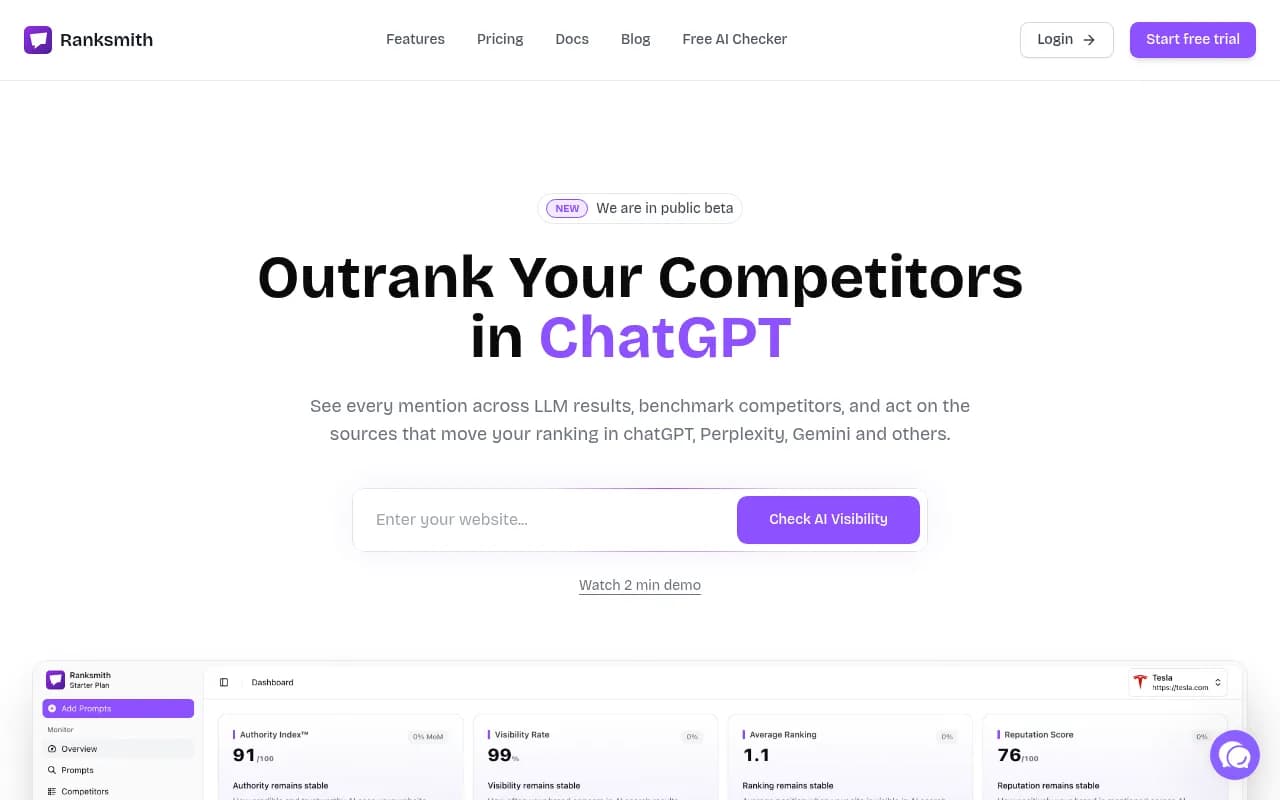
Ranksmith positions itself around actionable insights rather than raw data, which is a step in the right direction.
For teams that want to keep their monitoring tool but add a content layer on top, pairing something like Peec.ai with a dedicated GEO content tool is a reasonable interim approach. It's just more workflow overhead than having everything in one place.
Why this matters more in 2026 than it did last year
AI search traffic is no longer a rounding error. Perplexity's user base has grown significantly. ChatGPT's search features are now embedded in the default experience for millions of users. Google's AI Overviews appear on a substantial portion of queries. The brands that show up in those responses are getting real traffic. The ones that don't are losing it to competitors who figured this out earlier.
The monitoring-only tools were fine when AI search was a curiosity worth keeping an eye on. At this point, it's a channel that requires active management -- which means the tools need to support active management, not just passive observation.
There's also a compounding effect worth thinking about. AI models learn from the content they crawl. If your competitors are publishing content specifically engineered to get cited, and you're not, the gap widens over time. Watching that gap widen on a dashboard is demoralizing. Having a system that helps you close it is a different experience entirely.
How to evaluate whether your current tool is enough
A few questions worth asking about whatever AI visibility tool you're currently using:
When you find a prompt where competitors are visible and you're not, does the tool tell you why? Not just that the gap exists, but what content is missing, what topics aren't covered, what angle your site hasn't taken?
When you want to create content to close a gap, does the tool help you do that -- or do you have to switch to a different system with no connection to the visibility data?
When you publish new content, can you track whether it gets cited? Not just whether your overall visibility score improves, but which specific pages are being referenced by which AI models?
If the answer to any of those is "no" or "I have to do that manually," you're in the monitoring-only trap. The data is there. The path from data to action isn't.
The bottom line
Ceyo AI, Otterly.AI, and Peec.ai are reasonable starting points for teams that are new to AI visibility and want to understand where they stand. They're not the right long-term solution for teams that actually want to improve their standing.
The monitoring-only model made sense when AI search was new and the primary goal was awareness. In 2026, the goal is performance -- showing up in ChatGPT's recommendations, getting cited in Perplexity responses, appearing in Google AI Overviews. That requires a different kind of tool. One that doesn't just show you the problem, but helps you fix it.