Ceyo AI Review 2026
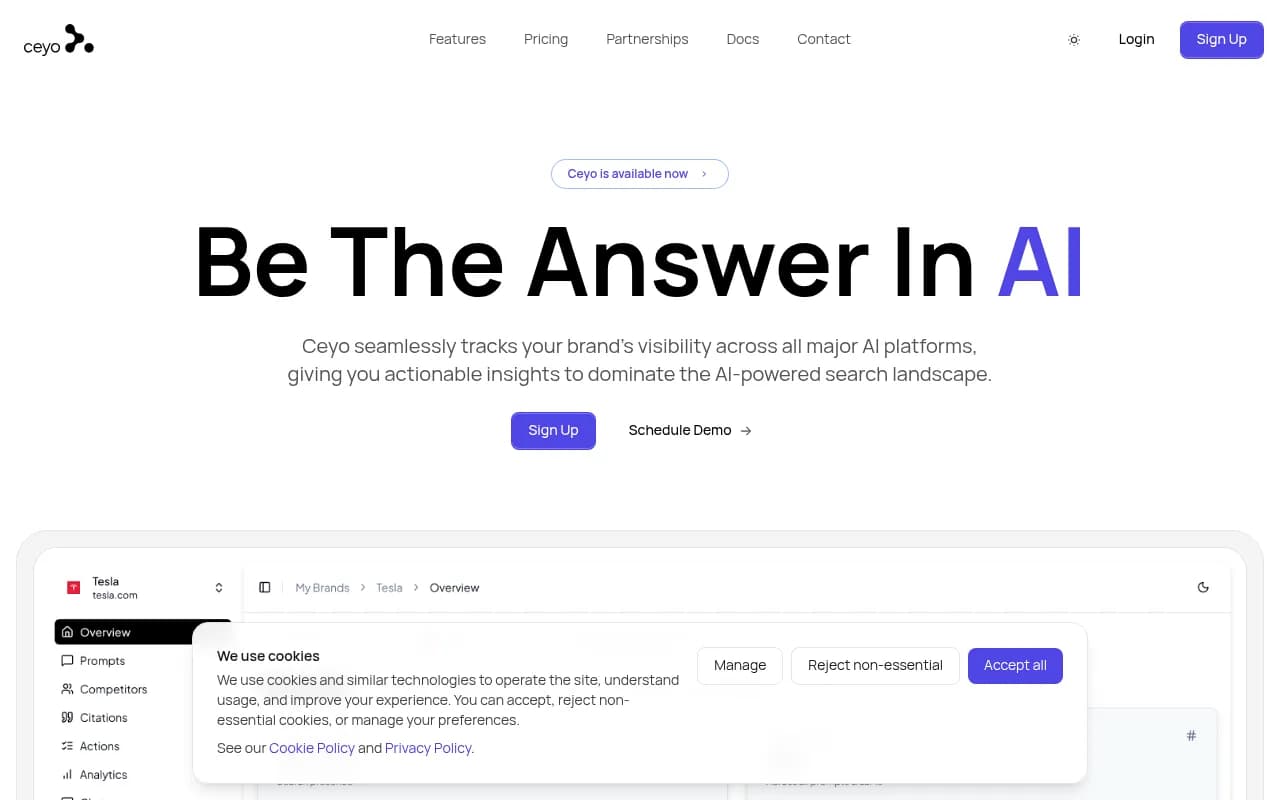
Ceyo tracks how your brand appears in AI-generated search results across major language models like ChatGPT, Gemini, Claude, and Perplexity. Built for marketing teams and agencies, it monitors brand mentions, sentiment, and competitive positioning in LLM responses with real-time alerts and actionable recommendations.
Summary
- Monitoring-only platform -- tracks brand mentions in ChatGPT, Gemini, Claude, Perplexity, and Grok but lacks content generation, AI crawler logs, and traffic attribution that Promptwatch offers
- Best for: Marketing teams and agencies that want basic visibility tracking across 5-6 AI models without optimization tools
- Pricing: Starts at $49/mo (Core plan) or $89/mo depending on source, with monthly and yearly billing options
- Key limitation: No content gap analysis, no AI writing agent, no crawler logs, no visitor analytics -- you see where you're invisible but get no help fixing it

Ceyo is a brand monitoring platform for AI search engines. It tracks how your brand appears in responses from ChatGPT, Gemini, Claude, Perplexity, and Grok -- showing you which prompts mention your brand, what sentiment those mentions carry, and how you stack up against competitors. The platform targets marketing teams, SEO specialists, and agencies that want to understand their "Share of Answer" in the AI-powered search landscape.
The company positions itself around the shift from traditional SEO to GEO (Generative Engine Optimization) -- the idea that AI models are becoming the new search engines, and brands need to track their visibility in AI-generated answers the same way they track Google rankings. Ceyo's pitch is straightforward: if ChatGPT or Perplexity recommends your competitor instead of you, you need to know about it.
Prompt Analytics Dashboard
The core feature is a prompt analytics table that shows how your brand performs across thousands of test queries. For each prompt (e.g. "Best laptop for developers", "Top project management tools"), you see:
- Visibility percentage -- how often your brand appears in the response
- Sentiment -- whether mentions are positive, neutral, or negative
- Average position -- where your brand ranks when mentioned
- Impact score -- whether the prompt is high relevance, high volume, or high intent
- Competing brands -- which other brands appear in the same responses
- Category and geography -- what vertical the prompt belongs to and which country it's tracked in
This gives you a snapshot of where you're winning and where you're invisible. If your visibility is 12% on "Top CRM for startups" while HubSpot is at 85%, you know you have a problem. The table format makes it easy to scan hundreds of prompts and prioritize which ones to focus on.
Real-Time Brand Mention Tracking
Ceyo monitors actual LLM responses in real time. You can see the full text of what ChatGPT or Claude says about your brand, which products get mentioned, and how the AI frames your offering. The platform shows example queries like "What's the best laptop for software development?" alongside the AI's response and which brands were cited.
This is useful for brand safety -- if an AI model is giving outdated or incorrect information about your product, you'll catch it. It's also helpful for competitive intelligence: you can see exactly how competitors are being positioned and what language the AI uses to describe them.
AI-Powered Analytics Assistant
Ceyo includes a chatbot interface where you can ask natural language questions about your data. "How is my brand performing on ChatGPT?" or "Which competitors are mentioned most often?" and the assistant pulls insights from your scans. This is a nice quality-of-life feature for executives who want quick answers without digging through dashboards.
The assistant is not a content generation tool -- it's purely for querying your existing data. You can't ask it to write articles or suggest content improvements. It's a reporting layer, not an optimization layer.
Smart Action Plans
The platform generates a prioritized list of recommendations to improve your AI visibility. Examples include:
- Optimize homepage content for AI crawlers (add structured data, clear product descriptions)
- Create a comprehensive FAQ section (answer common questions AI models reference)
- Build industry authority content (publish thought leadership to increase citations)
- Monitor competitor AI mentions (track how competitors appear in responses)
Each action is tagged with an impact level (high/medium/low) and a category (content, strategy, analysis). The action plan updates daily based on your scans. This is helpful for teams that don't know where to start, but the recommendations are generic -- they don't tell you which specific prompts to target or what content gaps exist on your site.
Multi-LLM Coverage
Ceyo tracks 5-6 AI models: ChatGPT, Gemini, Perplexity, Grok, Google AI (including AI Overviews and Gemma). Claude and Copilot are listed as "coming soon". This is narrower than Promptwatch, which monitors 10+ models including DeepSeek, Meta AI, and Mistral.
You can compare how your brand performs across different models. If you're highly visible in ChatGPT but invisible in Perplexity, that tells you where to focus. The platform also supports multi-region tracking -- you can monitor responses in the US, UK, Germany, Netherlands, Singapore, Japan, Australia, Brazil, India, Canada, and France.
Competitive Benchmarking
Ceyo shows which competitors appear alongside your brand in AI responses. You can see their visibility percentages, sentiment scores, and average positions. This is useful for understanding the competitive landscape in AI search, but it's descriptive, not prescriptive -- you see who's winning, but not why or how to catch up.
The platform also surfaces "source intelligence" -- which domains and articles AI platforms cite when mentioning your brand. This helps you understand where the AI is pulling information from, so you can influence the narrative by getting cited in those sources. However, Ceyo doesn't provide Reddit or YouTube tracking, which are major sources of AI training data and real-time citations.
Who Is It For
Ceyo is built for marketing teams, SEO specialists, and agencies that want to monitor brand presence in AI search results. The ideal user is someone who:
- Already understands GEO/AEO and wants a dashboard to track progress
- Manages multiple brands or clients and needs a centralized view of AI visibility
- Has a content team that can act on the insights (because Ceyo doesn't generate content for you)
- Cares about brand safety and wants to catch misinformation in AI responses
It's not for solo founders or small businesses that need hand-holding. The platform assumes you know what to do with the data -- it shows you the problem but doesn't solve it for you. If you're looking for a tool that helps you create content, optimize for AI crawlers, or track actual traffic from AI sources, Ceyo won't get you there.
Integrations & Ecosystem
The website doesn't mention any integrations with Google Search Console, analytics platforms, or content management systems. There's no API documentation or developer resources listed. The platform appears to be a standalone dashboard with no way to export data or connect it to your existing workflows.
This is a significant limitation for agencies or enterprises that need to pull AI visibility data into client reports or internal BI tools. You're locked into Ceyo's interface and reporting format.
Pricing & Value
Ceyo offers a Core plan starting at $49/mo (or $89/mo depending on the source -- the website shows conflicting numbers). There are monthly and yearly billing options, with yearly plans offering a discount. The pricing page mentions "transparent pricing for every stage" and "scale as you grow", suggesting multiple tiers, but specific details aren't provided.
For comparison, Promptwatch starts at $99/mo (Essential plan) and includes 50 prompts, 5 AI-generated articles, crawler logs, and visitor analytics. Ceyo's $49-89/mo entry point is cheaper, but you're getting a monitoring-only tool with no optimization features.
The value proposition depends on what you need. If you just want to track brand mentions and sentiment across a few AI models, Ceyo's pricing is competitive. If you want to actually improve your AI visibility -- with content gap analysis, AI-generated articles, crawler logs, and traffic attribution -- you'll need a more comprehensive platform.
Strengths & Limitations
Strengths:
- Clean, intuitive dashboard that makes it easy to scan hundreds of prompts at once
- Real-time brand mention tracking with full response text and sentiment analysis
- Multi-region support for tracking AI responses in 11+ countries
- Competitive benchmarking shows which brands appear alongside yours and how they're positioned
- Action plan feature gives teams a starting point for improving visibility
Limitations:
- No content generation -- Ceyo doesn't help you create articles, FAQs, or optimized content to improve your AI visibility. You see the gaps but have to fill them yourself.
- No AI crawler logs -- You can't see which AI models are actually crawling your website, what pages they're reading, or whether they're encountering errors. This makes it hard to diagnose indexing issues.
- No traffic attribution -- Ceyo doesn't track whether AI visibility translates into actual website traffic or conversions. You're flying blind on ROI.
- Limited LLM coverage -- 5-6 models vs. Promptwatch's 10+. Missing DeepSeek, Meta AI, Mistral, and full Claude/Copilot support.
- No Reddit or YouTube tracking -- These platforms are major sources of AI citations, and Ceyo doesn't monitor them.
- No prompt volume or difficulty scoring -- You don't know which prompts are high-volume or easy to win, so you can't prioritize effectively.
- No integrations or API -- Data is siloed in Ceyo's dashboard with no way to export or connect to other tools.
- Generic action plans -- Recommendations are high-level and don't tell you which specific content to create or which prompts to target.
Bottom Line
Ceyo is a solid monitoring tool for teams that want to track brand mentions in AI search results. The dashboard is clean, the sentiment analysis is useful, and the competitive benchmarking gives you a sense of where you stand. But it stops at monitoring -- you see the problem, then you're on your own to fix it.
For teams that want optimization, not just tracking, Promptwatch is the stronger choice. It shows you the same visibility data but adds content gap analysis (which prompts competitors rank for that you don't), an AI writing agent (generates articles grounded in citation data), crawler logs (see which AI models are reading your site), and traffic attribution (connect visibility to revenue). Ceyo tells you where you're invisible. Promptwatch helps you become visible.
Best use case: Marketing teams at mid-sized companies that already have a content strategy and just need a dashboard to track AI brand mentions across ChatGPT, Gemini, and Perplexity.
Frequently asked questions
What is Ceyo AI and what does it do?
How much does Ceyo AI cost?
Who is Ceyo AI designed for?
Which AI platforms does Ceyo AI monitor?
What are the main limitations of Ceyo AI?
What metrics does Ceyo AI track?
Does Ceyo AI offer a free plan?
How is Ceyo AI different from Promptwatch?
Similar and alternative tools to Ceyo AI