Key Takeaways
- Ceyo AI starts at $49/mo (Core plan) vs Omnia's pricing on request -- Ceyo is more transparent and accessible for smaller teams
- Ceyo emphasizes prompt-level analytics with detailed sentiment, impact scoring, and category tagging -- Omnia focuses on share of voice and competitive benchmarking
- Omnia includes an AI visibility roadmap that translates tracking data into actionable steps (content creation, technical SEO, placement) -- Ceyo provides recommendations but less structured guidance
- Both track the same 4 core LLMs (ChatGPT, Perplexity, Claude, Gemini) with real-time monitoring and alerts
- Ceyo shows more granular prompt data (average position, relevance scoring, geo-tagging) -- Omnia leans heavier on citation analysis and competitor share of voice
- Omnia offers a free trial and positions itself for SEO/marketing experts -- Ceyo targets marketing teams and agencies with a lower entry price
Overview
Ceyo AI
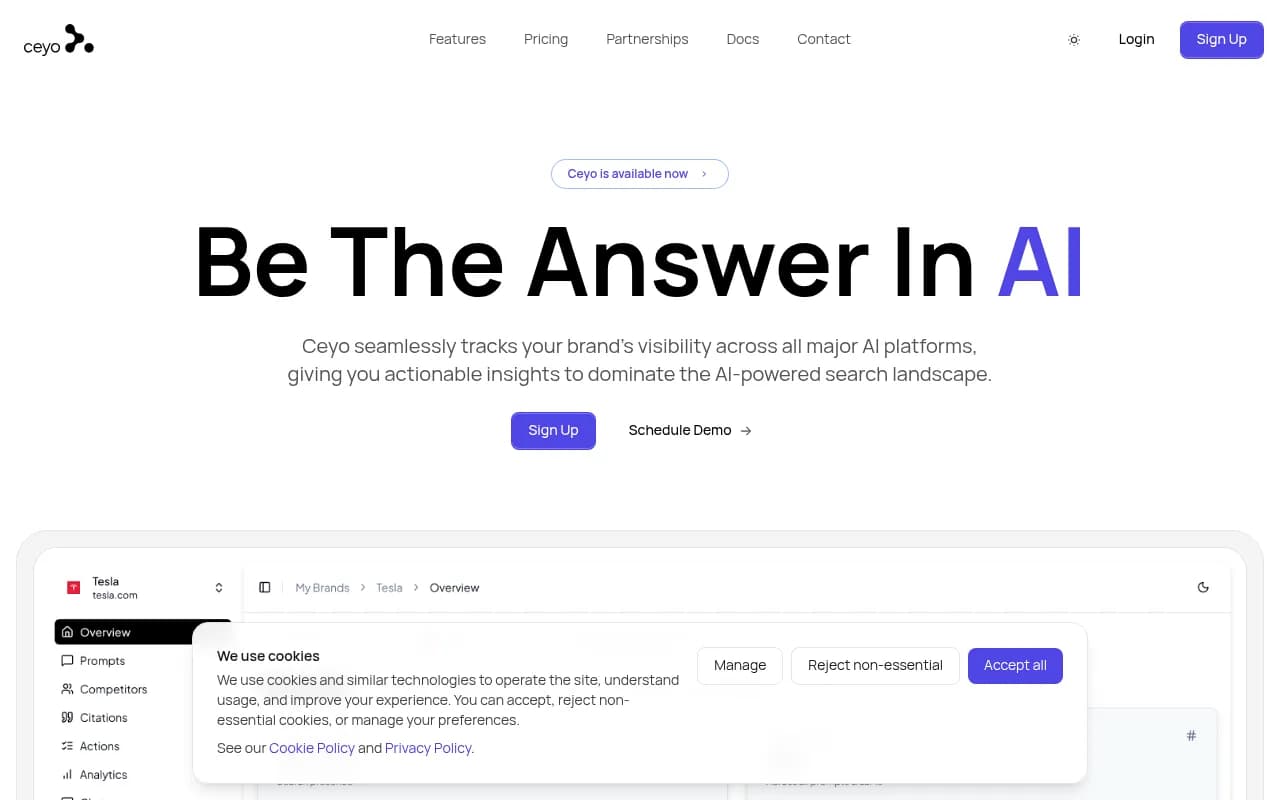
Ceyo tracks how your brand appears in AI-generated search results across ChatGPT, Gemini, Claude, and Perplexity. Built for marketing teams and agencies, it monitors brand mentions, sentiment, and competitive positioning with real-time alerts. The platform emphasizes prompt-level analytics -- you see exactly which queries drive your brand's presence, along with visibility percentages, sentiment scores, average position, impact ratings, and competing brands for each prompt. Ceyo also tags prompts by category and geography, making it easier to spot patterns across regions or product lines.
Pricing starts at $49/mo for the Core plan, with a higher-tier option at $89/mo depending on feature needs. Monthly and yearly billing available.
Omnia
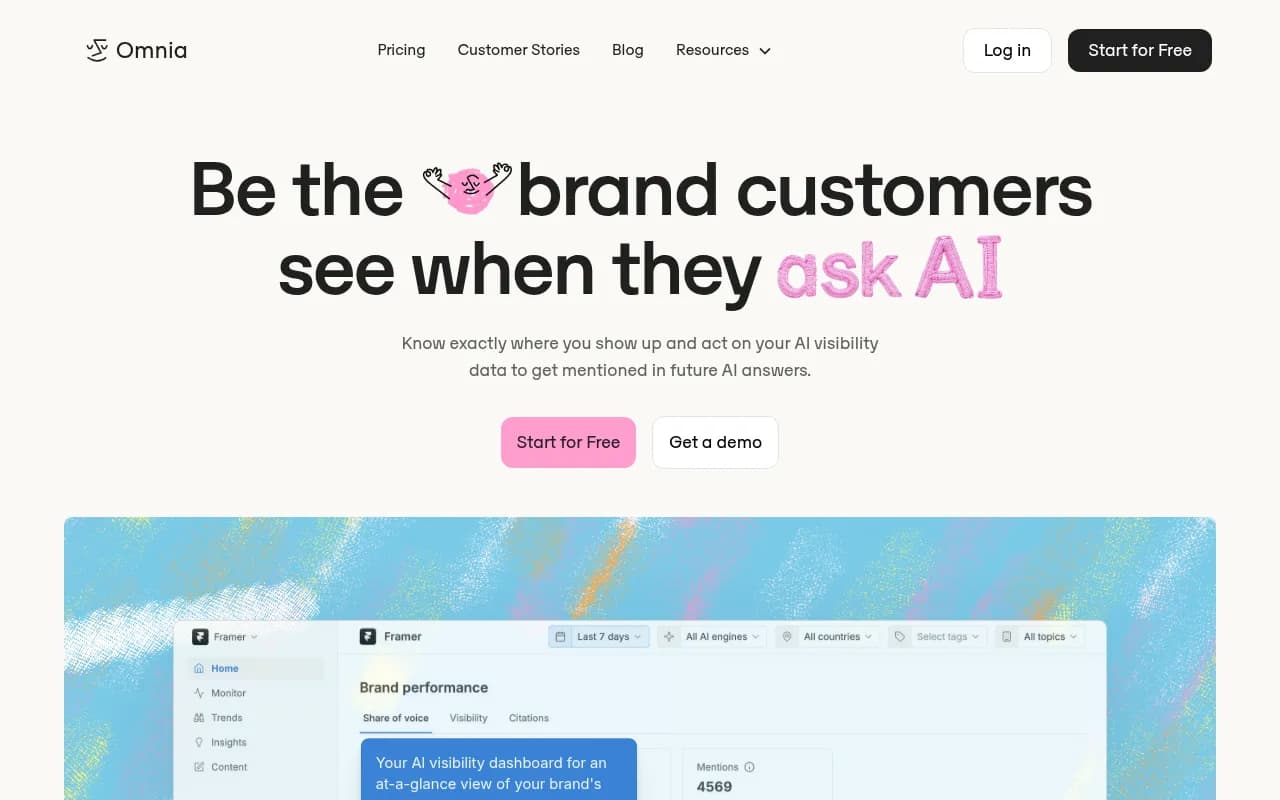
Omnia is an AI visibility platform built for SEO and marketing experts. It monitors citations and mentions across ChatGPT, Perplexity, Gemini, and Microsoft Copilot (note: Ceyo doesn't list Copilot, Omnia doesn't list Claude explicitly in their main copy, though both likely cover similar ground). Omnia's core strength is share of voice analytics -- you see how you stack up against competitors in AI search results, which citations AI engines pull from, and where your brand appears (or doesn't).
What sets Omnia apart is its "AI visibility roadmap" feature: the platform translates tracking data into a step-by-step action plan covering content creation, technical SEO, and content placement. It's designed to close the loop between monitoring and optimization. Pricing is available on request, with a free trial offered and a Pro Plan for advanced features.
Side-by-Side Comparison
| Feature | Ceyo AI | Omnia |
|---|---|---|
| Starting price | $49/mo (Core plan) | Pricing on request |
| Free trial | Not mentioned | Yes |
| LLMs tracked | ChatGPT, Gemini, Claude, Perplexity | ChatGPT, Perplexity, Gemini, Copilot |
| Prompt analytics | Detailed (visibility %, sentiment, avg position, impact, brands, category, geo) | Yes, with share of voice focus |
| Sentiment tracking | Yes (Positive/Neutral/Negative per prompt) | Not explicitly highlighted |
| Citation analysis | Competing brands shown per prompt | Deep citation tracking (sources AI pulls from) |
| Competitor benchmarking | Brand-level comparison per prompt | Share of voice analytics across competitors |
| Actionable recommendations | Real-time alerts and recommendations | AI visibility roadmap (content, SEO, placement steps) |
| Geo-tagging | Yes (prompts tagged by country) | Not mentioned |
| Category tagging | Yes (Technology, Software, AI Tools, etc.) | Not mentioned |
| Target audience | Marketing teams, agencies | SEO and marketing experts |
| Ease of use | Not rated, but dashboard looks straightforward | May require onboarding for advanced features (per research) |
| API/integrations | Not mentioned | Not mentioned |
Pricing comparison
| Plan | Ceyo AI | Omnia |
|---|---|---|
| Entry tier | $49/mo (Core plan) | Pricing on request |
| Mid tier | $89/mo (depending on source) | Pro Plan (price not public) |
| Enterprise | Not mentioned | Custom pricing |
| Free trial | No | Yes |
| Billing options | Monthly, yearly | Not specified |
Ceyo wins on pricing transparency. You know what you're paying before you talk to sales. Omnia's "pricing on request" model suggests they're targeting larger teams or agencies willing to negotiate, but it adds friction for smaller teams who want to sign up and start tracking today.
Prompt analytics and tracking depth
Ceyo AI: Granular prompt-level data
Ceyo's dashboard shows a table of prompts with columns for visibility percentage, sentiment, average position, impact rating, competing brands (with logos), category, and geo-tagging. For example:
- "Best laptop for developers" -- 85% visibility, Positive sentiment, avg position 2.3, High Relevance impact, competing brands Apple/Lenovo/Dell, Technology category, US geo
- "Top CRM for startups" -- 12% visibility, Negative sentiment, avg position 8.5, Low Relevance, HubSpot/Salesforce/Pipedrive, Sales category, France geo
This level of detail makes it easy to spot which prompts you're winning, which ones you're invisible for, and where sentiment is slipping. The geo-tagging is useful if you operate in multiple markets -- you can see that you rank well in the US but poorly in Germany for the same query type.
Verdict: Ceyo gives you more raw data per prompt. If you want to drill into individual queries and see exactly where you stand, Ceyo's table view is clearer.
Omnia: Share of voice and citation focus
Omnia emphasizes competitive benchmarking and citation analysis. You see your share of voice vs competitors across AI engines, and the platform surfaces which sources (URLs, domains) AI models are citing when they mention your brand or competitors. The "Monitor" section shows topic-level share of voice with popovers for detail.
Omnia also includes a "Trends" view to discover what prompts you should be monitoring -- essentially surfacing real customer questions about your industry or product. This is closer to keyword research for AI search.
Verdict: Omnia is better if you care more about competitive positioning ("Am I winning vs Competitor X?") and understanding the citation landscape ("Which pages are AI models pulling from?"). Ceyo shows you competing brands per prompt, but Omnia goes deeper on share of voice metrics.
Actionable insights and optimization
Ceyo AI: Real-time alerts and recommendations
Ceyo provides "actionable recommendations" and real-time alerts when your brand's visibility or sentiment changes. The website copy emphasizes tracking and insights but doesn't detail what those recommendations look like -- likely suggestions to improve content, fix negative sentiment, or target high-impact prompts you're missing.
Verdict: Ceyo tells you what's happening and nudges you toward fixes, but it's not clear how prescriptive those nudges are.
Omnia: AI visibility roadmap
Omnia's standout feature is the "AI visibility roadmap." The platform translates your tracking data into a step-by-step action plan covering:
- Content creation (what to write to fill gaps)
- Technical SEO (how to make your site more crawlable for AI)
- Content placement (where to publish or get cited)
Each recommendation is mapped to your brand's real gaps -- the prompts where you're invisible or underperforming. This is a more structured approach than generic "improve your content" advice.
Verdict: Omnia wins on actionability. If you want a roadmap that tells you exactly what to do next, Omnia delivers. Ceyo gives you the data and some recommendations, but Omnia turns that data into a prioritized to-do list.
Worth noting: if you're looking for even deeper optimization capabilities -- like AI content generation grounded in citation data, or tracking AI crawler logs to see how LLMs discover your site -- Promptwatch covers that angle with tools that go beyond monitoring into active content creation and technical optimization.

User interface and ease of use
Ceyo's dashboard (based on the screenshot) is a clean table view with color-coded sentiment (green for Positive, gray for Neutral, red for Negative) and brand logos for quick scanning. The layout feels familiar if you've used any analytics tool -- rows of prompts, columns of metrics, sortable and filterable.
Omnia's interface (based on screenshots) uses a more visual approach with trend graphs, share of voice charts, and insight cards. The "Insights" section shows detailed breakdowns with popovers for additional context. It looks polished but may require some onboarding to navigate advanced features (per external research noting a learning curve).
Verdict: Ceyo is probably faster to pick up if you just want to see prompt-level data in a table. Omnia's visual approach is richer but might take a few sessions to master.
LLM coverage
Both tools track the big four: ChatGPT, Perplexity, Gemini, and Claude (or Copilot in Omnia's case -- the exact list varies slightly by source). Neither tool mentions tracking newer models like DeepSeek, Grok, or Meta AI, which are increasingly relevant in 2026.
If you need broader LLM coverage (10+ models including Grok, DeepSeek, Mistral, Meta AI, and Google AI Overviews), you'd need to look at platforms like Promptwatch that track a wider range.
Verdict: Tie. Both cover the core LLMs most brands care about. Neither is comprehensive across the full AI search landscape.
Citation and source analysis
Ceyo shows competing brands per prompt but doesn't emphasize citation-level detail -- you see that Apple, Lenovo, and Dell are mentioned for "Best laptop for developers," but not which specific URLs or pages AI models are citing.
Omnia explicitly highlights citation tracking: you see which sources AI engines pull information from when they mention your brand or competitors. This is valuable for understanding where to get backlinks, guest posts, or PR coverage to improve your AI visibility.
Verdict: Omnia wins on citation depth. If you want to reverse-engineer which domains and pages are driving AI mentions, Omnia gives you that data.
Geo and category tagging
Ceyo tags each prompt by geography (US, UK, Germany, Singapore, Netherlands, France, Japan in the example table) and category (Technology, Software, AI Tools, Infrastructure, Design, Sales, Communication). This makes it easy to filter by region or product line.
Omnia doesn't mention geo-tagging or category tagging in their main copy. Their focus is more on topic-level monitoring and share of voice across competitors.
Verdict: Ceyo wins if you operate in multiple markets or have diverse product lines. The geo and category tags make it easier to segment your data.
Target audience and positioning
Ceyo positions itself for "marketing teams and agencies" -- the $49/mo entry price and straightforward dashboard suggest they're targeting smaller teams or agencies managing multiple clients.
Omnia is "built for SEO and marketing experts" and lists clients like Exoticca, Ironhack, Growth Hackers, and Europa Press. The "pricing on request" model and emphasis on advanced features (roadmap, citation analysis) suggest they're targeting mid-market to enterprise teams with dedicated SEO or content resources.
Verdict: Ceyo is more accessible for smaller teams. Omnia is better suited for established marketing teams with budget and expertise.
Pros and cons
Ceyo AI pros
- Transparent pricing starting at $49/mo
- Granular prompt-level analytics (visibility %, sentiment, avg position, impact)
- Geo-tagging and category tagging for easy segmentation
- Clean table-based UI that's easy to scan
- Real-time alerts for visibility and sentiment changes
Ceyo AI cons
- Less emphasis on citation-level detail (which URLs AI models cite)
- Recommendations are mentioned but not detailed -- unclear how actionable they are
- No free trial mentioned
- Doesn't track newer LLMs like DeepSeek, Grok, Meta AI
- Less structured optimization guidance compared to Omnia's roadmap
Omnia pros
- AI visibility roadmap that translates data into actionable steps (content, SEO, placement)
- Deep citation analysis (see which sources AI engines pull from)
- Share of voice analytics for competitive benchmarking
- Free trial available
- Trends feature to discover new prompts worth monitoring
- Trusted by recognizable brands (Exoticca, Ironhack, Europa Press)
Omnia cons
- Pricing on request (no transparency, adds friction)
- May require onboarding for advanced features (per external research)
- Less granular prompt-level data (no avg position, impact scoring, geo-tagging)
- Doesn't track newer LLMs like DeepSeek, Grok, Meta AI
- More expensive (implied by enterprise positioning)
Who should pick which tool
Pick Ceyo AI if:
- You're a smaller marketing team or agency with a tight budget ($49/mo is accessible)
- You want transparent pricing and no sales calls before signing up
- You care about prompt-level granularity (visibility %, sentiment, avg position, impact)
- You operate in multiple markets and need geo-tagging
- You want a straightforward dashboard you can start using immediately
- You're comfortable taking recommendations and running with them (vs needing a structured roadmap)
Pick Omnia if:
- You're an established SEO or marketing team with budget for enterprise tools
- You want a structured AI visibility roadmap that tells you exactly what to do next
- You care deeply about citation analysis (which URLs and domains AI models cite)
- You need share of voice analytics to benchmark against competitors
- You're willing to go through a sales process and onboarding to unlock advanced features
- You want a free trial before committing
Pick something else if:
- You need broader LLM coverage (10+ models including DeepSeek, Grok, Meta AI, Google AI Overviews)
- You want AI content generation built in (not just monitoring and recommendations)
- You need to track AI crawler logs to see how LLMs discover your site
- You want page-level tracking (which specific pages are being cited) and traffic attribution
For those use cases, platforms like Promptwatch offer monitoring plus optimization tools (content gap analysis, AI writing agent, crawler logs, page-level tracking) that go beyond what Ceyo or Omnia provide.
Final verdict
Ceyo AI is the better pick for smaller teams who want transparent pricing, granular prompt data, and a straightforward dashboard. You get visibility tracking, sentiment analysis, and geo/category tagging at a price point that won't blow your budget. The trade-off: less structured guidance on what to do with the data.
Omnia is the better pick for established marketing teams who want a roadmap, not just a dashboard. The AI visibility roadmap, citation analysis, and share of voice metrics make it easier to turn insights into action. The trade-off: higher cost (implied), less pricing transparency, and a steeper learning curve.
Both tools cover the core LLMs (ChatGPT, Perplexity, Gemini, Claude/Copilot) and provide real-time monitoring. Neither offers AI content generation, crawler log analysis, or tracking for newer models like DeepSeek and Grok. If you need those capabilities, you're looking at a different category of tool entirely -- platforms that optimize for AI visibility, not just monitor it.