Xfunnel Review 2026
XFunnel is an AI search visibility and optimization platform that tracks brand citations across ChatGPT, Perplexity, Gemini, Claude, and more. Now being acquired by HubSpot, it combines monitoring, competitor analysis, and expert-led optimization playbooks for enterprise marketing teams.
Key takeaways
- XFunnel tracks brand visibility across major AI search engines including ChatGPT, Perplexity, Gemini, Claude, Copilot, Google AI Overviews, and AI Mode -- covering the platforms where your buyers are increasingly getting recommendations
- The platform differentiates itself from pure monitoring tools by pairing its dashboard with dedicated analyst support, weekly strategy calls, and action-oriented playbooks -- though this is a service-heavy model rather than a self-serve optimization loop
- Lacks several capabilities that Promptwatch offers: no AI crawler logs, no built-in AI content generation, no Reddit/YouTube citation tracking, no ChatGPT Shopping monitoring, and no prompt volume or difficulty scoring
- Being acquired by HubSpot, which raises real questions about the product's independent roadmap and long-term availability as a standalone tool
- Best suited for mid-market and enterprise marketing teams that want hands-on analyst support alongside their AI visibility data -- not teams looking for a self-serve, action-first platform
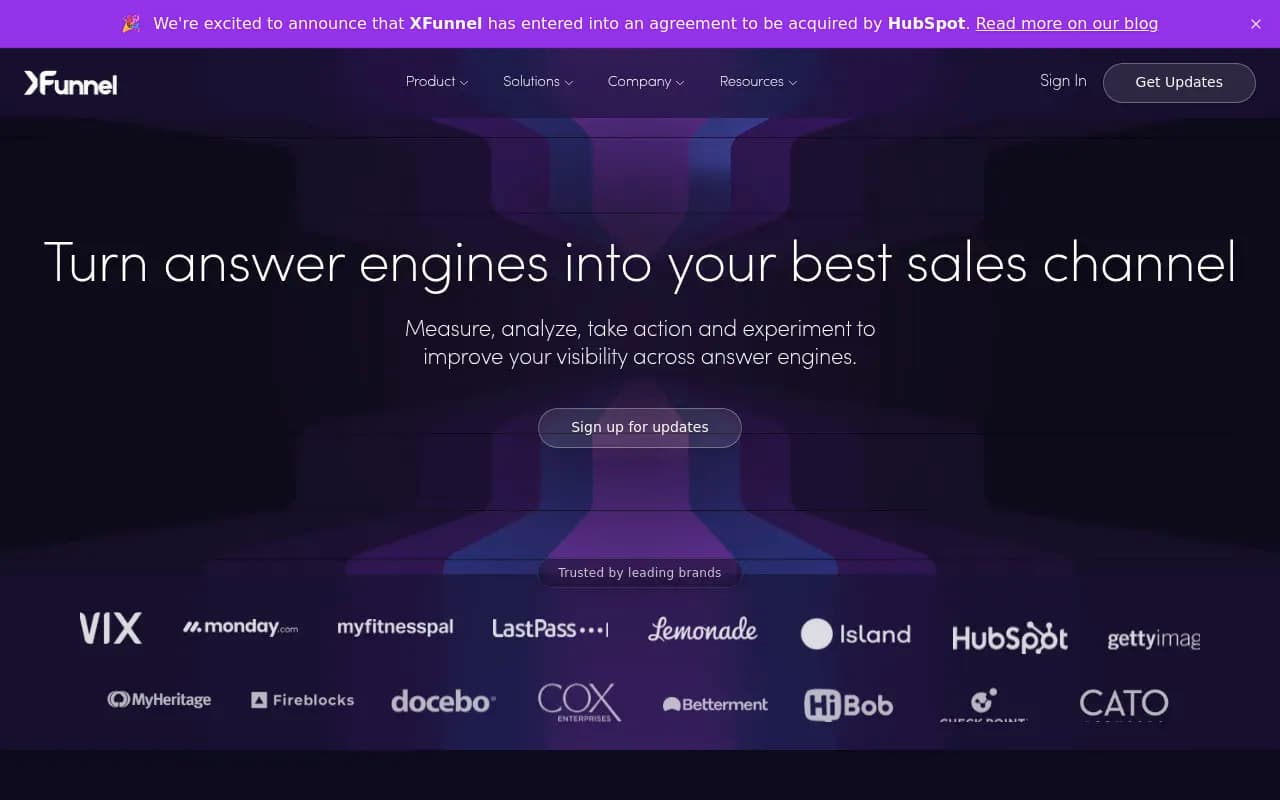
XFunnel is an AI search visibility platform built to help marketing teams understand and improve how their brand appears in AI-generated answers. The company positioned itself in the growing GEO (Generative Engine Optimization) space, targeting brands that want to be cited by ChatGPT, Perplexity, Gemini, and similar tools when buyers ask questions relevant to their products. Its client list includes recognizable names like Wix, Monday.com, MyFitnessPal, LastPass, Getty Images, and HubSpot itself -- which is notable given that HubSpot has now agreed to acquire the company.
The acquisition announcement is the biggest thing happening at XFunnel right now. The company posted on its blog that it has "entered into an agreement to be acquired by HubSpot," framing it as a new chapter in helping marketing teams succeed in the AI era. For existing customers and anyone evaluating the tool today, that's a significant variable. Product roadmaps tend to shift during acquisitions, and it's not yet clear whether XFunnel will continue as a standalone product, get absorbed into HubSpot's marketing suite, or eventually be sunset. That uncertainty is worth factoring into any buying decision.
The platform's core pitch is that it's not "just another dashboard." XFunnel pairs its analytics with dedicated analyst support, weekly meetings, and what it calls "tailored playbooks" -- action plans built around your specific goals and competitive situation. This service-led model is genuinely different from most monitoring tools, but it also means the product is more of a managed service than a pure SaaS platform. Whether that's a strength or a limitation depends entirely on what your team needs.
Key features
AI search engine coverage
XFunnel monitors brand visibility across ChatGPT, Perplexity, Gemini, Claude, Copilot, Google AI Overviews, and Google AI Mode. That's a solid set of the major platforms where AI-generated answers are influencing purchase decisions. The platform tracks how often your brand appears in responses, what context it appears in, and how that compares to competitors.
Share of Voice and brand visibility tracking
The core measurement layer shows your brand's Share of Voice across AI search engines -- essentially, what percentage of relevant AI responses mention you versus your competitors. You can segment this by region, persona, and product, which matters for companies with multiple product lines or international markets. Sentiment analysis is also included, so you can see not just whether you're being mentioned but whether the mentions are positive, neutral, or negative.
Query research and intent analysis
XFunnel includes a research module that helps you identify which questions users are asking AI search engines in your category. You can segment by intent level, region, and persona. This is useful for content planning -- knowing which questions AI models are fielding for your product category tells you where to focus your content efforts. The platform claims to surface "ask keywords" and topic clusters, though it's not entirely clear from the public-facing information how deep the volume data goes compared to traditional keyword tools.
Citation and source analysis
The analyze module breaks down which sources AI engines are citing when they answer questions in your space. This tells you which content is driving visibility -- your own pages, competitor pages, or third-party sources. Understanding citation patterns is genuinely useful: if Perplexity keeps citing a specific industry publication when answering questions about your category, that's a signal about where you should be publishing or earning coverage.
Competitor benchmarking
You can compare your AI visibility against specific competitors across all monitored platforms. The competitor heatmap view shows who's winning for which prompts and on which AI engines. This is standard for the category, but XFunnel's persona-level segmentation adds some nuance -- you can see how visibility differs depending on the type of buyer asking the question.
Experimentation platform
XFunnel claims multivariate experiment capabilities with "20% to 40%+ improvement variability" in visibility outcomes. The idea is that you make a content or optimization change, then measure whether it moved your AI visibility scores. This is a meaningful feature -- most monitoring tools don't close the loop between action and outcome. Whether the experimentation tooling is robust enough for rigorous A/B testing or more of a before/after comparison isn't fully clear from the available information.
Dedicated analyst support and playbooks
This is where XFunnel genuinely differs from self-serve tools. Every account gets a dedicated analyst who works directly with your team, weekly progress meetings, and "tailored playbooks" built around your specific situation. The platform also provides content briefs that writers can execute immediately, and an "affiliate activation kit" with outreach tactics for getting your brand mentioned on third-party sites that AI engines tend to cite. This managed-service layer is valuable for teams that don't have in-house GEO expertise, but it also means you're paying for human time, not just software.
Hallucination monitoring
XFunnel published research tracking a "Hallucination Score" across 437 companies and 270,000+ business queries, measuring which AI engines accurately represent verified business capabilities. This suggests the platform has some capability to flag when AI models are misrepresenting your product -- a genuinely useful feature for compliance-sensitive industries like fintech, insurance, or cybersecurity.
Who is it for
XFunnel's customer list tells you a lot about its target market. Wix, Monday.com, MyFitnessPal, LastPass, Lemonade, Getty Images, Betterment, Fireblocks -- these are mid-market to enterprise SaaS and tech companies with dedicated marketing teams and real budgets. The testimonials come from SEO leads, inbound marketing team leads, and growth marketing group leaders at companies with hundreds to thousands of employees. This is not a tool built for solo consultants or small agencies.
The service-heavy model (dedicated analyst, weekly calls, custom playbooks) reinforces this. If you're a marketing team of two at a startup, you probably don't need a dedicated analyst -- you need a self-serve tool you can learn quickly. But if you're the SEO lead at a 500-person SaaS company trying to figure out why ChatGPT keeps recommending your competitor instead of you, having an expert who can run experiments and interpret the data alongside you is genuinely valuable.
Industries where XFunnel seems to fit particularly well: B2B SaaS, fintech, cybersecurity, and any category where buyers are doing AI-assisted research before making purchase decisions. The hallucination monitoring feature is especially relevant for regulated industries where AI models getting your product details wrong could create real problems.
Who should probably look elsewhere: agencies managing multiple client accounts (the pricing and service model doesn't seem built for that), small teams that need a self-serve tool with a clear action loop, and anyone who needs content generation capabilities built into the platform rather than just content briefs.
Integrations and ecosystem
XFunnel's most significant integration news is the HubSpot acquisition itself. Once that closes, some level of integration with HubSpot's marketing suite seems likely, though the specifics haven't been announced. For now, the platform appears to operate as a standalone web application.
The website doesn't prominently advertise a public API, third-party integrations, or browser extensions. Given the enterprise focus and managed-service model, it's possible that data export and custom reporting are handled through the analyst relationship rather than self-serve integrations. This is a meaningful gap compared to platforms that offer Looker Studio connectors, Slack alerts, or Zapier workflows out of the box.
There's no mention of Google Search Console integration for traffic attribution, which is a notable absence -- connecting AI visibility to actual website traffic and revenue is one of the harder problems in GEO, and platforms that solve it have a real advantage.
Pricing and value
XFunnel's pricing page exists but specific tier prices aren't publicly listed in the scraped content -- the site directs visitors to "book a strategy call" for pricing, which is typical for enterprise-oriented tools. One third-party comparison site mentions plans "starting from $0," suggesting there may be a free tier or trial, but this couldn't be verified from the primary source.
The managed-service model (dedicated analyst, weekly meetings) implies pricing is likely in the thousands per month for meaningful engagement, not the $99-$579/month range of self-serve platforms. For comparison, Promptwatch starts at $99/month for a self-serve Essential plan and goes to $579/month for Business, with agency and enterprise pricing available separately.
Whether XFunnel's pricing represents good value depends on how much you value the human expert layer. If your team genuinely lacks GEO expertise and would otherwise spend significant internal time figuring out optimization strategies, paying for analyst support could be cost-effective. If you have capable in-house SEO talent and just need the data and tools, a self-serve platform will likely give you more flexibility at lower cost.
Strengths and limitations
What XFunnel does well:
- The dedicated analyst and weekly meeting model is genuinely differentiated. Most GEO tools give you data and leave you to figure out what to do with it. XFunnel's service layer is designed for teams that want a partner, not just a dashboard.
- The experimentation platform concept -- measuring the impact of content changes on AI visibility -- is the right idea. Closing the loop between action and outcome is what separates optimization tools from monitoring tools.
- Hallucination monitoring is a smart and underserved feature, particularly for enterprise brands in regulated industries where AI misrepresentation is a real risk.
- The client roster (Wix, Monday.com, HubSpot, Getty Images) suggests the platform has been validated by sophisticated marketing teams with high standards.
Honest limitations:
- The HubSpot acquisition creates genuine uncertainty. Buying decisions made today could be affected by product changes, pricing shifts, or eventual discontinuation as a standalone tool. That's a real risk.
- No AI crawler logs. Knowing which pages AI crawlers are visiting, how often, and what errors they encounter is increasingly important for GEO -- and XFunnel doesn't appear to offer this. Promptwatch includes real-time crawler logs as part of its Professional plan.
- No built-in content generation. XFunnel provides content briefs, but the actual writing is left to your team. Platforms like Promptwatch include an AI writing agent that generates articles grounded in citation data, which closes the gap between "knowing what to write" and "having something to publish."
- No Reddit or YouTube citation tracking. A significant portion of AI citations come from Reddit threads and YouTube content, and XFunnel doesn't appear to surface these sources. This is a meaningful blind spot for brands trying to understand the full picture of what's influencing AI recommendations.
- No ChatGPT Shopping tracking, no prompt volume or difficulty scoring, and no query fan-out analysis -- capabilities that help teams prioritize which prompts to target first.
- Self-serve access appears limited. The emphasis on analyst support and strategy calls suggests the platform isn't designed for teams that want to explore data independently without scheduling a meeting.
Bottom line
XFunnel is a credible AI search visibility platform with a genuinely differentiated service model -- the dedicated analyst support and experimentation playbooks set it apart from pure monitoring dashboards. It's best suited for mid-market and enterprise marketing teams at B2B SaaS or tech companies that want a hands-on partner to help them navigate GEO, not just a tool to log into.
That said, the HubSpot acquisition creates real uncertainty about the product's future, and the platform has meaningful gaps compared to more complete GEO platforms. Teams that need AI crawler logs, built-in content generation, Reddit/YouTube citation tracking, or prompt volume data should evaluate Promptwatch, which covers all of these and operates as a fully self-serve optimization platform rather than a managed service.
Best use case in one sentence: A mid-market SaaS marketing team that wants expert-guided AI search optimization and is comfortable with a managed-service model rather than a self-serve tool.
Frequently asked questions
What is XFunnel?
Is XFunnel being acquired by HubSpot?
How much does XFunnel cost?
Which AI search engines does XFunnel monitor?
How does XFunnel compare to other GEO tools like Promptwatch?
Who is XFunnel best suited for?
Similar and alternative tools to Xfunnel