Key takeaways
- Promptwatch starts at $99/mo with transparent self-serve pricing and a 7-day free trial. Xfunnel is enterprise-only with custom pricing -- you need to talk to sales before you can even see a number.
- Promptwatch goes beyond monitoring: it includes a built-in AI content generation agent, answer gap analysis, and AI crawler logs. Xfunnel's differentiation is human expert support and optimization playbooks, not automated tooling.
- Xfunnel is being acquired by HubSpot. That's potentially exciting for HubSpot users, but it introduces real uncertainty about the platform's independent future, pricing, and roadmap for everyone else.
- Promptwatch covers 10+ AI models including Grok, DeepSeek, Mistral, and Meta AI. Xfunnel focuses on the core four (ChatGPT, Perplexity, Gemini, Claude) without publicly confirming the same breadth.
- For agencies managing multiple clients, Promptwatch has explicit agency pricing and multi-site plans. Xfunnel's enterprise model is less clearly structured for agency workflows.
- If you want to close the loop from "where am I invisible?" to "here's the content that fixes it," Promptwatch is the more complete platform. Xfunnel is better if you want a managed, consultative approach with hands-on expert guidance.
Overview
Promptwatch

Promptwatch is an end-to-end AI search visibility platform used by 7,000+ brands including Booking.com, Center Parcs, Yelp, and Typeform. It tracks how brands appear in responses from ChatGPT, Claude, Perplexity, Gemini, Grok, DeepSeek, Copilot, Mistral, Meta AI, and Google AI Overviews -- then goes further by helping you actually fix the gaps. The platform's core loop is: find where you're invisible, generate content engineered to get cited, and track whether it works. It has a 4.7/5 rating on G2 and has processed over 1.1 billion citations, clicks, and prompts.
Xfunnel
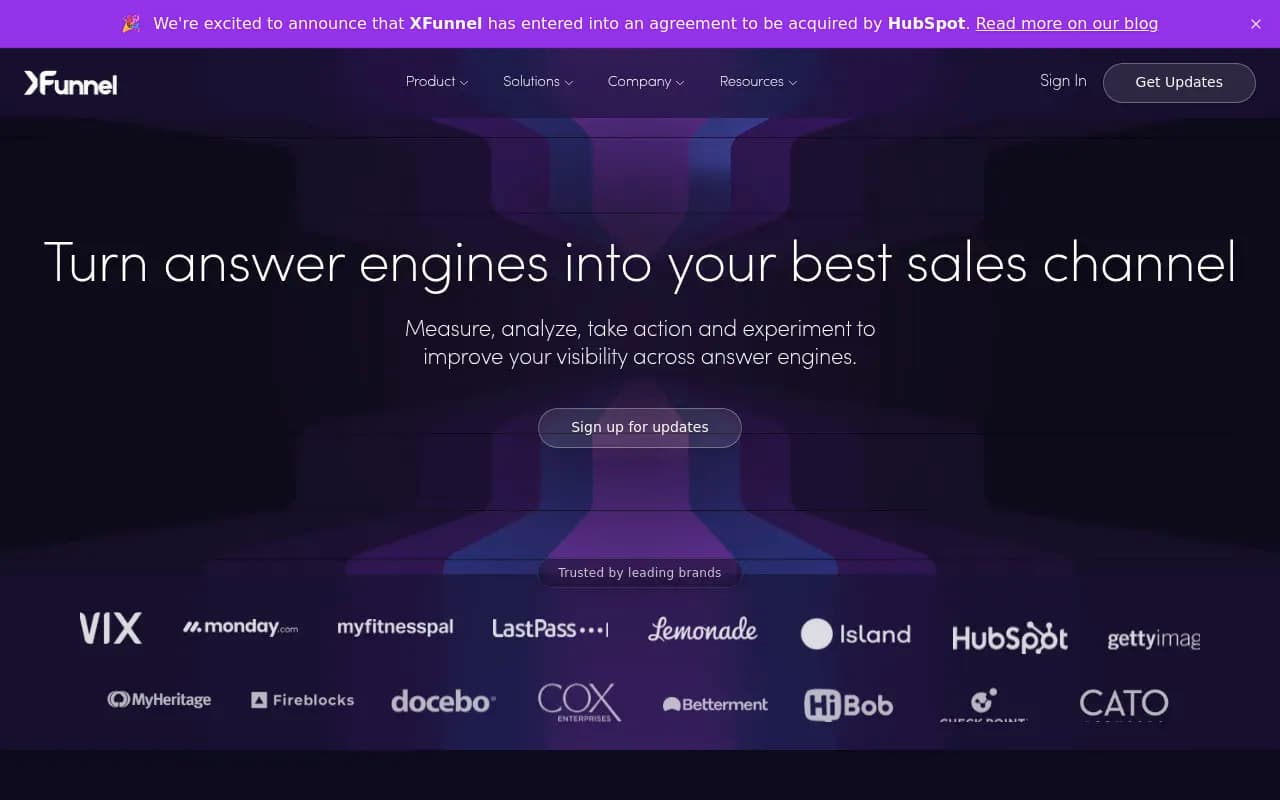
Xfunnel is an AI search visibility platform that tracks brand citations across the major AI engines and pairs monitoring data with human expert support. Its client list includes Wix, Monday.com, Getty Images, and HubSpot. The platform emphasizes a "measure, analyze, take action, experiment" workflow, with optimization playbooks delivered by a team of specialists rather than automated tools. In early 2026, Xfunnel announced an agreement to be acquired by HubSpot -- a significant development that shapes how you should think about its long-term trajectory.
Side-by-side comparison
| Feature | Promptwatch | Xfunnel |
|---|---|---|
| Starting price | $99/mo (Essential) | Custom enterprise pricing |
| Free trial | 7-day free trial | Contact sales |
| Self-serve signup | Yes | No |
| AI models tracked | 10+ (ChatGPT, Claude, Perplexity, Gemini, Grok, DeepSeek, Copilot, Mistral, Meta AI, Google AI Overviews) | Core 4 (ChatGPT, Perplexity, Gemini, Claude) |
| Content gap analysis | Yes (Answer Gap Analysis) | Via expert playbooks |
| AI content generation | Yes (built-in writing agent) | No |
| AI crawler logs | Yes (real-time) | Not confirmed |
| Prompt volume & difficulty scoring | Yes | Not confirmed |
| Reddit & YouTube tracking | Yes | Not confirmed |
| ChatGPT Shopping tracking | Yes | Not confirmed |
| Traffic attribution | Yes (GSC, code snippet, server logs) | Not confirmed |
| Competitor heatmaps | Yes | Yes |
| Multi-language / multi-region | Yes | Yes |
| Agency / multi-site plans | Yes (explicit agency pricing) | Enterprise custom |
| Looker Studio & API | Yes | Not confirmed |
| G2 rating | 4.7/5 | Not listed |
| Acquisition status | Independent | Being acquired by HubSpot |
Head-to-head feature deep-dive
Monitoring and citation tracking
Both platforms do the core job of tracking brand mentions in AI responses. You set up prompts, the platform queries AI models on a schedule, and you see whether your brand appears, what competitors appear alongside you, and how that changes over time.
Promptwatch has a clear edge in breadth. Ten AI models is a lot -- and the inclusion of Grok, DeepSeek, and Mistral matters if your audience is international or if you're tracking emerging platforms. Xfunnel covers the four models that account for most enterprise traffic today, which is a reasonable prioritization, but it means you're flying blind on a growing slice of AI search.
Promptwatch also goes deeper on the citation side. It tracks which specific pages, Reddit threads, and YouTube videos AI models cite -- not just whether your brand appears. That source-level data is genuinely useful for knowing where to publish or what to optimize. Xfunnel's citation tracking is less publicly documented at this level of granularity.
Verdict: Promptwatch wins on model coverage and citation depth. Xfunnel is adequate for the major platforms but doesn't match the breadth.
Content gap analysis and optimization
This is where the two platforms diverge most sharply.
Promptwatch's Answer Gap Analysis shows you the specific prompts where competitors appear but you don't. It's not just "you're missing coverage on topic X" -- it surfaces the actual questions AI models are answering, with prompt volume estimates and difficulty scores, so you can prioritize what to work on first. The query fan-out feature shows how a single prompt branches into sub-queries, which is useful for understanding the full scope of a topic.
Xfunnel's approach is different. Rather than automated gap analysis, it offers expert-led optimization playbooks. A team of specialists reviews your data and tells you what to do. This can be valuable if you want a managed service and don't have the internal bandwidth to interpret data yourself. But it's slower, less scalable, and depends on the quality of the humans involved.
Verdict: Depends on what you need. Promptwatch is better for teams that want to move fast and self-serve. Xfunnel suits teams that want a consultative, managed approach.
Content generation
Promptwatch has a built-in AI writing agent. It generates articles, listicles, and comparison pages grounded in real citation data -- the same 880M+ citations the platform has analyzed. The output is designed to get cited by AI models, not just rank in traditional search. You can target specific personas, incorporate competitor analysis, and track whether the content actually improves your visibility scores after publication.
Xfunnel does not appear to have automated content generation. Its optimization support is human-delivered.
Verdict: Promptwatch wins outright. If content creation is part of your workflow, Xfunnel doesn't compete here.
AI crawler logs
Promptwatch's crawler log feature shows you in real time which AI crawlers (ChatGPT, Claude, Perplexity, etc.) are hitting your website, which pages they're reading, and what errors they encounter. This is genuinely useful for diagnosing indexing issues -- if an AI model isn't citing your content, this tells you whether it's even reading it.
Xfunnel does not publicly document a comparable feature.
Verdict: Promptwatch only.
Traffic attribution
Promptwatch connects AI visibility to actual website traffic through three methods: a JavaScript snippet, Google Search Console integration, or server log analysis. You can see which AI-driven visits are converting, not just which prompts your brand appears in.
Xfunnel's traffic attribution capabilities are not clearly documented on its public site.
Verdict: Promptwatch wins. Closing the loop to revenue is one of the harder problems in GEO, and Promptwatch has built specific tooling for it.
Human expert support
This is Xfunnel's clearest differentiator. The platform is built around the idea that optimization requires human judgment, not just dashboards. Their team works with clients on strategy, playbook development, and implementation. For enterprise marketing teams that are new to AI search and want a partner rather than a tool, this is genuinely valuable.
Promptwatch offers support and onboarding, but it's primarily a self-serve platform. The platform does the analytical heavy lifting, but the strategic decisions are yours.
Verdict: Xfunnel wins for teams that want a managed, consultative relationship. Promptwatch wins for teams that want control and speed.
The HubSpot acquisition factor
This deserves its own section because it's a real consideration. Xfunnel has announced an agreement to be acquired by HubSpot. For existing HubSpot customers, this could eventually mean tight CRM integration and a streamlined workflow. But for everyone else, it raises questions: Will Xfunnel remain available as a standalone product? Will pricing change? Will the roadmap shift to serve HubSpot's priorities rather than standalone GEO needs?
These aren't hypothetical concerns -- acquisitions routinely change product direction, pricing, and availability. If you're evaluating Xfunnel for a multi-year commitment, this uncertainty is worth factoring in.
Promptwatch is independent and has been building its platform specifically for AI search visibility since the category emerged.
Pricing comparison
| Plan | Promptwatch | Xfunnel |
|---|---|---|
| Free tier | 7-day free trial | Not available |
| Entry-level | $99/mo (Essential: 1 site, 50 prompts, 5 articles) | Custom enterprise pricing |
| Mid-tier | $249/mo (Professional: 2 sites, 150 prompts, 15 articles, crawler logs) | Custom enterprise pricing |
| Business | $579/mo (Business: 5 sites, 350 prompts, 30 articles) | Custom enterprise pricing |
| Agency / Enterprise | Custom pricing available | Custom pricing |
| Annual discount | Yes | Unknown |
Xfunnel's pricing opacity is a real friction point for anyone doing a budget evaluation. You can't self-qualify, you can't compare plans, and you can't start without a sales conversation. That's fine if you're a large enterprise with a procurement process, but it's a barrier for everyone else.
Promptwatch's pricing is specific enough to plan around. The Essential plan at $99/mo is accessible for individual marketers and small teams. The Professional plan at $249/mo adds crawler logs, state/city tracking, and more prompts -- which is where most serious teams will land.
Pros and cons
Promptwatch
Pros:
- Transparent, accessible pricing with a 7-day free trial
- Covers 10+ AI models including Grok, DeepSeek, and Mistral
- Built-in AI content generation grounded in citation data
- Answer Gap Analysis with prompt volume and difficulty scoring
- Real-time AI crawler logs for diagnosing indexing issues
- Traffic attribution connects visibility to actual revenue
- Reddit and YouTube tracking for understanding AI citation sources
- ChatGPT Shopping monitoring
- Explicit agency and multi-site plans
- 4.7/5 on G2 with 7,000+ customers
Cons:
- Primarily self-serve -- less hand-holding than Xfunnel
- The volume of features can feel overwhelming at first
- No native CRM integration (though Looker Studio and API are available)
Xfunnel
Pros:
- Human expert support and optimization playbooks
- Strong enterprise client list (Wix, Monday.com, Getty Images)
- Potential future HubSpot integration for existing HubSpot customers
- Consultative approach suits teams that want a managed service
Cons:
- No transparent pricing -- requires a sales conversation
- No self-serve trial or free tier currently available
- Content generation is human-led, not automated
- AI crawler logs and traffic attribution not confirmed
- HubSpot acquisition creates uncertainty about independent roadmap
- Fewer AI models tracked than Promptwatch
- No documented Reddit/YouTube tracking or ChatGPT Shopping monitoring
Who should pick which tool
Pick Promptwatch if:
- You want to start quickly without a sales process
- Your budget is defined and you need transparent pricing
- You want to generate AI-optimized content, not just track visibility
- You need crawler log data to diagnose indexing issues
- You're an agency managing multiple client sites
- You want to track AI models beyond the core four (Grok, DeepSeek, Mistral, Meta AI)
- You want to connect AI visibility to actual traffic and revenue
Pick Xfunnel if:
- You're a large enterprise that wants a managed, consultative service
- You have the budget for custom enterprise pricing and prefer human-led strategy
- You're already a HubSpot customer and want to wait for a potential native integration
- Your team lacks bandwidth to interpret data and act on it independently
- You're comfortable with the uncertainty around the HubSpot acquisition
Final verdict
For most marketing teams evaluating AI search visibility tools in 2026, Promptwatch is the stronger choice. It covers more AI models, includes content generation and gap analysis that Xfunnel doesn't match with automated tooling, has transparent pricing you can actually plan around, and lets you start in 7 days without a sales call.
Xfunnel's human expert model has genuine appeal for enterprise teams that want a partner rather than a platform -- but the HubSpot acquisition makes it a riskier long-term bet for anyone not already in the HubSpot ecosystem. If you're evaluating both, the practical question is simple: do you want a tool you control, or a service that does the work for you? Promptwatch is the former, and it's the more capable one.