Key takeaways
- All four tools track brand visibility across AI search engines like ChatGPT, Perplexity, and Gemini -- but they differ significantly in what they do with that data.
- Goodie and Trakkr.ai are the most stripped-back options, suited to solo founders and small teams who want simple dashboards without a steep learning curve.
- Peec.ai is a solid mid-tier pick for agencies that need clean reporting and multi-language tracking but don't need content optimization.
- Promptwatch is the only one of the four that goes beyond monitoring -- it identifies content gaps, generates AI-optimized content, and tracks whether that content actually gets cited. If you want to improve your visibility (not just watch it), that distinction matters.
The AI brand tracking space has exploded. Eighteen months ago, there were maybe a dozen tools doing this. Now there are well over a hundred, and most of them look nearly identical in a demo.
So when you're comparing four tools in roughly the same weight class -- Goodie, Promptwatch, Peec.ai, and Trakkr.ai -- the question isn't really "which one tracks AI mentions?" They all do. The question is: what happens after the tracking?
That's where these four tools diverge in ways that actually matter for your workflow.
What we're comparing and why it matters
AI search engines -- ChatGPT, Perplexity, Claude, Gemini, Google AI Overviews -- are now a meaningful part of how people discover products, services, and brands. When someone asks "what's the best project management tool for remote teams?" and ChatGPT gives them a list, your brand either appears or it doesn't. Traditional SEO tools don't tell you this. That's the gap these tools fill.
The four tools in this comparison are often grouped together as "lightweight" options -- more accessible than enterprise platforms like Profound or BrightEdge, and more focused than general SEO suites like Semrush or Ahrefs. But lightweight doesn't mean identical. Let's get into it.
Goodie
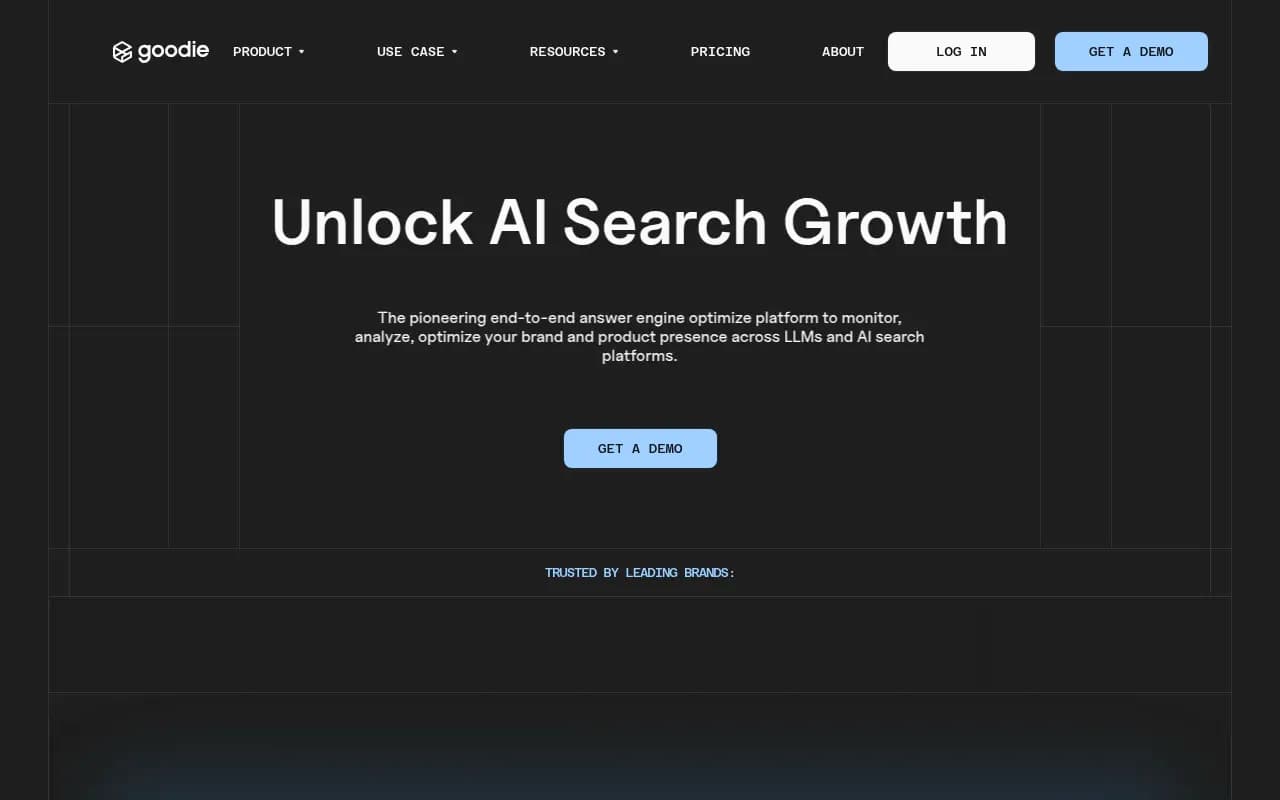
Goodie (higoodie.com) is one of the newer entrants in this space. The pitch is simple: monitor how your brand appears in AI-generated responses, get alerts when something changes, and see how you stack up against competitors.
The interface is clean and genuinely easy to use. You set up your brand, add a list of prompts you care about, and Goodie starts querying AI models on your behalf. You get a visibility score, a breakdown by model (ChatGPT, Perplexity, etc.), and some basic sentiment analysis around how your brand is described.
What Goodie does well:
- Fast setup -- you can be tracking within minutes
- Clean, readable dashboards that don't require training to interpret
- Decent competitor comparison views
- Affordable entry point for small teams
Where it falls short:
- No content gap analysis -- it tells you you're invisible for a prompt, but not why or what to do about it
- No crawler logs or traffic attribution
- Prompt library is limited; you're mostly working with what you add manually
- No built-in content generation
Goodie is a good fit for founders and small marketing teams who want a quick pulse check on AI visibility without committing to a complex platform. If you're just starting to think about AI search and want something that doesn't require a consultant to set up, Goodie makes sense.
Peec.ai

Peec.ai has been around long enough to build a real reputation, particularly among agencies. It treats prompts as the core tracking unit -- you define the questions your target audience might ask, and Peec monitors how AI models respond to those questions over time.
The reporting is genuinely good. Peec produces clean, shareable outputs that work well in client-facing contexts. It also handles multi-language tracking better than most tools at this price point, which matters if you're running campaigns across markets.
What Peec.ai does well:
- Strong prompt-level tracking with historical trend data
- Multi-language and multi-region support
- Clean reporting that agencies can share with clients
- Covers major AI models including ChatGPT, Perplexity, Claude, and Gemini
Where it falls short:
- Monitoring-only -- there's no content optimization or generation layer
- No crawler logs to understand how AI bots interact with your site
- No Reddit or YouTube tracking (both of which influence AI citations)
- No traffic attribution to connect AI visibility to actual revenue
As one Reddit user in r/SEO_tools_reviews put it: "Go with Peec AI if you need deep research and agency-style reporting." That's a fair summary. It's a reporting tool, not an optimization tool.
Trakkr.ai
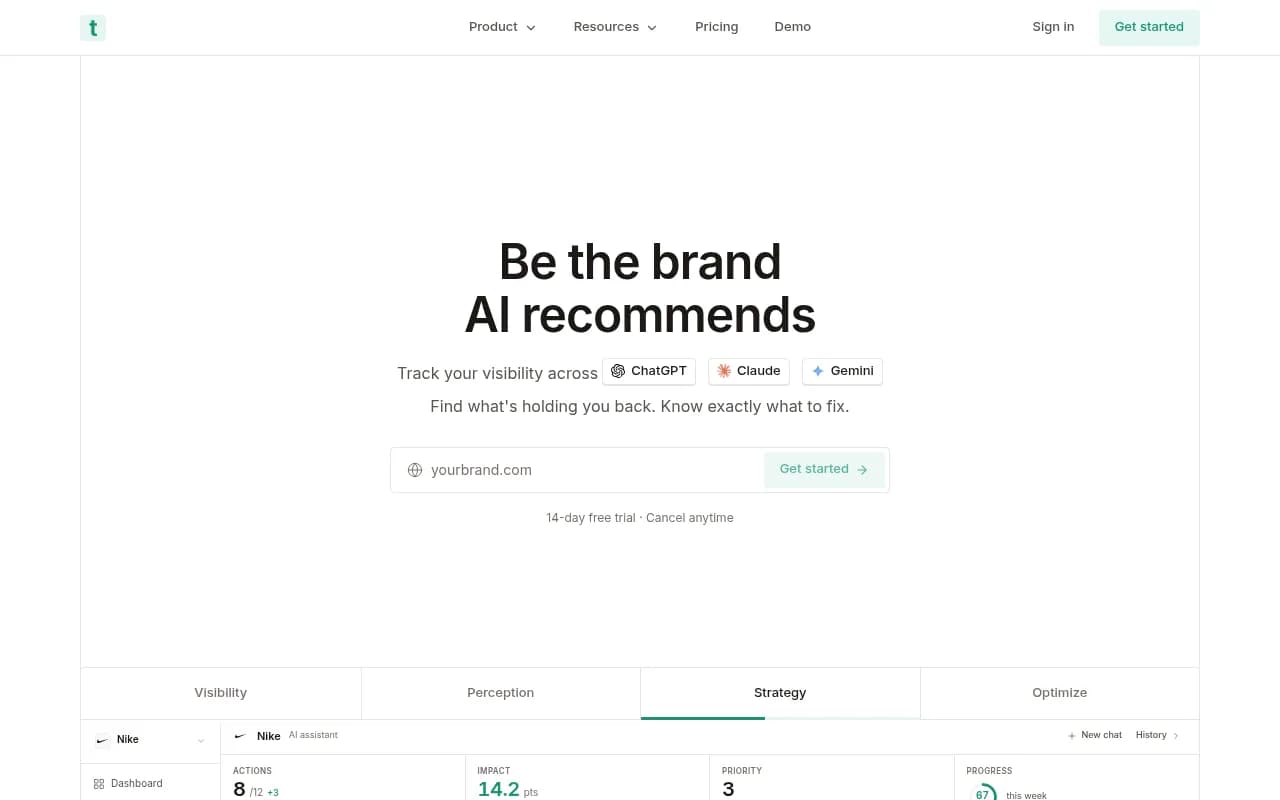
Trakkr.ai sits in a similar lane to Goodie -- lightweight, accessible, and focused on getting you visibility data without friction. It tracks your brand across ChatGPT, Claude, Perplexity, and a few other models, and gives you a dashboard showing mention frequency, sentiment, and competitor comparisons.
The standout feature is its alert system. Trakkr.ai is reasonably good at notifying you when something changes -- a competitor starts appearing more often, your brand drops out of a response it used to appear in, or sentiment shifts. For teams that want passive monitoring without logging in every day, that's useful.
What Trakkr.ai does well:
- Good alert and notification system
- Simple competitor tracking
- Low barrier to entry -- pricing is accessible
- Decent coverage of major AI models
Where it falls short:
- No content creation or gap analysis
- Limited prompt intelligence (no volume estimates or difficulty scores)
- No page-level tracking to see which specific pages are being cited
- No integration with traffic analytics
Trakkr.ai is best for teams that want a set-it-and-monitor-it solution. It's not built for teams that want to actively improve their AI visibility -- it's built for teams that want to know where they stand.
Promptwatch
Promptwatch is the most capable platform in this comparison, and the one that's hardest to categorize as "just a tracker." It monitors AI visibility across 10 models -- ChatGPT, Perplexity, Claude, Gemini, Google AI Overviews, DeepSeek, Grok, Mistral, Meta AI, and Copilot -- but the monitoring is really just the starting point.

The core difference is what Promptwatch does after it finds a gap. Its Answer Gap Analysis shows you exactly which prompts competitors are visible for that you're not. Not just "you're missing here" -- but the specific topics, questions, and angles that AI models want to answer but can't find on your site. Then the built-in AI writing agent generates content (articles, listicles, comparisons) grounded in real citation data from over 880 million citations analyzed. You publish, and then page-level tracking shows whether that content starts getting cited by AI models.
That loop -- find gaps, create content, track results -- is what separates Promptwatch from the other three tools in this comparison.
Other things Promptwatch does that the others don't:
- AI Crawler Logs: real-time logs of ChatGPT, Claude, Perplexity, and other AI crawlers hitting your site, including which pages they read and errors they encounter
- Prompt Intelligence: volume estimates and difficulty scores for each prompt, plus query fan-outs showing how one prompt branches into sub-queries
- Reddit and YouTube tracking: surfaces discussions that directly influence AI recommendations
- ChatGPT Shopping tracking: monitors when your brand appears in product recommendations and shopping carousels
- Traffic attribution: connects AI visibility to actual revenue via a code snippet, Google Search Console integration, or server log analysis
Pricing starts at $99/month for the Essential plan (1 site, 50 prompts, 5 articles), with Professional at $249/month and Business at $579/month. There's a free trial available.
Is it overkill for a solo founder? Probably. But for any marketing team that's serious about improving their AI search presence -- not just watching it -- Promptwatch is in a different category than the other three.
Side-by-side comparison
| Feature | Goodie | Peec.ai | Trakkr.ai | Promptwatch |
|---|---|---|---|---|
| AI model coverage | ChatGPT, Perplexity, others | ChatGPT, Claude, Gemini, Perplexity | ChatGPT, Claude, Perplexity, others | 10 models incl. Grok, DeepSeek, Copilot |
| Prompt-level tracking | Basic | Strong | Basic | Strong + volume/difficulty scores |
| Competitor tracking | Yes | Yes | Yes | Yes + heatmaps |
| Content gap analysis | No | No | No | Yes |
| AI content generation | No | No | No | Yes (880M+ citations) |
| Crawler logs | No | No | No | Yes |
| Reddit/YouTube tracking | No | No | No | Yes |
| Traffic attribution | No | No | No | Yes |
| Multi-language/region | Limited | Yes | Limited | Yes |
| ChatGPT Shopping tracking | No | No | No | Yes |
| Starting price | Low | ~$89/mo | Low | $99/mo |
| Best for | Solo founders, small teams | Agencies, reporting | Passive monitoring | Growth teams wanting to improve visibility |
How to choose
The honest answer is that the right tool depends on what you actually want to do with the data.
If you want to know whether AI models mention your brand, any of these four tools will tell you that. The question is what you do next.
Choose Goodie if you're just getting started, have a small budget, and want a clean dashboard to check in on occasionally. It's a good first step into AI visibility monitoring.
Choose Peec.ai if you're an agency that needs polished, client-ready reports and multi-language coverage. It's a solid reporting tool, and the prompt-level tracking is genuinely well-built.
Choose Trakkr.ai if you want passive monitoring with good alerts and don't need to actively optimize anything. It's a low-maintenance option for teams that want to stay informed without building a workflow around it.
Choose Promptwatch if you want to actually improve your AI visibility, not just track it. The content gap analysis, AI writing agent, crawler logs, and traffic attribution make it the only tool in this group that closes the loop between "we're invisible here" and "here's what we did about it, and here's whether it worked."
A note on the broader market
It's worth stepping back for a second. The AI visibility monitoring space has a lot of tools that look similar on the surface -- dashboards, visibility scores, competitor comparisons. Most of them are monitoring-only. They show you data. They don't help you act on it.
That's not a criticism of Goodie, Peec.ai, or Trakkr.ai specifically -- monitoring has real value, especially for teams that are just starting to think about AI search. But if you're evaluating tools with the expectation that tracking alone will improve your visibility, it won't. You still need to create content that AI models want to cite, fix crawl issues that prevent AI bots from reading your site, and understand which prompts are actually worth targeting.
The tools that help you do all of that -- not just watch the numbers -- are the ones worth paying for long-term.
Final take
For most teams reading this, the comparison probably comes down to two real options: Peec.ai if you're an agency that needs clean reporting, or Promptwatch if you need to actually move the needle on AI visibility.
Goodie and Trakkr.ai are fine entry points, but they're hard to recommend over Promptwatch at similar or only slightly lower price points, given the gap in capability.
If you're not sure, start with a free trial of Promptwatch and see whether the content gap analysis surfaces anything useful. In most cases, it does -- and that's usually the moment teams realize monitoring alone wasn't going to get them where they needed to go.