Key takeaways
- An AEO audit is different from a traditional SEO audit: you're not checking rankings, you're checking whether AI models cite your content when answering questions in your category
- The audit covers four core areas: technical crawler access, content extractability, authority signals, and citation tracking
- Most brands discover they have significant "answer gaps" — prompts where competitors get cited but they don't
- Fixing those gaps requires creating content structured for AI extraction, not just keyword optimization
- Tracking results means monitoring citation frequency across multiple AI models, not just one
Traditional SEO audits ask: "Where do we rank?" An AEO audit asks something more uncomfortable: "When someone asks an AI about our category, do we even exist?"
That's a harder question to answer, and the stakes are higher than they used to be. ChatGPT now handles over 2 billion queries daily. AI-referred sessions to websites grew 527% year-over-year through mid-2025. If AI models aren't citing your content, you're invisible to a fast-growing slice of your potential audience — and you probably don't know it yet.
This guide walks through a 10-step AEO audit process you can run right now. Some steps take 10 minutes. Others take a few days. But by the end, you'll know exactly where your visibility gaps are and what to fix first.
What an AEO audit actually measures
Before diving into steps, it's worth being clear about what you're auditing. An AEO audit evaluates four things:
- Whether AI crawlers can access and read your content
- Whether your content is structured so AI models can extract clean answers from it
- Whether your brand has enough authority signals for AI models to trust it as a source
- Whether your content actually gets cited — and for which prompts
The last point is the one most people skip. You can have technically perfect content that AI models still ignore because a competitor answered the question better, or because your brand simply isn't on the AI's radar yet. The audit has to close that loop.
Step 1: Establish your baseline visibility
You can't fix what you haven't measured. The first step is finding out where you currently stand across the AI models that matter to your audience.
Pick 10-15 prompts that represent how your customers actually search. Not keyword-style queries like "best CRM software" but conversational questions like "What's the best CRM for a 10-person sales team?" or "Is [Your Brand] a good option for B2B companies?" These are the kinds of questions AI models get asked constantly.
Then run those prompts manually across ChatGPT, Perplexity, Google AI Overviews, and at least one other model (Claude or Gemini). Record whether your brand appears, whether your content is cited, and what competitors show up instead.
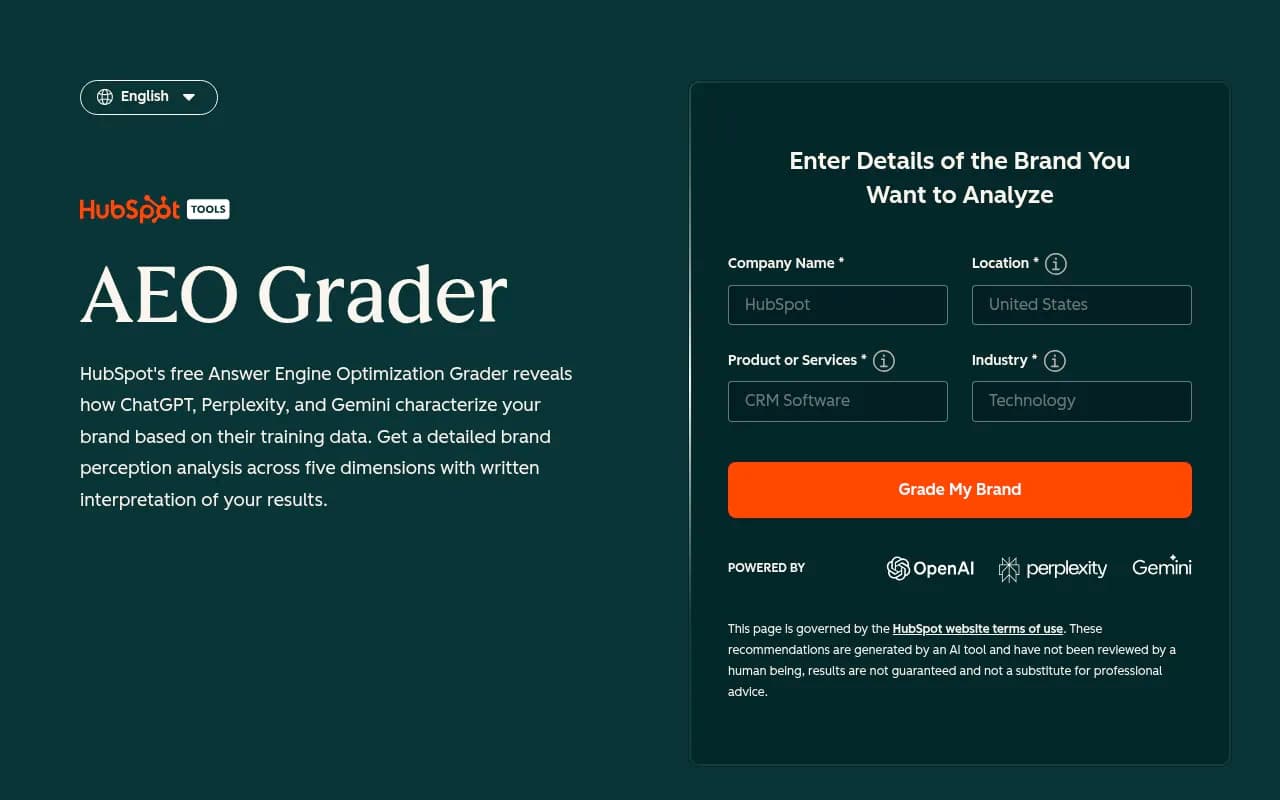
For a faster baseline, HubSpot's free AEO Grader is worth running. It evaluates your brand across five dimensions — sentiment, recognition, share of voice, and market positioning — using ChatGPT, Perplexity, and Gemini.
For ongoing tracking at scale, you'll want a dedicated platform. Promptwatch tracks your visibility across 10 AI models simultaneously, so you're not manually running prompts every week.

Step 2: Map your answer gaps
This is the most valuable part of the audit, and the most overlooked.
An answer gap is a prompt where a competitor gets cited but you don't. It's not just about prompts where you're invisible — it's about prompts where someone else is winning the citation you should have.
To find these gaps systematically, you need to:
- Build a list of 50-100 prompts covering your category (product comparisons, use case questions, "best of" queries, how-to questions)
- Run those prompts across AI models
- Record which brands appear in responses and which sources get cited
- Identify where competitors appear but you don't
This is tedious to do manually. Promptwatch's Answer Gap Analysis automates this — it shows you exactly which prompts competitors are visible for that you're missing, along with the specific content your site lacks. That's the difference between knowing you have gaps and knowing what to write to close them.
Step 3: Audit AI crawler access
AI models can only cite content they've actually read. Before worrying about content quality, check whether AI crawlers can access your site at all.
The main crawlers to check for:
- GPTBot (OpenAI/ChatGPT)
- ClaudeBot (Anthropic)
- PerplexityBot
- Google-Extended (Google AI)
- Meta-ExternalAgent (Meta AI)
Check your robots.txt file first. A surprising number of sites accidentally block AI crawlers — either through overly broad disallow rules or because someone added a block during a privacy panic and never revisited it. If User-agent: GPTBot has a Disallow: / rule, ChatGPT can't crawl your site.
Also check your server logs for actual crawler visits. Are these bots hitting your site? How often? Which pages are they reading? Most technical SEO tools won't show you this. Promptwatch's AI Crawler Logs feature does — it shows real-time logs of which AI crawlers are visiting, which pages they read, and any errors they hit.
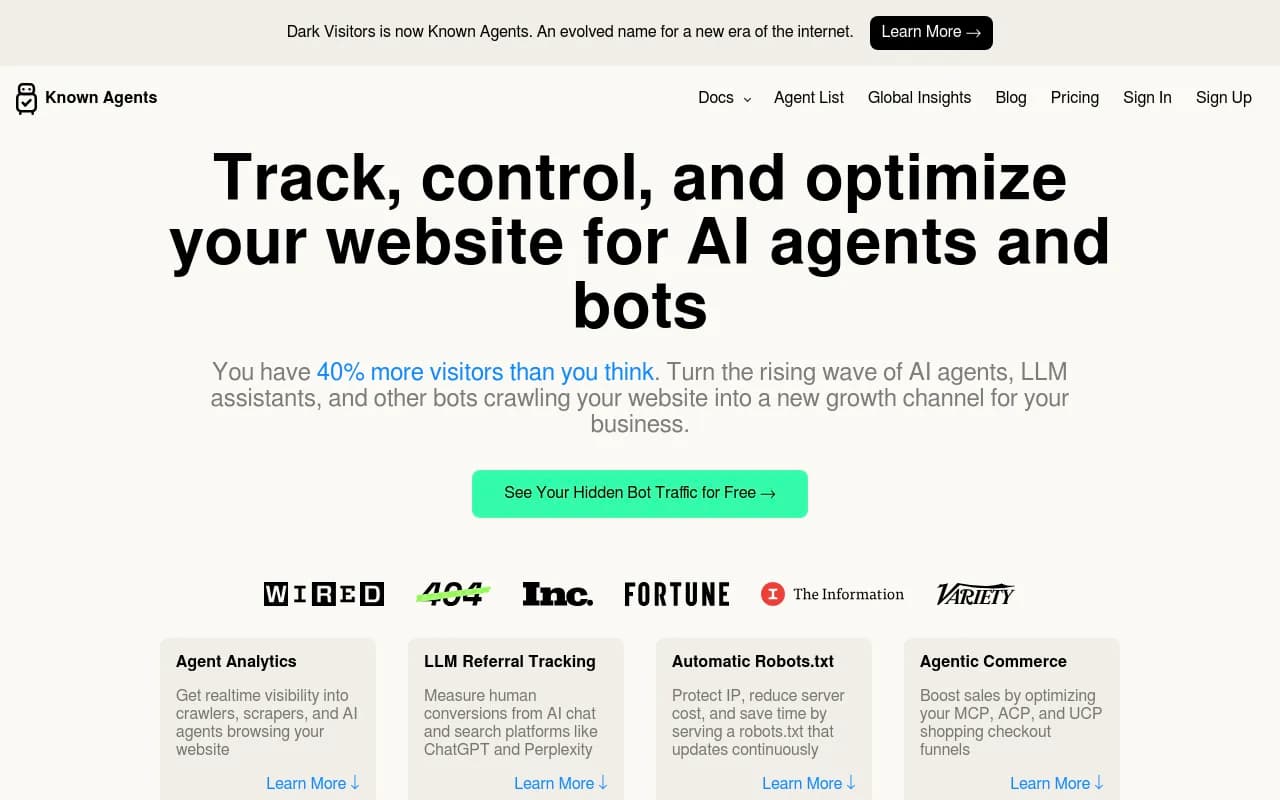
DarkVisitors is another useful tool here — it maintains an updated list of known AI crawlers and their user-agent strings, so you can verify your robots.txt is configured correctly.
Step 4: Check your content's extractability
AI models don't just need to access your content — they need to extract clean answers from it. This is where most content fails the AEO test.
The LinkedIn checklist of 48 AEO factors (published in 2026) makes a useful point: long introductions and loosely defined sections reduce extractability because they force AI systems to infer intent rather than find a direct answer.
Run your key pages through this quick extractability check:
- Does each section start with a direct answer to the implied question in the heading?
- Are paragraphs short (3-4 sentences max)?
- Does the heading accurately describe what's in the section below it?
- Is there a clear FAQ section with question-and-answer pairs?
- Are key facts stated explicitly, not buried in prose?
If you read a section heading and then have to read three paragraphs before finding the actual answer, AI models will often skip your content entirely or extract a garbled version of it.
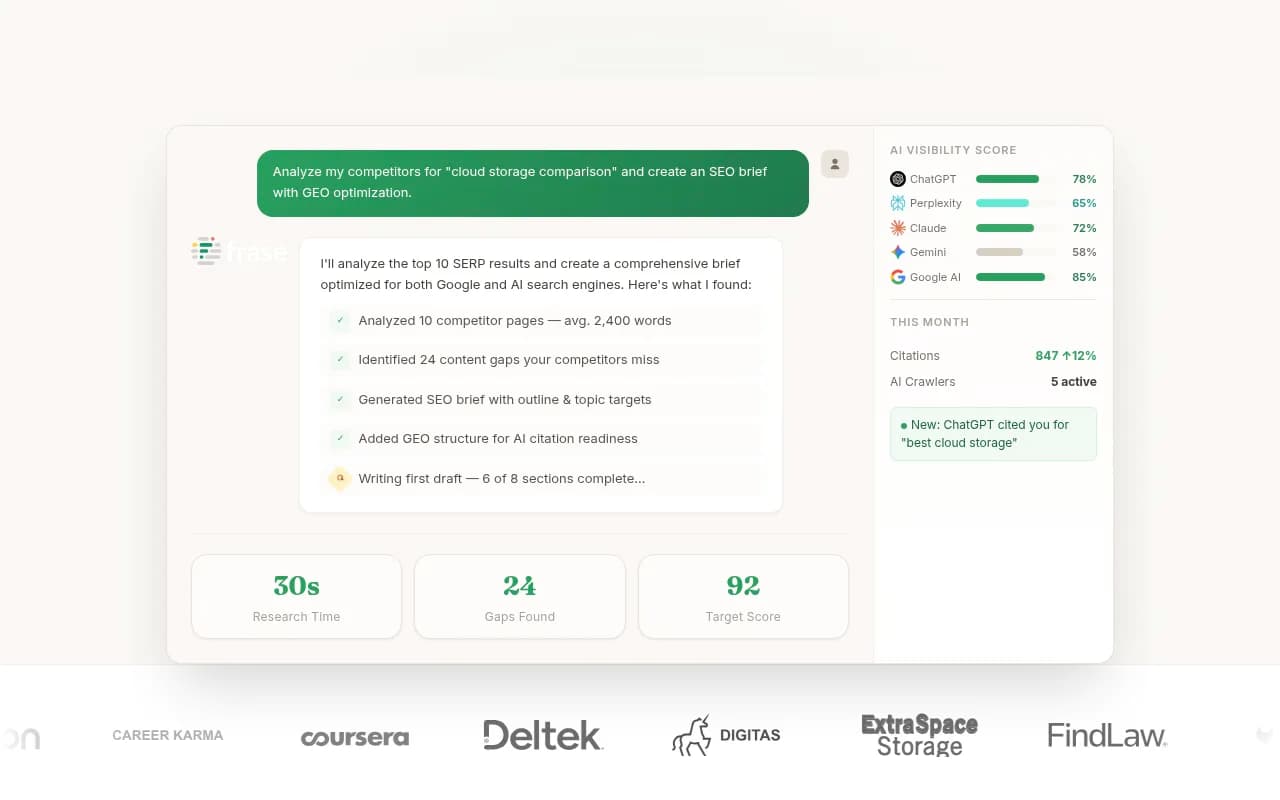
Frase is worth using here — it scores content for both traditional SEO and AI extractability simultaneously, which saves time when you're auditing a large content library.
Step 5: Audit your schema markup
Schema markup is one of the clearest signals you can send to AI models about what your content contains. It's not magic, but it does help.
For AEO purposes, the most important schema types are:
FAQPage— marks up question-and-answer pairs explicitlyHowTo— signals step-by-step instructional contentArticleandBlogPosting— establishes content type and authorshipOrganization— establishes your brand's identity, location, and contact infoProductandReview— for product pages and comparison content
Run your site through Google's Rich Results Test to see what schema you currently have. Then cross-reference against your most important pages — the ones you want AI models to cite. If a page has no schema, that's a gap worth fixing.
Screaming Frog can crawl your entire site and flag pages missing schema, which is much faster than checking page by page.
Step 6: Evaluate your E-E-A-T signals
AI models don't just extract content — they evaluate whether to trust the source. Google's E-E-A-T framework (Experience, Expertise, Authoritativeness, Trustworthiness) applies here, but the signals that matter for AI citation are slightly different from traditional SEO.
For AEO, the signals that carry weight include:
- Named authors with verifiable credentials (LinkedIn profiles, author bios, published work elsewhere)
- Citations from other authoritative sources (other websites linking to you, mentions in industry publications)
- Consistent brand mentions across the web (not just your own site)
- Wikipedia presence or mentions
- Active presence on platforms AI models frequently cite (Reddit, YouTube, industry forums)
Check whether your brand appears in AI responses when someone searches for your category without naming you. If ChatGPT answers "what are the best tools for X" and you're not mentioned, that's partly an authority signal problem, not just a content gap.
Brand24 tracks brand mentions across 25M+ sources, which helps you understand how widely your brand is referenced across the web — a proxy for how much authority AI models assign to you.
Step 7: Analyze which sources AI models are actually citing
This step flips the audit around. Instead of asking "why aren't we being cited?", ask "what IS being cited, and why?"
For each of your target prompts, look at the sources AI models cite in their responses. You'll often find:
- Specific competitor pages that answer the question more directly than yours
- Reddit threads or YouTube videos that AI models treat as authoritative
- Third-party review sites or comparison pages
- Industry publications you haven't been featured in
This tells you where to focus. If Perplexity keeps citing a Reddit thread about your category, that thread is influencing recommendations — and you should either participate in that conversation or create content that addresses the same questions more authoritatively.
Promptwatch's citation analysis shows exactly which pages, Reddit threads, and domains AI models cite for your target prompts. That's much more actionable than guessing.
Step 8: Test your brand sentiment and positioning
AI models don't just cite sources — they form opinions about brands. When someone asks "Is [Your Brand] trustworthy?" or "What are the downsides of [Your Brand]?", the AI synthesizes a response based on everything it's read about you.
You need to know what that response looks like.
Run these prompts manually across ChatGPT, Perplexity, and Gemini:
- "[Your Brand] review"
- "Is [Your Brand] worth it?"
- "[Your Brand] vs [main competitor]"
- "Problems with [Your Brand]"
- "Who uses [Your Brand]?"
Record the sentiment, the specific claims made, and the sources cited. If AI models are repeating outdated information, negative reviews, or competitor talking points, that's a brand authority problem you need to address through content and PR — not just technical optimization.
HubSpot's AEO Grader is specifically built for this kind of brand perception audit. It's free and takes about two minutes to run.
Step 9: Audit your content freshness and coverage
AI models have a strong preference for recent, comprehensive content. Two things to check here:
Freshness: When were your key pages last updated? If your "best practices" guide was written in 2023 and hasn't been touched since, AI models may deprioritize it in favor of more recent content. Add a visible "last updated" date to important pages and actually update them — not just the date.
Coverage: Map your content against the full range of questions someone might ask about your category. You're looking for topics where you have no content at all, topics where your content is thin (under 500 words), and topics where competitors have much more comprehensive coverage.
A simple way to do this: take your list of 50-100 target prompts from Step 2 and check whether each one has a corresponding page on your site that directly answers it. The ones that don't are your content gaps.
MarketMuse is useful for content gap analysis — it maps your existing content against topic coverage and identifies where you're thin relative to competitors.
Step 10: Create a prioritized fix list and track results
By now you have a lot of data. The last step is turning it into an action plan you'll actually execute.
Prioritize fixes in this order:
- Technical crawler blocks (fix immediately — nothing else matters if AI can't read your site)
- High-traffic answer gaps where competitors are winning citations
- Brand sentiment issues (negative or inaccurate AI responses about your brand)
- Schema markup on your most important pages
- Content freshness updates on pages that are stale but still relevant
- New content to cover gaps in your topic map
Then set up tracking so you can see whether your fixes are working. This means monitoring citation frequency across AI models over time — not just checking once and moving on.
| Fix type | Priority | Time to impact | Effort |
|---|---|---|---|
| Unblock AI crawlers in robots.txt | Critical | Immediate | Low |
| Answer gap content (new articles) | High | 4-8 weeks | High |
| Schema markup | High | 2-4 weeks | Medium |
| Content freshness updates | Medium | 2-6 weeks | Medium |
| Brand sentiment / PR | Medium | 8-16 weeks | High |
| FAQ sections on existing pages | Medium | 2-4 weeks | Low |
| Author bio and E-E-A-T signals | Low | 4-8 weeks | Low |
Tools to support your AEO audit
Here's a quick reference for the tools mentioned in this guide, plus a few others worth knowing about:
| Tool | Best for | Free tier? |
|---|---|---|
| Promptwatch | End-to-end AEO tracking, gap analysis, content generation | Trial available |
| HubSpot AEO Grader | Brand perception audit across ChatGPT, Perplexity, Gemini | Free |
| Frase | Content optimization for AI extractability | Paid |
| Screaming Frog | Technical crawl, schema audit | Free (500 URLs) |
| DarkVisitors | AI crawler identification and robots.txt config | Free |
| Brand24 | Brand mention tracking and authority signals | Trial available |
| MarketMuse | Content gap and topic coverage analysis | Paid |
A few other platforms worth exploring depending on your needs:
SE Ranking has added solid AI visibility tracking to its traditional SEO suite, which makes it a reasonable option if you're already using it for rank tracking.

Otterly.AI is a lightweight monitoring tool if you're just starting out and want to track citation frequency without a full platform commitment.

AthenaHQ covers 8+ AI search engines and is worth considering for teams that need broad model coverage.

Profound is a strong option for enterprise teams that need deep AI visibility analytics with competitive benchmarking.
How often should you run an AEO audit?
The full 10-step process is worth running quarterly. AI models update their training data, competitors publish new content, and the prompts that matter to your audience shift over time.
Between full audits, keep a lighter monitoring cadence running: check your citation frequency weekly, watch for new answer gaps as competitors publish content, and update your most important pages whenever the underlying information changes.
The brands winning in AI search right now aren't the ones who ran one audit. They're the ones treating AEO as an ongoing practice — finding gaps, creating content, tracking results, and repeating. That cycle is what separates brands that appear in AI responses from brands that don't.