DarkVisitors Review 2026
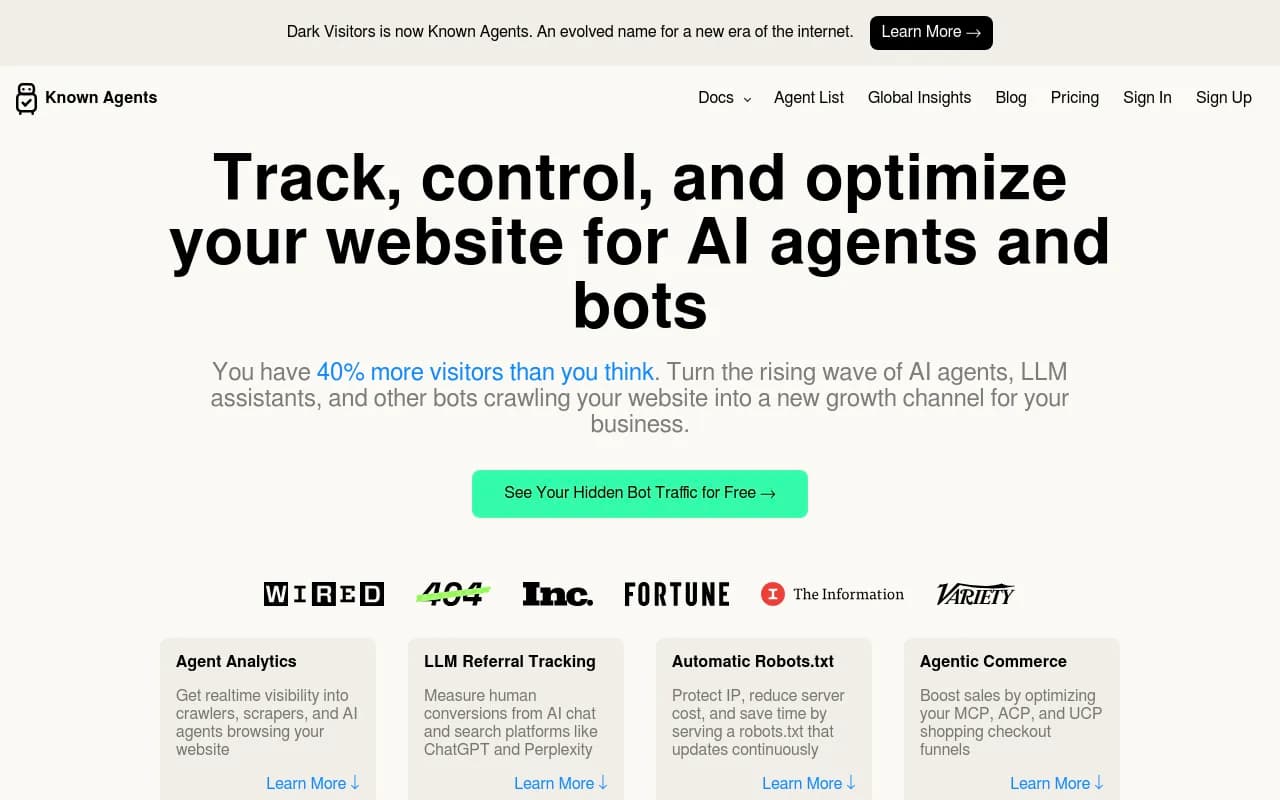
Known Agents (formerly Dark Visitors) reveals the hidden 40% of your website traffic from AI crawlers, scrapers, and LLM assistants. Monitor bot activity in real-time, measure human referrals from ChatGPT and Perplexity, auto-update your robots.txt, and optimize for AI shopping agents. Built for pub
Summary
- Best for: Publishers, e-commerce sites, and businesses that want visibility into AI bot traffic and LLM referrals -- especially those concerned about unauthorized scraping or looking to optimize for AI-driven discovery
- Standout strength: Automatic robots.txt that updates continuously as new bots emerge, plus real-time detection of spoofed crawlers pretending to be Googlebot or Bingbot
- Key limitation: Lacks content optimization and gap analysis tools that platforms like Promptwatch offer -- Known Agents shows you what's happening but doesn't help you create content that ranks better in AI search results
- Pricing: Freemium model with limited features on free tier; paid plans required for advanced analytics and detailed reports

Known Agents (rebranded from Dark Visitors in early 2026) is a specialized analytics and control platform for the growing ecosystem of AI agents, crawlers, and bots visiting your website. The core premise: research shows websites receive roughly 40% more traffic than standard analytics reveal, because most tools ignore non-human visitors. Known Agents surfaces this hidden layer -- GPTBot scraping for OpenAI training data, Perplexity crawlers indexing for AI search, autonomous shopping agents browsing product pages, and dozens of other AI systems you probably didn't know were reading your site.
The platform targets three main audiences. Publishers and content creators who want to understand which AI models are consuming their work and potentially protect against unauthorized scraping. E-commerce businesses optimizing for the emerging wave of AI shopping agents (ChatGPT Instant Checkout, Gemini Shopping, etc.). And technical teams at any company that need to reduce server load from aggressive bot traffic or detect bad actors spoofing legitimate crawlers.
Known Agents launched as Dark Visitors and gained attention in tech media (Wired, 404 Media, Fortune, The Information) for its comprehensive database of AI crawlers and its approach to robots.txt management. The rebrand to Known Agents in 2026 reflects a shift in positioning -- from defensive "block the bots" to proactive "understand and optimize for AI agents as a growth channel."
Agent Analytics: Real-time visibility into bot traffic
The core feature is a dashboard that identifies and categorizes every non-human visitor to your site. Known Agents maintains a database of hundreds of known AI agents, crawlers, and scrapers -- everything from GPTBot (OpenAI's training crawler) and CCBot (Common Crawl) to lesser-known scrapers like Bytespider and PanguBot. When one of these agents hits your site, Known Agents logs it with full context: which agent, timestamp, pages visited, HTTP response codes, IP address, hosting provider, and geographic origin.
The analytics break down by agent category: AI data scrapers (training LLMs), AI search crawlers (Perplexity, You.com), search engine bots (Googlebot, Bingbot), SEO tools (AhrefsBot, SemrushBot), and generic scrapers. You can drill into individual agents to see visit frequency over time, which pages they target most, and whether their traffic is spiking. This is useful for publishers who want to know if a specific AI company is heavily scraping their archive, or for e-commerce sites noticing unusual bot patterns on product pages.
Session replay for AI agents
One of the more interesting capabilities: Known Agents records browsing sessions from autonomous AI agents that navigate your site like humans. These aren't simple crawlers hitting a sitemap -- they're agents from platforms like ChatGPT's browsing mode or experimental shopping assistants that click through multiple pages, interact with forms, or follow internal links. You can review these sessions to understand how AI systems experience your site and identify friction points (broken links, slow pages, confusing navigation) that might prevent them from surfacing your content in AI answers or recommendations.
This is where Known Agents starts to touch on optimization territory, but it stops short of actionable guidance. You see what happened, but the platform doesn't tell you what to fix or how to structure content for better AI visibility. That's a gap where platforms like Promptwatch go further -- they show you which prompts competitors rank for that you don't, then help you generate content to close those gaps.
Spoofed bot detection
A legitimately useful security feature: Known Agents verifies that bots claiming to be Googlebot, Bingbot, or other major crawlers are actually from Google, Microsoft, etc. It does reverse DNS lookups and IP validation to catch bad actors spoofing user agents. If a "Googlebot" request comes from a Nigerian IP that doesn't resolve to Google's infrastructure, Known Agents flags it as spoofed. This helps you identify scrapers trying to bypass robots.txt rules or access restricted content by pretending to be legitimate.
The platform sends alerts when it detects spoofed traffic or when a specific agent's visit rate suddenly spikes (useful if a new scraper starts hammering your server).
LLM referral tracking
This is the "growth channel" angle. Known Agents tracks human visitors who arrive at your site from AI chat platforms -- someone asks ChatGPT a question, ChatGPT cites your article, the person clicks through. The dashboard shows total LLM referrals over time and breaks them down by platform: ChatGPT, Perplexity, Gemini, DeepSeek, Claude, etc. You see which AI systems are recommending your content and driving actual traffic.
This is valuable directional data, but it's limited compared to full AI visibility platforms. Known Agents tells you "ChatGPT sent 276 referrals this month" but doesn't show you which prompts triggered those citations, what your competitors are ranking for, or how to improve your citation rate. Promptwatch offers all of that -- prompt-level tracking, competitor heatmaps, content gap analysis, and an AI writing agent to generate articles optimized for AI search. Known Agents is monitoring-only; Promptwatch is built around taking action.
Automatic robots.txt management
This is Known Agents' signature feature and the reason many people originally adopted Dark Visitors. Instead of manually maintaining a robots.txt file with hundreds of bot user-agents, you connect Known Agents to your site and it serves a dynamically updated robots.txt on your behalf. You choose which categories of bots to allow or block (AI scrapers, SEO crawlers, search engines, etc.), and Known Agents generates the corresponding rules.
The key advantage: as new bots emerge -- and they emerge constantly, with AI companies launching new crawlers every few months -- Known Agents automatically adds them to your robots.txt. You don't have to track bot announcements or manually update your file. The platform claims to update its bot database continuously, so your robots.txt stays current without any effort.
You can also create custom rules for specific agents or URL patterns. For example, allow Googlebot everywhere but block GPTBot from your /archive section.
WordPress plugin for enforcement
The robots.txt protocol is voluntary -- bots can ignore it. Known Agents offers a WordPress plugin that actively blocks bots violating your robots.txt rules. If you've disallowed Bytespider but it tries to access a page anyway, the plugin returns a 403 error and logs the violation. This is particularly useful for aggressive scrapers from China and other regions that routinely ignore robots.txt.
The plugin also handles the robots.txt serving, so you don't need to set up a separate integration if you're on WordPress.
Agentic commerce (early access)
This is a newer, less-developed feature aimed at e-commerce. The pitch: AI shopping agents (ChatGPT's instant checkout, Gemini Shopping, future platforms) will become a meaningful sales channel, and you need to optimize your product feed and checkout flow for them. Known Agents promises tools to track how AI agents discover and purchase your products, and to optimize your "MCP, ACP, and UCP shopping checkout funnels" (Model Context Protocol, Agent Context Protocol, Universal Commerce Protocol -- emerging standards for AI-to-commerce integration).
As of early 2026, this is mostly positioning and early access signups. The actual functionality appears limited to basic product feed validation. It's an interesting direction but not yet a reason to choose Known Agents over alternatives.
Integrations and setup
Known Agents supports WordPress (plugin), Cloudflare Workers, AWS Lambda, Fastly, Shopify, Node.js, and generic server-side integrations. Setup involves adding a tracking script or middleware to log requests and send data to Known Agents' API. The robots.txt feature requires pointing your robots.txt to Known Agents' endpoint or using the WordPress plugin.
Documentation is available but not as extensive as larger platforms. Expect some technical lift if you're not on WordPress.
Who is it for
Known Agents makes sense for three groups:
-
Publishers and content sites (news outlets, blogs, niche media) who want visibility into which AI models are scraping their content and the ability to block unauthorized use. If you're concerned about OpenAI or Anthropic training on your articles without permission, Known Agents gives you the tools to monitor and control that. However, if you also want to optimize for AI search visibility -- rank higher in ChatGPT and Perplexity answers -- you need a platform like Promptwatch that offers content gap analysis, prompt tracking, and AI-optimized content generation.
-
E-commerce sites preparing for AI shopping agents. If you believe ChatGPT and Gemini will send meaningful product traffic in the next 1-2 years, Known Agents' LLM referral tracking and (eventually) agentic commerce tools could be useful. But this is still early -- most e-commerce sites won't see ROI from this yet.
-
Technical teams dealing with bot-related server load or security issues. If aggressive scrapers are driving up your AWS bill or you're seeing spoofed Googlebot traffic, Known Agents' detection and blocking features are practical solutions.
Known Agents is NOT for: Marketing teams that want to improve their AI search rankings and drive more traffic from LLMs. The platform shows you what's happening but doesn't help you optimize content, close visibility gaps, or track performance at the prompt level. For that, you need Promptwatch, which combines monitoring with actionable optimization tools -- content gap analysis, AI writing agent, crawler logs, and page-level citation tracking across 10+ AI models.
Strengths
- Comprehensive bot database: Tracks hundreds of AI agents and crawlers, updated continuously as new ones emerge
- Automatic robots.txt: Saves significant time vs. manually maintaining bot rules, especially valuable for publishers
- Spoofed bot detection: Catches bad actors pretending to be Googlebot or other legitimate crawlers
- LLM referral tracking: One of the few tools that measures human traffic from AI chat platforms
- WordPress plugin: Easy setup and active enforcement of robots.txt rules for WordPress sites
Limitations
- Monitoring-only, no optimization: Known Agents shows you bot activity and LLM referrals but doesn't help you improve your AI search rankings or create content that gets cited more often. Lacks content gap analysis, prompt-level tracking, AI writing tools, and page-level citation data that Promptwatch provides.
- No AI crawler logs: Doesn't show you which pages AI crawlers are actually reading or errors they encounter (Promptwatch offers real-time crawler logs for ChatGPT, Claude, Perplexity, etc.)
- Limited LLM coverage: Tracks referrals from major platforms but doesn't monitor your visibility across all AI models or show you competitor performance
- Agentic commerce is vaporware: The e-commerce features are mostly marketing at this stage, not production-ready tools
- Freemium limits unclear: Pricing details are vague -- free tier exists but paid plan costs and feature gates aren't publicly documented
Pricing and value
Known Agents uses a freemium model. The free tier includes basic bot analytics and limited event tracking. Paid plans unlock advanced features, detailed reports, and higher event limits, but specific pricing isn't published on the website. Based on third-party sources, expect to pay for meaningful usage, especially if you have high traffic.
For comparison, Promptwatch starts at $99/month (Essential plan: 1 site, 50 prompts, 5 AI-generated articles, basic analytics) and scales to $249/month (Professional: 2 sites, 150 prompts, 15 articles, crawler logs, regional tracking) and $579/month (Business: 5 sites, 350 prompts, 30 articles). Promptwatch includes the monitoring Known Agents offers PLUS content optimization, gap analysis, and AI writing tools -- a more complete solution for teams that want to improve AI visibility, not just track it.
Bottom line
Known Agents is a solid choice if your primary goal is understanding and controlling bot traffic -- blocking unauthorized scrapers, reducing server load, or monitoring which AI models are consuming your content. The automatic robots.txt and spoofed bot detection are genuinely useful, especially for publishers.
But if you want to optimize for AI search -- rank higher in ChatGPT, Perplexity, and Gemini answers, drive more LLM referrals, and systematically improve your AI visibility -- Known Agents falls short. It's a monitoring dashboard, not an optimization platform. Promptwatch is the better choice for marketing and SEO teams focused on AI search growth, offering content gap analysis, prompt tracking, AI content generation, crawler logs, and page-level citation data across 10+ AI models. Known Agents shows you the problem; Promptwatch helps you fix it.
Frequently asked questions
What is DarkVisitors and what does it do?
Who should use DarkVisitors?
Is DarkVisitors free to use?
What are the key features of DarkVisitors?
How does DarkVisitors compare to Promptwatch?
Can DarkVisitors detect fake crawlers?
What is the robots.txt feature in DarkVisitors?
Does DarkVisitors track ChatGPT and Perplexity referrals?
Similar and alternative tools to DarkVisitors