Key takeaways
- About 73% of brands that rank on page one of Google receive zero mentions in AI-generated responses -- traditional SEO rankings don't translate to AI visibility.
- Each major AI platform (ChatGPT, Perplexity, Gemini, Claude) has distinct citation patterns, so a one-size-fits-all approach won't work.
- AI visibility requires a three-step loop: find your content gaps, create content engineered for AI citation, then track which pages get cited and by which models.
- Schema markup, entity signals, and answer-first content structure are the technical foundations that make AI models trust and cite your content.
- Automated tracking tools are no longer optional -- AI responses are non-deterministic, meaning you need to run each prompt many times to get a reliable baseline.
Here's something that should bother you: your domain authority is solid, your keyword rankings haven't moved in months, and by traditional SEO metrics you're doing fine. But when a potential buyer asks ChatGPT "what's the best [your category] tool?" your brand doesn't appear. Not even close.
That's not a ranking problem. It's an AI search visibility problem, and the gap between the two is widening every quarter.
The research is pretty stark. Roughly 73% of brands that rank on page one of Google receive zero mentions in the corresponding AI-generated responses. AI Overviews on Google reduce click-through rates for traditional organic links by around 34.5%. For high-traffic informational keywords, some sites have lost up to 64% of their traffic as AI answers satisfy user intent directly on the page.
The old playbook -- optimize for keywords, build backlinks, rank on page one -- was built for a world where search engines returned a list of links. Generative engines don't do that. They synthesize an answer from a small set of sources they trust. If you're not in that set, you're invisible.
This guide walks through how to get in that set, platform by platform.
Why AI search works differently from traditional search
Traditional SEO optimizes for rankings. AI search optimizes for citation.
Generative engines like ChatGPT, Perplexity, and Gemini use Retrieval-Augmented Generation (RAG) to pull chunks of information from across the web, cross-reference claims against what researchers call a "Consensus of Truth," and assemble a single synthesized response. They're not ranking your page -- they're deciding whether your content is trustworthy enough to quote.
That changes the rules in a few important ways:
- Position on a results page is irrelevant if the AI doesn't cite you at all
- Content structure matters more than keyword density -- AI models extract specific passages, not whole pages
- Entity signals (who you are as a brand, what you're known for, whether you're cited elsewhere) carry significant weight
- Zero-click is the default -- over 50% of AI searches never result in a website visit
The implication: you need to optimize for being cited, not for being ranked.
Step 1: Audit your current AI visibility baseline
Before changing anything, you need to know where you stand. And in 2026, that baseline can't come from Google Search Console alone.
AI responses are non-deterministic. The same prompt can return different results depending on the model's temperature settings, recent data refreshes, and which sources it retrieved. Leading frameworks recommend running each priority query at least 10 to 20 times to establish a statistical baseline. Manually testing five prompts takes about 20 minutes. Tracking a thousand prompts across multiple AI platforms is not a manual job.
Your audit should cover four dimensions:
| Dimension | What to measure |
|---|---|
| Mention presence | Does your brand appear in AI responses for your category? |
| Recommendation position | When you appear, are you first, third, or buried? |
| Sentiment | Is the mention positive, neutral, or qualified with caveats? |
| Competitor share of voice | Who is getting cited when you're not? |
For the competitor dimension specifically, you want to know which prompts your competitors are visible for that you're not. That's your content gap list -- the specific topics and questions AI models want answers to but can't find on your site.
Tools like Promptwatch are built specifically for this kind of systematic audit, tracking visibility across 10 AI models simultaneously and surfacing the exact prompts where competitors outrank you.

Other options worth knowing about:



The key difference between these tools: some are monitoring dashboards that show you data, others help you act on it. Know which you're buying before you commit.
Step 2: Map the prompts that matter for your category
Not all prompts are equal. A prompt with high volume and low competition is worth more than a high-volume prompt where three established brands already dominate every AI response.
The prompt research process looks like this:
- List the questions your buyers actually ask during research (not just keywords -- full questions)
- Identify which of those prompts trigger AI-generated answers vs. traditional results
- Estimate volume and difficulty for each prompt
- Check who currently gets cited for each prompt
For step 3, tools that provide prompt volume estimates and difficulty scores help you prioritize. You want to find "winnable" prompts -- high enough volume to matter, low enough competition that you can realistically get cited.
For step 4, run the prompts manually across ChatGPT, Perplexity, and Gemini and note which brands appear, in what position, and with what framing. This is tedious at scale but gives you a clear picture of the competitive landscape.

Step 3: Platform-by-platform optimization
Each major AI platform has different citation patterns. Here's what the research shows about each one.
ChatGPT (OpenAI)
ChatGPT relies heavily on its training data, Bing's index, and increasingly on real-time web retrieval through its browsing tool. A few things that influence whether it cites you:
- Whether you appear in Bing's index (not just Google's)
- Whether your brand is mentioned in third-party sources that ChatGPT trusts -- industry publications, Reddit, review sites
- Whether your content directly answers the question being asked, in plain language
- Schema markup, particularly FAQ schema and HowTo schema
ChatGPT also has a shopping feature that surfaces product recommendations in carousels. If you're in e-commerce or SaaS, getting into those carousels requires a different optimization path -- structured product data, reviews, and pricing information that ChatGPT can parse.
Perplexity
Perplexity is the most citation-transparent of the major AI engines -- it shows its sources directly in the response. That makes it easier to study and, in some ways, easier to optimize for.
Perplexity favors:
- Content that directly answers a specific question in the first paragraph (answer-first structure)
- Pages with clear, parseable structure -- headers, bullet points, short paragraphs
- Sources that are already cited frequently by other AI responses (a compounding effect)
- Fresh content -- Perplexity updates more frequently than ChatGPT's training data
The practical implication: if you can get cited by Perplexity, you're often on the path to being cited by other models too. It's a good leading indicator.
Google AI Overviews and AI Mode
Google AI Overviews pull from Google's index, which means traditional SEO signals still matter here more than on other platforms. But the content that gets featured in AI Overviews is often different from what ranks in position one.
Google AI Overviews favor:
- Content with strong E-E-A-T signals (Experience, Expertise, Authoritativeness, Trustworthiness)
- Pages that directly answer the query without burying the answer in preamble
- Structured data markup -- FAQ schema, HowTo schema, Article schema
- Content that matches the specific intent of the query, not just the keyword
Google AI Mode (the conversational search experience) is newer and still evolving, but early data suggests it follows similar patterns to AI Overviews with an even stronger preference for authoritative, well-structured sources.
Claude (Anthropic)
Claude is increasingly used as a research tool, and its citation behavior reflects that. It tends to favor:
- Long-form, well-reasoned content that demonstrates genuine expertise
- Content from sources with established credibility in a domain
- Nuanced, balanced perspectives rather than purely promotional content
If your content reads like a marketing brochure, Claude is less likely to cite it. If it reads like a thoughtful expert explaining something, you're in better shape.
Gemini
Gemini integrates deeply with Google's knowledge graph, which means entity signals matter significantly. Being a recognized entity in Google's Knowledge Graph -- with a Wikipedia page, consistent NAP data, and mentions across authoritative sources -- gives you an advantage in Gemini responses.
Gemini also pulls from YouTube, which is worth noting if you have video content. A well-structured YouTube video with a detailed description can appear in Gemini responses in ways that text-only content can't.
Step 4: Create content engineered for AI citation
This is where most optimization guides stop at vague advice like "create high-quality content." Let's be more specific.
Answer-first structure
AI models extract passages, not pages. That means your content needs to answer the question in the first paragraph, then provide supporting detail. The inverted pyramid structure that journalists use is actually a good model here.
Bad structure: 500 words of context, then the answer. Good structure: The answer in sentence one, then the context.
Topical authority, not just individual pages
AI models assess whether you're a credible source on a topic, not just whether a single page is good. That means you need a cluster of content around each topic you want to be cited for -- a pillar page, supporting articles, FAQ content, comparison pages.
A brand with 20 well-structured pages on a topic is more likely to be cited than a brand with one excellent page on the same topic.
Schema markup
At minimum, implement:
- FAQ schema on any page that answers questions
- HowTo schema on instructional content
- Article schema with author information
- Organization schema with your brand's entity information
Schema helps AI models parse your content correctly and understand what your page is about without having to infer it from the text.
Third-party mentions and citations
AI models trust sources that other trusted sources cite. That means:
- Getting mentioned in industry publications
- Building a presence on Reddit in relevant subreddits (AI models read Reddit extensively)
- Earning reviews on G2, Capterra, Trustpilot, and similar platforms
- Getting cited in YouTube videos that cover your category
This is the part that takes the longest but compounds the most. A brand that's mentioned in 50 credible third-party sources is much harder to displace from AI responses than a brand that only optimizes its own website.
Step 5: Technical foundations that AI crawlers need
AI models crawl your website to discover and index your content. If they can't crawl it effectively, they can't cite it.
robots.txt and AI crawler access
Check your robots.txt file. Some brands have inadvertently blocked AI crawlers (GPTBot, ClaudeBot, PerplexityBot) while trying to block other bots. If you're blocking these crawlers, you're invisible to the models they power.
Page speed and crawlability
AI crawlers have limited patience for slow pages. Core Web Vitals still matter, not just for Google rankings but for how efficiently AI crawlers can process your content.
Structured data consistency
Your structured data should be consistent across your site. Conflicting schema signals confuse AI models about what your brand is and what it does.
AI crawler logs
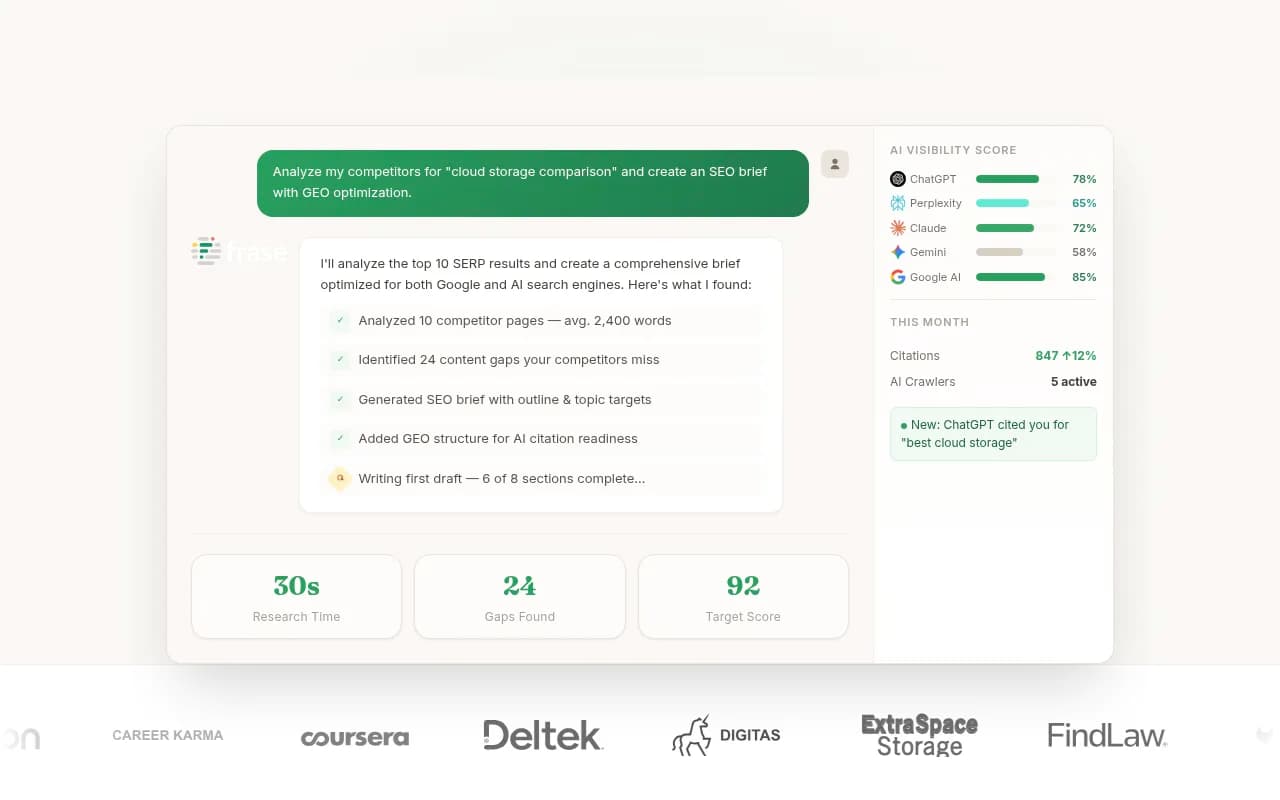
One underused tactic: monitoring which pages AI crawlers actually visit, how often they return, and whether they encounter errors. This data tells you whether your optimization efforts are working at the crawl level, before you even check whether you're being cited.
Step 6: Track what's working
This is the step most brands skip, and it's why they can't tell whether their optimization efforts are having any effect.
AI visibility tracking requires a different approach from traditional rank tracking:
- You need to track across multiple models (ChatGPT, Perplexity, Gemini, Claude, Grok, etc.)
- You need to run each prompt multiple times to account for non-determinism
- You need page-level tracking to see which specific pages are being cited
- You need to connect visibility to actual traffic and revenue
The last point is harder than it sounds. AI-referred traffic doesn't always show up cleanly in Google Analytics. Some platforms are working on traffic attribution methods -- UTM parameters from AI referrals, server log analysis, GSC integration -- to connect the dots between AI citations and actual business outcomes.
Here's a comparison of the main tracking approaches:
| Approach | Pros | Cons |
|---|---|---|
| Manual prompt testing | Free, direct | Doesn't scale, non-deterministic |
| Monitoring-only platforms | Easy setup, good dashboards | No action layer, just data |
| Full optimization platforms | Gap analysis + content generation + tracking | Higher cost, more setup |
| Traditional SEO tools with AI add-ons | Familiar interface | AI features often shallow |
The compounding effect: why early movers win
There's a flywheel effect in AI visibility that's worth understanding. AI models learn from what they cite. Brands that get cited frequently become more likely to be cited in the future, because their content appears in more training data and retrieval indexes.
That means the brands investing in AI visibility now are building a compounding advantage. The brands that wait until AI search is "proven" will find themselves trying to displace incumbents who've been cited thousands of times.
This isn't hypothetical -- it's already visible in category after category. In most B2B software categories, two or three brands dominate AI responses across all major models, and they're not always the brands with the highest Google rankings.
The gap between "visible in AI search" and "invisible in AI search" is becoming the most important competitive divide in digital marketing. The playbook above is how you get to the right side of it.
Putting it all together: a 90-day action plan
If you're starting from scratch, here's a realistic sequence:
Days 1-30: Audit and baseline
- Set up automated tracking across at least three AI models
- Run your top 50 priority prompts and document who gets cited
- Identify your top 10 content gaps (prompts where competitors appear and you don't)
- Check your robots.txt for AI crawler blocks
- Implement basic schema markup if you haven't already
Days 31-60: Content and technical fixes
- Create answer-first content for your top 10 gap prompts
- Build out topical clusters around your core categories
- Fix any crawlability issues surfaced by your audit
- Start building third-party presence (industry publications, Reddit, review sites)
Days 61-90: Track, iterate, expand
- Review which new pages are getting cited and by which models
- Identify the next 10 content gaps to address
- Connect AI visibility data to traffic and revenue where possible
- Expand your prompt tracking list based on what you've learned
The brands that win in AI search aren't the ones with the biggest budgets. They're the ones with the most systematic approach to finding gaps, filling them with the right content, and tracking what works.