Key takeaways
- Google still dominates product discovery: 56.68% of US consumers start their buying journey on Google, vs. just 7.26% on ChatGPT (Smarty Marketing survey, May 2026).
- ChatGPT's shopping traffic is mostly informational -- 93.7% of ChatGPT searches are informational, with only 0.1% transactional. It influences decisions but rarely closes them.
- The two platforms cite brands differently. Google Shopping pulls from structured product feeds and paid listings. ChatGPT pulls from editorial content, reviews, Reddit threads, and third-party sources.
- Fixing Google Shopping visibility means optimizing your product feed, bids, and structured data. Fixing ChatGPT visibility means creating content that AI models actually want to cite.
- These are genuinely separate problems that need separate strategies -- but they're not competing priorities. You need both.
The framing problem most brands get wrong
When ChatGPT launched its shopping features, a lot of marketing teams treated it as "Google Shopping but AI." Same problem, new interface. Just port over the same tactics and you're done.
That's wrong, and it's costing brands real visibility.
Google Shopping and ChatGPT Shopping operate on fundamentally different logic. One is a structured, paid, feed-driven marketplace. The other is an AI that synthesizes information from across the web and decides -- on its own -- which brands to mention. The inputs are different. The ranking signals are different. And critically, the user intent sitting behind each platform is different too.
If you're treating them as the same problem, you're probably solving neither of them well.
What the data actually shows about where shoppers go
Let's get grounded in numbers before talking strategy.
A May 2026 survey of US consumers by Smarty Marketing found that when people intend to buy something, they go to:
- Google: 56.68%
- Amazon: 28.96%
- ChatGPT: 7.26%
- Reddit: 4.56%
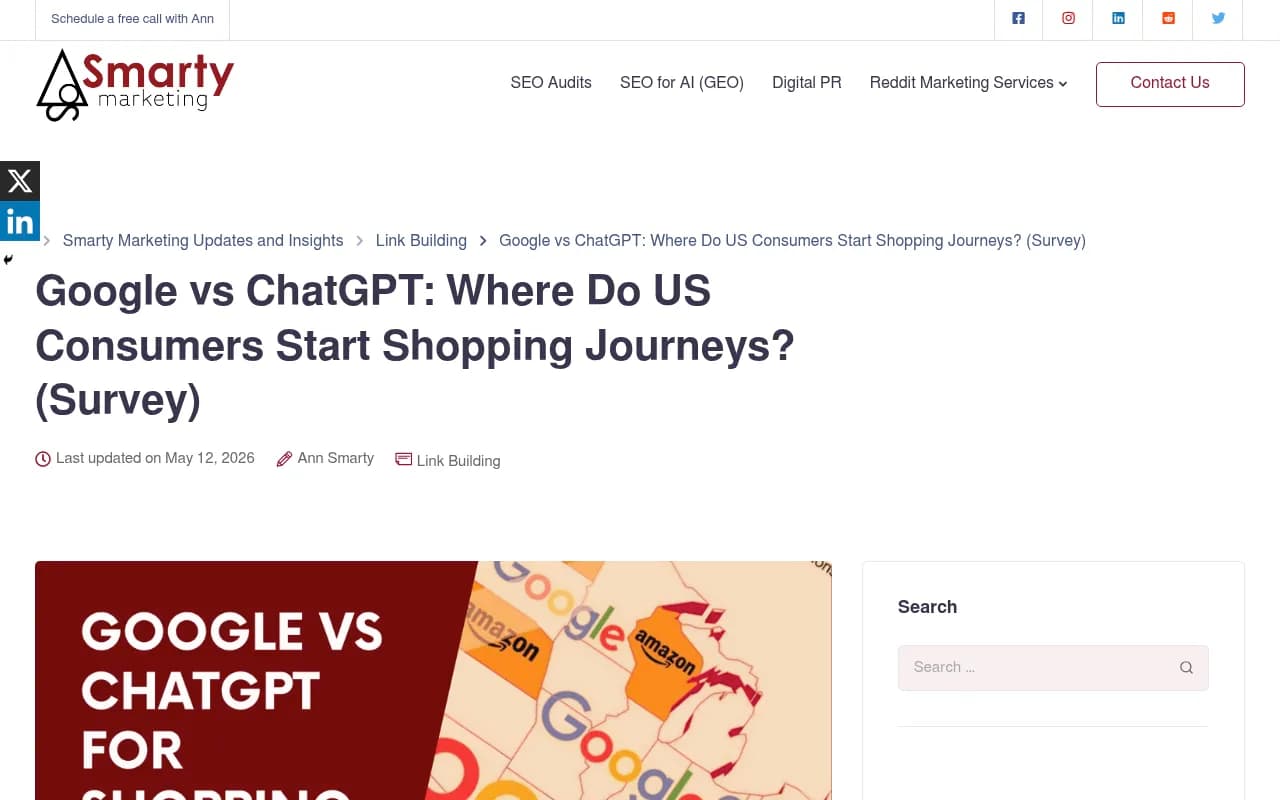
That 7.26% for ChatGPT is not nothing -- it represents millions of shopping journeys. But it also means the "ChatGPT is replacing Google" narrative is, at minimum, premature. Google still wins by a wide margin, and Amazon is the real challenger for product discovery, not AI.
Here's the nuance that matters: 43.94% of respondents said they generally use search less because they can ask an AI platform. So ChatGPT isn't necessarily capturing shopping intent directly -- it's intercepting the research phase that used to happen on Google. People ask ChatGPT "what's the best standing desk under $500?" and then go to Google (or Amazon) to actually buy it.
That distinction changes everything about how you should approach each platform.
How Google Shopping actually works (and what breaks visibility there)
Google Shopping is a pay-to-play system built on structured data. Your products appear in Shopping carousels because:
- You've submitted a product feed to Google Merchant Center
- Your feed data is accurate, complete, and matches your landing pages
- You're running Smart Shopping or Performance Max campaigns (or free listings for organic)
- Your product titles, descriptions, and attributes match what people are searching for
When brands are invisible in Google Shopping, the causes are usually mechanical: feed errors, mismatched GTINs, disapproved products, thin product descriptions, or bids that can't compete for high-intent queries.
The fix is also mechanical. Audit your Merchant Center for disapprovals. Clean up your feed. Make sure your product titles front-load the attributes shoppers actually search for (brand, model, size, color -- in that order). Use structured data markup on your product pages so Google can verify your feed data. For competitive categories, you need to be in the auction.
This is traditional e-commerce optimization. It's well-documented, tool-supported, and largely deterministic. If your feed is clean and your bids are competitive, you show up.
How ChatGPT Shopping actually works (and why it's so different)
ChatGPT doesn't have a product feed. There's no Merchant Center equivalent. You can't bid your way in.
When someone asks ChatGPT "what's the best noise-cancelling headphone for travel?" it generates a response by synthesizing information from its training data and, increasingly, live web browsing. It cites brands and products based on what it has "read" -- editorial reviews, comparison articles, Reddit discussions, YouTube videos, and third-party content that mentions your products.
This is why brands with great Google Shopping performance sometimes find themselves completely absent from ChatGPT recommendations, while competitors with weaker paid presence get mentioned repeatedly. The signals ChatGPT responds to have almost nothing to do with your product feed.
According to BrightEdge's analysis of how AI models cite retailers, Google AI Overviews and ChatGPT handle retail queries in fundamentally different ways. Google AI Overviews tend to surface product-level information and pull from structured e-commerce data. ChatGPT leans heavily on editorial authority -- who's written about your product, what reviewers say, what communities discuss.
The 93.7% informational query stat from LinkedIn research makes sense in this context. ChatGPT is mostly being used for research and comparison, not to complete a transaction. People are asking it to help them decide, not to process their order.
The visibility gap that's hardest to see
Here's what makes the ChatGPT problem particularly frustrating: you can have excellent SEO, a clean product feed, and strong Google rankings -- and still be invisible in AI-generated recommendations.
This is exactly the complaint you see in e-commerce communities. A Shopify forum thread from early 2026 captures it well: "Our SEO person says our rankings are solid. But this AI visibility issue feels completely separate, and I do not understand what is causing it."
It is completely separate. Your Google rankings tell you almost nothing about your ChatGPT visibility. The two systems use different signals, and a brand can be strong in one while being a ghost in the other.
The underlying issue is usually a content gap. ChatGPT cites sources that comprehensively answer the questions buyers ask during research. If your website doesn't have that content -- detailed comparisons, use-case guides, honest "who is this for" breakdowns -- AI models have nothing to cite. They'll recommend competitors who do have it.
A practical comparison of the two problems
| Dimension | Google Shopping | ChatGPT Shopping |
|---|---|---|
| How you get visibility | Product feed + bids + structured data | Editorial content + third-party citations |
| Primary user intent | Transactional (ready to buy) | Informational (researching) |
| Can you pay for placement? | Yes (Shopping ads) | No |
| Main ranking signals | Feed quality, bids, relevance, reviews | Content authority, citation frequency, editorial coverage |
| Where fixes happen | Google Merchant Center, feed management, PPC | Your website content, PR, community presence |
| How fast can you fix it? | Days to weeks | Weeks to months |
| Tools that help | Google Merchant Center, feed management tools | AI visibility platforms, content strategy tools |
| What breaks visibility | Feed errors, disapprovals, low bids | Missing content, no third-party mentions, thin editorial coverage |
Fixing Google Shopping visibility: the short version
For Google Shopping, the checklist is fairly standard:
- Audit Google Merchant Center for disapproved products and fix them
- Ensure GTINs, MPNs, and brand attributes are accurate
- Rewrite product titles to match high-intent search patterns (not your internal naming conventions)
- Add structured data (Product schema) to your product pages
- Use high-quality images that meet Google's spec requirements
- For competitive categories, run Performance Max campaigns with proper asset groups
- Monitor feed health weekly, not monthly
Tools like Semrush can help with keyword research to inform your product title rewrites.
For technical feed management at scale, enterprise platforms like Botify handle crawl-level issues that affect how Google reads your product pages.
Fixing ChatGPT Shopping visibility: the harder problem
This is where most brands are stuck. The fix isn't a setting you change -- it's a content and authority-building program.
To get cited by ChatGPT (and other AI models like Perplexity, Claude, and Gemini), your brand needs to exist in the kinds of sources AI models trust. That means:
Create content that answers research-phase questions. Not product pages -- actual editorial content. Comparison guides ("X vs Y"), use-case breakdowns ("best X for Y scenario"), honest buyer's guides that acknowledge tradeoffs. This is the content AI models cite when someone asks a research question.
Get mentioned in third-party editorial sources. AI models don't just cite your own website. They cite review sites, industry publications, and community discussions. A product review on a respected tech site carries more weight in ChatGPT's recommendations than your own product description.
Show up in Reddit and YouTube. This sounds odd as a marketing tactic, but it's real. ChatGPT's training data and live browsing includes Reddit threads and YouTube content. Brands that are discussed positively in these channels get cited. Brands that aren't, don't.
Fix your technical AI crawlability. If AI crawlers can't read your pages, they can't cite them. This means checking your robots.txt, ensuring your content isn't locked behind JavaScript rendering issues, and making sure your most important pages are actually accessible to bots.
The challenge is that most of this work is invisible until it starts working. You can't see which ChatGPT queries your competitors are winning and you're not. You can't tell which content gaps are costing you citations.
That's where AI visibility platforms come in. Promptwatch tracks exactly which prompts your competitors appear in that you don't -- and then helps you create the content to close those gaps, rather than just showing you the data and leaving you to figure it out.

For brands that want to specifically track ChatGPT Shopping appearances (the product recommendation carousels), Promptwatch includes ChatGPT Shopping tracking as part of its monitoring suite -- one of the few platforms that does.
The "your Google feed is already powering ChatGPT" angle
One development worth knowing about: according to Bizibl's January 2026 research, 10.5% of shoppers already use AI tools like ChatGPT and Gemini as a discovery channel. And there's growing evidence that ChatGPT's shopping features are pulling data from Google's Shopping ecosystem in some cases.
This creates an interesting dynamic. A well-maintained Google Shopping feed might indirectly help your ChatGPT Shopping presence -- but only for product-level queries. For the research-phase, informational queries where ChatGPT is most active, your feed does nothing. You still need the editorial content strategy.
The practical implication: don't neglect your Google feed thinking it's "old school." It may be doing double duty. But don't assume it solves your AI visibility problem either.
What a combined strategy actually looks like
Rather than treating these as competing priorities, the brands winning in 2026 are running parallel tracks:
Track 1: Google Shopping hygiene. This is ongoing maintenance. Weekly feed audits, responsive bid management, product title optimization as search trends shift. It's not glamorous but it compounds.
Track 2: AI content authority. This is a publishing program. Identify the research questions your buyers ask before they purchase. Create comprehensive, honest content that answers those questions. Distribute it through channels AI models trust (your site, relevant publications, community forums). Track which AI models start citing you and for which queries.
The second track takes longer to show results. But given that 43.94% of consumers say they use traditional search less because of AI, the brands building AI visibility now are positioning themselves for a channel that's growing while Google's share of the research phase slowly shrinks.
For tracking both sides of this, a few tools worth knowing:
For AI visibility monitoring and content gap analysis:
For tracking how AI models cite your brand across ChatGPT, Perplexity, Gemini, and others:


For enterprise-level AI search visibility with content optimization:
The intent gap is the real story
Step back from the tactical details and the core insight is this: Google Shopping and ChatGPT Shopping serve different moments in the customer journey.
Google Shopping is where purchase intent crystallizes. Someone knows what they want, they're comparing prices and options, and they're close to buying. Visibility here directly drives revenue.
ChatGPT Shopping is where purchase intent forms. Someone is figuring out what they want, learning about categories, and building a mental shortlist. Visibility here influences which brands make it onto that shortlist -- which then drives Google Shopping and direct traffic later.
If you're only optimizing for Google Shopping, you're showing up at the end of a journey where your brand may have already been eliminated. If you're only optimizing for ChatGPT, you're building awareness without capturing the transaction.
The brands that win are the ones that show up at both moments. That requires two genuinely different strategies, two different sets of tools, and two different timelines for results.
The good news: the content you create for ChatGPT visibility also tends to improve your organic Google rankings, your email conversion rates, and your overall brand authority. It's not wasted work even if the AI visibility results take time. The Google Shopping work, meanwhile, is largely self-contained and delivers faster feedback.
Start both. Measure both. Don't confuse them.