Key takeaways
- AI citation tracking tools vary widely: some just show you where you appear in AI answers, others help you actually fix gaps and create content that gets cited.
- Promptwatch is the only platform in this comparison that closes the full loop: find gaps, generate optimized content, track results, and attribute traffic to revenue.
- Hall AI and LLM Clicks are solid monitoring tools with clean UIs, but neither offers content generation or crawler log access.
- LLMrefs is best used as an AI visibility layer on top of a traditional SEO stack -- it doesn't replace a full GEO platform.
- Trakkr.ai is a lightweight, affordable option for teams that just need basic brand mention tracking across a handful of AI models.
If you've spent any time in SEO over the past 18 months, you've probably noticed something uncomfortable: your traditional rank tracker keeps reporting stable positions while your pipeline quietly shrinks. Buyers are asking ChatGPT for recommendations. Perplexity is summarizing your category without mentioning you. Google AI Overviews are answering questions your blog posts used to own.
That's the gap AI citation tracking tools are built to close. But not all of them close it the same way -- or even close it at all.
This guide compares five tools that come up most often in 2026: Promptwatch, Hall AI, LLM Clicks, LLMrefs, and Trakkr.ai. I'll cover what each one actually does, where it falls short, and who it's best suited for.
What AI citation tracking actually means in 2026
Before diving into the tools, it's worth being precise about what we're comparing. "AI citation tracking" can mean several different things depending on who you ask:
- Monitoring whether your brand name appears in AI-generated answers
- Tracking which of your URLs are cited as sources in those answers
- Measuring how often competitors are cited instead of you
- Understanding which prompts trigger citations and at what volume
- Identifying content gaps that explain why you're not being cited
The first two are table stakes in 2026. Most tools do them. The last three are where the real differences show up -- and where the gap between monitoring tools and optimization platforms becomes obvious.
The five tools at a glance
| Tool | Best for | AI models tracked | Content generation | Crawler logs | Starting price |
|---|---|---|---|---|---|
| Promptwatch | Full GEO optimization cycle | 10+ (ChatGPT, Claude, Perplexity, Gemini, Grok, DeepSeek, Copilot, Meta AI, and more) | Yes (built-in AI writing agent) | Yes | $99/mo |
| Hall AI | Brand mention monitoring | ChatGPT, Perplexity, Claude, Gemini | No | No | ~$49/mo |
| LLM Clicks | Citation source analysis | ChatGPT, Perplexity, Claude, Gemini | No | No | Freemium |
| LLMrefs | AI visibility layer for SEO teams | ChatGPT, Perplexity, Claude, Gemini, Grok, Copilot | No | No | Free tier available |
| Trakkr.ai | Lightweight brand tracking | ChatGPT, Perplexity, Claude, Gemini | No | No | Low-cost / freemium |
Promptwatch
Promptwatch is the most complete platform in this comparison -- and the only one that goes beyond monitoring into actual optimization.

The core difference is what happens after you see the data. Most tools show you that competitors are being cited for prompts you're missing. Promptwatch shows you the same thing, then gives you the tools to fix it. The Answer Gap Analysis surfaces specific prompts where competitors are visible but you're not, along with the exact content angles your site is missing. From there, the built-in AI writing agent generates articles, listicles, and comparisons grounded in real citation data -- not generic SEO filler.
That loop (find gaps, create content, track results) is what makes it an optimization platform rather than a dashboard.
A few capabilities that stand out compared to the other tools here:
AI Crawler Logs show you in real time which pages ChatGPT, Claude, Perplexity, and other AI crawlers are visiting, how often, and what errors they're hitting. This is genuinely rare -- none of the other four tools in this comparison offer it.
Prompt Intelligence gives you volume estimates and difficulty scores per prompt, plus query fan-outs that show how one prompt branches into sub-queries. This lets you prioritize high-value, winnable prompts instead of tracking everything equally.
Reddit and YouTube Insights surface the discussions that directly influence AI recommendations -- a channel most platforms ignore entirely.
ChatGPT Shopping Tracking monitors when your brand appears in ChatGPT's product recommendations and shopping carousels, which matters a lot for e-commerce and consumer brands.
Pricing starts at $99/month for the Essential plan (1 site, 50 prompts, 5 articles). The Professional plan at $249/month adds crawler logs, state/city tracking, and 15 articles per month. Business is $579/month for 5 sites and 30 articles.
The main trade-off: it's the most expensive option here, and the feature depth can feel like a lot if you genuinely just need basic monitoring. But if you're serious about improving AI visibility rather than just measuring it, the gap between Promptwatch and the alternatives is significant.
Hall AI
Hall AI is a clean, focused monitoring tool built around tracking how AI platforms talk about your brand. It's not trying to be a full GEO platform -- it does one thing and does it reasonably well.
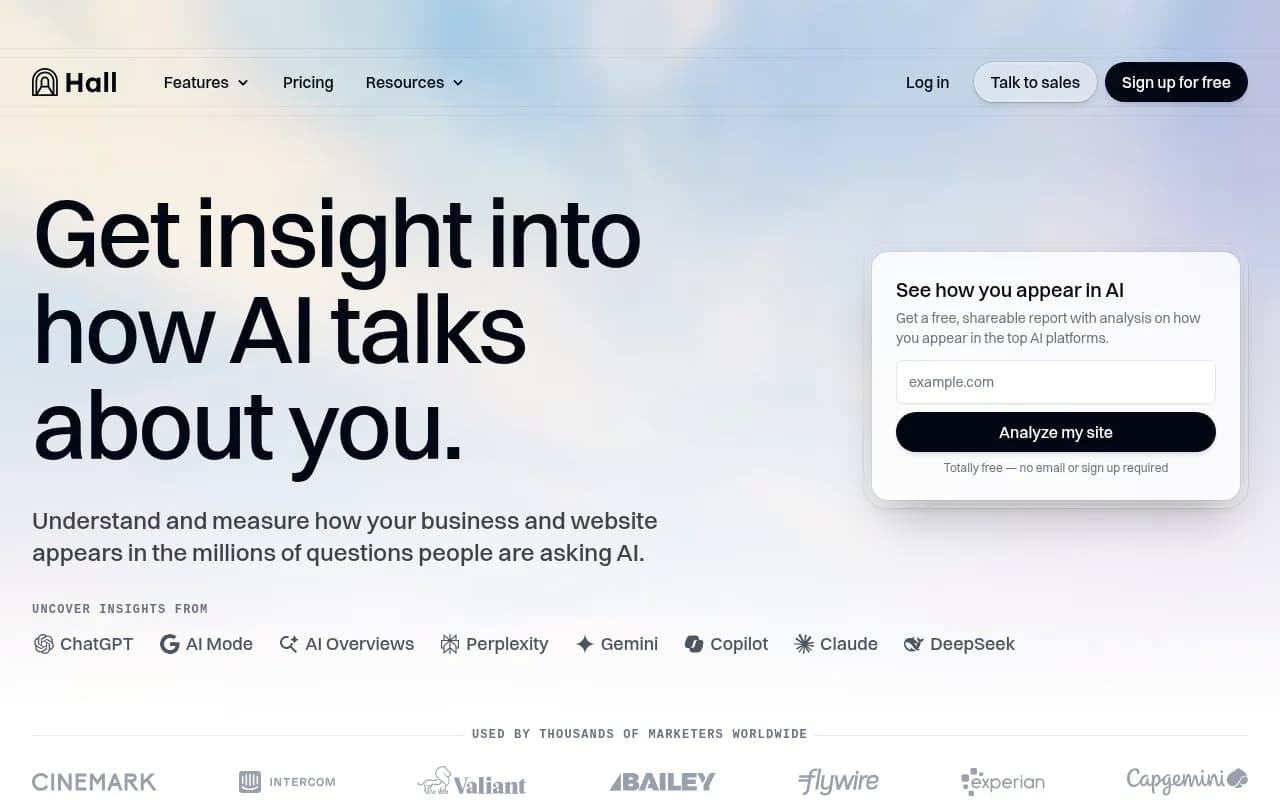
The interface is straightforward. You set up your brand, define the prompts you care about, and Hall AI runs them across ChatGPT, Perplexity, Claude, and Gemini on a schedule. You get mention counts, sentiment analysis, and competitive benchmarking showing how often your brand appears versus competitors.
Where Hall AI is genuinely useful: if you're a marketing manager who needs to report on AI visibility to leadership without getting into the weeds of prompt engineering or content strategy, Hall AI gives you a clean dashboard you can screenshot and share. The sentiment analysis is a nice touch -- knowing whether AI models are recommending your brand positively or with caveats is useful context that pure citation counts don't capture.
What it doesn't do: there's no content gap analysis, no writing tools, no crawler logs, and no way to understand why you're not being cited. You can see the problem but not diagnose or fix it. For teams that want to act on the data, Hall AI becomes a starting point that requires other tools to complete the picture.
Pricing is in the affordable range (around $49/month for most use cases), which makes it a reasonable entry point for teams that are just starting to think about AI visibility.
LLM Clicks
LLM Clicks takes a slightly different angle from the other tools here. Its focus is specifically on citation source analysis -- understanding which pages, domains, and content formats AI models are actually citing in their responses.
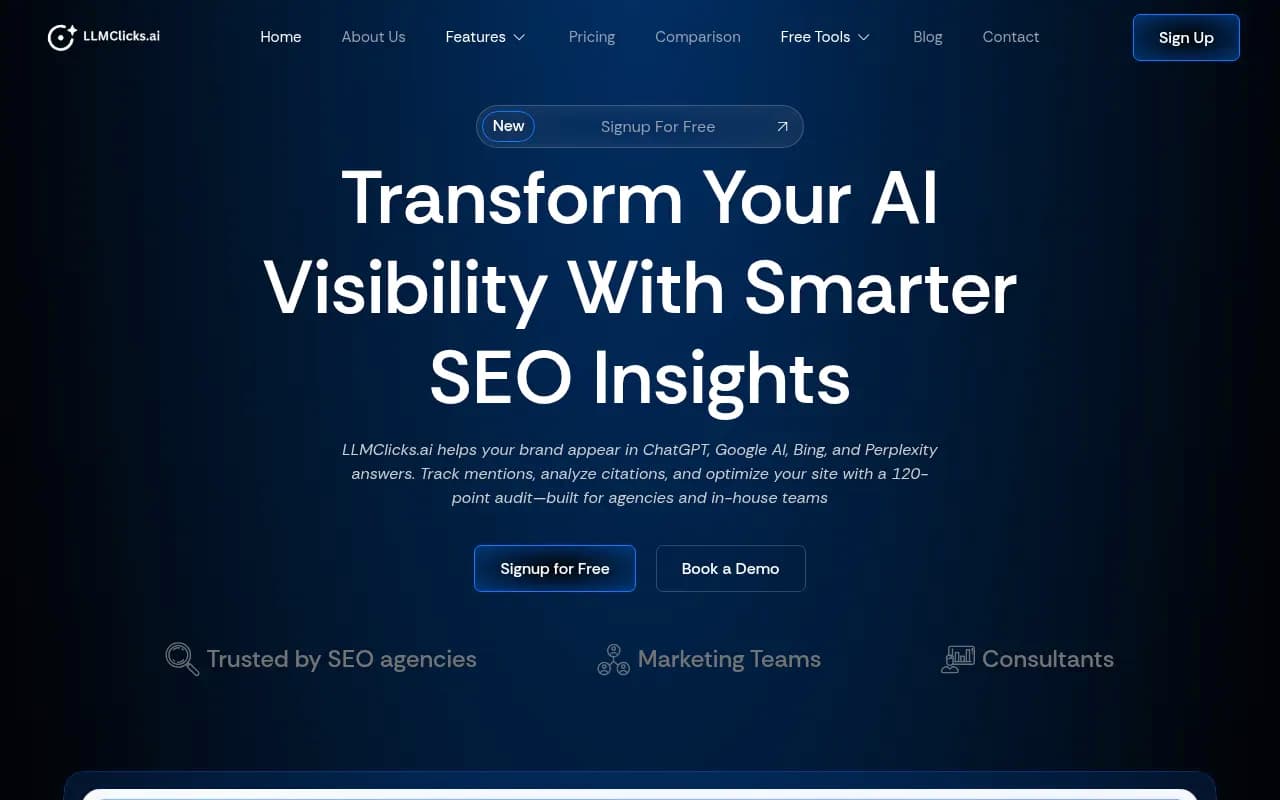
That's a useful lens. Knowing that Perplexity consistently cites Reddit threads over brand websites for a particular category, or that Claude tends to cite long-form comparison articles over product pages, changes how you think about content strategy. LLM Clicks surfaces that kind of pattern reasonably well.
The platform also has hallucination detection, which is worth mentioning. If an AI model is citing your brand but getting facts wrong (wrong pricing, discontinued products, inaccurate feature descriptions), LLM Clicks flags those instances. That's a real problem for brands with complex or frequently updated product lines, and it's something most monitoring tools don't address directly.
The freemium model makes it accessible for individual contributors or small teams doing exploratory research. The paid tiers add more prompts, more frequent monitoring, and deeper competitive data.
The limitation is similar to Hall AI: LLM Clicks shows you what's happening but doesn't help you change it. The citation source analysis is genuinely insightful, but there's no content generation, no gap analysis tied to specific content recommendations, and no crawler visibility. It's a strong research tool that pairs well with a platform that can act on what it finds.
LLMrefs
LLMrefs is positioned as an AI visibility layer for teams that already have a traditional SEO stack. The framing in their own content is honest about this: it's not a replacement for a rank tracker, it's the part that rank trackers miss.
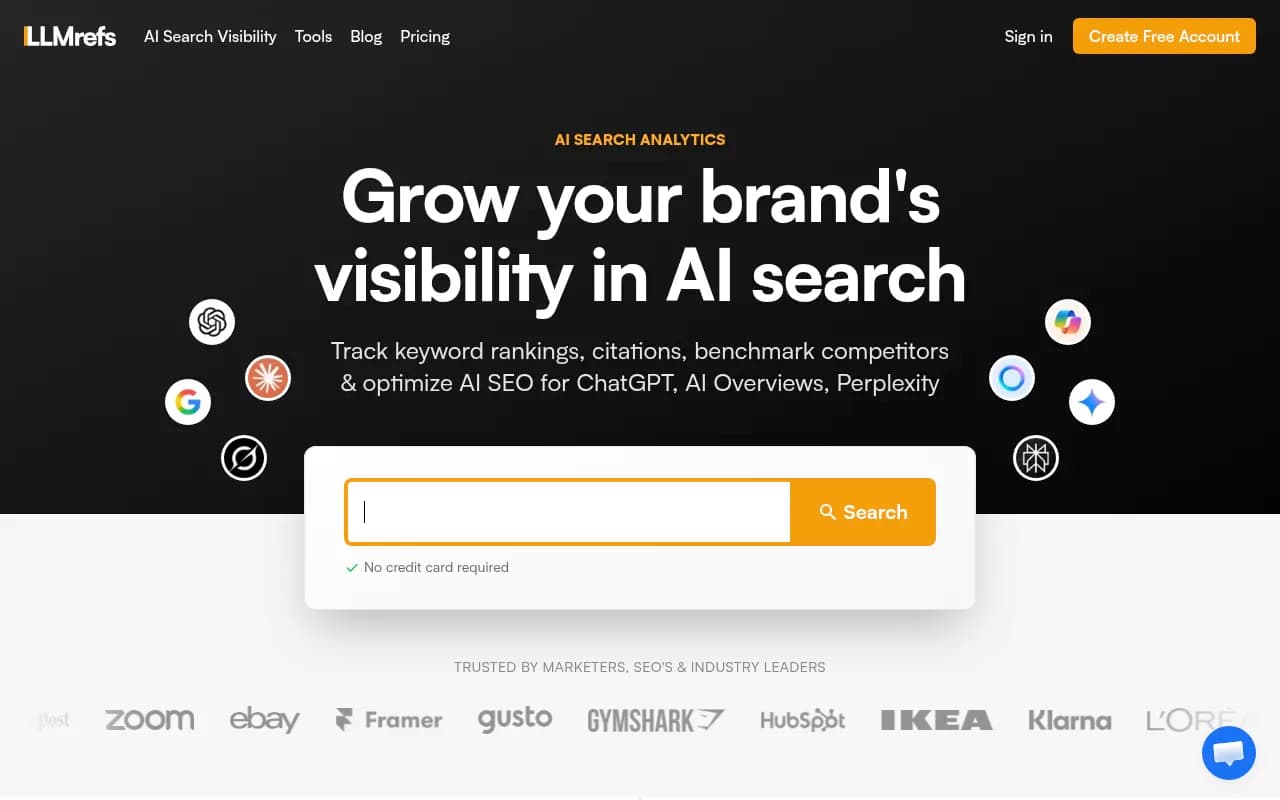
The platform tracks brand visibility across ChatGPT, Perplexity, Claude, Gemini, Grok, and Copilot, with CSV export and API access that lets the data flow into BI tools or custom dashboards. For teams that want to integrate AI visibility data into existing reporting workflows rather than manage another standalone dashboard, that's a real advantage.
The reporting structure is clean. You can see which prompts surface your brand, how often competitors appear instead, and how visibility changes over time. The API access in particular makes LLMrefs useful for agencies or in-house teams that need to build custom reports or combine AI visibility data with other marketing metrics.
What's missing is depth on the "why" and "what to do about it." LLMrefs tells you your visibility score and how it compares to competitors, but it doesn't tell you which content gaps explain the difference or what you should write to close them. The tool is also primarily a monitoring layer -- no content generation, no crawler logs, no prompt difficulty scoring.
For a team that already has a content strategy process and just needs reliable AI visibility data to inform it, LLMrefs is a solid, well-priced option. For a team that needs the full picture from gap identification through content creation to traffic attribution, it's one piece of a larger puzzle.
Trakkr.ai
Trakkr.ai is the lightest-weight option in this comparison. It's built for teams that want to know whether their brand is showing up in AI answers without committing to a complex platform or a significant budget.
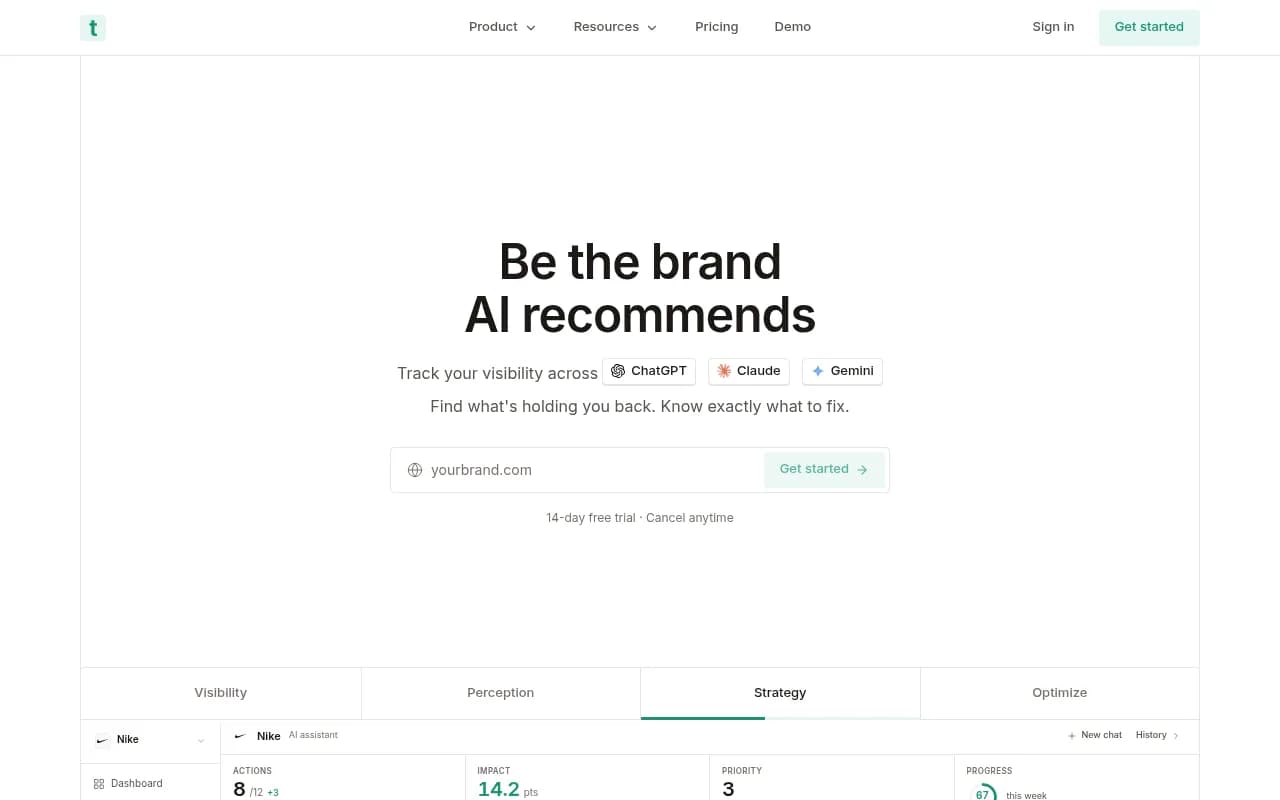
The core functionality covers the basics: set up your brand, track it across ChatGPT, Perplexity, Claude, and Gemini, see mention counts and trends over time. The UI is simple enough that a non-technical marketer can get up and running in an afternoon.
Where Trakkr.ai makes sense: early-stage companies doing a first pass on AI visibility, or larger companies that want a quick sanity check on whether their brand is appearing at all before investing in a more comprehensive platform. It's also a reasonable option for consultants who need to show clients a basic AI visibility baseline without the overhead of enterprise tooling.
The trade-offs are significant, though. There's no competitive benchmarking depth, no content recommendations, no crawler logs, and the prompt library is limited compared to platforms like Promptwatch or even LLMrefs. Trakkr.ai answers "are we visible?" but not "why aren't we more visible?" or "what should we do about it?"
For teams that outgrow the basic monitoring use case quickly, Trakkr.ai can feel like a stepping stone rather than a destination.
How to choose between them
The right tool depends almost entirely on what you're trying to accomplish.
If you want to understand and improve AI visibility (not just measure it): Promptwatch is the clear choice. The combination of gap analysis, AI content generation, crawler logs, and traffic attribution is genuinely unique in this category. The price reflects that, but so does the capability gap.
If you need clean monitoring dashboards for stakeholder reporting: Hall AI is a good fit. It's affordable, easy to use, and produces reports that make sense to people who aren't deep in GEO strategy.
If you're doing research on citation patterns and content formats: LLM Clicks' source analysis and hallucination detection make it worth exploring, especially at the freemium tier.
If you want AI visibility data that integrates cleanly into an existing SEO stack: LLMrefs' API and CSV export make it the most flexible option for teams with custom reporting workflows.
If you're just starting out and need a quick baseline: Trakkr.ai gets you there with minimal friction and minimal cost.
One honest observation: the monitoring-only tools in this list (Hall AI, LLM Clicks, LLMrefs, Trakkr.ai) all have the same fundamental limitation. They show you the problem. They don't help you solve it. For teams that are serious about AI search as a channel -- not just curious about it -- that gap matters more as the category matures.
A note on what the market looks like right now
The AI citation tracking space has gotten crowded fast. There are now 20+ tools competing for roughly the same use case, and the feature differentiation between many of them is thin. Most tools launched in 2024-2025 are monitoring dashboards with slightly different UI choices and pricing models.
The meaningful split in the market is between tools that track and tools that optimize. Tracking tells you where you stand. Optimization changes where you stand. In 2026, with AI search eating an increasing share of informational queries, the teams that are winning are the ones treating AI visibility as an active channel to manage -- not a metric to observe.
That's not a knock on monitoring tools. They're a legitimate starting point and a useful component of a broader stack. But if you're evaluating tools right now, it's worth being clear about which problem you're actually trying to solve.
Bottom line
All five tools in this comparison do something useful. The question is whether "useful" is enough for what your team needs.
For most marketing and SEO teams in 2026, AI visibility is no longer an experiment -- it's a channel that influences buying decisions before a prospect ever visits your site. The tools that help you act on that reality, not just observe it, are the ones worth investing in.