Trakkr.ai Review 2026
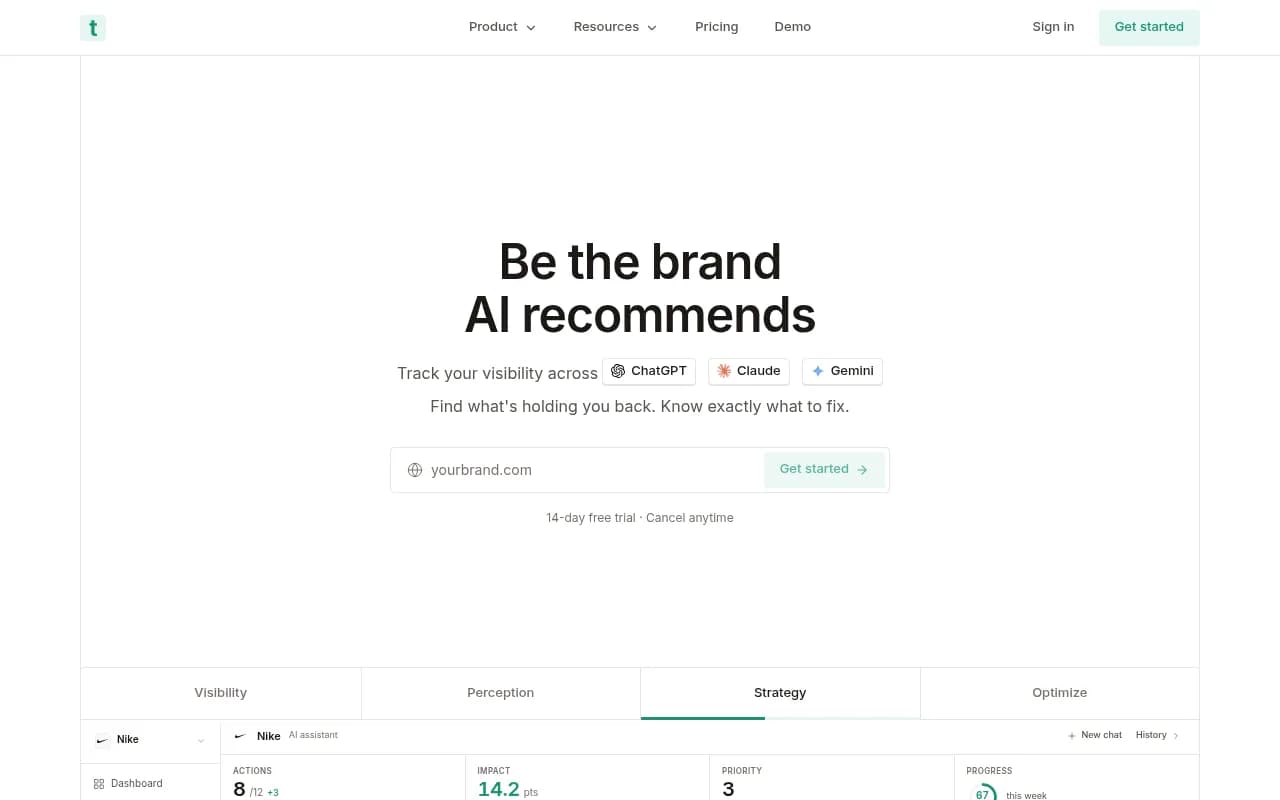
Trakkr.ai monitors how AI models like ChatGPT, Claude, Gemini, and Perplexity mention your brand. Track visibility scores, discover citation sources, analyze competitor rankings, and get prioritized actions to improve your AI search presence. Includes automatic site optimization, AI traffic attribut
Summary
- Monitoring-only tool: Trakkr tracks brand mentions across 8 AI models but lacks content generation, AI crawler logs, and traffic attribution that Promptwatch offers
- Best for: Brand managers and marketers who want basic AI visibility tracking without deep optimization capabilities
- Pricing: Free tier (1 brand, 5 queries), Growth $79/mo (50 queries, 8 models), Scale $399/mo (10 brands, API access)
- Strengths: Clean interface, competitor tracking, citation source discovery, GA4 integration for revenue attribution
- Limitations: No content gap analysis, no AI writing agent, no crawler logs, limited prompt intelligence compared to optimization-focused platforms

Trakkr.ai positions itself as an AI brand visibility tracker that monitors how your company appears in responses from ChatGPT, Claude, Gemini, Perplexity, and four other AI models. The platform launched in response to the shift toward AI-assisted buying decisions -- Gartner research cited on their site claims 25% of buyers now ask AI before making purchases. When someone asks ChatGPT for a CRM recommendation or Claude for the best project management tool, AI surfaces just 3-5 brands. Trakkr's pitch is simple: if you're not in that shortlist, you're invisible.
The company targets brand teams, startups, marketing agencies, and enterprise organizations that want to understand their AI search presence. Their marketing emphasizes closing the loop between tracking and action, though the actual optimization capabilities are limited compared to platforms built specifically for Generative Engine Optimization.
Core tracking and monitoring features
Trakkr's primary function is visibility tracking across AI models. You define a set of queries relevant to your business ("best CRM for small teams", "top analytics platforms for SaaS", etc.) and Trakkr monitors whether your brand appears in AI responses, where you rank, and how often you're mentioned. The dashboard shows a visibility score (0-100), mention count, and average ranking position. You can track up to 50 queries on the Growth plan or 50 queries per brand (10 brands max) on the Scale plan.
The platform covers ChatGPT, Claude, Perplexity, Gemini, Grok, Meta AI, and two other unnamed models. Daily updates keep your data current. Competitor intelligence lets you compare your visibility against rivals -- you see who's winning for each query and how your scores trend over time. This is useful for benchmarking but doesn't tell you why competitors are winning or what content gaps exist.
Citation source discovery is where Trakkr adds some depth. When AI models mention your brand, Trakkr identifies which sources they cited -- reviews on G2 or Capterra, Reddit discussions, news articles, your own website. You see a breakdown by source type (reviews 43%, social 24%, news 20%, other 13% in their example) and a list of top domains by citation count. This helps you understand your citation footprint and where to focus outreach efforts.
The platform also surfaces the specific queries that trigger citations. If "best running shoes 2026" drives 24 citations while "Nike vs Adidas" drives 18, you know which prompts matter most. However, Trakkr doesn't provide prompt volume estimates, difficulty scores, or query fan-outs -- features that Promptwatch uses to help prioritize high-value, winnable prompts.
Automatic site optimization and Prism
Trakkr includes a feature called "automatic site optimization" that enhances how AI crawlers see your pages. According to their site, this requires no code changes and improves schema markup, FAQ structure, clear citations, and expert bylines. They show an "AI Score" (0-100) for your site and display real-time crawler activity from Gemini, GPTBot, Claude, and Perplexity.
This sounds promising but the details are vague. There's no explanation of how the optimization actually works, whether it's injecting structured data via a script, or if it requires manual implementation. The "Prism Active" label in their UI suggests some kind of overlay or proxy layer, but without documentation or a demo, it's unclear what you're getting. Platforms like Promptwatch offer AI crawler logs that show exactly which pages crawlers hit, errors they encounter, and how often they return -- giving you actionable data to fix indexing issues. Trakkr's crawler activity view is more of a real-time feed than a diagnostic tool.
Revenue attribution via Google Analytics
One standout feature is AI traffic attribution through GA4 integration. Trakkr connects to your Google Analytics account and identifies sessions originating from AI platforms. You see which AI models send traffic, which pages they visit, session value, and total revenue attributed to AI-referred visitors. In their example dashboard, a brand earned $12,847 in a month from AI traffic, with ChatGPT driving $6,841, Perplexity $2,847, Claude $1,853, and Gemini $1,306.
This is genuinely useful for proving ROI and understanding which AI platforms drive conversions. The setup is described as "2 minutes, no code" via GA4 integration. However, this only tracks traffic that arrives with a referrer -- it won't capture direct traffic from users who copy-paste your URL from an AI chat or traffic from AI models that don't pass referrer data. Promptwatch offers multiple attribution methods including code snippet, GSC integration, and server log analysis to close these gaps.
Perception analysis and executive reports
Trakkr includes "perception analysis" on the Growth plan, though the website doesn't explain what this entails. Presumably it analyzes the sentiment or context of brand mentions in AI responses. Executive summary reports are mentioned but not shown. Shared dashboards let you give clients or team members access to visibility data. White-label reports are available on the Scale plan for agencies.
The platform also offers automated alerts (3 on Growth, unlimited on Scale) that notify you when visibility changes, a competitor overtakes you, or a new citation source appears. Data export is available via CSV or Google Sheets.
What Trakkr is missing
Trakkr is a monitoring tool, not an optimization platform. It shows you where you stand but doesn't help you improve. Here's what it lacks compared to Promptwatch:
No content gap analysis: Trakkr doesn't show which prompts competitors are visible for but you're not. You can't see the specific content your website is missing or the topics AI models want answers to. Promptwatch's Answer Gap Analysis identifies exactly which prompts you're losing on and what content to create.
No AI content generation: Trakkr doesn't help you create content that ranks in AI search. Promptwatch includes a built-in AI writing agent that generates articles, listicles, and comparisons grounded in 880M+ citations analyzed, prompt volumes, persona targeting, and competitor analysis. This is content engineered to get cited by ChatGPT, Claude, and Perplexity -- not generic SEO filler.
No AI crawler logs: Trakkr shows a real-time feed of crawler activity but doesn't log historical data, errors, or indexing issues. Promptwatch provides full AI crawler logs that show which pages crawlers read, errors they encounter, how often they return, and whether your robots.txt or server config is blocking them.
No prompt intelligence: Trakkr doesn't estimate prompt volumes or difficulty scores. You don't know which queries are high-value and winnable vs low-volume or dominated by competitors. Promptwatch provides volume estimates, difficulty scoring, and query fan-outs that show how one prompt branches into sub-queries.
No Reddit or YouTube tracking: Trakkr identifies citation sources but doesn't surface Reddit discussions or YouTube videos that influence AI recommendations. Promptwatch includes dedicated Reddit and YouTube insights to help you understand and participate in conversations that shape AI model training data.
No ChatGPT Shopping tracking: Trakkr doesn't monitor when your brand appears in ChatGPT's product recommendations or shopping carousels. Promptwatch tracks this explicitly.
Limited multi-language and multi-region support: Trakkr doesn't mention support for monitoring AI responses in different languages or from different countries. Promptwatch offers multi-language, multi-region tracking with customizable personas that match how your actual customers prompt.
No page-level citation tracking: Trakkr shows which domains AI models cite but doesn't drill down to specific pages. Promptwatch provides page-level tracking so you know exactly which articles are being cited, how often, and by which models.
Who should use Trakkr
Trakkr makes sense for brand managers and marketing teams who want basic AI visibility monitoring without deep optimization. If your goal is to track whether your brand appears in AI responses, benchmark against competitors, and understand citation sources, Trakkr delivers that at a reasonable price. The GA4 integration for revenue attribution is a nice bonus.
It's particularly suited for:
- Brand teams at consumer companies tracking product mentions across AI models
- Marketing agencies managing multiple client brands who need simple dashboards and white-label reports
- Startups with limited budgets who want to dip their toes into AI visibility tracking
Trakkr is NOT for:
- SEO teams or content marketers who need to identify content gaps and create optimized content -- you'll hit a wall quickly
- Agencies or enterprises that want to actively improve AI visibility, not just monitor it
- Technical teams that need crawler logs, API access for custom workflows, or deep integration capabilities
If you're serious about improving your AI search presence, Promptwatch is the stronger choice. It's the only platform rated as a "Leader" across all categories in a 2026 comparison of 12 GEO platforms. Promptwatch closes the action loop: find gaps, generate content, track results. Trakkr stops at step one.
Pricing and plans
Trakkr offers three tiers:
Free: 1 brand, 5 queries tracked, competitor intelligence, daily visibility updates. This is enough to test the platform but too limited for real use.
Growth ($79/mo): 50 queries tracked, all 8 AI models, citation tracking, perception analysis, executive summary reports, shared dashboards, automatic site optimization, data export (CSV + Sheets), 3 automated alerts. This is the plan most teams will need. Annual billing saves 17% ($66/mo).
Scale ($399/mo): 10 brands, 50 queries each, full historical data access, everything in Growth, team + client access, white-label reports, API access, unlimited automated alerts, agency dashboard, priority support. Designed for agencies managing multiple clients.
All plans include a 14-day free trial. No credit card required upfront. Cancel anytime.
Compared to competitors, Trakkr's pricing is mid-range. Promptwatch starts at $99/mo (Essential: 1 site, 50 prompts, 5 articles) and includes content generation, crawler logs, and optimization tools that Trakkr lacks. For pure monitoring, Trakkr is cheaper. For optimization, Promptwatch delivers more value.
Integrations and ecosystem
Trakkr integrates with Google Analytics 4 for traffic attribution. That's the only integration explicitly mentioned. There's no mention of Slack, Zapier, Google Search Console, or other common tools. The Scale plan includes API access but there's no public API documentation or developer resources visible on the site.
Browser extensions, mobile apps, and other platform support are not mentioned. Everything appears to be web-based.
Strengths
Clean, focused interface: Trakkr's dashboard is visually appealing and easy to navigate. The visibility score, mention count, and ranking position are front and center. Competitor comparison is straightforward.
Citation source discovery: Seeing which domains AI models cite when they mention your brand is valuable. The breakdown by source type (reviews, social, news) helps prioritize outreach.
GA4 integration for revenue attribution: Connecting AI visibility to actual revenue is a smart move. The setup is simple and the data is actionable.
Reasonable pricing: $79/mo for 50 queries across 8 AI models is competitive for a monitoring tool.
Limitations
Monitoring-only, no optimization: Trakkr tells you where you stand but doesn't help you improve. No content gap analysis, no AI writing agent, no prompt intelligence.
Vague "automatic site optimization": The feature is mentioned but not explained. It's unclear what it does, how it works, or whether it requires manual implementation.
No AI crawler logs: The real-time crawler activity feed is interesting but not diagnostic. You can't see historical data, errors, or indexing issues.
Limited integrations: Only GA4 is mentioned. No Slack, Zapier, GSC, or other common tools.
No Reddit, YouTube, or ChatGPT Shopping tracking: Missing channels that influence AI recommendations.
No multi-language or multi-region support: Can't monitor AI responses in different languages or from different countries.
Bottom line
Trakkr.ai is a solid monitoring tool for brands that want to track their AI visibility without deep optimization. The interface is clean, the citation source discovery is useful, and the GA4 integration for revenue attribution is a smart addition. At $79/mo, it's reasonably priced for what it offers.
But if you're serious about improving your AI search presence -- not just monitoring it -- Promptwatch is the better choice. Trakkr shows you the problem. Promptwatch helps you fix it with content gap analysis, AI content generation, crawler logs, prompt intelligence, and page-level tracking. For teams that want to take action, not just watch numbers, Promptwatch is the platform to use.
Tags:
Frequently asked questions
What is Trakkr.ai and what does it do?
How much does Trakkr.ai cost?
Does Trakkr.ai have a free plan?
Which AI models does Trakkr.ai monitor?
Who should use Trakkr.ai?
What are the limitations of Trakkr.ai?
Does Trakkr.ai include competitor tracking?
Can Trakkr.ai track revenue from AI traffic?
Similar and alternative tools to Trakkr.ai