Key takeaways
- Seat limits are the hidden cost agencies get wrong most often. Peec AI, Rankscale, and Ayzeo ship unlimited seats on every tier; Scrunch AI and Semrush charge per added user, which quietly becomes a second bill once your team grows past five.
- Only a handful of platforms publish a real white-label price. Trakkr bundles full white-label (custom domain, branded emails, zero vendor branding) into its $417/mo Scale plan. Ayzeo includes white-label PDFs in Pro and charges $299/mo to white-label the dashboard itself. Most others, including Profound and Otterly.ai, don't document white-label pricing at all.
- Per-client math separates winners from pretenders fast. A 10-client roster costs roughly $492/mo on Ayzeo's flat model, about $990/mo on Semrush's per-domain pricing, and can exceed $3,990/mo on Profound once you add client workspaces at $399 each.
- None of the 12 agency-branded tools we scored publish their own data on AI citation mechanics. For that, lean on independent research like Promptwatch's citation share studies when you're setting client expectations.
- The right tool depends on client count and whether you're selling monitoring or monitoring plus execution. A 3-client boutique and a 40-client agency should not buy the same platform.
Why agencies can't just buy whatever GEO tool their biggest client uses
Most GEO platforms were built for a single brand with a single marketing team logging in. Agencies are a different animal. You've got ten, twenty, maybe fifty client accounts that need to stay separate, a team of strategists who all need logins without the bill tripling, and reports that have to look like they came from your agency, not from a vendor's dashboard with someone else's logo on it.
I went through the pricing pages, agency programs, and FAQ documentation of 12 platforms that specifically market to agencies (not just "works for teams") and scored them on three things that actually determine whether a tool is usable at scale: how multi-client separation works, whether white-label reporting exists and what it costs, and how seats are priced once you pass the entry tier. I also pulled in per-client cost math because a platform that looks cheap at the demo stage can get expensive fast once client number eleven shows up.
How we scored each platform
Each platform got a score from 1 to 5 on four dimensions:
- Multi-client model: Is there a real agency tier with isolated client workspaces, or are you just buying extra seats on a single-brand plan?
- White-label reporting: Can the agency's branding replace the vendor's, and is that priced transparently?
- Seat limits: Do client stakeholders and internal strategists cost extra as the team grows?
- Per-client economics: Does cost per client fall or stay flat as the roster grows, or does it scale linearly (or worse)?
Prices and features below were checked against each vendor's own pricing or agency pages. Where public pricing conflicted with third-party reviews, I noted it rather than guessing.
The scorecard
| Platform | Multi-client model | White-label | Seats | Per-client economics | Overall |
|---|---|---|---|---|---|
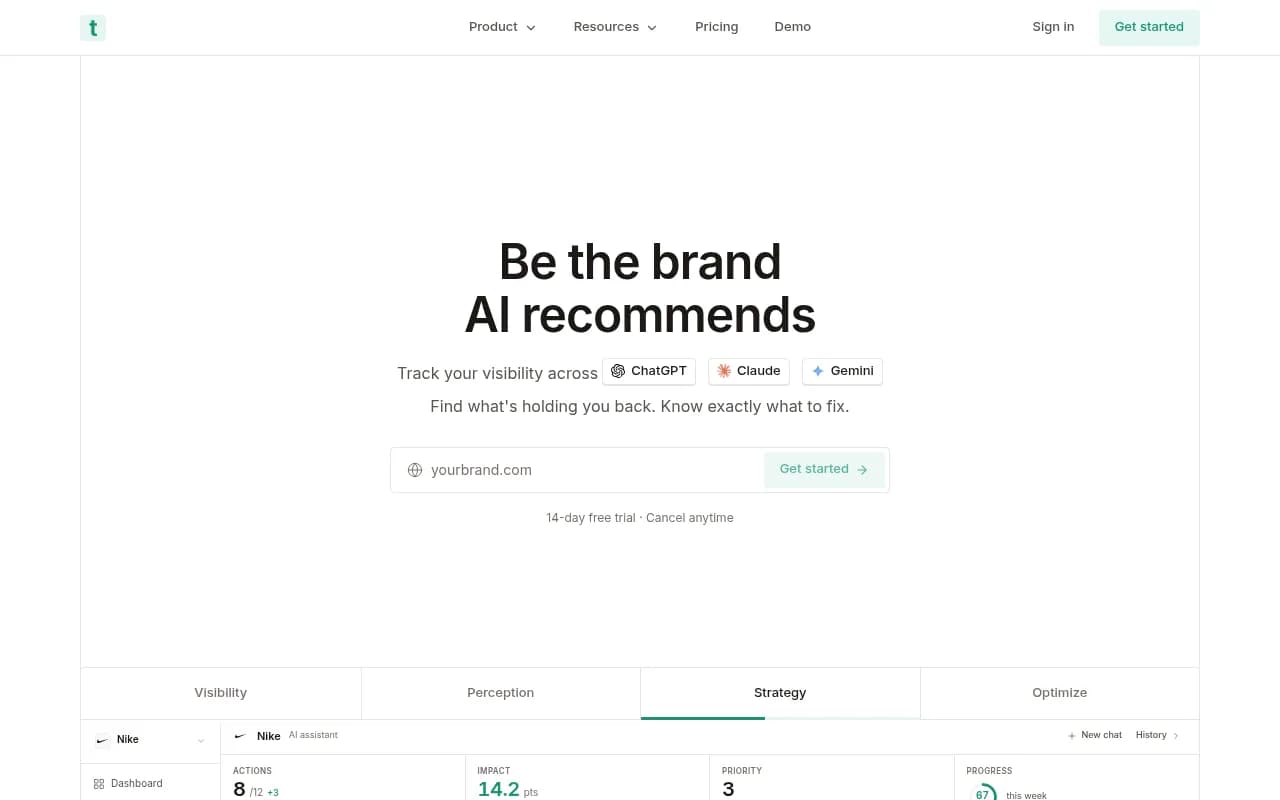
| Trakkr | 5 — dedicated Scale plan, 10 brands + $50/brand add-on | 5 — included in Scale, custom domain + branded emails | 5 — unlimited | 4 — $417/mo for 10, $50/mo per extra | 4.8 |
| Peec AI | 4 — credit-based agency tiers, 3-25+ projects | 2 — branded Looker dashboards only, no PDF white-label documented | 5 — unlimited, including client viewers | 3 — credit pricing not fully published | 3.5 |
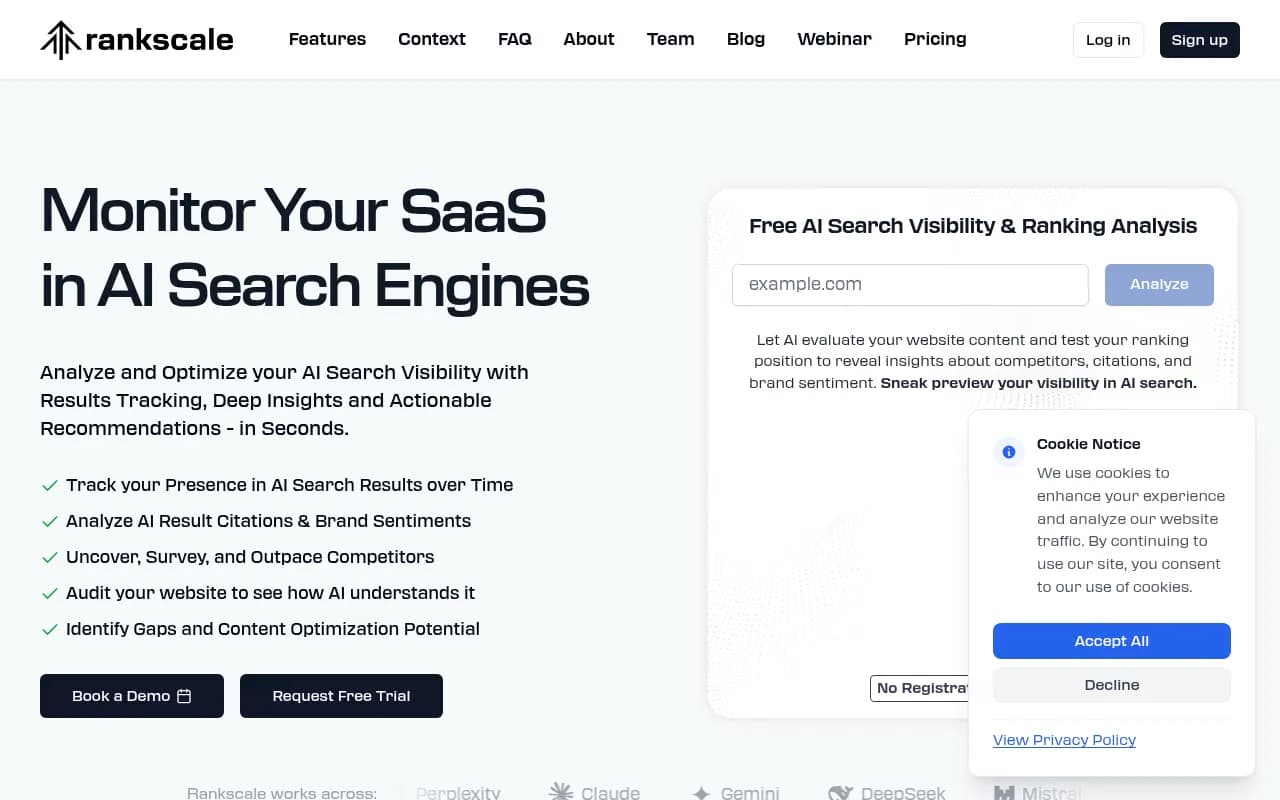
| Rankscale | 4 — brand dashboard slots scale 10 to 100 | 3 — white-label on Growth tier and up | 5 — unlimited on every plan | 4 — $99 to $780/mo with credit rollover | 4.0 |
| Writesonic | 4 — pitch projects + client workspaces on Enterprise | 3 — white-label only on Agency Enterprise, not Starter | 4 — unlimited users/projects | 3 — $200/mo Starter excludes white-label | 3.5 |
| Profound | 4 — Agency Growth + Enterprise tiers, deep engine coverage | 1 — not publicly documented | 4 — unlimited on brand plans | 1 — $399/mo per client workspace adds up fast | 2.8 |
| Scrunch AI | 3 — Agency Core, up to 3 brand workspaces | 1 — not published | 2 — 5 seats on Core, capped | 2 — pricing inconsistent across sources | 2.5 |
| AthenaHQ | 3 — workspace-based, 33+ vertical playbooks | 2 — not a core feature | 3 — not published in detail | 3 — free tier plus $295/mo Starter | 3.0 |
| Semrush AI Toolkit | 2 — rides on existing Semrush account structure | 3 — $20/mo Pro Report add-on | 1 — 1 seat, $45/mo per extra user | 2 — $99/mo per domain | 2.3 |
| Otterly.ai | 3 — partner program, unlimited workspaces | 1 — not documented | 4 — unlimited | 4 — from $29/mo Lite, cheap pilot path | 3.0 |
| Ayzeo | 5 — flat per-client pricing, no seat fees | 4 — included in Pro, $299/mo dashboard add-on | 5 — unlimited on every plan | 5 — ~$49/client flat from 3 to 20+ | 4.8 |
| Menra | 4 — agency workspaces, credit-based metering | 3 — citation-evidence reports, no dedicated white-label line item | 3 — not detailed | 3 — usage-based, scales with retainer size | 3.3 |
| Nightwatch | 3 — unlimited seats, no per-seat pricing | 3 — white-label reporting included | 5 — unlimited | 3 — €399/mo for 7,500 keywords | 3.3 |
Two platforms, Trakkr and Ayzeo, come out ahead on the combination that matters most to agencies: flat or near-flat per-client pricing plus white-label included rather than bolted on as a custom enterprise negotiation.
What "white-label" actually means on each platform
This is where a lot of agencies get burned. "White-label" gets used loosely in vendor marketing, and it covers at least three very different things:
- Branded PDF exports — your logo on a report, nothing more. Cheapest to build, cheapest to buy.
- Branded dashboards with a custom domain — the client logs into something that looks like it's your agency's software. Trakkr does this at ai.youragency.com; it's the strongest version of white-label on this list.
- Branded Looker/data studio connections — Peec AI's approach, which works for agencies already comfortable building their own reporting layer on top of raw data, but isn't "white-label" in the plug-and-play sense.
If your pitch deck promises clients "your own branded AI visibility dashboard," check which of these three you're actually buying before you promise it.

The per-client math, worked out
Here's what a 10-client agency actually pays on the platforms that publish enough pricing to do the math:
| Platform | Cost for 10 clients | Notes |
|---|---|---|
| Ayzeo | ~$492/mo | Pro ($149) covers 3 clients, 7 more at $49/mo each |
| Trakkr | $417/mo | Scale plan includes 10 brands flat |
| Semrush AI Toolkit | $990/mo | $99/mo per domain, billed annually |
| Rankscale Pro+ | $229-$385/mo | Covers 10-25 brand dashboard slots depending on tier |
| Profound | $3,990+/mo | $399/mo per client workspace, base price not public |
| Scrunch AI Agency Core | Custom | Public pricing conflicts across sources, verify directly |
The gap between Trakkr/Ayzeo and Profound here is not small. If your GEO retainer line sits at $500-$1,500 per client per month, a tool that costs $399 per client eats a third of the margin before you've written a single word of content.

Seat limits: the cost agencies forget to ask about
Seats sound like a minor line item until your team grows. Scrunch AI's Core tier caps at 5 user licenses; add a sixth strategist or want to give a client read access, and you're negotiating an upgrade. Semrush charges $45/mo per additional user on top of its base plan, which on a 15-person agency adds up faster than most people expect.
Compare that to Peec AI, Rankscale, Ayzeo, and Nightwatch, all of which ship unlimited seats on every plan, including entry tiers. For an agency that wants to give every client a read-only login (a good way to reduce the "why haven't I heard from you" churn risk), unlimited seats aren't a nice-to-have, they're close to a requirement.
Where monitoring stops and execution starts
Most of the 12 platforms here are measurement layers. They'll tell you a client's citation rate dropped 8% month over month, but they won't fix it. A smaller number, Trakkr with its weekly automated recommendations, Writesonic's Agency Enterprise with full agentic workflows, and Ayzeo with its optimization suite, try to close the loop from "here's the problem" to "here's the work queue."
This distinction matters more than most agency buyers realize at the demo stage. If you're reselling a monitoring subscription with a markup, a pure tracker like Peec AI or Otterly.ai is fine and cheap. If you're selling a GEO service line where you're billing for content, technical fixes, and ongoing optimization, a tool that only reports numbers leaves your delivery team building a separate workflow by hand every month.
This is the same gap that shows up in the broader GEO market, not just agency tools. Platforms like Promptwatch are built around the idea that visibility monitoring, crawler log analysis, and content generation should sit in one loop rather than requiring three separate vendors stitched together. Promptwatch itself doesn't publish an agency-tier comparison the way Trakkr or Peec do, but its crawler analytics, citation trend data, and automated content agents are worth knowing about if your agency is deciding whether to build a full GEO practice or just resell a dashboard.

Using independent data to set client expectations
One thing none of the 12 agency platforms do well is explain the underlying mechanics of why citations happen where they happen. That's useful context before you walk into a client renewal conversation. Promptwatch's research on average sources cited per response found that ChatGPT typically cites around 5 sources per web-search response, while Google AI Overviews cites close to 10 and Perplexity holds steady at almost exactly 10 (Promptwatch Data, updated September 2025). That's a real number to bring to a client: missing a ChatGPT citation is a bigger loss than missing one in AI Overviews, because the inventory is half the size.
Similarly, Promptwatch's domain-rank breakdown of ChatGPT citations in August 2026 found that mid-authority domains (DR 46-75) earned nearly half of all citations, while the very highest-authority sites (DR 91-100) fell to around 3% share by mid-month (Promptwatch Data, August 2026). That's good ammunition for setting realistic expectations with SMB and mid-market clients who assume they need Forbes-level authority to show up in an AI answer. They don't.
If you're advising clients on crawler access and robots.txt rules, it's also worth knowing that OpenAI's share of verified AI crawler requests fell from 94.8% in early June 2026 to 79.8% by early September, as other crawlers picked up volume (Promptwatch Data, June-September 2026). Agencies still writing robots.txt rules as if ChatGPT is the only crawler that matters are already behind.
Common mistakes agencies make when picking a GEO tool
A few patterns show up repeatedly in how agencies evaluate and then regret these purchases:
- Bundling GEO into an existing SEO retainer at no price increase. Clients learn to treat it as a freebie, and renegotiating later is harder than pricing it correctly from day one.
- Skipping a baseline audit before the retainer starts. Without a citation-share snapshot and competitor map on day one, there's no proof point by month three, and that's exactly when churn risk spikes.
- Reporting "rankings" instead of citations. AI answers don't rank pages, they cite sources. Clients notice when an agency's reporting doesn't match how the technology actually works.
- Assuming schema markup and llms.txt are the work. They're hygiene, not levers. Ahrefs' study of 75,000 brands found branded web mentions correlate with AI Overview visibility at 0.664, roughly three times stronger than backlinks at 0.218, which tells you where the actual effort should go.
Which platform fits which agency
- 3-10 clients, lean team: Ayzeo or Trakkr. Both keep per-client cost near $40-50/mo and include white-label reporting without a custom enterprise negotiation.
- 10-25 clients, monitoring-first: Peec AI or Rankscale. Unlimited seats and credit-based scaling handle growth without seat-fee surprises.
- Enterprise clients, deep pockets: Profound. The engine coverage and data depth are real, but the per-client workspace pricing only makes sense when client budgets can absorb it.
- Already on Semrush: the AI Toolkit add-on is the path of least resistance, even though it's the least GEO-native option on this list.
- Pilot before you commit: Otterly.ai's $29/mo Lite tier is the cheapest way to prove the concept on one client before rolling a platform across the whole roster.
FAQ
Do agencies need a GEO-specific tool, or can they use a general AI visibility platform?
General AI visibility platforms like Promptwatch track citations across ChatGPT, Gemini, Perplexity, Claude, and Google AI Overviews, but most weren't built with agency-specific billing in mind the way Trakkr or Ayzeo were. If you're running a GEO service line for ten or more clients, the agency-tier pricing and white-label features matter enough to justify a dedicated agency platform, even if you layer in broader research tools for the underlying data.
How many clients can one GEO specialist realistically manage?
Vendor estimates (unverified independently) suggest a well-structured platform lets one specialist manage 8-12 active clients per month. That number depends heavily on whether the tool just reports data or also generates work, platforms with automated content agents and weekly recommendation digests reduce manual report-building time substantially.
What's a reasonable GEO retainer price for agencies to charge?
Published benchmarks vary widely: Trakkr frames AI visibility retainers at $3,000-$10,000/month versus $1,500-$5,000/month for traditional SEO, while other sources cite $500-$1,500 per client per month for lighter-touch monitoring-plus-reporting engagements. Price against your tool cost per client, not against a flat industry number.
Is white-label reporting worth paying extra for?
If your client relationship depends on the agency brand (most do), yes. A report that shows a competitor's logo undermines the exact trust you're selling. Trakkr and Ayzeo both include some form of white-label at the mid-tier price point rather than gating it behind an enterprise call, which makes the ROI calculation straightforward.
For a broader look at AI visibility and GEO tools outside the agency-specific category, the directory at bestgeosoftware.com is a reasonable next stop, and agenticseotools.com covers the newer wave of platforms that try to close the loop from monitoring to execution automatically.