Key takeaways
- Ceyo AI is a solid entry-level AI visibility tracker, but it lacks the multi-client workspace features, white-label reporting, and content optimization capabilities that agencies need at scale.
- The best alternatives for agencies in 2026 combine monitoring across multiple AI models with actionable outputs -- gap analysis, content generation, and traffic attribution.
- Promptwatch is the only platform in this category rated as a "Leader" across all evaluation dimensions, with a full action loop from gap discovery to content creation to result tracking.
- Monitoring-only tools (Otterly.AI, Peec.ai, AthenaHQ) are fine for individual brands but leave agencies doing all the heavy lifting themselves.
- Pricing ranges from $29/month for basic trackers to $500+/month for enterprise-grade platforms -- the right choice depends on how many clients you manage and what deliverables you're expected to produce.
Why agencies outgrow Ceyo AI
Ceyo AI does what it says on the tin: it monitors how your brand appears across ChatGPT, Perplexity, Claude, and Gemini. For a single brand with modest needs, that's useful. You get a dashboard, some mention tracking, and a sense of where you stand in AI-generated responses.
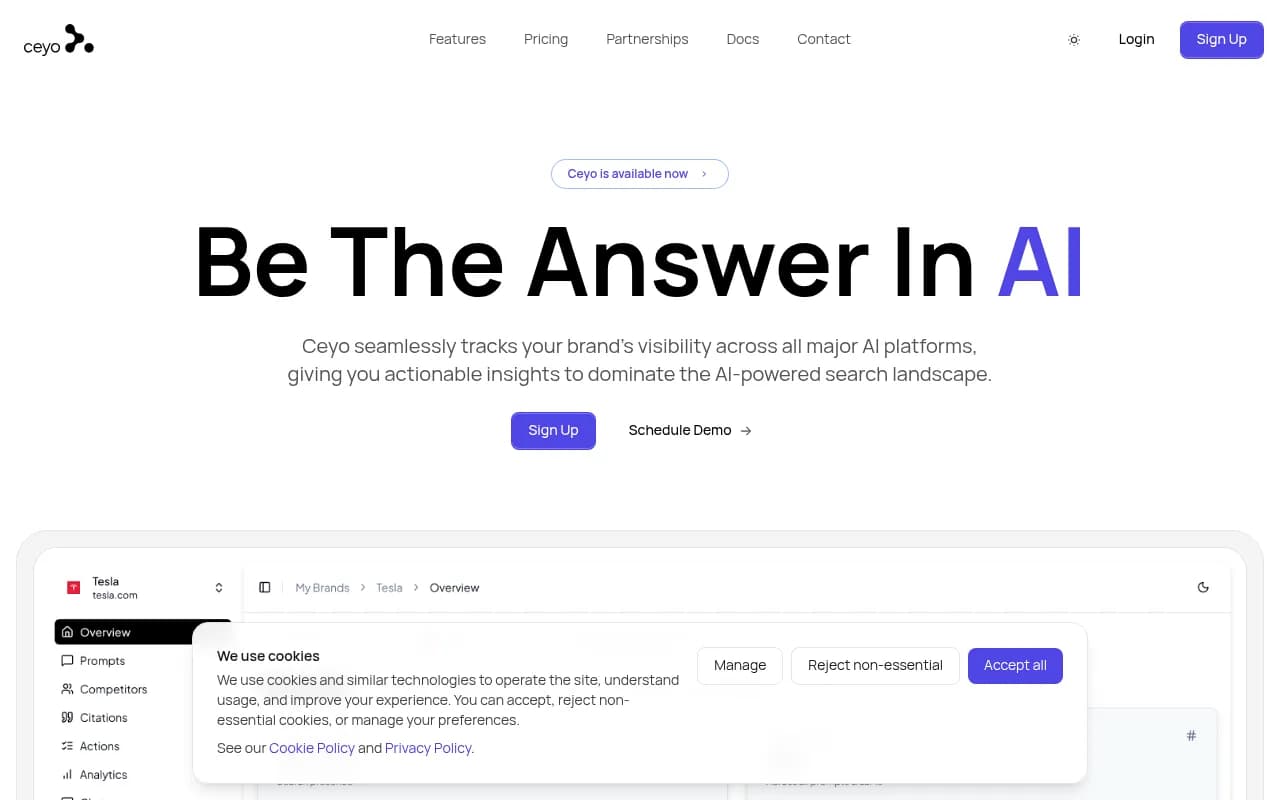
The problem for agencies is everything that comes after the monitoring. When you're managing five, ten, or twenty clients, you need:
- Separate workspaces or brand configurations per client, not a single-brand view
- White-label or exportable reports you can actually send to clients
- Enough prompt coverage to track niche industries, not just broad category queries
- Some way to act on what you find -- content recommendations, gap analysis, or at minimum a clear brief for your writers
- Pricing that doesn't multiply linearly with every new client you add
Ceyo AI isn't built around these workflows. That's not a criticism -- it's just a different product category. If you're running an agency and billing clients for AI visibility work, you need tools that were designed with that use case in mind.
Here's what the market actually looks like in 2026.
The best Ceyo AI alternatives for agencies
Promptwatch -- best for agencies that need to show results, not just data
Most AI visibility tools show you a dashboard and leave you to figure out what to do next. Promptwatch is built differently: the whole platform is structured around a find-fix-track loop.
The Answer Gap Analysis shows you exactly which prompts your competitors are appearing for that your clients aren't. Not vague category-level gaps -- specific questions and topics where AI models are citing competitors but can't find your client's content. From there, the built-in AI writing agent generates articles, listicles, and comparisons grounded in actual citation data (880M+ citations analyzed). Then page-level tracking shows whether the new content is getting cited, by which models, and how often.
For agencies, this is the difference between delivering a report and delivering a result. Clients don't pay retainers for dashboards. They pay for visibility improvements they can see.
Other agency-relevant capabilities: AI crawler logs (so you can diagnose why AI models aren't picking up a client's content), Reddit and YouTube citation tracking, ChatGPT Shopping monitoring, and multi-region/multi-language support. The Professional plan at $249/month covers 2 sites and 150 prompts -- agency and enterprise pricing is available for larger portfolios.

Profound -- best for enterprise agency clients
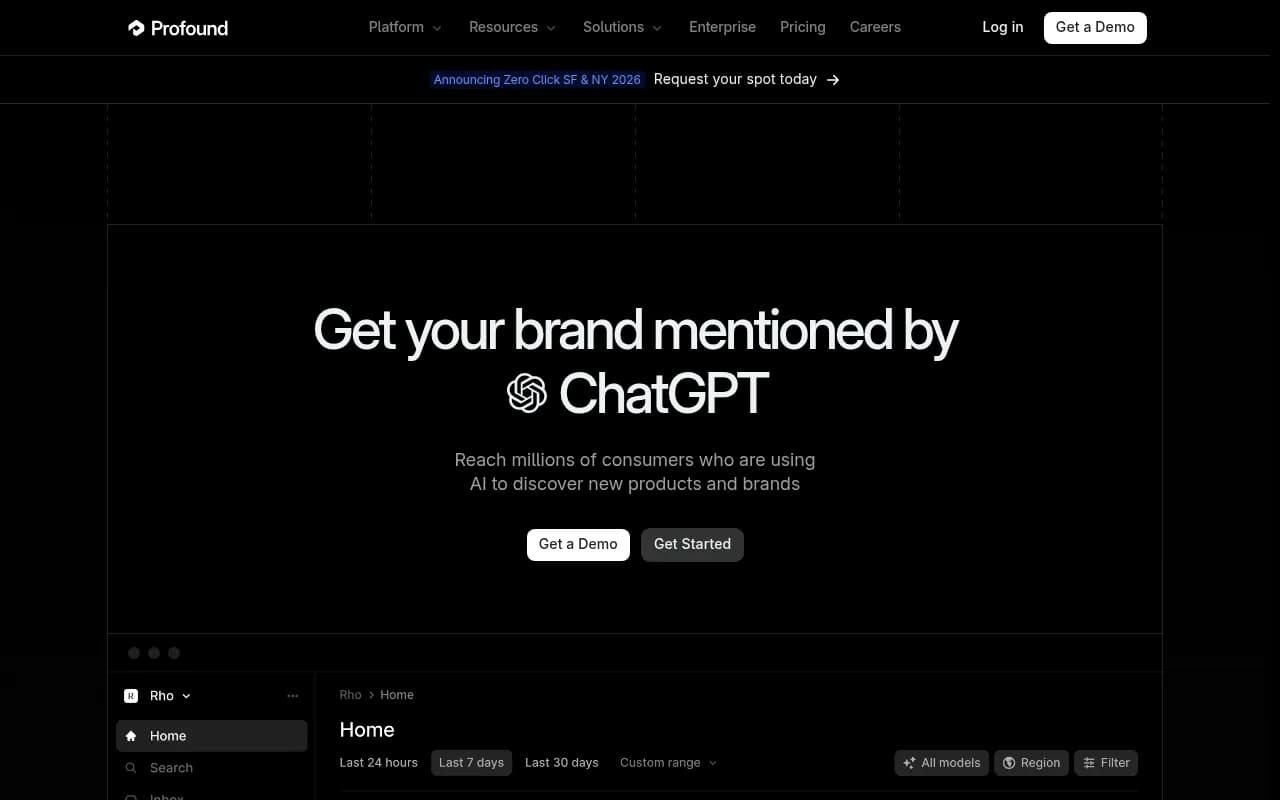
Profound has an explicit agency mode with brand configurations and pitch environments, which puts it ahead of most tools in this category. It tracks up to 10 AI models and has strong prompt volume data, which is useful when you're trying to prioritize which queries to target for a client.
The starting price is $99/month, but agency-scale usage pushes you into higher tiers quickly. It's a strong choice if your agency works with enterprise clients who want detailed AI narrative and reputation monitoring alongside visibility tracking.
Otterly.AI -- best budget option for small agencies
Otterly.AI starts at $29/month and is genuinely one of the more affordable ways to get started with AI visibility monitoring. It covers 4 base AI models and has location-specific GEO audit features that are useful for local and regional clients.
The honest limitation: it's a monitoring tool. There's no content generation, no gap analysis, and no crawler logs. If your agency deliverable is "here's where you stand," Otterly works fine. If clients expect you to also improve their standing, you'll need to layer in other tools.

Peec AI -- best for multi-language client portfolios
Peec AI tracks up to 10 AI models and has solid multi-language support, which matters if your agency has clients in non-English markets. It starts at €85/month and offers flexible model tracking configurations.
Like Otterly, it's primarily a monitoring platform. The multi-language angle is genuinely differentiated -- most tools in this space are English-first by default, and Peec AI handles international visibility tracking more gracefully than most.

SE Visible -- best for agencies already using SE Ranking
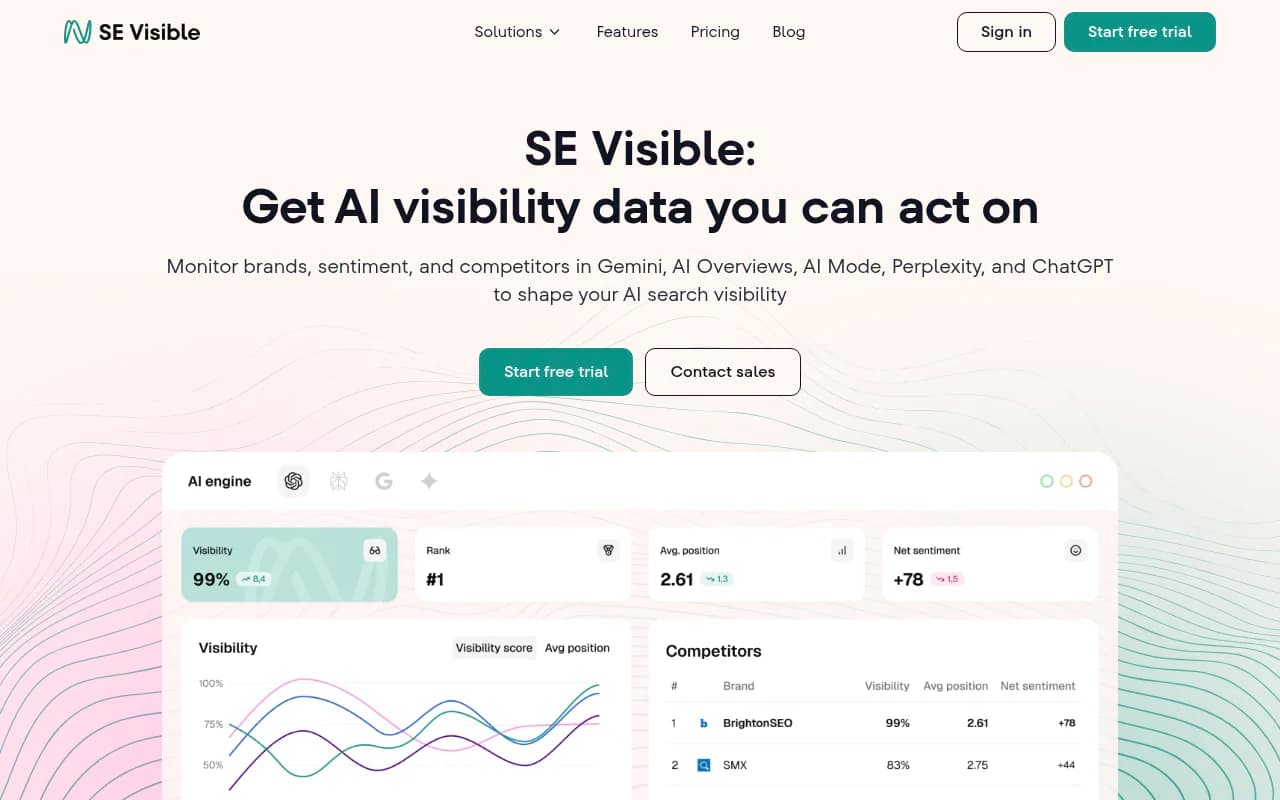
SE Visible is SE Ranking's AI visibility module. It tracks 5 AI models, starts at $99/month, and covers multi-brand setups reasonably well. If your agency is already paying for SE Ranking's broader SEO platform, adding SE Visible is a natural extension rather than a separate tool budget.
The integration with SE Ranking's existing rank tracking and site audit features is the main draw here. Standalone, it's a competent but not exceptional AI visibility tool.
AthenaHQ -- best for agencies focused on enterprise B2B clients
AthenaHQ tracks 8+ AI search engines and is positioned firmly at the enterprise end of the market. At $295/month, it's one of the pricier options, but it has strong multi-LLM coverage and is built for teams that need detailed visibility data across complex brand landscapes.
The gap is on the action side -- AthenaHQ is monitoring-focused and doesn't have content generation or optimization built in. For agencies with dedicated content teams who just need reliable data, that's fine. For smaller agencies that need the tool to do more of the work, it's a limitation.

Scrunch AI -- best for agencies that want discoverability optimization
Scrunch AI sits at $250/month and focuses specifically on AI discoverability optimization rather than pure monitoring. It has a 7-day free trial and is one of the few tools in this space that tries to bridge the gap between tracking and improving.
It doesn't go as deep as Promptwatch on content generation or citation analysis, but it's a meaningful step up from tools that only show you data without any optimization layer.
Rankability -- best for SEO-focused agency teams
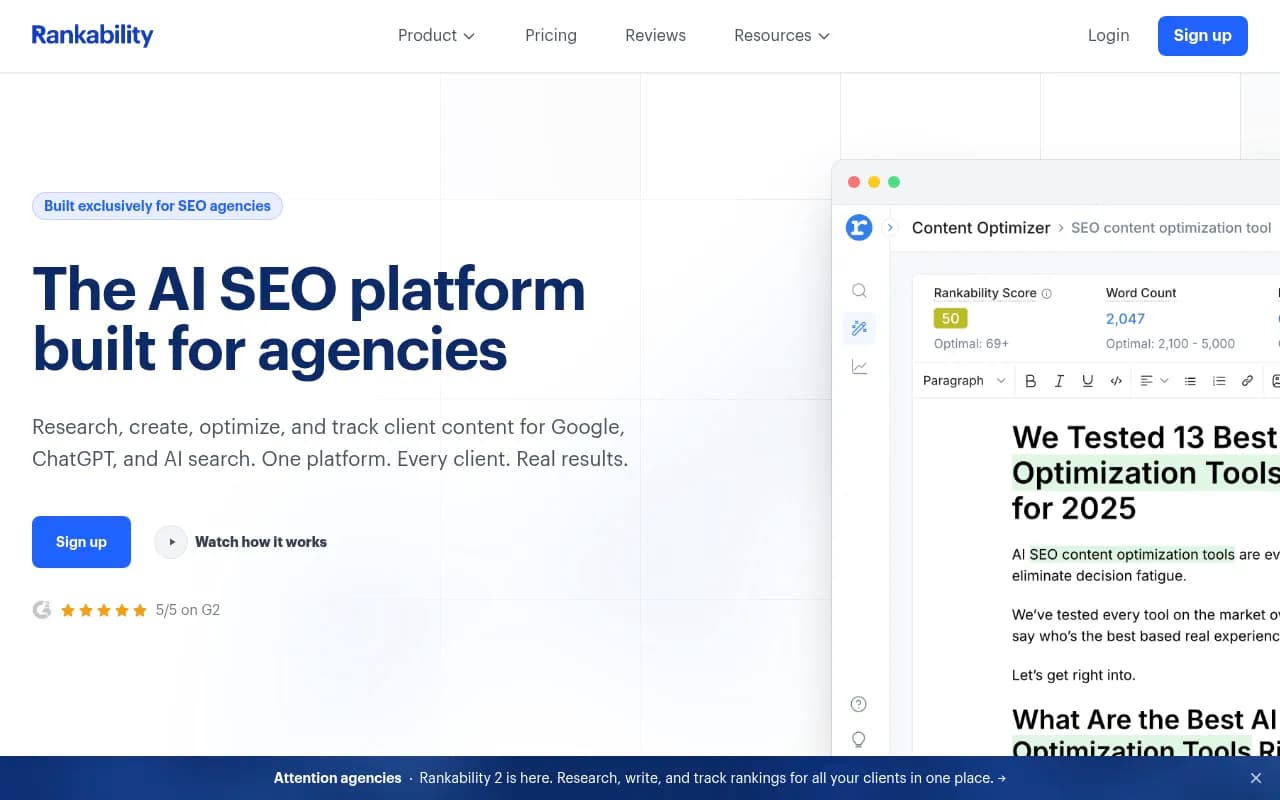
Rankability comes at AI visibility from an SEO angle, with a Search Performance Index scoring system that gives clients a single metric to track over time. Starting at $70/month, it's positioned as an agency-friendly platform with analytics built around reporting.
The AI visibility features are solid if your agency's primary framing is still SEO-first, with AI search as an additional channel to monitor rather than the core focus.
Cairrot -- built specifically for marketing agencies
Cairrot is worth calling out because it's explicitly designed for agency workflows -- LLM visibility tracking built with multi-client management in mind. It's a newer entrant in this space, but the agency-first positioning means the product decisions are made with your use case as the primary one, not an afterthought.
Wellows -- good for agencies tracking multiple brands
Wellows handles AI search visibility tracking for both brands and agencies, with a setup that accommodates multiple client accounts. It's a cleaner fit for agency workflows than tools that were originally built for single-brand use.
Feature comparison table
| Tool | Multi-client support | Content generation | Crawler logs | AI models tracked | Starting price | Best for |
|---|---|---|---|---|---|---|
| Promptwatch | Yes | Yes (AI writing agent) | Yes | 10+ | $99/mo | Agencies needing full action loop |
| Profound | Yes (agency mode) | No | No | Up to 10 | $99/mo | Enterprise agency clients |
| Otterly.AI | Limited | No | No | 4 | $29/mo | Budget-conscious small agencies |
| Peec AI | Yes | No | No | Up to 10 | €85/mo | Multi-language portfolios |
| SE Visible | Yes | No | No | 5 | $99/mo | SE Ranking users |
| AthenaHQ | Yes | No | No | 8+ | $295/mo | Enterprise B2B agencies |
| Scrunch AI | Yes | Partial | No | Not specified | $250/mo | Discoverability-focused agencies |
| Rankability | Yes | No | No | Multi-model | $70/mo | SEO-first agency teams |
| Cairrot | Yes (agency-first) | No | No | Not specified | Not listed | Agency-native workflows |
| Ceyo AI | Limited | No | No | 4 | Not listed | Single-brand monitoring |
What to actually look for when evaluating these tools
Multi-client workspace architecture
This sounds obvious but it's where a lot of tools fall short. "Multi-client support" can mean anything from a proper workspace system with separate dashboards, user permissions, and reporting per client, to simply letting you add multiple brand names to a single account. Ask specifically: can each client have their own workspace? Can you control what team members see? Can you export client-specific reports without manual filtering?
The monitoring-to-action gap
Every tool on this list will show you visibility scores and mention counts. The real question is what happens next. Some tools stop at the data. Others -- Promptwatch being the clearest example -- are built around helping you actually improve the numbers. For agencies, this matters because your clients are paying for outcomes, not reports.
Prompt coverage and quality
Tracking 50 prompts for a client in a competitive industry isn't enough. Look at how many prompts a plan includes, whether you can customize them per client, and whether the tool gives you any signal on which prompts are worth targeting (volume estimates, difficulty scores). A tool that tracks 500 generic prompts is less useful than one that tracks 50 high-intent prompts specific to your client's category.
White-label and reporting options
If you're billing clients for AI visibility work, you probably don't want your reports to say "Powered by [Tool Name]" at the bottom. Check whether white-label exports are available, what the report formats look like, and whether you can schedule automated delivery.
Pricing model at scale
Some tools price per brand, some per prompt, some per seat. Run the math for your actual client count before committing. A $29/month tool that charges per brand can get expensive fast if you're managing 20 clients.
The honest take on the market in 2026
The AI visibility tool space has grown quickly and a lot of the tools are, bluntly, monitoring dashboards with different UIs. They'll show you that your client appears in 34% of relevant ChatGPT responses and their competitor appears in 61%. That's useful information. But it doesn't tell you what to do about it, and it doesn't help you do it.
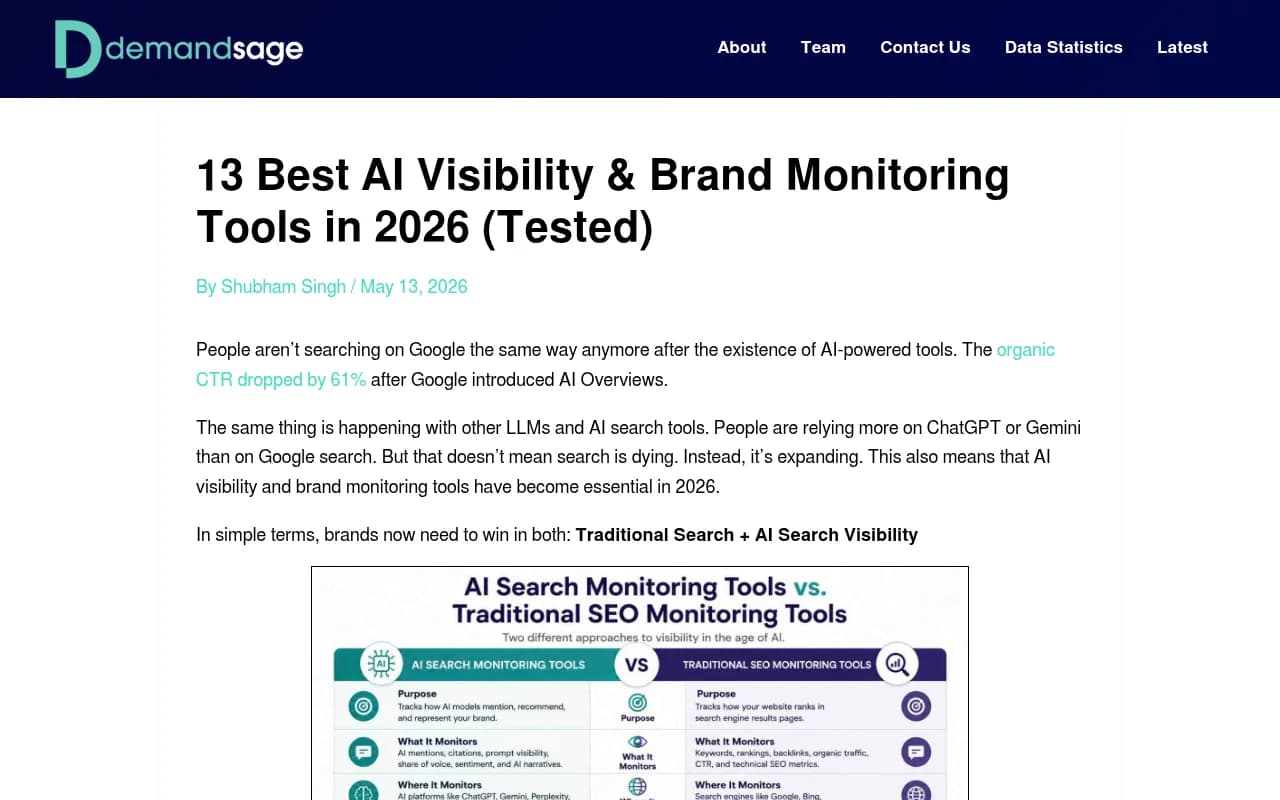
For agencies, the tools that will actually differentiate your service offering are the ones that close the loop -- from identifying gaps to generating content that fills them to tracking whether it worked. That's a much shorter list.
Ceyo AI is a reasonable starting point for a brand that wants basic AI monitoring. For agencies managing multiple clients and expected to deliver measurable improvements, it's not the right tool. The alternatives above cover the full range from budget monitoring (Otterly.AI at $29/month) to full-stack optimization (Promptwatch at $99-$579/month depending on scale), and the right choice depends on what you're actually being asked to deliver.
If your agency is selling "AI visibility audits" as a one-time deliverable, a monitoring-only tool might be sufficient. If you're selling ongoing AI SEO retainers, you need something that helps you show month-over-month improvement -- which means you need the content optimization and tracking capabilities that only a handful of platforms actually have.