Cairrot Review 2026
Agency-focused tool for tracking brand mentions and source citations within AI-generated answers from ChatGPT and other LLMs, with client reporting features.
Key takeaways
- Cairrot tracks brand visibility across 6 LLMs (ChatGPT, Claude, Perplexity, Gemini, Grok, DeepSeek) at pricing that starts at $39/month -- genuinely cheaper than most competitors
- Compared to Promptwatch, Cairrot is a monitoring-focused tool: it lacks content gap analysis, an AI writing agent, AI crawler logs, ChatGPT Shopping tracking, prompt volume/difficulty scoring, query fan-outs, and traffic attribution -- all of which Promptwatch provides
- Strong fit for smaller agencies and SEO consultants who need client-ready reports without enterprise-level budgets
- Open-data architecture with a public API and one-click integrations with Looker Studio, Databox, GA4, and Google Search Console
- AI Readiness audit is a useful differentiator, surfacing technical and content-level optimization priorities
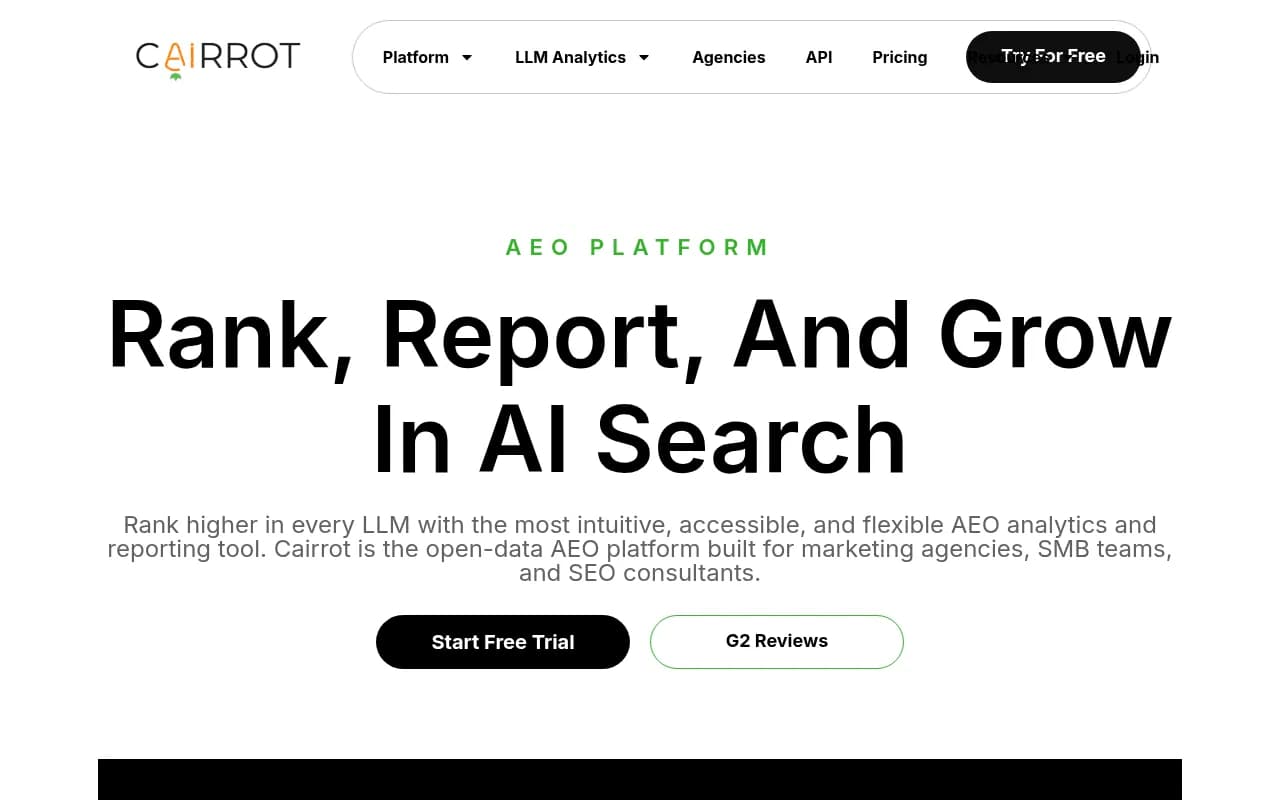
Cairrot is an Answer Engine Optimization (AEO) analytics platform built for marketing agencies, SEO consultants, and SMB marketing teams that want to understand how their brand appears inside AI-generated answers. The tool tracks brand mentions, citations, and visibility rankings across six major LLMs: ChatGPT, Claude, Perplexity, Gemini, Grok, and DeepSeek. Its pitch is simple -- most competing tools are either too expensive for smaller teams or too complex to integrate into existing workflows. Cairrot tries to fix both problems.
The platform positions itself as "open-data" and "API-first," which is a meaningful distinction in a market where many tools lock you into proprietary dashboards with no export path. For agencies that already have BI stacks built around Looker Studio or Databox, that matters. The pricing is also genuinely aggressive: $39/month for the Starter plan puts it within reach of solo consultants and small shops that would otherwise be priced out of AI visibility tracking entirely.
Cairrot appears to be a relatively early-stage product -- the website references 2025 and 2026 content uploads, and the G2 review count is still building. But the testimonials from agency owners and SEO managers suggest it's already being used in real client engagements, not just by early adopters kicking the tires.
Key features
AI visibility tracking across 6 LLMs
The core of Cairrot is prompt-based tracking: you define the queries your brand should appear in, and Cairrot runs those prompts against ChatGPT, Claude, Perplexity, Gemini, Grok, and DeepSeek to see whether your brand is mentioned, cited, or ranked. Results are organized by LLM so you can see where you're winning and where you're invisible. The Starter plan covers only ChatGPT and Perplexity (15 prompts), while Pro and Enterprise unlock all five LLMs with 40 and 100 prompts respectively.
- Tracks brand mentions, citations, and average rank position per LLM
- Supports geo-targeting by country, locality, and language
- Custom LLM configurations (e.g., tracking only Grok or Gemini) available on request
AI Readiness audit
This is one of Cairrot's more interesting features. Rather than just showing you where you rank, the AI Readiness report audits your website for technical and content-level factors that influence LLM citation likelihood. You get a scored list of optimization priorities -- things like structured data, content clarity, and citation-worthiness signals. The score updates as Cairrot discovers new AEO ranking factors, which means it's not a static checklist.
- Surfaces dozens of optimization priorities per site
- Score is recalculated as new AEO strategies are identified
- Useful for agencies that need to show clients a concrete starting point
AI optimization insights
Beyond the readiness audit, Cairrot provides ongoing optimization suggestions tied to what's actually working across LLMs at any given time. This includes identifying which content formats and tactics are favored by specific models, and which third-party websites are most frequently cited by LLMs in your category (useful for link-building and PR targeting).
- Content tactic recommendations per LLM
- Citation source discovery (which domains LLMs cite most in your niche)
- Actionable rather than purely descriptive
Citation and mention analytics
Cairrot tracks both citations (direct source links in LLM responses) and brand mentions (name references without a link). You can see trends over time, compare against competitors, and filter by LLM. The Cloudflare integration and WordPress plugin enable real-time citation logging directly from your own server, which is a more reliable signal than polling alone.
- Cloudflare integration for server-level citation tracking
- WordPress plugin for crawl logging
- Competitor citation benchmarking
GA4 and Google Search Console integration
Two-click integration with GA4 and GSC means you can pull LLM-driven traffic data into the same dashboard as your traditional search metrics. This is genuinely useful for agencies that need to show clients a unified picture of organic performance. The LLM traffic dashboards update in real time.
- Connects GA4 and GSC without custom code
- Real-time LLM traffic reporting
- Useful for client-facing reports that blend SEO and AEO data
Open API and BI integrations
Cairrot's API-first architecture is a real selling point for data-heavy teams. One-click integrations with Looker Studio and Databox mean you can pipe Cairrot data into existing reporting workflows without building custom connectors. The API gives you full ownership of your data -- you can feed it into internal tools, agentic workflows, or custom dashboards.
- Public API with full data access
- Looker Studio and Databox integrations (one-click)
- Designed for teams that already have BI infrastructure
Client reporting features
For agencies specifically, Cairrot includes reporting features designed to look good in client presentations. Prompt tracking and visibility benchmarks are formatted for stakeholder consumption, not just internal analysis. Multiple team members can access the account (up to 3 on Starter, 10 on Pro, unlimited on Enterprise).
- Multi-user access with team member limits per plan
- Report-ready visibility benchmarks
- Prompt tracking organized by topic/category
Who is it for
Cairrot's clearest fit is small-to-mid-size marketing agencies that are starting to get questions from clients about AI search visibility but don't have the budget for enterprise-tier tools. An agency running 5-15 client accounts, each needing monthly AEO reports alongside traditional SEO deliverables, would find the Pro plan ($99/month, 40 prompts, 10 team members) a reasonable entry point. The client-facing reporting features and GA4 integration make it easier to fold AEO into existing reporting workflows without rebuilding everything.
SEO consultants working independently are another strong fit. The Starter plan at $39/month is low enough that it doesn't require a business case to justify -- you can just try it. The AI Readiness audit gives solo practitioners a structured framework for AEO recommendations, which is useful when you're building a new service offering from scratch.
SMB in-house marketing teams, particularly those without dedicated data engineering resources, will appreciate the one-click BI integrations. If your team already uses Looker Studio for reporting, connecting Cairrot takes minutes rather than weeks.
Who should probably look elsewhere: enterprise brands running large-scale AI visibility programs across dozens of markets and hundreds of prompts will hit Cairrot's limits quickly. The Enterprise plan caps at 100 prompts and 5 LLMs, which isn't enough for complex multi-market tracking. Teams that need content gap analysis, AI-generated content recommendations, or traffic attribution tied to specific AI citations will also find Cairrot's feature set too narrow -- those capabilities simply aren't here.
Integrations and ecosystem
Cairrot's integration story is one of its stronger points relative to its price tier. The platform connects to:
- Google Analytics 4: Real-time LLM traffic dashboards, two-click setup
- Google Search Console: Blended SEO/AEO reporting
- Looker Studio: One-click data visualization
- Databox: One-click BI integration
- Cloudflare: Server-level citation logging via integration
- WordPress: Plugin for crawl logging and citation tracking
- Open API: Full data export for custom tools and agentic workflows
The Cloudflare and WordPress integrations are worth calling out specifically -- they enable a more reliable form of citation tracking by capturing LLM traffic at the server level rather than relying solely on prompt polling. This is a meaningful technical differentiator at this price point.
There's no mention of a native mobile app, and the browser extension ecosystem isn't referenced on the site. Enterprise and Garden Partner users get access to a dedicated Slack channel with the Cairrot cofounders, which is an unusual but potentially valuable support channel for agencies that want direct access to the product team.
Pricing and value
Cairrot's pricing is structured across three tiers:
- Starter -- $39/month: 2 LLMs (ChatGPT and Perplexity), 15 prompts, up to 3 team members, email support, API access
- Pro -- $99/month: 5 LLMs (ChatGPT, Perplexity, Gemini, Claude, DeepSeek), 40 prompts, up to 10 team members, email support, API access, free onboarding and consultation call
- Enterprise -- $299/month: 5 LLMs, 100 prompts, unlimited team members, API access, Slack support, professional onboarding
A free trial is available. Annual billing discounts are not explicitly listed on the site but may be available on request.
For context: Promptwatch's Essential plan starts at $99/month for 50 prompts and 1 site, while tools like Profound and Scrunch AI operate at significantly higher price points. Cairrot's Starter plan at $39/month is genuinely the cheapest entry point in the AEO tracking market for a tool that covers multiple LLMs. The Pro plan at $99/month is competitive with Promptwatch's entry tier but covers fewer LLMs (5 vs. 10+) and lacks several capabilities.
The value proposition is clear: if you need basic AEO tracking and client reporting at a price that doesn't require budget approval, Cairrot delivers. If you need the full optimization loop -- gap analysis, content generation, crawler logs, traffic attribution -- you'll need to spend more elsewhere.
Strengths and limitations
What Cairrot does well:
- Pricing accessibility: $39/month for multi-LLM tracking is genuinely rare. Most competitors start at $99/month or higher for comparable coverage.
- Open-data architecture: The public API and one-click BI integrations make Cairrot easy to fold into existing workflows. This is a real differentiator for data-driven agencies.
- AI Readiness audit: A structured, scored audit of your site's AEO readiness is more actionable than raw visibility data alone. It gives agencies a concrete deliverable to hand clients.
- Cloudflare and WordPress integrations: Server-level citation logging is a more reliable signal than prompt polling alone, and it's unusual to see this at the Starter price point.
- Client reporting UX: The dashboard and report formatting are clearly designed with agency presentations in mind, not just internal analysis.
Where Cairrot falls short:
- No content gap analysis: Cairrot can tell you where you're invisible, but it can't show you which specific prompts competitors are winning that you're not -- and it can't generate content to close those gaps. Promptwatch's Answer Gap Analysis and built-in AI writing agent handle both.
- No AI crawler logs: Cairrot doesn't show you which AI crawlers are hitting your site, which pages they're reading, or what errors they're encountering. Promptwatch's crawler log feature fills this gap. Without it, you're flying blind on how AI engines actually discover your content.
- No traffic attribution: There's no way to connect AI visibility to actual revenue or conversions. Promptwatch offers traffic attribution via code snippet, GSC integration, or server log analysis. Cairrot's GA4 integration shows LLM traffic but doesn't close the loop to business outcomes.
- No ChatGPT Shopping tracking: As AI-powered shopping recommendations grow, this is an increasingly important channel. Cairrot doesn't cover it.
- No prompt volume or difficulty scoring: You can track prompts, but Cairrot doesn't tell you how many people are actually searching those prompts in AI tools or how competitive they are. Promptwatch provides volume estimates and difficulty scores to help prioritize.
- Limited LLM coverage: 5-6 LLMs vs. Promptwatch's 10+. Missing Copilot, Meta AI, Mistral, and Google AI Mode.
- Prompt caps are tight: 100 prompts on the Enterprise plan is limiting for agencies managing multiple large clients or brands with broad topic coverage.
Bottom line
Cairrot is a solid entry-level AEO tracking tool that punches above its weight on price. For solo SEO consultants, small agencies, and SMB marketing teams that need to start tracking AI visibility without committing to enterprise-level spend, it's one of the most accessible options in the market. The AI Readiness audit, open API, and BI integrations make it more than a simple dashboard.
That said, it's a monitoring tool, not an optimization platform. If you need to understand why you're invisible in AI search, generate content to fix it, track how AI crawlers interact with your site, or connect AI visibility to revenue, Cairrot doesn't have those capabilities. For teams that need the full loop, Promptwatch is the more complete solution.
Best for: Marketing agencies and SEO consultants who need affordable, multi-LLM visibility tracking with clean client reporting and BI integration, and don't yet need advanced optimization or content generation features.
Frequently asked questions
What is Cairrot?
How much does Cairrot cost?
Which AI models does Cairrot track?
Does Cairrot offer a free trial?
How does Cairrot compare to Promptwatch?
What integrations does Cairrot support?
Similar and alternative tools to Cairrot