Key takeaways
- Promptwatch is a full optimization platform -- it finds gaps, generates content, and tracks results. Cairrot is a monitoring and reporting tool that stops at the analytics layer.
- Cairrot starts at $39/mo with a free tier; Promptwatch starts at $99/mo with only a 7-day trial. Budget matters here.
- Promptwatch monitors 10+ AI models including Gemini, Google AI Overviews, Copilot, and Mistral. Cairrot covers 5 (ChatGPT, Perplexity, Grok, Claude, DeepSeek).
- Promptwatch has AI crawler logs, ChatGPT Shopping tracking, Reddit/YouTube citation insights, and a built-in content agent. Cairrot has none of these.
- Cairrot's open-data, API-first architecture and Looker Studio/Databox integrations make it genuinely strong for data-driven agencies who want to pipe data into their own BI stack.
- If you just need clean LLM visibility reporting at a low price, Cairrot is a solid choice. If you need to actually move the needle on AI visibility, Promptwatch is the more complete tool.
Overview
Promptwatch

Promptwatch is the most complete AI search visibility platform on the market right now. It's used by 8,000+ brands and agencies including Booking.com, Typeform, and Yelp, and it's rated 4.7/5 on G2. The core idea is that monitoring alone isn't enough -- you need to find where you're invisible, create content that fixes it, and then track whether it worked. Promptwatch is built around that full loop: Answer Gap Analysis, an AI content agent, page-level citation tracking, real-time crawler logs, and traffic attribution. It monitors 10+ AI models and processes over 1.1 billion citations, clicks, and prompts.
Cairrot
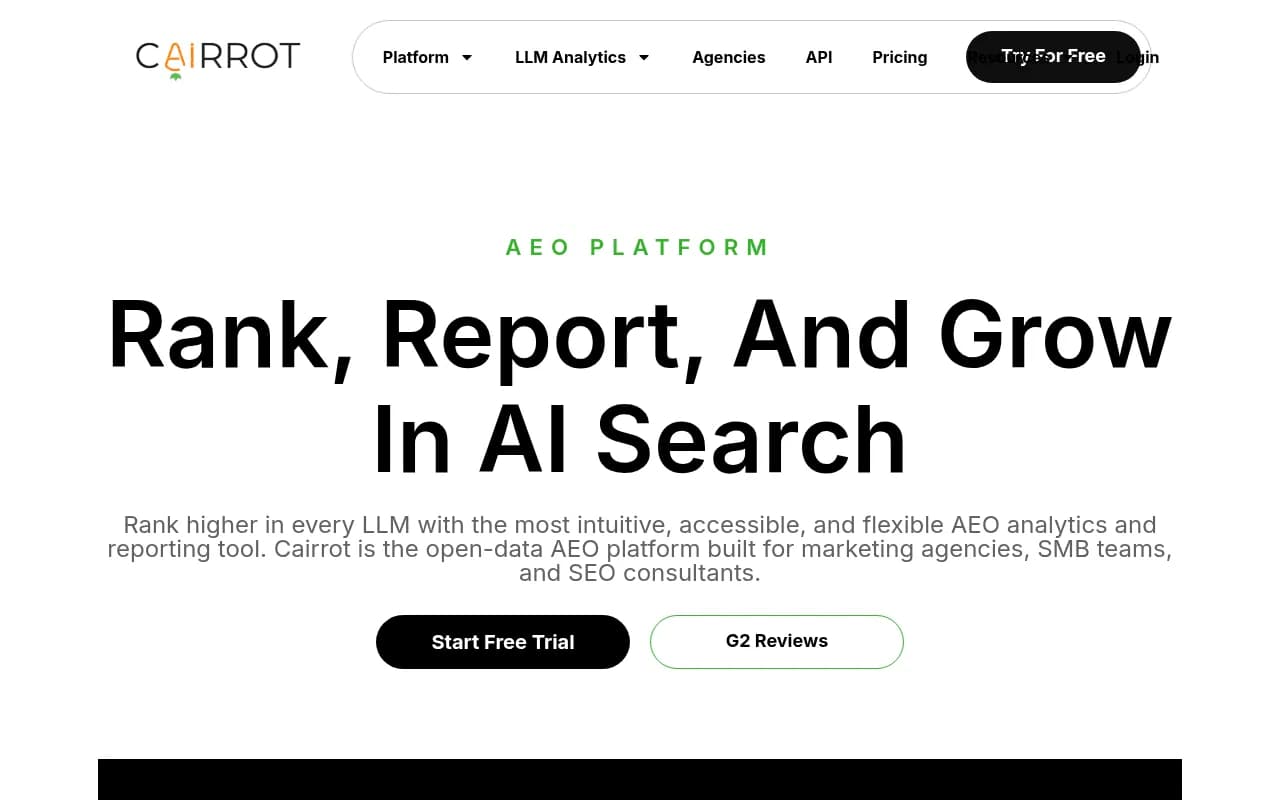
Cairrot is a newer, leaner AEO analytics platform aimed squarely at marketing agencies, SMB teams, and SEO consultants. It tracks brand visibility across 5 LLMs (ChatGPT, Perplexity, Grok, Claude, DeepSeek) and positions itself as the most affordable way to get LLM tracking without the enterprise price tag. Its open-data philosophy -- API-first, Looker Studio integration, Databox support -- makes it appealing to teams who want to own their data and plug it into existing workflows. It does not have content generation, crawler logs, or ChatGPT Shopping tracking.
Side-by-side comparison
| Feature | Promptwatch | Cairrot |
|---|---|---|
| Starting price | $99/mo | $39/mo |
| Free plan | No (7-day trial) | Yes (freemium) |
| AI models tracked | 10+ (ChatGPT, Claude, Gemini, Perplexity, Grok, DeepSeek, Copilot, Mistral, Meta/Llama, Google AI Overviews, Google AI Mode) | 5 (ChatGPT, Perplexity, Grok, Claude, DeepSeek) |
| Content generation | Yes (AI writing agent) | No |
| Answer gap / content gap analysis | Yes | Partial (optimization suggestions) |
| AI crawler logs | Yes (real-time) | Yes (Cloudflare integration) |
| Traffic attribution | Yes (GSC, code snippet, server logs) | Yes (GA4, GSC integration) |
| Reddit & YouTube tracking | Yes | No |
| ChatGPT Shopping tracking | Yes | No |
| Prompt volume & difficulty scores | Yes | No |
| Competitor heatmaps | Yes | No |
| Multi-language & multi-region | Yes | Yes |
| API access | Yes | Yes (open API) |
| Looker Studio integration | Yes | Yes |
| Databox integration | No | Yes |
| G2 rating | 4.7/5 | Listed (fewer reviews) |
| Target audience | Marketing teams, SEO teams, agencies, enterprise brands | Agencies, SMB teams, SEO consultants |
Head-to-head feature deep-dive
AI model coverage
Promptwatch monitors 10+ AI platforms: ChatGPT, Claude, Gemini, Perplexity, Grok, DeepSeek, Copilot, Mistral, Meta/Llama, Google AI Overviews, and Google AI Mode. That last two matter a lot -- Google's AI search surfaces are where a huge chunk of organic traffic decisions are being made right now.
Cairrot covers 5 models: ChatGPT, Perplexity, Grok, Claude, and DeepSeek. That's a solid core set, and for many agencies it's enough. But if your clients care about Gemini or Google AI Overviews -- and most should -- Cairrot leaves a gap.
Verdict: Promptwatch wins on breadth. Cairrot covers the essentials but misses Google's AI surfaces entirely.
Content optimization and generation
This is where the two tools diverge most sharply.
Promptwatch has a built-in AI content agent that generates articles, listicles, and comparison pages grounded in real citation data. It analyzes 880M+ citations to understand what content AI models actually cite, then helps you produce more of it. The Answer Gap Analysis shows you exactly which prompts competitors rank for that you don't -- and the content agent helps you close those gaps.
Cairrot provides "AI Optimization reports" with suggestions for improving your content and an "AI Readiness" audit to check technical soundness. These are useful, but they're recommendations, not execution. You still have to write the content yourself.
Verdict: Promptwatch is the clear winner here. If content creation is part of your workflow, Cairrot requires you to bring your own tools.
Analytics and data depth
Cairrot's open-data positioning is genuinely appealing. Its API-first architecture means you can pipe data into Looker Studio, Databox, or your own BI stack with minimal friction. For agencies that already have reporting infrastructure, this is a real advantage. The cofounders also offer direct Slack access for Garden Partners and Enterprise users, which is a nice touch for smaller teams.
Promptwatch's analytics go deeper on the AI-specific side: prompt volume estimates, difficulty scores, query fan-outs (how one prompt branches into sub-queries), competitor heatmaps, and page-level citation tracking. You can see not just whether you're mentioned, but which specific pages are being cited, how often, and by which model.
Cairrot tracks citations and mentions across its 5 LLMs and gives you country/locality/language breakdowns. It also has a Cloudflare integration for real-time citation data, which is solid.
Verdict: Tie, depending on what you need. Cairrot wins on data portability and BI integration. Promptwatch wins on AI-specific data depth.
Crawler logs and technical insights
Promptwatch's AI Crawler Logs show in real time when ChatGPT, Claude, Perplexity, and other AI crawlers hit your pages -- which pages they read, errors they encounter, and how often they return. This is genuinely useful for diagnosing why certain pages aren't getting cited.
Cairrot has a Cloudflare integration that tracks "authentic, real-time citation data" and a WordPress plugin. It's less clear from the product documentation whether this extends to full crawler-level logs or is primarily citation tracking.
Verdict: Promptwatch has more transparency into the crawl layer. Cairrot's Cloudflare integration is useful but appears more citation-focused than crawler-diagnostic.
Traffic attribution
Both tools connect AI visibility to actual website traffic, which is the right question to be asking.
Promptwatch offers three attribution methods: a code snippet, Google Search Console integration, or server log analysis. This flexibility matters for teams with different technical setups.
Cairrot integrates with GA4 and Google Search Console for "real-time LLM traffic dashboards." The 2-click setup is a genuine ease-of-use win for non-technical users.
Verdict: Roughly equal, with Cairrot winning on setup simplicity and Promptwatch winning on attribution method flexibility.
Unique features worth calling out
Promptwatch has a few capabilities that Cairrot simply doesn't have:
- Reddit and YouTube citation tracking: surfaces discussions that influence AI recommendations, a channel most tools ignore
- ChatGPT Shopping tracking: monitors when your brand appears in ChatGPT's product recommendations and shopping carousels
- Competitor heatmaps: visual comparison of your AI visibility vs competitors across each LLM
- Prompt intelligence: volume estimates and difficulty scores for each prompt, so you can prioritize winnable queries
None of these exist in Cairrot. For brands in competitive categories where AI shopping recommendations matter (e-commerce, travel, SaaS), the ChatGPT Shopping tracking alone could justify the price difference.
Pricing comparison
| Plan | Promptwatch | Cairrot |
|---|---|---|
| Free | No (7-day trial only) | Yes (freemium) |
| Entry paid | $99/mo (Essential: 1 site, 50 prompts, 5 articles) | $39/mo |
| Mid-tier | $249/mo (Professional: 2 sites, 150 prompts, 15 articles, crawler logs) | Not publicly detailed |
| Higher tier | $579/mo (Business: 5 sites, 350 prompts, 30 articles) | Not publicly detailed |
| Agency/Enterprise | Custom pricing | Custom (Garden Partners tier) |
| Annual discount | Yes | Not confirmed |
Cairrot's pricing is notably more accessible. At $39/mo, it's the most affordable way to get multi-LLM tracking across 5 models -- and the free tier means you can test it without a credit card. Promptwatch's $99/mo entry tier is 2.5x the price, and the 7-day trial is short for a tool with this much surface area.
That said, the Promptwatch Professional plan at $249/mo includes content generation, crawler logs, and city-level tracking -- features that don't exist in Cairrot at any price point.
Pros and cons
Promptwatch
Pros:
- Monitors 10+ AI models including Google AI Overviews and Google AI Mode
- Full content generation built in -- not just suggestions, actual articles
- Answer Gap Analysis shows exactly which prompts you're missing
- Real-time AI crawler logs for technical diagnosis
- ChatGPT Shopping, Reddit, and YouTube tracking
- Prompt volume and difficulty scoring
- 880M+ citations analyzed for content grounding
- 4.7/5 on G2 with a large, established user base
Cons:
- No permanent free plan, only a 7-day trial
- More expensive at every tier compared to Cairrot
- More complex -- there's a learning curve if you just want simple reporting
- Overkill for solo consultants or very small teams
Cairrot
Pros:
- Free tier available -- genuinely accessible for testing
- $39/mo entry price is the lowest in this category for multi-LLM tracking
- API-first, open-data architecture is great for BI integration
- Looker Studio and Databox integrations out of the box
- Clean, intuitive interface designed for agency reporting
- Direct cofounder access for higher-tier users
- WordPress plugin for easy citation tracking
Cons:
- Only 5 LLMs tracked -- no Gemini, Google AI Overviews, Copilot, or Mistral
- No content generation -- you get suggestions, not execution
- No Reddit or YouTube citation tracking
- No ChatGPT Shopping monitoring
- No prompt volume or difficulty scoring
- Competitor heatmaps not available
- Smaller user base and fewer public reviews than Promptwatch
Who should pick which tool
Pick Promptwatch if:
- You need to track Google AI Overviews or Gemini (critical for most brands)
- Content creation is part of your AI visibility strategy, not just reporting
- You want to understand why you're not getting cited, not just that you're not
- You're managing multiple brands or sites at scale
- ChatGPT Shopping, Reddit influence, or prompt-level intelligence matter to your use case
- You're an agency or enterprise team that needs the full picture
Pick Cairrot if:
- You're a solo SEO consultant or small agency with a tight budget
- You need clean, client-ready reporting without a steep learning curve
- Your clients primarily care about ChatGPT, Perplexity, and Claude (not Google's AI surfaces)
- You want to pipe LLM data into your own BI stack via API
- You want to test AI visibility tracking before committing to a paid tool
- Affordability is the primary constraint
Final verdict
Cairrot and Promptwatch are solving the same surface-level problem -- "where does my brand show up in AI search?" -- but they're built for different ambitions.
Cairrot is a clean, affordable monitoring tool that does what it says. For a solo consultant or small agency that needs basic LLM tracking and good client reports without spending $100+/mo, it's a reasonable choice. The open-data architecture is a genuine differentiator for teams with existing BI infrastructure.
Promptwatch is for teams that want to actually improve their AI visibility, not just measure it. The content agent, Answer Gap Analysis, crawler logs, and 10-model coverage make it a materially different product. The price reflects that -- but so do the results.
If your goal is to understand your AI visibility, Cairrot works. If your goal is to grow it, Promptwatch is the more complete tool.