Key takeaways
- Answer gap analysis -- finding which prompts your competitors rank for but you don't -- is the most important feature in any AI visibility platform right now.
- Ceyo AI and AthenaHQ are solid monitoring tools, but neither offers a built-in way to act on the gaps they surface.
- Profound has content creation capabilities through its Agents feature, but users report inconsistent data reliability.
- Promptwatch is the only platform in this comparison that closes the full loop: find gaps, generate content engineered for AI citation, then track whether it worked.
- If your goal is visibility improvement (not just visibility measurement), the platform you choose matters a lot.
Answer gap analysis sounds simple: show me the prompts where my competitors appear in AI responses but I don't. In practice, it's one of the hardest things to do well -- and the way each platform handles it tells you almost everything about whether it's a monitoring tool or an optimization tool.
This comparison looks at four platforms that come up constantly in 2026 discussions about AI visibility: Ceyo AI, Promptwatch, Profound, and AthenaHQ. They're not all the same category of product, even though they're often compared. Let's get into it.
What answer gap analysis actually means in 2026
Traditional SEO had keyword gap analysis: find keywords your competitors rank for that you don't, then create content targeting those keywords. The feedback loop was slow but the logic was clear.
AI visibility gap analysis is more complex. AI models don't "rank" pages the way Google does. They cite sources based on what they've indexed, what they trust, and what answers a given prompt. So a gap isn't just a missing keyword -- it's a missing topic, angle, or piece of content that AI models want to cite but can't find on your site.
According to AthenaHQ's State of AI Search 2026 Report, the average brand appears in just 17.2% of AI responses for relevant prompts. Teams actively optimizing for AI visibility are reaching up to 56.7%. That gap between 17% and 57% is the opportunity. Answer gap analysis is how you find where to start.
The question is: does your platform just show you the gap, or does it help you close it?
Ceyo AI
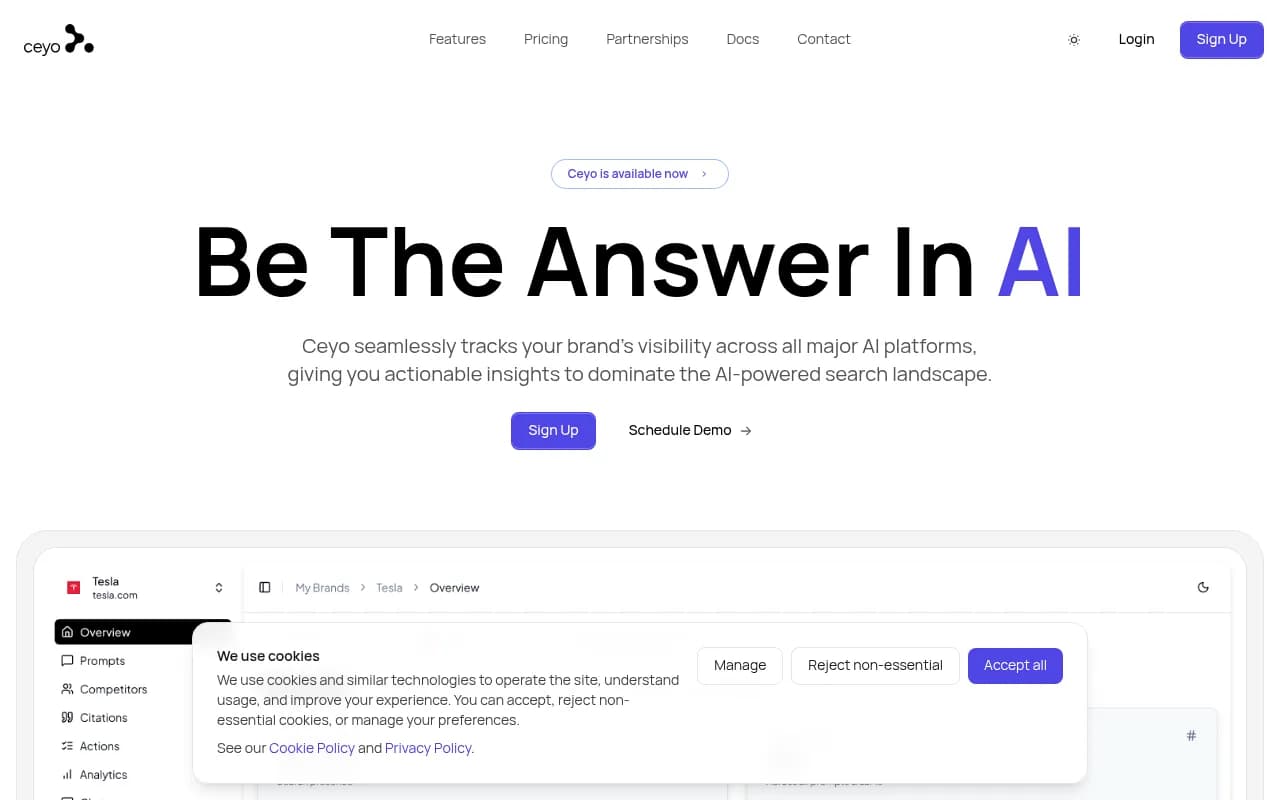
Ceyo AI monitors brand visibility across ChatGPT, Perplexity, Claude, and Gemini. It's a relatively newer entrant in the space, and its positioning is clean: track how AI models mention your brand, see where competitors appear, and get alerts when things change.
For answer gap analysis specifically, Ceyo AI shows you which prompts competitors are being cited for. The interface is straightforward, which is a genuine strength for smaller teams who don't want to spend hours learning a new platform.
The limitation is what happens after you see the gap. Ceyo AI is a monitoring tool. It surfaces the data, but the next step -- figuring out what content to create, writing it, and tracking whether it worked -- happens outside the platform. For a team that already has a strong content operation and just needs the signal, that might be fine. For teams that need the full workflow, it's only half the picture.
AthenaHQ

AthenaHQ has built a strong reputation in the AEO (Answer Engine Optimization) space. It covers 8+ AI platforms, has a 4.9 rating on G2, and counts SoFi, ZoomInfo, and Wix among its customers. The platform is genuinely good at showing you citation patterns and prompt-level visibility data.
Its answer gap analysis surfaces which prompts competitors rank for, and it does this with reasonable depth. The UI is polished and the data is presented in a way that makes competitive gaps easy to spot.
Where AthenaHQ runs into friction is the action layer. The platform is built around monitoring and insight delivery. Translating those insights into content changes -- and then measuring whether those changes improved your AI visibility -- requires external tools. AthenaHQ's own comparison page acknowledges this workflow challenge, noting that teams need to "optimize content" and "continuously monitor results" as separate steps outside the platform.
That's not a fatal flaw, but it does mean AthenaHQ is best suited to teams with dedicated content resources who can act on what the data shows.
Profound

Profound is the most feature-complete of the "monitoring plus some action" tools. It has Prompt Volumes (showing how often specific prompts are asked), Answer Engine Insights (showing how AI models respond), and Agents (an automated content production feature that handles the full cycle from gap identification to content creation).

The Agents feature is genuinely interesting -- it's one of the few attempts in this space to connect gap analysis directly to content output. McKinsey's research cited on Profound's own site projects $750 billion in US revenue flowing through AI-powered search by 2028, and Profound is clearly positioning itself to capture the enterprise teams that take that number seriously.
The honest caveat: user feedback on Profound consistently mentions data reliability issues. Multiple reviews flag inconsistency in how visibility scores change week to week, and some users report difficulty translating the platform's insights into concrete next steps. At Profound's price point (enterprise-tier, demo-required), that's a meaningful friction point.
Profound is a strong option for large teams with the budget and patience to work through those rough edges. For mid-market teams, the value proposition gets murkier.
Promptwatch
Promptwatch takes a different approach from all three tools above. It's built around what it calls the action loop: find gaps, create content, track results. The gap analysis is the starting point, not the end product.

The Answer Gap Analysis feature shows exactly which prompts competitors are visible for that you're not -- with prompt volume estimates and difficulty scores so you can prioritize which gaps are actually worth closing. That prioritization layer matters more than it sounds. Without it, you're staring at a list of hundreds of gaps with no way to know where to start.
What happens next is where Promptwatch separates itself. The built-in AI writing agent generates articles, listicles, and comparisons grounded in citation data from over 880 million citations analyzed. This isn't a generic content generator -- it's trained on what AI models actually cite, which means the output is engineered to get picked up by ChatGPT, Claude, Perplexity, and others. Once content is published, page-level tracking shows exactly which pages are being cited, how often, and by which models.
A few other capabilities that matter for gap analysis specifically:
- Query fan-outs show how a single prompt branches into sub-queries, so you can see the full content surface area around a topic rather than just the top-level gap.
- AI Crawler Logs show when ChatGPT, Claude, and Perplexity bots are actually reading your pages -- useful for diagnosing why a page isn't getting cited even after you've optimized it.
- Reddit and YouTube tracking surfaces discussions that directly influence AI recommendations, which is a channel most gap analysis tools ignore entirely.
Promptwatch covers 10 AI models: ChatGPT, Perplexity, Google AI Overviews, Google AI Mode, Claude, Gemini, Meta/Llama, DeepSeek, Grok, and Mistral. That breadth matters because different AI models cite different sources, and a gap on ChatGPT isn't necessarily a gap on Perplexity.
Feature comparison
| Feature | Ceyo AI | AthenaHQ | Profound | Promptwatch |
|---|---|---|---|---|
| Answer gap analysis | Basic | Yes | Yes | Yes, with priority scoring |
| Prompt volume estimates | No | Limited | Yes | Yes |
| Difficulty scoring | No | No | No | Yes |
| Query fan-outs | No | No | No | Yes |
| Built-in content generation | No | No | Yes (Agents) | Yes (AI writing agent) |
| Content grounded in citation data | No | No | Partial | Yes (880M+ citations) |
| AI crawler logs | No | No | No | Yes |
| Reddit/YouTube tracking | No | No | No | Yes |
| ChatGPT Shopping tracking | No | No | Yes | Yes |
| Page-level citation tracking | No | Limited | Yes | Yes |
| Traffic attribution | No | No | No | Yes (GSC, code snippet, server logs) |
| AI models covered | 4 | 8+ | Multiple | 10 |
| Pricing starts at | N/A | Demo | Demo | $99/mo |
Which platform is right for which team?
The honest answer depends on what you actually need from gap analysis.
If you need a lightweight monitoring tool to track brand mentions and spot competitor gaps without a complex setup, Ceyo AI is worth a look. It's clean, covers the major models, and doesn't require a large budget or a long onboarding process.
If you need deep AEO monitoring with strong data visualization and you have a content team that can act on what the platform surfaces, AthenaHQ is a serious option. The G2 rating reflects real customer satisfaction, and the platform's focus on AI citation patterns is genuinely useful.
If you're an enterprise team with budget for a premium tool and you want monitoring plus some content automation, Profound is worth evaluating -- just go in with realistic expectations about data consistency and plan for a longer setup period.
If your goal is to actually improve AI visibility rather than just measure it, Promptwatch is the most complete option in this comparison. The gap analysis is more actionable (priority scores, difficulty ratings, query fan-outs), the content generation is grounded in real citation data rather than generic SEO logic, and the tracking closes the loop so you know whether your content changes are working. The $99/month entry point also makes it accessible to teams that aren't at enterprise scale.
The gap analysis gap
There's a meta-problem worth naming here. Most platforms in this space were built to answer the question "where am I invisible?" That's a useful question. But the more important question is "what do I do about it?" -- and very few platforms are built to answer that one.
The research from McKinsey that Profound cites on their own site makes this concrete: only 16% of brands are systematically tracking AI search performance. The brands that are tracking it and acting on it are the ones reaching 56%+ visibility. The difference between tracking and acting is what separates monitoring tools from optimization platforms.
Answer gap analysis is only valuable if it leads somewhere. The platform you choose should make that path as short as possible.
Bottom line
Ceyo AI and AthenaHQ are solid monitoring tools. Profound is trying to be more but has execution gaps. Promptwatch is the only platform here that was built from the start around the full optimization cycle -- find the gap, create the content, measure the result.
For most marketing and SEO teams in 2026, that full cycle is what they actually need. Knowing where you're invisible is step one. Getting cited is the goal.