Gauge Review 2026
Tracks your brand against competitors across AI engines and provides clear roadmaps to improve visibility in AI-powered search results.
Summary
- Best for teams that want action, not just monitoring: Gauge combines AI visibility tracking with an agentic content engine that writes optimized articles based on real citation data and competitor gaps
- Lacks the depth of Promptwatch: No AI crawler logs, no traffic attribution, no Reddit/YouTube tracking, and no ChatGPT Shopping monitoring—features that Promptwatch offers to close the optimization loop
- Strong on competitor intelligence: Gap analysis shows exactly where competitors appear but you don't, with concrete recommendations for each missing prompt
- Pricing starts accessible: $99/mo Starter plan (ChatGPT only, 100 prompts) up to $599/mo Growth (all models, 600 prompts, 18 AI-generated articles/month)
- Real UI data, not just API calls: Gauge scrapes actual AI engine interfaces rather than hitting generic APIs, which surfaces more accurate citation and mention data

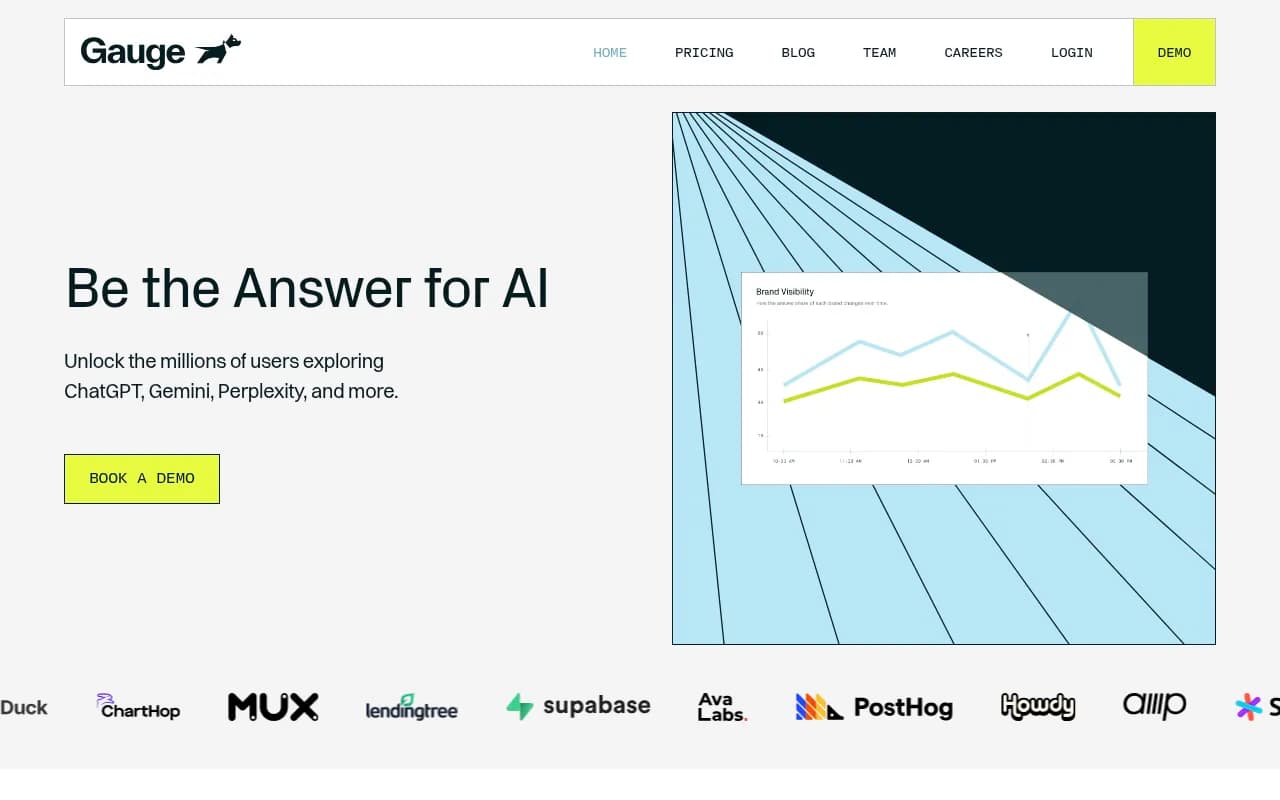
Gauge is a generative engine optimization (GEO) platform that tracks how your brand appears in AI-powered search results across ChatGPT, Claude, Gemini, Perplexity, Copilot, Google AI Mode, and AI Overviews. It's built for marketing teams and agencies that need to understand their AI visibility and actually do something about it—not just stare at charts. The platform launched in 2024 and has gained traction with B2B SaaS companies like MotherDuck, Supabase, and Howdy, who use it to monitor brand mentions and citations in AI answers.
The core pitch: Gauge doesn't stop at showing you where you're invisible. It tells you what content to create, which pages to audit, and which affiliates or social sources to target. The built-in AI content engine drafts articles optimized for both AI search and traditional SEO, grounded in the citation data Gauge collects. This positions it as an optimization platform rather than a pure monitoring tool—though it still lacks several capabilities that Promptwatch offers, like AI crawler logs, traffic attribution, and Reddit/YouTube tracking.
Prompt Tracking and Brand Coverage
Gauge runs your configured prompts daily across all major AI models (ChatGPT, Claude, Gemini, Perplexity, Copilot, AI Mode, AI Overviews) and tracks two key metrics: mention rate (how often your brand appears in answers) and citation rate (how often your website is cited as a source). You configure prompts based on your category—e.g. "best project management tools", "how to track SEO performance", "top CRM for small business"—and Gauge monitors how AI engines respond over time.
The platform claims to pull "real user interface data" rather than hitting generic APIs. This means Gauge scrapes the actual AI engine interfaces that users see, which can surface different results than what you'd get from a programmatic API call. This is a meaningful technical distinction—API responses often differ from what the model shows in its consumer-facing UI, especially for features like citations, shopping carousels, or visual elements. Gauge's approach should theoretically give you more accurate data about what real users encounter.
You can track multiple brands (yours and competitors) simultaneously. The dashboard shows mention trends over time, which prompts are driving the most visibility, and which AI models favor your brand vs competitors. This is table stakes for any GEO tool, but Gauge executes it cleanly.
Gap Analysis and Competitor Intelligence
This is where Gauge differentiates itself from pure monitoring dashboards. The Gap Analysis feature shows you prompts where competitors are mentioned but you're not. It's essentially a visibility heatmap: green squares mean you're cited, red squares mean you're missing. Click into any gap and Gauge surfaces the specific content competitors have that you lack—topics, angles, use cases, integrations mentioned.
For example, if "best CRM for real estate agents" consistently cites your competitors but not you, Gauge will flag this prompt and show you what those competitors are saying (or what third-party sources are saying about them) that earns the citation. This is useful for content prioritization—you can see exactly which prompts are high-value and winnable.
The Coverage Analysis feature does the inverse: shows you where you're already visible and what content is earning those citations. This helps you double down on what's working. If a specific landing page or blog post is getting cited frequently, you know that content structure and topic angle resonates with AI models.
Compared to Promptwatch, Gauge's gap analysis is solid but lacks the depth of Promptwatch's Answer Gap Analysis, which not only shows missing prompts but also provides prompt volume estimates, difficulty scores, and query fan-outs (how one prompt branches into sub-queries). Promptwatch also tracks Reddit discussions and YouTube videos that influence AI recommendations—channels Gauge doesn't monitor at all.
Agentic Content Engine
Gauge's standout feature is its AI-powered content creation. The platform analyzes your gap data, competitor citations, and top-performing topics, then drafts full articles optimized to rank in both AI search and traditional Google search. You get a set number of articles per month depending on your plan: 3 articles on Starter ($99/mo), 18 articles on Growth ($599/mo), custom on Enterprise.
The content engine isn't just a generic GPT wrapper. Gauge claims it's "data-driven"—meaning it grounds articles in the actual citation patterns and topics it observes across AI models. If Gauge sees that articles about "CRM integrations with Slack" consistently get cited, it will draft content around that angle. The output is markdown-formatted and ready to publish, though you'll still want a human editor to refine tone and add brand voice.
This is a major workflow advantage over monitoring-only tools like Otterly.AI, Peec.ai, or AthenaHQ, which show you the data but leave you to figure out what to write. That said, Promptwatch also offers an AI writing agent with similar capabilities—and Promptwatch's agent is grounded in 880M+ citations analyzed, plus prompt volumes and persona targeting, which may produce more strategically targeted content.
Gauge also includes an "Audit" feature that scans your existing pages and recommends improvements to boost AI visibility. This is useful for optimizing high-traffic pages that aren't getting cited yet.
Citation and Source Analysis
Gauge tracks which domains and URLs AI models cite most frequently in their answers. You can see the top sources overall, or drill down by prompt. This helps you identify authoritative sites to target for backlinks or guest posts, and it reveals which of your own pages are earning citations.
The Citation Rate metric shows what percentage of AI answers cite your website. The Mention Rate metric shows how often your brand is mentioned even when your site isn't cited (meaning AI is pulling info from third-party sources about you). Both metrics are useful for understanding whether your visibility problem is a content problem (you're not mentioned at all) or a citation problem (you're mentioned but not linked).
One limitation: Gauge doesn't track AI crawler logs. You can't see which AI bots (ChatGPT-User, Claude-Web, PerplexityBot, etc.) are hitting your site, how often, or what pages they're reading. Promptwatch offers real-time AI crawler logs that show exactly which pages AI engines are indexing and any errors they encounter—critical for diagnosing why your content isn't getting cited. Gauge also lacks traffic attribution, so you can't connect AI visibility to actual revenue or conversions.
Integrations and Data Access
Gauge integrates with Google Analytics 4 (to pull AI referral traffic data), Google Search Console (to measure organic search performance alongside AI search), and Slack (for alerts and notifications). You can also push data to S3 for custom BI workflows, or access it programmatically via Gauge's API. Data export is available as CSV or JSON.
These integrations are solid but not comprehensive. Promptwatch offers deeper traffic attribution via code snippet, GSC integration, or server log analysis, plus Looker Studio integration for custom reporting. Gauge's S3 integration is useful for technical teams but requires more setup.
Agentic AI Assistant
Gauge includes an AI assistant that can analyze your AI search data, organic search data, and user analytics to recommend strategy. You can ask it questions like "Which prompts should I prioritize?" or "What content gaps are costing me the most visibility?" and it will surface insights based on your data. This is a nice quality-of-life feature for non-technical marketers who don't want to dig through dashboards.
The assistant can also execute on recommendations—e.g. "Draft an article targeting the top 3 gap prompts"—which ties into the content engine. This is where the "agentic" framing comes in: Gauge is trying to automate the entire workflow from insight to action.
Who Is It For
Gauge is best for B2B SaaS companies, digital agencies, and marketing teams that want to improve their AI search presence but don't have the bandwidth to manually research competitors, draft content, and track citations. The platform is particularly strong for teams that are already doing SEO and want to extend their strategy into AI search without starting from scratch.
Ideal user: A growth marketer at a Series A SaaS company managing 10-20 competitors, tracking 200-500 prompts, and publishing 5-10 articles per month. Gauge gives you the data and the content engine to scale that workflow without hiring a full-time GEO specialist.
Not ideal for: Enterprise brands that need deep technical integrations, multi-language/multi-region tracking, or granular page-level analytics. Gauge's Starter and Growth plans are limited in scope (100-600 prompts), and the platform doesn't offer the same depth of prompt intelligence (volume estimates, difficulty scores, query fan-outs) that Promptwatch provides. If you need to track thousands of prompts across dozens of languages and regions, or if you want to monitor Reddit, YouTube, and ChatGPT Shopping, Promptwatch is the stronger choice.
Pricing and Value
Gauge offers three plans:
- Starter ($99/mo): 100 prompts, ChatGPT only, 3 AI-generated articles/month. Good for individuals or small teams testing the waters.
- Growth ($599/mo): 600 prompts, all AI models (ChatGPT, Claude, Gemini, Perplexity, Copilot, AI Mode, AI Overviews), 18 AI-generated articles/month. Most popular plan. Includes GA4, GSC, Slack integrations, API access, and S3 export.
- Enterprise (custom pricing): Custom prompt limits, custom article volume, dedicated support, advanced integrations.
The Starter plan is accessible but limited—ChatGPT-only tracking is a significant constraint since Perplexity, Claude, and Gemini often surface different sources and citations. The Growth plan at $599/mo is competitively priced for what you get (600 prompts, 18 articles, full model coverage), especially compared to competitors like Profound or Scrunch that charge similar or higher prices for monitoring-only features.
That said, Promptwatch offers more comprehensive capabilities at similar price points: the Professional plan ($249/mo) includes 150 prompts, 15 articles, AI crawler logs, and state/city tracking, while the Business plan ($579/mo) includes 350 prompts, 30 articles, and full traffic attribution. Promptwatch also monitors 10+ AI models (including DeepSeek, Grok, and Mistral) and tracks Reddit, YouTube, and ChatGPT Shopping—features Gauge lacks entirely.
Strengths
- Actionable gap analysis: Shows exactly where competitors are visible but you're not, with concrete recommendations for each missing prompt.
- Built-in content engine: Drafts AI-optimized articles based on real citation data, saving significant time vs manual content creation.
- Real UI data: Scrapes actual AI engine interfaces rather than hitting generic APIs, which should surface more accurate results.
- Clean integrations: GA4, GSC, Slack, S3, and API access cover most common workflows.
- Accessible pricing: $99/mo Starter plan is a low barrier to entry for small teams.
Limitations
- No AI crawler logs: Can't see which AI bots are hitting your site, how often, or what pages they're reading—critical for diagnosing indexing issues. Promptwatch offers real-time crawler logs.
- No traffic attribution: Can't connect AI visibility to actual revenue or conversions. Promptwatch provides code snippet, GSC integration, or server log analysis to track AI-driven traffic.
- No Reddit or YouTube tracking: Misses two major sources that influence AI recommendations. Promptwatch monitors both.
- No ChatGPT Shopping monitoring: Can't track when your brand appears in ChatGPT's product recommendations. Promptwatch includes this.
- Limited prompt intelligence: No volume estimates, difficulty scores, or query fan-outs. Promptwatch provides all three.
- Prompt limits on Growth plan: 600 prompts may not be enough for larger brands or agencies managing multiple clients.
Bottom Line
Gauge is a solid GEO platform for B2B SaaS companies and agencies that want more than monitoring—specifically, gap analysis and AI-powered content creation. The platform's strength is its workflow: it shows you where you're invisible, drafts content to fill those gaps, and tracks the results. The real UI data and clean integrations are nice touches.
But Gauge is still a monitoring-and-content tool, not a full optimization platform. It lacks AI crawler logs, traffic attribution, Reddit/YouTube tracking, and ChatGPT Shopping monitoring—all features that Promptwatch offers to close the optimization loop. If you want to understand how AI engines discover your content, track the traffic they send, and monitor the full ecosystem of sources that influence AI recommendations, Promptwatch is the stronger choice. Gauge works well for teams that just need prompt tracking and content generation, but it's not the complete toolkit it claims to be.
Frequently asked questions
What is Gauge and what does it do?
How much does Gauge cost?
Who is Gauge best for?
What AI engines does Gauge track?
How is Gauge different from other AI visibility tracking tools?
Does Gauge offer competitor analysis features?
What kind of content does Gauge's AI engine create?
Similar and alternative tools to Gauge