Key Takeaways
- Qwairy costs €49/mo to start vs Gauge's $99/mo -- half the price for basic monitoring, but Gauge includes AI content generation at the starter tier
- Gauge monitors 7 AI engines (ChatGPT, Claude, Gemini, Perplexity, Copilot, AI Mode, AI Overviews) while Qwairy tracks 10 (adds Grok, Mistral, DeepSeek)
- Qwairy's Action Center consolidates all recommendations in one place with impact/effort scoring -- Gauge spreads insights across separate modules
- Gauge generates 3 AI articles per month on the starter plan; Qwairy focuses on recommendations but doesn't include built-in content generation
- Both platforms offer competitor tracking and citation analysis, but Qwairy adds backlink opportunities and local business monitoring that Gauge lacks
- Gauge is ChatGPT-only on the starter plan; Qwairy gives you all 10 models from day one
Overview
Gauge: Strategic competitive intelligence for AI visibility
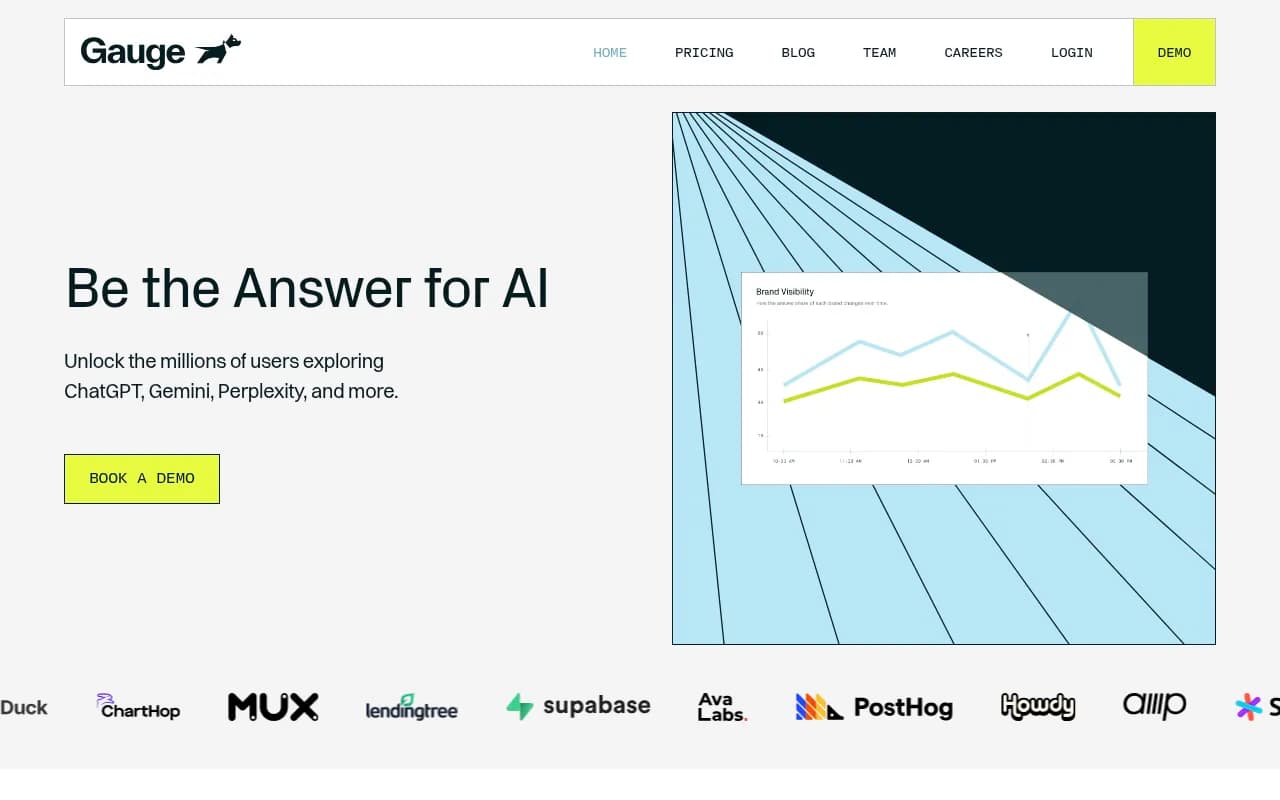
Gauge positions itself as a strategic competitive intelligence platform for AI search. The core pitch: track your brand across AI engines, understand where competitors are winning, and get clear roadmaps to improve visibility. Gauge emphasizes its three-step loop -- track mentions, analyze gaps, take action -- with a focus on competitive positioning. The platform monitors ChatGPT, Claude, Gemini, Perplexity, Copilot, AI Mode, and AI Overviews. Pricing starts at $99/mo for 100 prompts (ChatGPT only) with 3 AI-generated articles included.
What stands out: Gauge integrates content generation directly into the platform. You're not just seeing what's missing -- you can create articles to fill those gaps without leaving the tool.
Qwairy: Ultimate GEO strategy and optimization platform
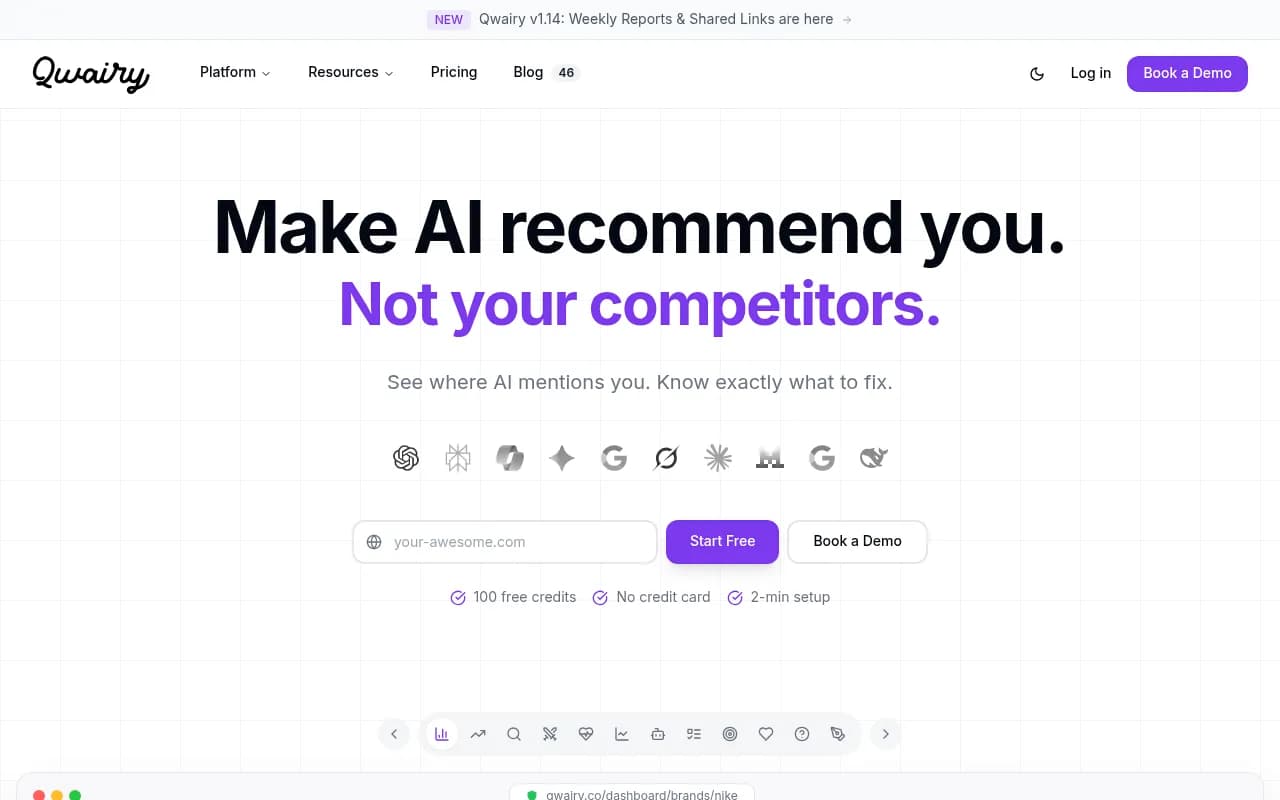
Qwairy calls itself the "most advanced and actionable GEO platform" and backs that up with a wider model coverage (10 AI engines including Grok, Mistral, DeepSeek) and a centralized Action Center that scores every recommendation by impact and effort. The platform covers prompt tracking, citation analysis, sentiment monitoring, query fan-outs, social signals, shopping results, local businesses, and ad monitoring. Pricing starts at €49/mo (~$53) with 100 free credits and access to all models from the start.
What stands out: Qwairy's Action Center is the hub -- it pulls in recommendations from site diagnostics, content gaps, backlink opportunities, competitor analysis, and technical fixes, then ranks them so you know exactly what to tackle first. It's a prioritization layer most competitors lack.
Side-by-side comparison
| Feature | Gauge | Qwairy |
|---|---|---|
| Starting price | $99/mo | €49/mo (~$53) |
| AI models monitored | 7 (ChatGPT, Claude, Gemini, Perplexity, Copilot, AI Mode, AI Overviews) | 10 (adds Grok, Mistral, DeepSeek) |
| Starter plan prompts | 100 (ChatGPT only) | 100 (all models) |
| Content generation | ✓ 3 articles/mo (starter), 18 articles/mo (growth) | ✗ Recommendations only |
| Action Center | ✗ Insights spread across modules | ✓ Centralized with impact/effort scoring |
| Competitor tracking | ✓ | ✓ |
| Citation analysis | ✓ | ✓ |
| Backlink opportunities | ✗ | ✓ |
| Local business monitoring | ✗ | ✓ |
| Shopping results tracking | ✗ | ✓ |
| Sentiment analysis | ✗ | ✓ |
| Free trial | ✓ | ✓ 100 free credits |
| Annual billing discount | Not specified | ✓ |
Head-to-head feature deep-dive
AI model coverage
Gauge tracks 7 AI engines: ChatGPT, Claude, Gemini, Perplexity, Copilot, Google AI Mode, and Google AI Overviews. That's the core set most brands care about. The catch: on the starter plan ($99/mo), you only get ChatGPT. To monitor all 7 models, you need the Growth plan at $599/mo.
Qwairy monitors 10 AI engines: everything Gauge has plus Grok, Mistral, and DeepSeek. More importantly, you get all 10 models on the starter plan (€49/mo). No artificial gating.
Verdict: Qwairy wins on breadth and accessibility. If you want full model coverage without jumping to a $600/mo plan, Qwairy is the obvious pick.
Pricing structure
| Plan | Gauge | Qwairy |
|---|---|---|
| Starter | $99/mo: 100 prompts, ChatGPT only, 3 articles | €49/mo: 100 credits, all 10 models |
| Mid-tier | $599/mo: 600 prompts, all models, 18 articles | Not specified (likely custom) |
| Enterprise | Custom | Custom |
Gauge's pricing is straightforward but expensive if you want full model access. The $99 starter plan is ChatGPT-only, which feels limiting in 2026 when Perplexity, Claude, and Gemini are just as important. The jump to $599/mo is steep.
Qwairy starts at €49/mo (~$53) and gives you all 10 models immediately. The credit system is less transparent than Gauge's prompt-based pricing, but the lower entry point and full model access make it easier to justify.
Verdict: Qwairy is half the price for full model coverage. Gauge makes sense if you specifically need the AI content generation and are willing to pay for it.
Content generation vs recommendations
Gauge includes AI-generated articles in every plan: 3 articles/mo on starter, 18 articles/mo on growth. The platform analyzes content gaps, then writes articles designed to rank in AI search. You're not just seeing what's missing -- you're getting drafts to publish.
Qwairy doesn't generate content. Instead, it gives you detailed recommendations in the Action Center: "Create content for 'best running shoes for marathon'" with an impact score of 88 and effort rating of "Medium." You still need to write the content yourself or hand it off to a writer.
Verdict: Gauge wins if you want an all-in-one solution that writes content for you. Qwairy wins if you have a content team and just need to know what to prioritize. The Action Center's impact/effort scoring is more sophisticated than Gauge's content gap analysis, but Gauge actually does the writing.
Worth noting: if you're also tracking how your brand shows up in AI search results and want to close the loop from content creation to visibility measurement, Promptwatch covers that angle with its Answer Gap Analysis and built-in AI writing agent. It's a natural complement to either platform.

Action Center vs distributed insights
Qwairy's Action Center is a single dashboard that pulls in recommendations from every part of the platform: site diagnostics, content gaps, backlink opportunities, competitor analysis, technical fixes, schema markup, local SEO. Each recommendation gets an impact score (0-100), an effort rating (Quick/Medium/Complex), and a status (Pending/In Progress/Completed). You can filter by priority, source, or type. It's a project management layer on top of the data.
Gauge doesn't have an equivalent. Insights are spread across the Track, Understand, and Act modules. You see competitive gaps in one place, citation analysis in another, content recommendations in a third. There's no unified view that says "here are the 15 things you should do this month, ranked by ROI."
Verdict: Qwairy's Action Center is a major differentiator. If you're juggling multiple priorities and need help deciding what to tackle first, Qwairy's scoring system is invaluable. Gauge gives you the data but leaves the prioritization to you.
Competitor analysis
Both platforms track competitor mentions across AI engines. You can see which prompts competitors rank for, what content they're cited in, and how your visibility compares.
Gauge emphasizes competitive positioning in its marketing -- "strategic competitive intelligence" is the tagline. The platform shows you where competitors are winning and gives you a roadmap to catch up.
Qwairy includes competitor tracking as part of the broader Action Center. You'll see recommendations like "Analyze why Adidas ranks higher for 'trail running'" with an impact score and effort estimate. The competitor data feeds into the prioritization engine rather than living in a separate module.
Verdict: Tie. Both platforms handle competitor tracking well. Gauge makes it more central to the narrative; Qwairy integrates it into the action workflow.
Citation and source analysis
Gauge shows you what content AI engines cite when they mention your brand (or don't mention you). You can see which pages are being referenced, what's being left out, and where the gaps are.
Qwairy does the same but adds backlink opportunities and social signals. The platform surfaces Reddit discussions, YouTube videos, and other sources that influence AI recommendations. You can also see which domains AI engines trust and get recommendations to reach out for backlinks.
Verdict: Qwairy goes deeper. The backlink opportunity layer and social signal tracking give you more levers to pull beyond just fixing your own content.
Local and shopping features
Gauge doesn't track local business listings or shopping results. It's focused on brand mentions in conversational AI responses.
Qwairy monitors local businesses ("Create local landing pages for top 5 cities") and shopping results ("Update product descriptions with key benefits"). If you're an e-commerce brand or a local business, these features matter.
Verdict: Qwairy wins for e-commerce and local businesses. Gauge is better suited for B2B brands and content-driven companies.
Sentiment analysis
Gauge doesn't explicitly mention sentiment tracking in its feature set.
Qwairy includes sentiment analysis as a core feature. You can see how AI engines talk about your brand (positive, neutral, negative) and get recommendations to address negative sentiment. Example from their demo: "Address negative sentiment about pricing" with an impact score of 81.
Verdict: Qwairy wins. Sentiment tracking is table stakes for brand monitoring in 2026, and Gauge's absence here is noticeable.
Query fan-out and prompt intelligence
Gauge tracks prompts but doesn't show query fan-outs (how one prompt branches into related sub-queries).
Qwairy includes query fan-out as a feature. You can see how a single prompt like "best running shoes" expands into "best running shoes for marathon," "best running shoes for flat feet," "best running shoes under $100," etc. This helps you understand the full landscape of related queries and prioritize content creation.
Verdict: Qwairy wins. Query fan-outs are critical for content strategy, and Gauge's omission is a gap.
Pricing comparison
| Plan | Gauge | Qwairy |
|---|---|---|
| Entry | $99/mo (100 prompts, ChatGPT only, 3 articles) | €49/mo (~$53, 100 credits, all 10 models) |
| Mid-tier | $599/mo (600 prompts, all 7 models, 18 articles) | Not publicly listed (likely custom) |
| Enterprise | Custom | Custom |
| Free trial | Yes | Yes (100 free credits) |
| Annual discount | Not specified | Available |
Gauge is more expensive at every tier. The $99 starter plan is ChatGPT-only, which feels like artificial gating in 2026. To get full model coverage, you're paying $599/mo. The value proposition: you're getting AI-generated articles included, which could save you content creation costs.
Qwairy is half the price for full model access. The €49 starter plan gives you all 10 AI engines, the Action Center, and all the recommendation features. The catch: no content generation. You're paying for intelligence, not execution.
Verdict: Qwairy is better value for most teams. Gauge makes sense if you specifically need the content generation and can justify the higher price.
Pros and cons
Gauge pros
- AI content generation included (3-18 articles/mo depending on plan)
- Strong competitive intelligence focus
- Clear three-step workflow (track, understand, act)
- Citation analysis shows exactly what's being referenced
Gauge cons
- Starter plan is ChatGPT-only ($99/mo for one model)
- No Action Center or unified prioritization view
- Missing sentiment analysis, local monitoring, shopping results
- No query fan-out or backlink opportunity features
- Expensive jump to full model access ($599/mo)
Qwairy pros
- All 10 AI models on the starter plan (€49/mo)
- Action Center with impact/effort scoring for every recommendation
- Sentiment analysis, local monitoring, shopping results included
- Query fan-out shows related prompts
- Backlink opportunities and social signal tracking
- Half the price of Gauge for full model coverage
Qwairy cons
- No built-in content generation (recommendations only)
- Credit-based pricing is less transparent than prompt-based
- Fewer case studies and public customer stories than Gauge
Who should pick which tool
Pick Gauge if:
- You need AI-generated articles and want an all-in-one solution that writes content for you
- You're a small team without dedicated content writers
- You're primarily focused on ChatGPT and don't need full model coverage immediately
- You value competitive intelligence over operational prioritization
- You're willing to pay $599/mo for full model access + content generation
Pick Qwairy if:
- You have a content team and just need to know what to prioritize
- You want full AI model coverage (10 engines) without paying $600/mo
- You need the Action Center's impact/effort scoring to manage multiple priorities
- You're an e-commerce brand or local business that needs shopping/local monitoring
- You want sentiment analysis, backlink opportunities, and social signal tracking
- You're budget-conscious and want the most features per dollar
Final verdict
Qwairy offers better value for most teams. You get twice the model coverage at half the price, plus features Gauge doesn't have (Action Center, sentiment analysis, local/shopping monitoring, query fan-outs, backlink opportunities). The Action Center's impact/effort scoring is a game-changer for prioritization -- it turns a pile of recommendations into a ranked to-do list.
Gauge's main advantage is content generation. If you're a small team that needs articles written for you, the $99-$599/mo price tag might be worth it. But for most brands with existing content resources, Qwairy's recommendation engine is more valuable than Gauge's article generator.
The real question: do you need content execution or content strategy? Qwairy is the better strategist. Gauge is the better executor. Pick based on what your team is missing.