Key takeaways
- AI search engines (ChatGPT, Perplexity, Google AI Overviews, Claude, Gemini) are now a primary discovery channel for service buyers -- and most service businesses have no idea if they're being cited or ignored.
- Getting cited requires more than good SEO. AI models pull from authoritative, well-structured, frequently-cited content -- not just pages that rank #1.
- The highest-leverage moves for service businesses: answer specific questions clearly, build topical authority, earn third-party mentions, and publish original data.
- Monitoring your AI visibility is table stakes in 2026. If you can't see where you're being cited (or not), you can't improve it.
- The gap between "monitoring" and "optimizing" is where most businesses stall. Closing that gap -- finding what's missing, creating content to fill it, tracking results -- is what actually drives inbound.
Why AI search matters for service businesses right now
If you run a service business -- consulting, legal, accounting, marketing, IT, design, whatever -- your buyers are increasingly starting their search in ChatGPT or Perplexity rather than Google. They type something like "best HR consulting firms for mid-size companies" or "who should I hire for a website redesign in 2026" and they get a synthesized answer with a short list of recommendations.
If your business isn't in that answer, you don't exist for that buyer.
This is different from traditional SEO in a meaningful way. Google shows a list of ten blue links and users decide what to click. AI search engines make the decision for them. They synthesize sources, pick a handful of names to mention, and present a confident recommendation. The businesses that get named get the inquiry. The rest get nothing.
For service businesses specifically, this dynamic is brutal and also a real opportunity. Most competitors haven't figured this out yet. The window to build AI search visibility before the space gets crowded is still open -- but it's closing.
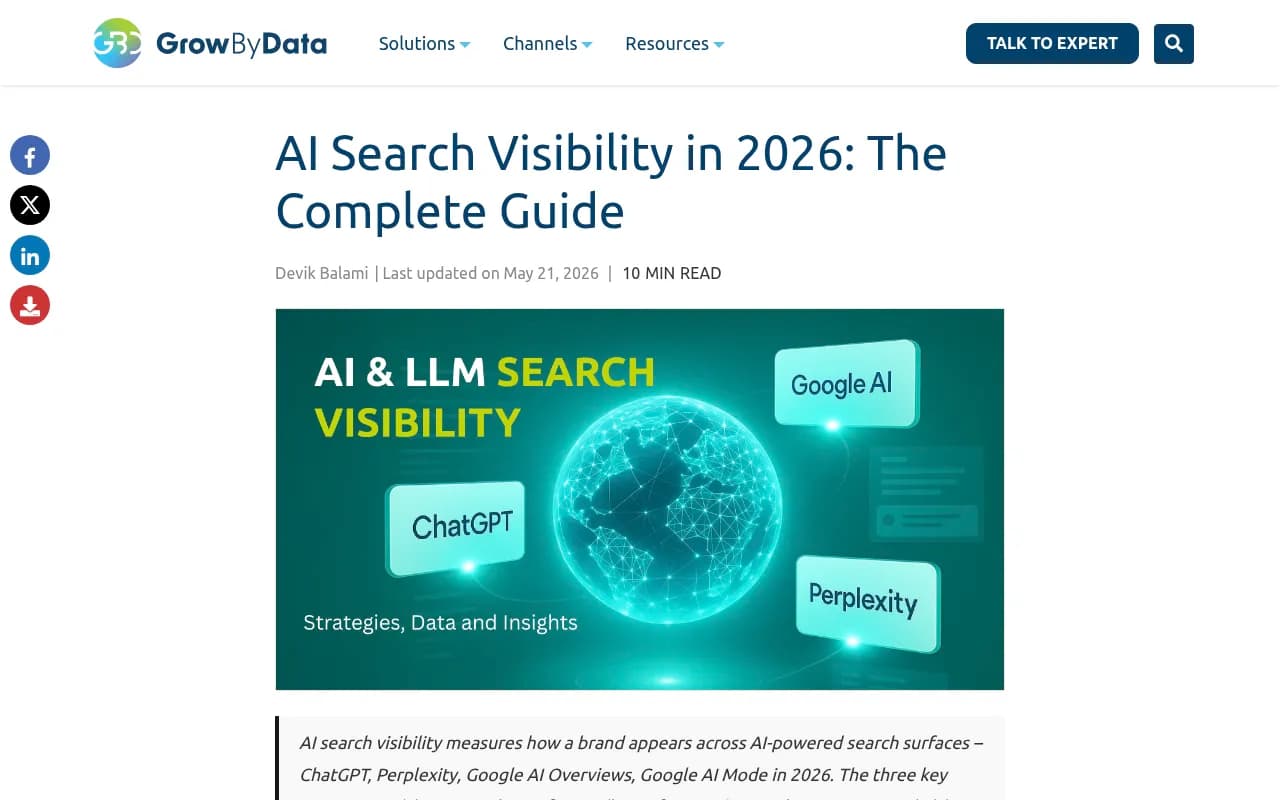
How AI models decide who to cite
Before you can optimize for AI citation, you need to understand how these models pick their sources. It's not random, and it's not purely based on domain authority.
AI models are trained on large corpora of text and then updated with retrieval mechanisms that pull live web content. When someone asks a question, the model looks for sources that:
- Directly and clearly answer the specific question being asked
- Come from domains that other credible sources have cited or linked to
- Use structured, readable content (headers, lists, clear definitions)
- Cover a topic with enough depth that the model can trust the source knows what it's talking about
- Are fresh enough to be relevant (especially for fast-moving topics)
One concrete data point worth knowing: according to The Digital Bloom's 2026 AI Citation Position & Revenue Report, ranking #1 organically gives you a 33.07% probability of being cited in AI Overviews -- the highest of any position. But that doesn't mean you need to rank #1 for everything. AI models also pull from sources that rank lower but answer a specific question better than the top result.
For service businesses, this means two things. First, your website needs pages that answer the specific questions your buyers ask -- not just pages that describe your services. Second, you need external credibility signals: mentions, citations, and links from sources the AI models already trust.
Step 1: Map the questions your buyers actually ask AI
The starting point for any AI visibility strategy is understanding what your potential clients are typing into ChatGPT or Perplexity. These prompts are different from traditional search queries. They're longer, more conversational, and often comparative.
Instead of "accounting firm Chicago," a buyer might ask: "What should I look for when hiring an accounting firm for a Series A startup?" or "Which accounting firms specialize in SaaS companies?"
Your job is to identify these prompts and make sure your website has clear, direct answers to them.
How to do this:
- Talk to your sales team. What questions do prospects ask before signing? Those are your prompts.
- Look at your intake forms and discovery call notes. What problems do people describe?
- Use a tool like Promptwatch to run actual prompts across multiple AI models and see who's getting cited -- and for what.

The Answer Gap Analysis feature in Promptwatch is particularly useful here. It shows you which prompts your competitors are being cited for that you're not. That's not just a list of topics -- it's a map of the content your website is missing.
Step 2: Build content that answers questions directly
Once you know the questions, you need content that answers them. Not vague service pages. Not "we offer comprehensive solutions." Actual answers.
This is where a lot of service businesses struggle. Their website is built to impress, not to inform. The homepage talks about the team's passion and the company's values. The services page lists offerings without explaining how they work or when you'd need them.
AI models can't cite a vibe. They cite specific, useful information.
What "answer-first" content looks like
For a legal firm, instead of a page titled "Employment Law Services," you'd have a page titled "What to do if your employer violates your non-compete agreement" -- and the page would actually answer that question, step by step, with enough detail that a reader (and an AI model) could act on it.
For a marketing agency, instead of "We do SEO," you'd have "How long does SEO take to show results for a B2B SaaS company?" with a real, specific answer.
The format matters too. Use clear headers. Use numbered lists for processes. Use short paragraphs. AI models parse structured content more reliably than dense prose.
Topical authority beats individual pages
One well-optimized page is good. A cluster of 10-20 pages that cover a topic from every angle is much better. AI models favor sources that demonstrate deep expertise on a subject -- not just one good answer, but a whole body of knowledge.
If you're a cybersecurity consulting firm, you want pages covering: what a security audit includes, how to prepare for a penetration test, what to do after a data breach, how to choose a cybersecurity firm, common vulnerabilities for small businesses, and so on. Each page answers a specific question. Together, they signal that your site is the authoritative source on this topic.
Tools like Clearscope or Surfer SEO can help you identify the semantic coverage your content needs.
Step 3: Earn third-party citations and mentions
AI models don't just read your website. They read everything -- industry publications, Reddit, YouTube, review sites, news articles. When multiple independent sources mention your business in a positive context, that's a strong signal that you're worth citing.
For service businesses, the most valuable citation sources are:
- Industry publications and trade press (getting quoted as an expert, not just a press release)
- Review platforms like G2, Clutch, or Trustpilot (AI models pull from these)
- Reddit discussions in relevant subreddits (this one surprises people, but AI models cite Reddit heavily)
- YouTube videos where you or your team explain concepts
- Podcast appearances where you're introduced as an expert in your field
The key is that these mentions need to be substantive. A one-line mention in a roundup article is less valuable than a 500-word feature where you're quoted explaining something specific.
Original research is disproportionately powerful
If you publish original data -- a survey, a benchmark report, an analysis of your client data (anonymized) -- other sites will cite it. And when other sites cite it, AI models treat your domain as a primary source.
A marketing agency that surveys 500 clients about their biggest content challenges and publishes the results has something no one else has. AI models can't fabricate that data. They have to cite you.
This doesn't need to be a massive research project. A survey of 100 people in your target industry, analyzed and written up clearly, is enough to generate citations.
Step 4: Fix your technical foundation
Content strategy won't help much if AI crawlers can't read your site properly. This is a less glamorous part of the work but it matters.
AI search engines send their own crawlers to read web content. If your pages are blocked, slow to load, or structured in a way that's hard to parse, you'll be invisible regardless of how good your content is.
The basics:
- Make sure your
robots.txtisn't accidentally blocking AI crawlers (ChatGPT, Claude, and Perplexity all have their own bots) - Use schema markup -- particularly
Organization,LocalBusiness,FAQPage, andHowToschemas where relevant - Keep your most important pages fast and clean. Heavy JavaScript frameworks can cause problems for crawlers.
- Make sure your NAP (name, address, phone) data is consistent across your site and third-party directories
If you want to see exactly which AI crawlers are hitting your site and which pages they're reading, Promptwatch's AI Crawler Logs feature shows this in real time. It's one of the few tools that gives you this level of visibility into how AI engines are actually discovering your content.
Step 5: Monitor your AI visibility and close the loop
Here's where most service businesses stop -- and where the real opportunity is.
Knowing you're not being cited is frustrating. But knowing exactly which prompts you're missing, which competitors are winning those prompts, and what content you'd need to create to change that -- that's actionable.
The monitoring tools available in 2026 range from basic to comprehensive. Some just show you a dashboard of mentions. Others help you understand why you're not being cited and what to do about it.
| Tool | Monitoring | Content gap analysis | Content generation | Crawler logs | Best for |
|---|---|---|---|---|---|
| Promptwatch | Yes (10 AI models) | Yes | Yes (AI writing agent) | Yes | Full-cycle optimization |
| Profound | Yes | Limited | No | No | Enterprise monitoring |
| Otterly.AI | Yes | No | No | No | Basic tracking |
| Peec AI | Yes | No | No | No | Multi-language monitoring |
| AthenaHQ | Yes | Limited | No | No | Brand tracking |
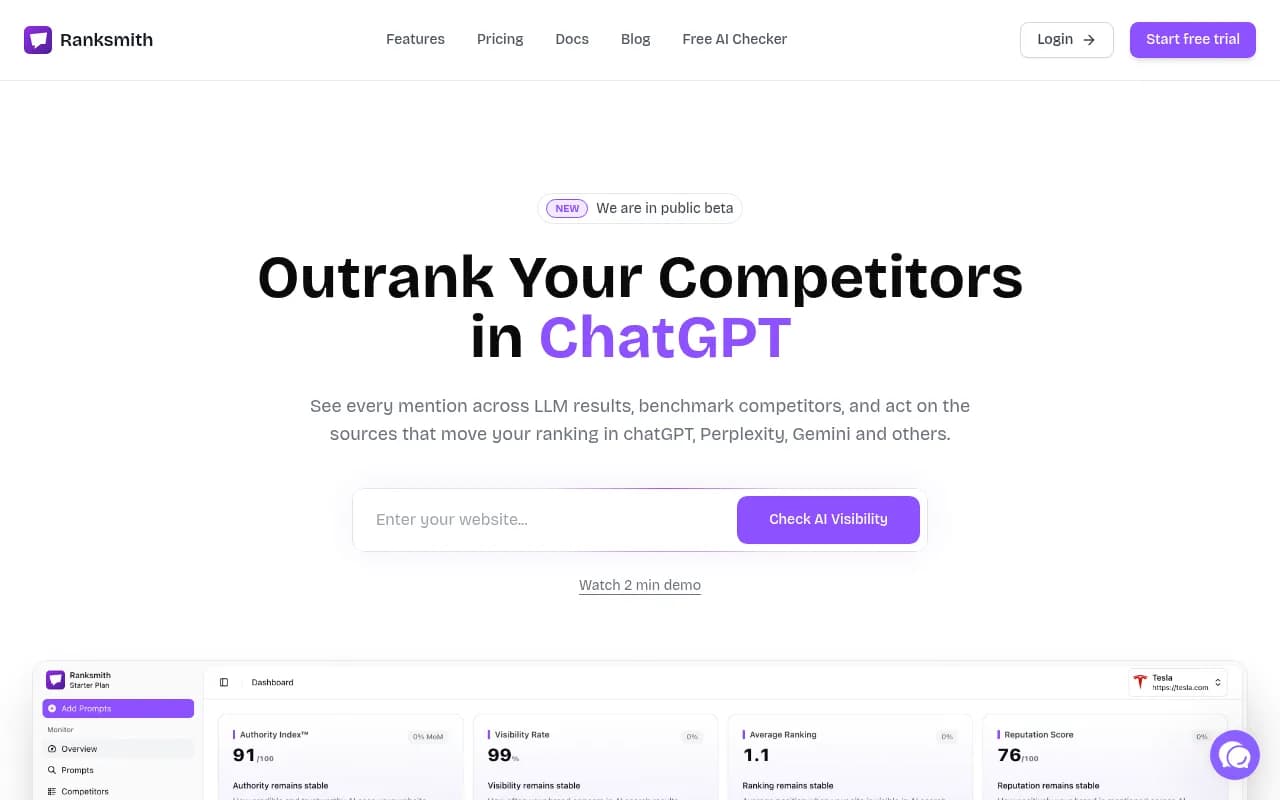
| Ranksmith | Yes | Limited | No | No | Actionable insights |




The distinction that matters most for a service business is whether the tool helps you act, not just observe. Seeing that you have 12% AI visibility while a competitor has 47% is useful information. Knowing which specific prompts they're winning, what content they have that you don't, and getting a draft article that could close the gap -- that's what moves the needle.
Step 6: Connect AI visibility to actual inbound inquiries
Visibility without attribution is just vanity. The goal is inbound inquiries, not citation counts.
This is harder to measure than traditional SEO because AI search doesn't always produce a clean referral URL. When someone asks ChatGPT for a recommendation and then visits your site directly, that shows up as direct traffic in Google Analytics. You lose the attribution.
A few ways to close this gap:
- Ask every new lead "how did you find us?" in your intake form. You'll start seeing "ChatGPT" or "Perplexity" show up more than you expect.
- Use UTM parameters on any links you can control (your Google Business Profile, directory listings, etc.)
- Implement server-side tracking or use a tool that can analyze server logs to identify AI crawler traffic and correlate it with subsequent visits
- Track your AI visibility scores over time alongside your inbound inquiry volume. If both move together, you have your signal.
Promptwatch supports traffic attribution through a code snippet, Google Search Console integration, or server log analysis -- which gives you a more complete picture of how AI visibility translates to actual visits and leads.
What a realistic 90-day plan looks like
If you're starting from zero, here's a practical sequence:
Weeks 1-2: Audit and baseline Run your key service prompts across ChatGPT, Perplexity, and Google AI Overviews. Document who's being cited. Set up a monitoring tool so you have a baseline. Check your robots.txt and schema markup.
Weeks 3-6: Content creation Write 8-12 pages that directly answer the questions you identified. Focus on questions where you have real expertise and where competitors have thin or no content. Publish them, submit them for indexing.
Weeks 7-10: Citation building Reach out to 3-5 industry publications with a pitch for a guest post or expert quote. Identify 2-3 Reddit communities where your buyers hang out and start contributing genuinely useful answers. Set up a simple survey for original research.
Weeks 11-12: Measure and iterate Compare your AI visibility scores to your baseline. Look at which new pages are getting cited. Check your inbound inquiry volume. Identify the next set of prompts to target.
This isn't a one-time project. AI search is dynamic -- models update, competitors publish new content, new prompts emerge. The businesses that win are the ones that treat AI visibility as an ongoing program, not a one-time fix.
The competitive reality
Most service businesses are still ignoring AI search entirely. That's a problem for them and an opportunity for you.
The businesses that move now -- building topical authority, earning citations, fixing their technical foundation, and monitoring their visibility -- will be much harder to displace in 12 months than they are today. AI models develop preferences for sources they've seen cited repeatedly. Early movers compound their advantage.
The flip side: if your competitors figure this out before you do, catching up gets expensive. They'll be the default recommendation for your category, and you'll be invisible.
The tools exist. The playbook is clear. The question is whether you treat this as a priority before it becomes urgent.