Key takeaways
- AI referral traffic grew roughly 700% in 2025, but it still represents only 0.15-0.25% of total global internet traffic -- the opportunity is real but early.
- ChatGPT's share of B2B AI referrals dropped from 89% to 63% in eight months. Claude, Gemini, and Perplexity now collectively account for nearly 36% of measurable AI referrals.
- 70.6% of AI-referred visits arrive without referrer headers and get misclassified as "direct" traffic in GA4 -- your current data almost certainly understates AI's contribution.
- The services industry leads all sectors in AI referral share (0.5% of total visits). Finance, tech, and health are also above average.
- Only 11% of domains are cited by both ChatGPT and Perplexity, meaning visibility on one platform doesn't automatically transfer to the other.
The state of AI referral traffic in 2026
Something interesting happened between mid-2025 and early 2026: AI search stopped being a ChatGPT monoculture.
Eight months ago, ChatGPT held 89% of measurable B2B AI referrals. By March-April 2026, that number had fallen to 62.6%, according to Goodie's longitudinal AI Search Market Share Report, which tracked referral sessions across 41 brand sites. Claude went from 1.4% to 18.5%. Gemini quadrupled its share. Perplexity more than doubled.
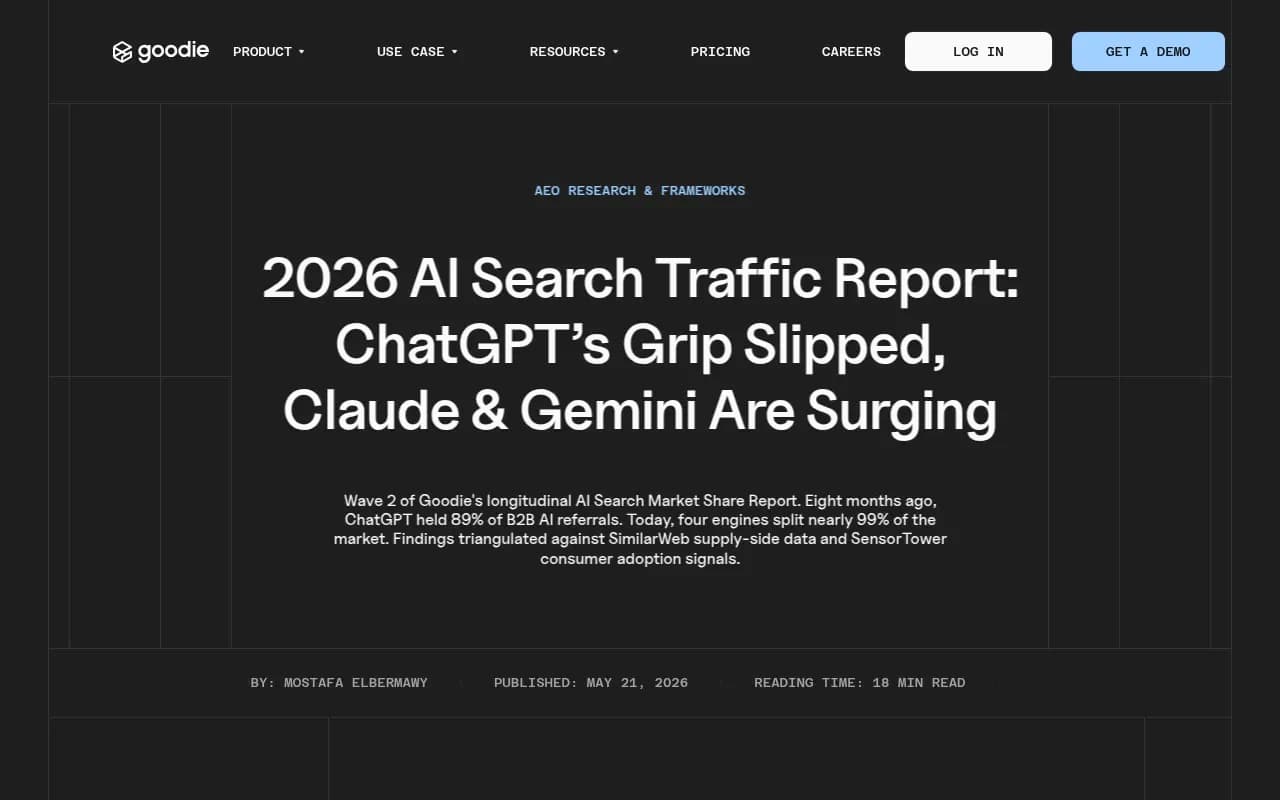
This isn't a minor shift. It means that a strategy built entirely around ChatGPT visibility now covers roughly a third less of the AI traffic landscape than it did a year ago. The displaced share moved to platforms with different retrieval logic, different citation behavior, and different user intent.
Here's where each platform stands right now:
| Platform | B2B AI referral share (Mar-Apr 2026) | Change vs mid-2025 | Monthly active users |
|---|---|---|---|
| ChatGPT | 62.6% | -26.5pp | 883M |
| Claude | 18.5% | +17.1pp | 30M |
| Gemini | 10.6% | +8.2pp | 650M |
| Perplexity | 7.3% | +4.2pp | 45M |
| Copilot | 4.0% | +0.8pp | 33M |
Sources: Goodie Wave 2 Report (May 2026), theStacc AI Search Market Share (April 2026)
Claude's rise is the most striking. It has a fraction of ChatGPT's user base but is now responsible for nearly one in five measurable AI referrals in B2B contexts. That tells you something about the type of user Claude attracts -- more research-oriented, more likely to follow citations.
The dark traffic problem: why your analytics are lying to you
Before getting into industry breakdowns, there's a measurement problem worth addressing directly.
Loamly analyzed 446,405 visits in their database and found that 70.6% of AI-referred traffic arrives without referrer headers. GA4 classifies all of it as "direct." Only 29.4% of AI traffic is correctly labeled as a referral.
| AI traffic type | Share of AI visits | How GA4 classifies it |
|---|---|---|
| AI referrer (visible) | 29.4% | Correctly labeled as referral |
| Dark AI (no referrer) | 70.6% | Misclassified as "direct" |
This matters a lot for benchmarking. When you look at your analytics and see a small trickle from ChatGPT.com, you're seeing less than a third of the actual picture. The rest is buried in your direct channel, quietly converting.
And it does convert. Loamly's data shows dark AI traffic converts at a 10.21% transactional rate, compared to 2.46% for non-AI traffic. That's a 4x difference. The visitors arriving from AI recommendations are pre-qualified -- they've already read a response that mentioned your brand or product, so they arrive with intent.
The practical implication: if you're benchmarking AI traffic purely from referral data, you're working with an incomplete picture. Tools that can identify AI crawler activity and cross-reference it with traffic patterns give you a more accurate view.
Promptwatch offers AI crawler logs that show exactly which AI bots are visiting your site, which pages they're reading, and how often they return -- which helps close the gap between what your analytics show and what's actually happening.

Industry breakdown: which sectors get the most AI referral traffic
Not all industries benefit equally from AI search referrals. Contentsquare's research on AI-referred traffic found that the services industry sees the highest share at 0.5% of total visits. That's still a small number in absolute terms, but it's meaningfully above the global average of 0.15-0.25%.
Here's how the major sectors compare:
| Industry | AI referral share (% of total visits) | Notes |
|---|---|---|
| Services (B2B, professional) | ~0.5% | Highest share; research-heavy queries |
| Technology / SaaS | Above average | High citation rates for product comparisons |
| Finance & fintech | Above average | Complex queries drive AI usage |
| Health & wellness | Above average | Medical and wellness queries common in AI |
| E-commerce / retail | Below average | Shopping still skews toward traditional search |
| Travel & hospitality | Below average | Booking intent still largely Google-driven |
| Media & publishing | Variable | Depends heavily on content type |
The pattern makes sense when you think about how people use AI search. They turn to ChatGPT or Perplexity when they have a complex question that requires synthesis -- "what's the best project management software for a 10-person remote team" or "how do I structure a Series A term sheet." These are research-heavy, comparison-oriented queries. They're also the bread and butter of B2B services, SaaS, finance, and health.
E-commerce and travel are different. Someone buying a jacket or booking a hotel still tends to go directly to a search engine or a platform. That's changing -- ChatGPT's shopping features are growing -- but the shift is slower in transactional categories.
B2B services: the biggest winner
The services sector's 0.5% AI referral share sounds modest, but context matters. For a B2B company with 100,000 monthly visitors, that's 500 AI-referred visits per month -- visitors who arrive having already read a recommendation. The conversion potential on that cohort is high.
Goodie's data specifically tracked B2B brand sites, which explains why their numbers show such dramatic AI referral growth. B2B buyers use AI assistants for vendor research, comparison shopping, and due diligence. If your company isn't being cited when someone asks "what are the best [category] tools for [use case]," you're invisible to a growing segment of your target audience.
Technology and SaaS
Tech companies are seeing above-average AI referral rates, driven largely by product comparison queries. When someone asks Perplexity "what's the difference between Notion and Confluence," both platforms get cited. The company with more structured, authoritative content about its own features tends to win those citations.
The fragmentation point is worth repeating here: only 11% of domains are cited by both ChatGPT and Perplexity, according to analysis of 680 million AI citations by Averi. That means ranking on one platform doesn't give you the other for free. Tech companies need to think about multi-platform visibility, not just ChatGPT optimization.
Finance and health
These sectors benefit from the same research-heavy query patterns as B2B services. "What's the difference between a Roth IRA and a traditional IRA" or "what are the symptoms of iron deficiency" are exactly the kinds of questions people ask AI assistants. Publishers and brands in these spaces that have deep, accurate, well-structured content are getting cited regularly.
The caveat: both finance and health are categories where AI models apply extra scrutiny (what OpenAI calls "YMYL" -- Your Money or Your Life content). Thin or unverified content in these sectors is less likely to be cited. Authoritative sources with clear credentials do better.
ChatGPT vs Perplexity: different audiences, different citation behavior
ChatGPT and Perplexity both drive meaningful traffic, but they behave differently and attract different users.
ChatGPT still dominates raw referral volume. SE Ranking's research across 63,987 sites found ChatGPT drives 78% of all AI referral traffic globally. Perplexity accounts for 15%, Gemini 6.4%.
But Perplexity users are more likely to click through. Perplexity is built around web search with citations -- every response shows sources, and users are expected to follow them. ChatGPT's interface is more conversational; users often get their answer without needing to click anywhere.
This means Perplexity tends to have a higher click-through rate per citation, even though it generates fewer total referrals. For publishers and content-heavy sites, Perplexity visibility can be disproportionately valuable.
The citation overlap issue is also important strategically. If only 11% of domains appear in both ChatGPT and Perplexity results, you can't assume that optimizing for one covers the other. The retrieval mechanisms are different. ChatGPT relies more on its training data and Bing integration. Perplexity does real-time web search. Content that ranks well in one doesn't automatically surface in the other.
The visibility baseline problem
Here's a finding from Loamly's 2,014-company dataset that should concern most marketers: 83.7% of companies in the dataset sit at the "baseline" citation rate for ChatGPT, meaning they're only being cited when someone searches for their brand by name.
| Platform | Companies at baseline (branded only) | % of dataset |
|---|---|---|
| ChatGPT | 1,278 of 1,528 | 83.7% |
| Claude | 1,217 of 1,528 | 79.6% |
| Gemini | 686 of 1,528 | 44.9% |
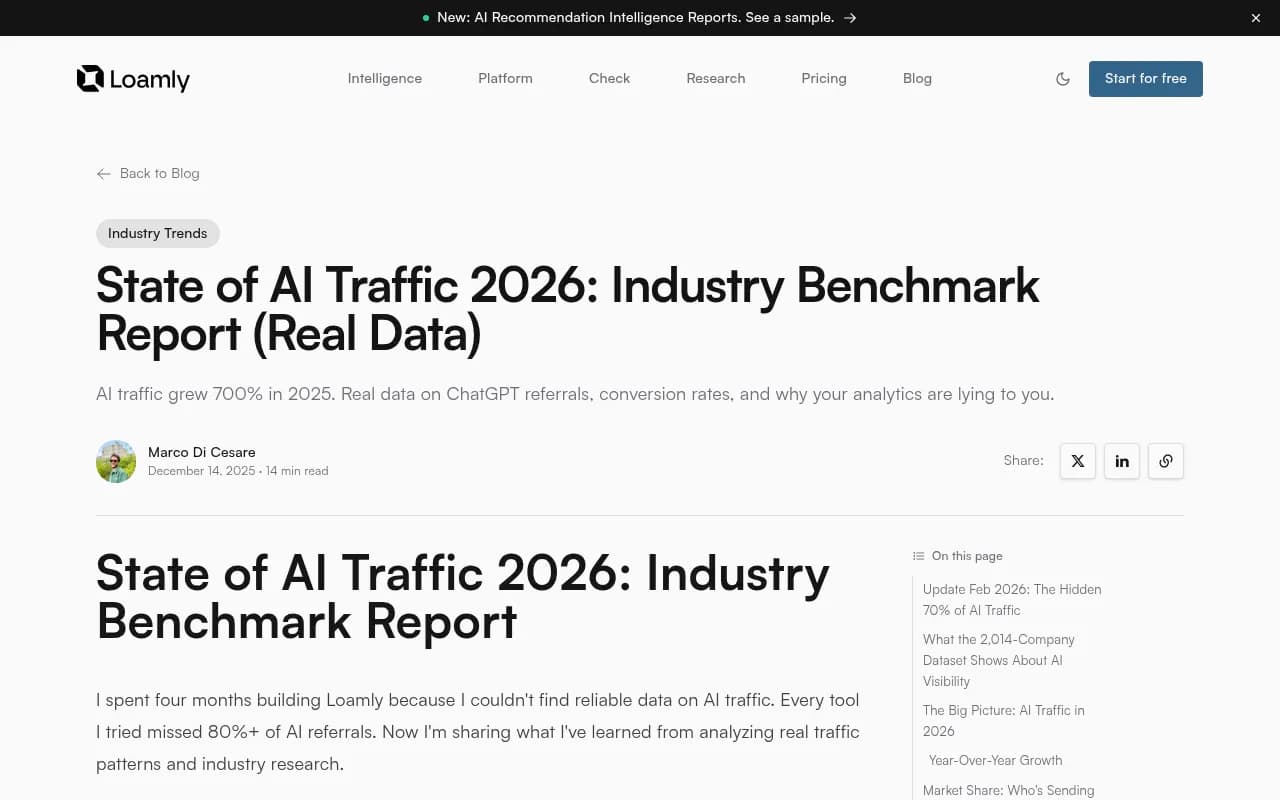
Being cited for branded queries is fine, but it doesn't drive discovery. The companies winning AI referral traffic are the ones getting cited for category-level and comparison queries -- "best tools for X," "how to solve Y," "alternatives to Z." That requires content that answers those questions better than anything else available.
Gemini's lower baseline rate (44.9%) is interesting. It suggests Gemini is more willing to cite companies for non-branded queries, which could mean it's a more accessible platform for smaller brands trying to build visibility.
What drives AI citation rates by industry
A few patterns emerge from the data on which content gets cited:
Depth beats breadth. AI models cite sources that give complete, accurate answers to specific questions. A 3,000-word guide that fully answers "how to choose an enterprise CRM" will outperform ten shallow blog posts on related topics.
Structure matters. Content with clear headers, numbered lists, comparison tables, and defined terminology is easier for AI models to parse and cite. This is especially true for Perplexity, which surfaces structured content more readily.
Authority signals count. In finance, health, and legal categories, AI models weight domain authority and author credentials more heavily. A certified financial planner's byline on a tax guide matters.
Freshness varies by platform. Perplexity does real-time search, so fresh content can surface quickly. ChatGPT's knowledge is more static (updated periodically), so older, well-established content can still dominate there.
Reddit and YouTube are citation sources. This surprises a lot of marketers, but AI models regularly cite Reddit threads and YouTube videos in their responses. For consumer categories especially, community content on these platforms influences AI recommendations. This is a channel most brands ignore entirely.
How to track and improve your AI referral traffic
Given the dark traffic problem and the platform fragmentation, measuring AI referral performance requires more than checking your GA4 referral sources.
A few approaches that actually work:
Server-side log analysis. AI crawlers (Googlebot for AI Overviews, GPTBot for ChatGPT, ClaudeBot for Anthropic) leave traces in server logs even when they don't pass referrer headers to users. Analyzing crawler logs tells you which pages AI models are reading and how often.
UTM tagging for AI-specific campaigns. If you're publishing content specifically designed to rank in AI search, tag it so you can isolate its performance.
Citation monitoring. Track which AI models are citing your brand and for which queries. This is the leading indicator -- citations precede traffic. If your citation rate is growing, traffic will follow.
Direct traffic segmentation. Some teams are starting to segment "direct" traffic by behavioral patterns (session duration, pages per visit, conversion rate) to identify the high-converting cohort that's likely AI-referred.
For teams that want a more systematic approach, platforms like Promptwatch track citations across 10+ AI models, show you which prompts competitors are winning that you're not, and include crawler log monitoring to see exactly how AI bots interact with your site.
Tools like SE Ranking also provide AI visibility tracking with referral data across their large site panel.
For monitoring citation patterns specifically, Goodie has published some of the most detailed longitudinal data on AI referral share shifts.
What to do with this data
The industry benchmarks point to a few concrete priorities:
If you're in B2B services, technology, finance, or health, AI referral traffic is already meaningful and growing fast. The question isn't whether to invest in AI search visibility -- it's whether you're investing enough.
If you're in e-commerce or travel, the opportunity is smaller today but accelerating. ChatGPT's shopping features and AI-powered travel planning tools are bringing transactional queries into AI interfaces. Getting your product data and content structured correctly now puts you ahead of the curve.
For everyone: stop optimizing only for ChatGPT. Claude's 18.5% share of B2B referrals is not a rounding error. Gemini's 647% year-over-year growth in active users means its referral share will keep climbing. A multi-platform approach isn't optional anymore.
And fix your measurement. If 70% of your AI traffic is hiding in "direct," you're making budget decisions based on incomplete data. Getting accurate attribution -- whether through server log analysis, AI-specific tracking tools, or behavioral segmentation -- is the foundation everything else builds on.
The brands that figure out multi-platform AI visibility in 2026 will have a significant head start. The data is clear on which industries are already winning. The question is whether your brand is one of them.