Key takeaways
- Most brands have hundreds of AI search gaps, but only a handful will actually move traffic. Prioritizing wrong wastes months.
- The fastest wins come from gaps where prompt volume is high, your competitors are already visible, and you have existing authority to build on.
- A simple scoring matrix (volume x difficulty x strategic fit) cuts through the noise and tells you exactly where to start.
- Tracking which pages get cited -- and by which AI models -- closes the loop between content effort and actual traffic.
- Tools like Promptwatch surface these gaps automatically, so you're not manually guessing what ChatGPT or Perplexity want to cite.
There's a specific kind of frustration that comes from doing AI search optimization without a prioritization framework. You know you have gaps. You might even have a list of them. But the list is long, your team is not, and every gap looks equally important until you're three months in and nothing has moved.
The problem isn't effort. It's sequencing.
This guide is about getting the sequence right. How to look at your AI search gaps and make a defensible call about which ones to fix first -- based on traffic potential, competitive dynamics, and how fast you can realistically create content that gets cited.
Why prioritization matters more in AI search than in traditional SEO
In traditional SEO, you could rank for a long-tail keyword with a thin page and see results in weeks. AI search doesn't work that way. ChatGPT, Perplexity, Claude, and Google AI Overviews are synthesizing answers from sources they've determined to be authoritative, comprehensive, and trustworthy. A thin page won't get cited. A page that partially answers a question won't get cited. You need content that actually earns its place in the response.
That means every piece of content you create for AI visibility is a real investment. Which makes the question of "where to start" genuinely consequential.
BrightEdge's 2026 Organic Search Performance Report documented a 28.4% year-over-year decline in traditional organic click-through rates. Gartner projects 62% of queries in mature markets will resolve without a click by end of 2026. Those numbers aren't reasons to panic -- they're reasons to be deliberate about where you spend your optimization budget.
Step 1: Build your gap inventory first
You can't prioritize what you haven't mapped. Before scoring anything, you need a complete picture of where your brand is invisible in AI responses.
This means running your target prompts through the AI models your audience actually uses -- ChatGPT, Perplexity, Google AI Overviews, Claude, Gemini -- and recording which ones mention you, which mention competitors, and which produce answers where nobody in your category appears.
The three types of gaps you're looking for:
- Prompts where competitors appear but you don't
- Prompts where no brand appears (pure content gap, not competitive)
- Prompts where you appear but are positioned poorly or cited inaccurately
Each type has a different fix and a different traffic ceiling. Competitive displacement gaps (type one) tend to have the highest immediate traffic potential because there's already proven demand. Pure content gaps can be high-value but require more effort to validate. Positioning gaps are often quick wins -- you already have the content, it just needs restructuring.
Doing this manually is painful at scale. Promptwatch's Answer Gap Analysis automates this by showing you exactly which prompts competitors rank for that you don't, with prompt volume estimates and difficulty scores attached.

Step 2: Score each gap on three dimensions
Once you have your inventory, resist the urge to just start with whatever looks interesting. Run every gap through a simple scoring matrix before touching your content calendar.
Dimension 1: Prompt volume
How often is this question actually being asked? A gap that covers a high-frequency prompt is worth more than one covering a niche question asked twice a month. Most AI visibility platforms now provide volume estimates for prompts -- use them.
If you're working without a tool, proxy volume by checking traditional search volume for the same query intent. It's not perfect, but it's better than guessing.
Dimension 2: Competitive difficulty
How entrenched are the sources currently being cited? If ChatGPT is citing a Wikipedia article, a government page, and a major industry publication for a given prompt, displacing those sources is a multi-month project. If it's citing a competitor's blog post from 2023 that's thin and outdated, you can probably beat it in weeks with a well-researched piece.
Look at the quality and authority of current citations, not just who's appearing. A competitor showing up in AI responses because of one decent article is a much easier target than a competitor with 40 pages of topical coverage on the subject.
Dimension 3: Your existing authority
Do you have any existing content, backlinks, or topical coverage in this area? AI models weight authority signals heavily. If you're starting from zero on a topic, you're building from scratch. If you have adjacent content that already gets cited, you're extending a foothold.
This is the dimension most teams underweight. Starting in an area where you already have some AI visibility is almost always faster than starting cold in a new topic cluster.
Scoring it
Score each gap 1-3 on each dimension, then multiply:
| Gap | Volume | Difficulty (inverse) | Existing authority | Score |
|---|---|---|---|---|
| "Best [your category] for small teams" | 3 | 2 | 3 | 18 |
| "How to choose [your product type]" | 3 | 1 | 2 | 6 |
| "[Your brand] vs [Competitor]" | 2 | 3 | 3 | 18 |
| "[Niche use case] guide" | 1 | 3 | 1 | 3 |
For difficulty, invert the score -- a hard gap scores 1, an easy gap scores 3. This way high scores consistently mean "high priority."
Anything scoring 12 or above goes in your first sprint. Everything else waits.
Step 3: Apply a strategic filter on top of the score
The matrix gets you to a shortlist. The strategic filter gets you to a sequence.
Ask three questions about each high-scoring gap:
Does this prompt appear in the buyer journey? A prompt like "what is [your category]" might have huge volume but low commercial intent. A prompt like "best [your product] for [specific use case]" has lower volume but the person asking it is much closer to a purchase decision. For traffic that converts, weight buyer-intent prompts higher.
Which AI model is your audience using? If your customers are primarily B2B and using Perplexity for research, gaps in Perplexity responses matter more than gaps in Gemini. If you're in e-commerce and ChatGPT Shopping is relevant, those gaps have direct revenue implications. Don't treat all AI models as equal -- your audience isn't distributed equally across them.
Can you create credible content here quickly? A gap is only valuable if you can fill it. If closing a particular gap requires original research, expert interviews, or data you don't have access to, it belongs in a later sprint regardless of its score. Gaps you can close with a well-structured, thoroughly-researched article in the next two weeks should jump the queue.
Step 4: Understand what "fixing" a gap actually requires
This is where a lot of teams go wrong. They identify a gap, write a page, and wonder why nothing changed. The issue is usually that the content doesn't match what AI models are looking for when they synthesize answers for that prompt.
Different prompt types need different content structures:
Comparison prompts ("X vs Y", "best X for Y") need comprehensive, structured comparisons with clear criteria. AI models want to cite sources that actually answer the question rather than just mentioning both options.
How-to prompts need step-by-step structure, specific detail, and ideally some original perspective or data. Generic how-to content is everywhere -- AI models increasingly favor sources that add something the others don't.
Definition and explainer prompts need authoritative, accurate definitions with enough depth to be useful. If you can add a real-world example or a nuance that competitors miss, that's what gets you cited.
Product/brand recommendation prompts need pages that are genuinely useful to someone making a decision -- not just a list of features, but actual guidance on who should choose what and why.
The common thread: AI models are trying to give their users a good answer. Content that actually answers the question well -- specifically, completely, with some original value -- gets cited. Content that's optimized for keywords but doesn't really answer anything doesn't.
Step 5: Sequence your sprints
With your scored, filtered list in hand, structure your work into two-week sprints. A realistic sprint for a small team might cover three to five gaps. A larger team or agency might cover ten to fifteen.
Sprint one should be exclusively your highest-scoring, easiest-to-create gaps. These are your proof of concept. They should start generating citations within four to six weeks of publication, which gives you early data on what's working before you commit to harder, longer-term gaps.
Sprint two can include some medium-difficulty gaps where you have strong existing authority. Sprint three is where you start tackling the harder competitive displacements that require more comprehensive content.
Don't try to fix everything at once. The teams that win in AI search in 2026 are the ones that ship consistently, track results, and iterate -- not the ones that spend three months building a perfect content strategy before publishing anything.
Step 6: Track citations at the page level
Publishing content is not the end of the process. You need to know whether the pages you created are actually getting cited, by which models, and for which prompts.
This matters for two reasons. First, it tells you whether your prioritization was right -- if a high-priority gap isn't generating citations after six weeks, something about your content or the gap assessment was off. Second, it tells you where to double down. If a page starts getting cited frequently, that's a signal to create adjacent content in the same topic cluster.
Page-level citation tracking is something most basic monitoring tools don't do well. They show you brand-level visibility scores but not which specific pages are driving citations. Promptwatch tracks this at the page level, showing you exactly which URLs are being cited, how often, and by which AI models -- which makes it much easier to connect content effort to actual results.
A note on prompt intelligence
One thing that separates effective AI gap prioritization from guesswork is having real data on prompt behavior. Not just "this keyword has X monthly searches" but understanding how a single prompt fans out into sub-queries.
When someone asks "what's the best project management tool for remote teams," AI models don't just answer that question in isolation. They draw on related queries: comparisons, feature breakdowns, use-case-specific recommendations, pricing questions. Understanding these query fan-outs tells you that fixing one gap often means creating a cluster of content, not a single page.
Promptwatch's Prompt Intelligence feature surfaces these fan-outs, showing you how one prompt branches into sub-queries so you can plan content clusters rather than isolated pages. This is particularly useful when you're deciding between two gaps with similar scores -- the one with a richer fan-out is usually the better investment.
Common prioritization mistakes to avoid
Chasing volume without checking difficulty. High-volume prompts are often dominated by Wikipedia, major publications, or government sources. The traffic ceiling is real, but so is the difficulty. Don't let big numbers distract you from winnable gaps.
Ignoring competitor citation patterns. If a competitor is appearing in AI responses for 40 prompts you're not, that's not 40 separate problems -- it's probably a topical authority gap in a specific subject area. Fix the underlying authority problem, not each individual prompt.
Treating all AI models the same. Google AI Overviews, ChatGPT, and Perplexity have meaningfully different citation behaviors. A gap in one model might not exist in another. Know which models your audience uses and weight your prioritization accordingly.
Skipping the "can we create this credibly" check. A gap is only a real opportunity if you can fill it with content that's actually authoritative. If you don't have the expertise, data, or resources to create genuinely good content on a topic, that gap should wait until you do.
Not closing the loop with traffic data. AI citations that don't drive traffic are interesting but not valuable. Connect your citation tracking to actual traffic attribution -- whether through a code snippet, Google Search Console integration, or server log analysis -- so you know which gaps are worth continuing to invest in.
Putting it together: a practical workflow
Here's the full workflow condensed:
- Run your target prompts across the AI models your audience uses and record where you're missing
- Categorize gaps by type: competitive displacement, pure content gap, or positioning issue
- Score each gap on volume, difficulty (inverted), and your existing authority
- Apply strategic filters: buyer intent, model relevance, content feasibility
- Build two-week sprints starting with highest-score, fastest-to-create gaps
- Create content that actually answers the prompt -- structured, specific, with original value
- Track citations at the page level and adjust based on what's working
The brands getting the most out of AI search right now aren't the ones with the most sophisticated strategy documents. They're the ones who picked a starting point, shipped content, watched what happened, and kept going.
Start with the gaps you can win. Win them. Then move to the harder ones.
Tools that help with AI gap prioritization
Several platforms can help you build your gap inventory and track results. Here are the ones worth knowing:
Promptwatch is the most complete option for the full workflow -- gap analysis, content generation grounded in citation data, and page-level tracking across 10+ AI models.
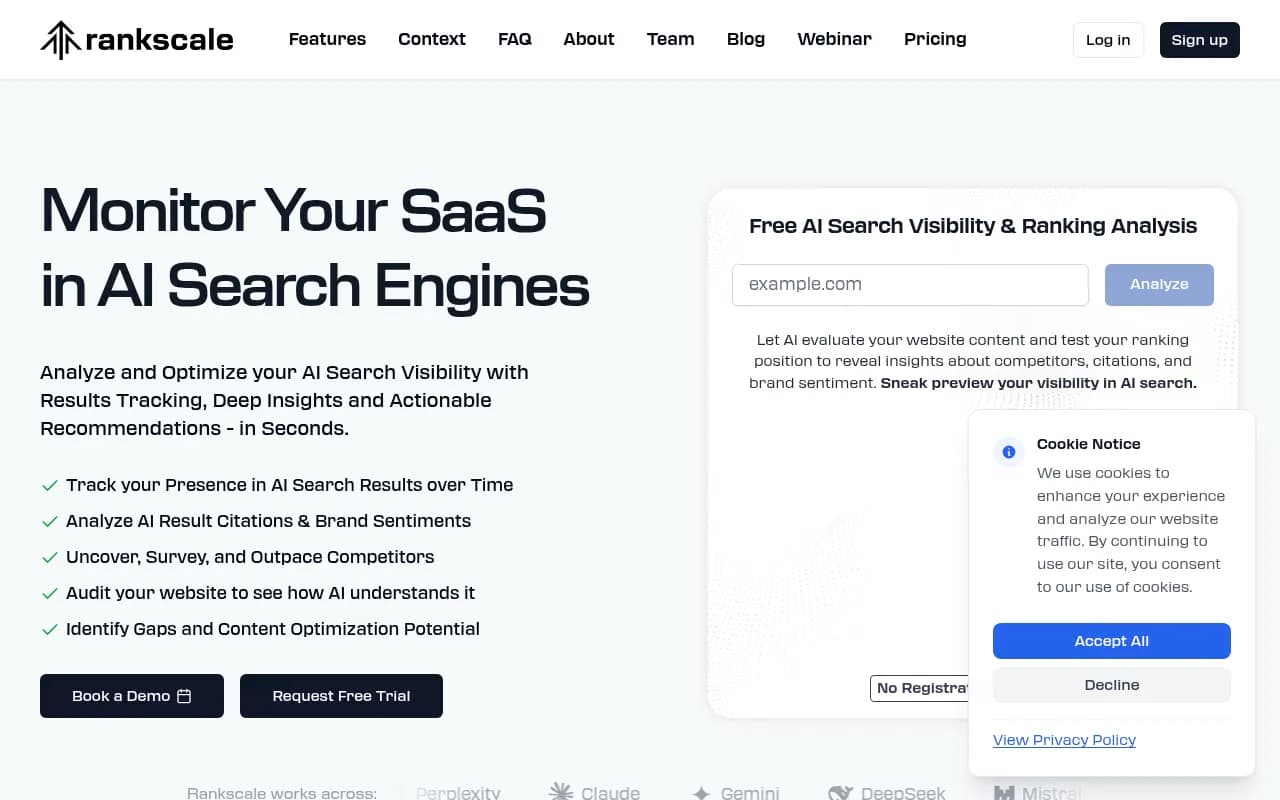
For teams that want to start with monitoring before committing to a full platform:


For enterprise teams needing deeper competitive intelligence:


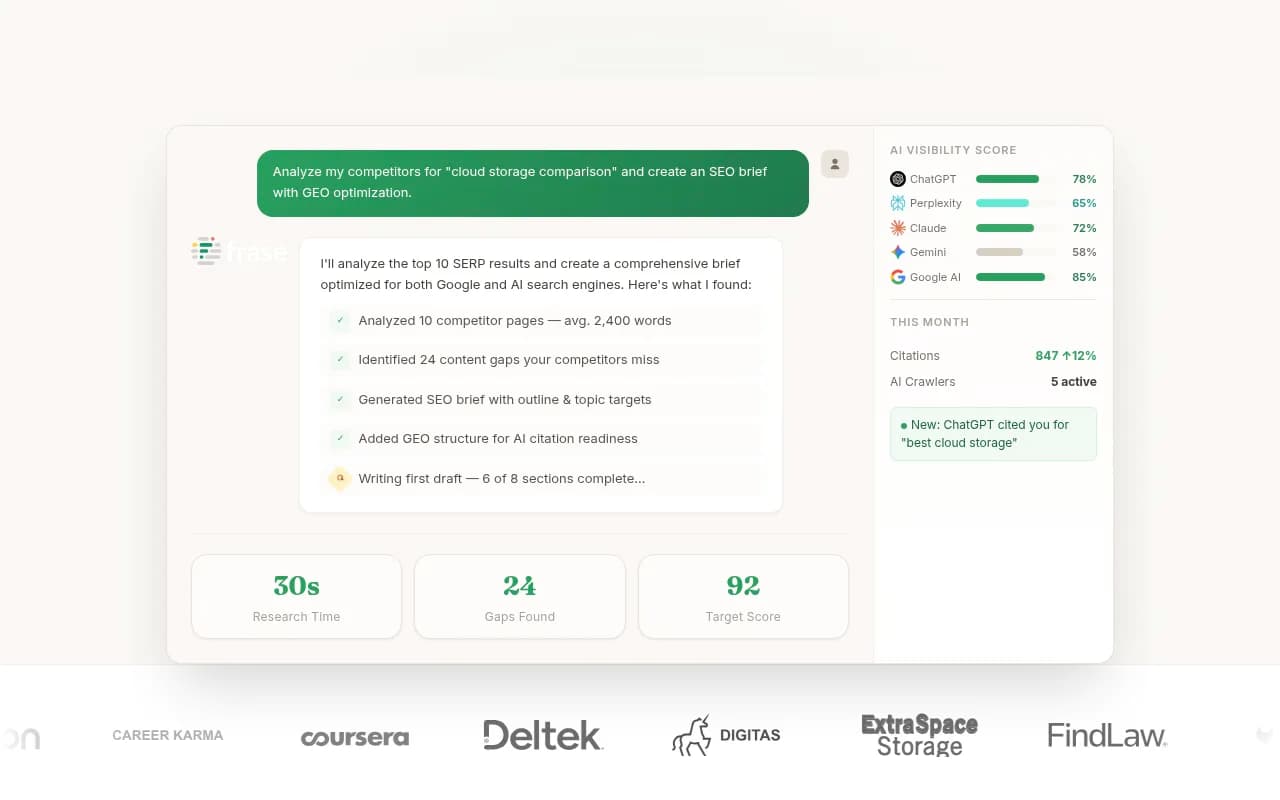
For content creation once you've identified your gaps:

The right tool depends on where you are in the process. If you're just starting to map your gaps, a lighter monitoring tool gets you moving fast. If you're ready to act on gaps and track results, you need something that goes beyond monitoring to actually help you fix what's broken.