Key takeaways
- AI search engines cite based on topical authority and content structure, not just domain age or backlink count — new sites can compete faster than in traditional SEO
- The fastest path to citations is owning a specific niche completely, not trying to cover everything
- Technical crawlability (llms.txt, structured data, clean HTML) matters more for AI than it does for Google
- Third-party mentions on Reddit, YouTube, and niche publications directly influence which brands AI models recommend
- Tracking your AI visibility from day one helps you spot what's working before competitors do
Starting a new website in 2026 is genuinely harder than it was five years ago. Back then, you could grind out backlinks, hit some keyword targets, and slowly climb Google's rankings over 12-18 months. That playbook still works, but it's increasingly beside the point.
The more important question now is: will ChatGPT recommend you? Will Perplexity cite your content? Will Google's AI Overview pull from your pages when someone asks a question you should be answering?
These aren't hypothetical concerns. Zero-click searches hit 65% in 2025 according to ConceptRecall's analysis, and that number is climbing. When someone asks an AI assistant which project management tool to use, or what the best accounting software is for freelancers, they get a direct answer with specific brand names. If your brand isn't in that answer, you don't exist for that person.
The good news: AI search doesn't care about your domain age the way Google does. It cares about whether your content is authoritative, specific, well-structured, and cited by others. A six-month-old website with genuinely useful, well-organized content can get cited by Claude or Perplexity before a ten-year-old site with thin pages.
Here's how to build that from scratch.
Why new websites can actually compete in AI search
Traditional SEO has a brutal catch-22 for new sites: you need backlinks to rank, but you need to rank to get backlinks. Domain authority accumulates slowly, and Google's trust signals take years to build.
AI search works differently. Large language models don't just look at PageRank. They evaluate:
- Whether your content directly and completely answers a specific question
- Whether your content is structured in a way that's easy to parse (headers, lists, clear prose)
- Whether other sources reference your brand or content
- Whether your topical coverage is deep rather than broad
That last point is where new sites have a real opening. A brand-new website that publishes 40 genuinely comprehensive articles about one narrow topic can develop stronger topical authority in that niche than an established site with 2,000 shallow pages spread across dozens of topics.
AI models are essentially trying to find the best answer to a question. If your page is the best answer, you have a shot at being cited -- regardless of when your domain was registered.
Step 1: Pick a niche narrow enough to own
The single biggest mistake new websites make is trying to compete broadly. "Digital marketing tips" is a losing battle. "Email marketing for independent bookshops" is winnable.
AI models develop a sense of which sources are authoritative for which topics. If your site consistently answers questions about a specific domain, you become the go-to source for that domain. That's how citations accumulate.
Practical approach: pick a topic where you can publish 30-50 articles that cover every meaningful question a reader might have. Not surface-level overviews -- actual answers. Think about what someone would need to know to go from zero to competent in your niche, and build content that walks them through it.
The narrower your initial focus, the faster you build the topical density that AI models reward.
Step 2: Fix your technical crawlability before publishing anything
AI crawlers behave differently from Googlebot. They're less patient with technical issues, and they're looking for clean, parseable content. Getting this right before you publish is much easier than retrofitting it later.
Create an llms.txt file
This is a plain text file at yourdomain.com/llms.txt that tells AI crawlers what your site is about and which pages are most important. It's the AI equivalent of robots.txt, but instead of blocking crawlers, you're guiding them. Include a brief description of your site, your key topics, and links to your most important pages.
Use structured data (schema markup)
Schema markup helps AI models understand what type of content they're looking at. For a new site, prioritize:
ArticleorBlogPostingschema on content pagesFAQPageschema on any page with question-and-answer sectionsOrganizationschema on your homepage and about pageHowToschema on tutorial content
This isn't optional anymore. AI models use structured data to categorize and cite content accurately.
Keep your HTML clean
AI crawlers struggle with JavaScript-heavy pages that require rendering to show content. If your content lives in a React or Vue component that only loads after JS executes, some AI crawlers may never see it. Use server-side rendering or static generation. Make sure your main content is in the HTML source, not injected by scripts.
Check your robots.txt
Make sure you're not accidentally blocking AI crawlers. Some security plugins and default CMS configurations block non-Googlebot crawlers. Check that GPTBot, ClaudeBot, PerplexityBot, and other AI crawlers can access your pages.
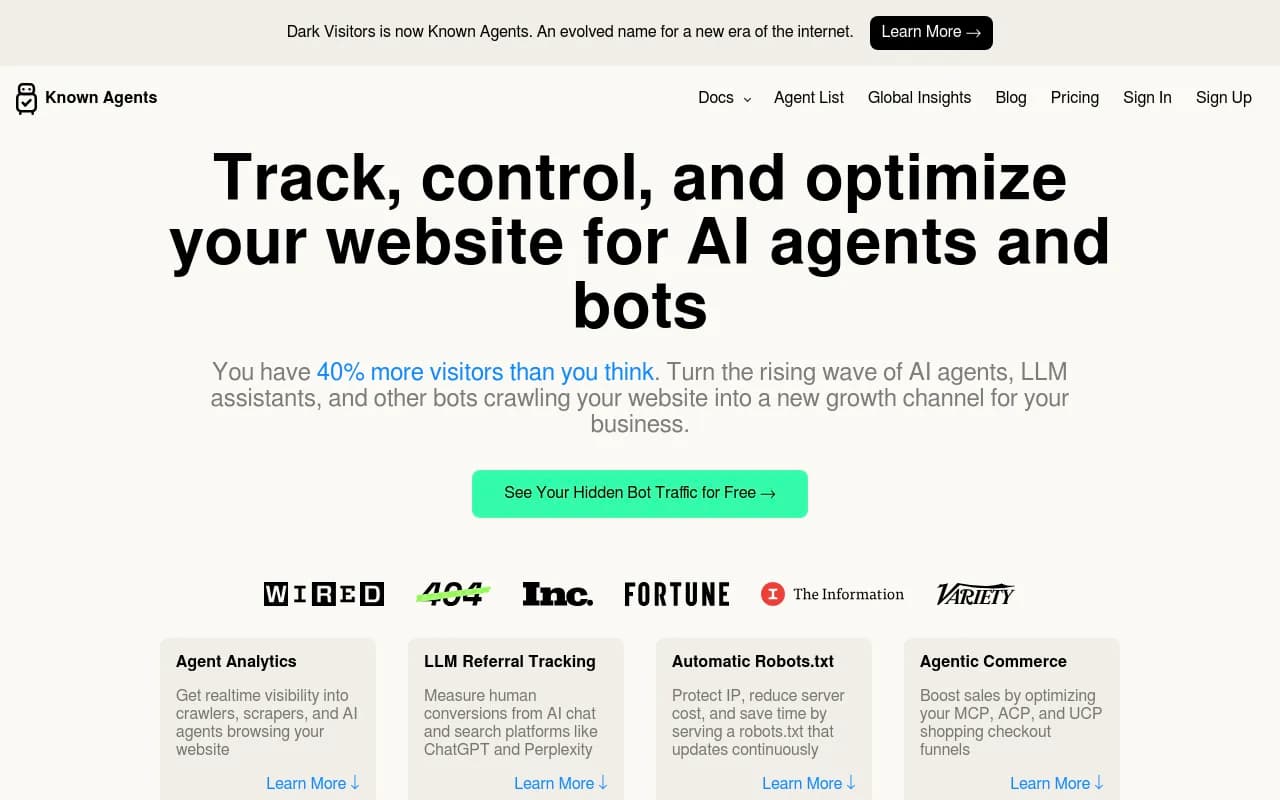
Tools like DarkVisitors can show you which AI crawlers are visiting your site and whether they're encountering errors.
Step 3: Write content that's structured for citation
There's a specific way to write content that AI models find easy to cite. It's not about keyword stuffing or hitting a word count. It's about clarity and structure.
Answer questions directly and early
When someone asks an AI a question, the AI looks for content that answers that question clearly and quickly. Don't bury your answer in three paragraphs of preamble. State the answer in the first sentence or two, then explain it.
Bad: "There are many factors to consider when choosing project management software, and the landscape has evolved significantly over the past few years..."
Better: "The best project management software for small teams in 2026 depends on whether you need time tracking. If you do, use Toggl Track. If you don't, Notion is simpler and cheaper."
Use headers that match real questions
Your H2 and H3 headings should read like questions people actually ask. "How long does it take to get cited by ChatGPT?" is better than "Timeline Considerations." AI models use headers to understand what a section is about and whether it answers a specific query.
Include specific, verifiable facts
AI models prefer content with concrete data points, specific examples, and named entities. Vague generalities ("many businesses find that...") are less citable than specific claims ("according to Semrush's 2025 State of Search report, 68% of B2B buyers now use AI search in their research process").
Use lists and tables where appropriate
Lists and tables are easy for AI to parse and reproduce in responses. If you're comparing options, use a table. If you're listing steps, use a numbered list. Don't force everything into prose when a structured format would be clearer.
Step 4: Build topical authority through content depth
Publishing one great article isn't enough. AI models develop a sense of which domains are authoritative for which topics based on the breadth and depth of coverage across the whole site.
For a new site, this means building what's sometimes called a "content cluster" or "topic hub": a pillar page that covers a topic comprehensively, supported by a series of deeper articles on specific subtopics.
For example, if your niche is "email marketing for e-commerce brands," your structure might look like:
- Pillar: The complete guide to email marketing for e-commerce (comprehensive overview)
- Supporting: How to write abandoned cart emails that convert
- Supporting: Email segmentation strategies for online stores
- Supporting: The best email marketing platforms for Shopify stores
- Supporting: How to grow an email list from zero for a new e-commerce brand
Each supporting article links back to the pillar, and the pillar links out to each supporting article. This interconnected structure signals topical authority to both AI models and traditional search engines.
Step 5: Publish original data and research
This is one of the most effective citation-building strategies available to new sites, and most people skip it because it sounds hard.
It doesn't have to be hard. Original data can be:
- A survey of 50-100 people in your target audience (Google Forms is free)
- An analysis of publicly available data that nobody has compiled before
- A benchmark study comparing tools or approaches in your niche
- An annual report on trends in your specific topic area
AI models can't fabricate proprietary data. If you publish a survey showing that 73% of freelance designers use Figma as their primary tool, and that data doesn't exist anywhere else, any AI model answering questions about design tool adoption has to cite you or make something up. They'll cite you.
Original research also gets picked up by other publications, which creates the third-party mentions that reinforce your authority (more on that below).
Step 6: Get mentioned on third-party platforms
AI models don't just read your website. They read the whole web, including Reddit, YouTube, industry forums, and publications. When multiple independent sources mention your brand in a positive context, AI models treat you as more credible.
For a new site, this means actively building a presence beyond your own domain.
Reddit is heavily cited by AI models, particularly Perplexity and ChatGPT. Find the subreddits where your target audience hangs out and contribute genuinely useful answers. Don't spam links to your site -- that gets you banned. Instead, become a helpful community member. When it's genuinely relevant, mention your site or content. Over time, your brand will appear in Reddit threads that AI models read and cite.
YouTube
YouTube content influences AI recommendations more than most people realize. A short video explaining a concept in your niche, even with modest production values, can get cited in AI responses. It also creates a second source that mentions your brand, which reinforces your authority.
Guest posts and interviews
Getting mentioned in established publications in your niche is valuable not just for the backlink but because it creates the kind of third-party validation AI models look for. A guest post on a respected industry blog, or an interview on a niche podcast that has a transcript, puts your brand name in contexts that AI models trust.
Product review platforms
If you have a product or service, get listed on G2, Capterra, Trustpilot, or whatever review platform is relevant to your industry. AI models frequently cite these platforms when recommending products.
Step 7: Optimize your brand's information layer
AI models build a mental model of your brand based on everything they've read about you. You want that model to be accurate and consistent.
Make sure your brand name, description, and key claims are consistent across:
- Your website (especially the About page and homepage)
- Your Google Business Profile
- Your LinkedIn company page
- Any industry directories or listings
- Wikipedia (if you're eligible for an article)
- Crunchbase, if you're a startup
The more consistently your brand is described across independent sources, the more confidently AI models will mention you.
Step 8: Track your AI visibility from day one
Most new site owners wait until they have "enough" content before they start tracking. That's a mistake. Tracking from the start tells you which content is getting traction, which AI models are crawling your site, and where your gaps are.
You don't need to obsess over metrics in the early days, but you do need a baseline. Some things worth monitoring:
- Which prompts is your brand appearing in (if any)?
- Which AI models are citing you?
- Which pages are being crawled by AI bots?
- What are competitors appearing for that you're not?
Promptwatch is built specifically for this kind of tracking. Beyond just showing you where you appear, it has an Answer Gap Analysis that shows which prompts competitors are visible for but you're not -- which is exactly the kind of intelligence a new site needs to prioritize content creation. It also logs AI crawler activity so you can see which of your pages AI bots are actually reading.

For simpler monitoring, tools like Otterly.AI and Peec AI offer more lightweight tracking at lower price points.


Step 9: Be patient but strategic about timelines
Getting cited by AI models takes time, but less time than building traditional SEO authority. Here's a rough timeline based on what practitioners are reporting in 2026:
| Milestone | Typical timeline |
|---|---|
| AI crawlers start visiting your site | 2-6 weeks after launch |
| First occasional citations in Perplexity | 2-4 months |
| Consistent citations for niche queries | 4-8 months |
| Appearing in ChatGPT recommendations | 6-12 months |
| Appearing in Google AI Overviews | 6-18 months |
These timelines compress significantly if you're publishing original research, getting mentioned on Reddit and in publications, and maintaining strong technical crawlability. They extend if your content is thin, your site has crawl errors, or you're trying to compete in a broad, contested niche.
Comparing AI visibility tools for new websites
If you're going to track your progress, here's how the main options compare for a new site with a limited budget:
| Tool | Best for | Starting price | Content gap analysis | Crawler logs |
|---|---|---|---|---|
| Promptwatch | Full optimization loop | $99/mo | Yes | Yes (Professional+) |
| Otterly.AI | Simple monitoring | Lower tier | No | No |
| Peec AI | Multi-language monitoring | Lower tier | No | No |
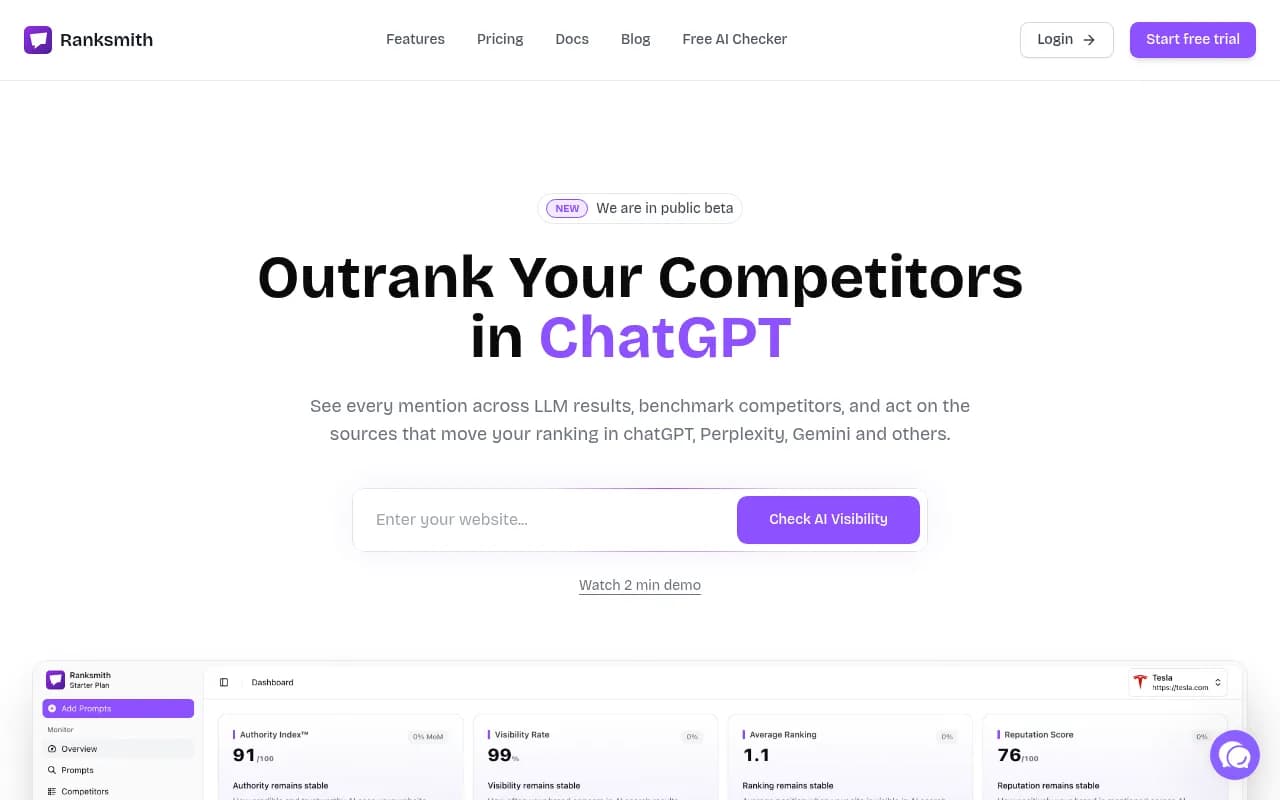
| Ranksmith | Actionable insights | Mid-tier | Limited | No |
| GetCito | Tracking + optimization | Mid-tier | Limited | No |
For a new site, the most valuable feature isn't just monitoring -- it's knowing what content to create next. That's why content gap analysis matters more at the start than it does for established sites.
The mindset shift that makes this work
Traditional SEO taught us to think about rankings: position 1, position 3, page 2. AI search doesn't work that way. There's no position 7. Either you're cited in the answer or you're not.
That changes the strategy. You're not trying to be slightly better than the competition across a broad range of keywords. You're trying to be the definitive source for a specific set of questions. That's actually more achievable for a new site than climbing from position 8 to position 3 in a competitive SERP.
Pick your niche. Cover it completely. Make your content easy to parse. Get mentioned by others. Track what's working. Repeat.
A new website with that approach can build meaningful AI search visibility in under a year. Most established sites with thousands of shallow pages won't be able to match that kind of focused topical authority, no matter how old their domain is.