Ranksmith Review 2026
AI search visibility tool offering actionable insights and recommendations for improving brand presence in AI-generated responses.
Key Takeaways
- Monitoring-only platform -- Ranksmith shows you where you rank in AI search but lacks content generation, AI crawler logs, and traffic attribution that Promptwatch offers
- Strong competitor benchmarking with automatic rival discovery, share of voice tracking, and side-by-side comparison across models
- Multi-model coverage spans ChatGPT, Perplexity, Gemini, Claude, and Grok (Google AI Overview on Enterprise only)
- Source intelligence identifies which citations drive rankings, but you're on your own to create the content that fixes gaps
- Best for small teams ($69-$549/mo) who want visibility dashboards without the optimization tools that platforms like Promptwatch provide

Ranksmith positions itself as a "comprehensive platform for tracking and optimizing your brand's presence across AI search engines," but in practice it's a monitoring dashboard with recommendations, not an optimization platform. The company launched in public beta in 2026 and targets marketers who want to understand how ChatGPT, Perplexity, Gemini, Claude, and Grok mention their brand -- but it stops short of helping you actually fix the problems it surfaces.
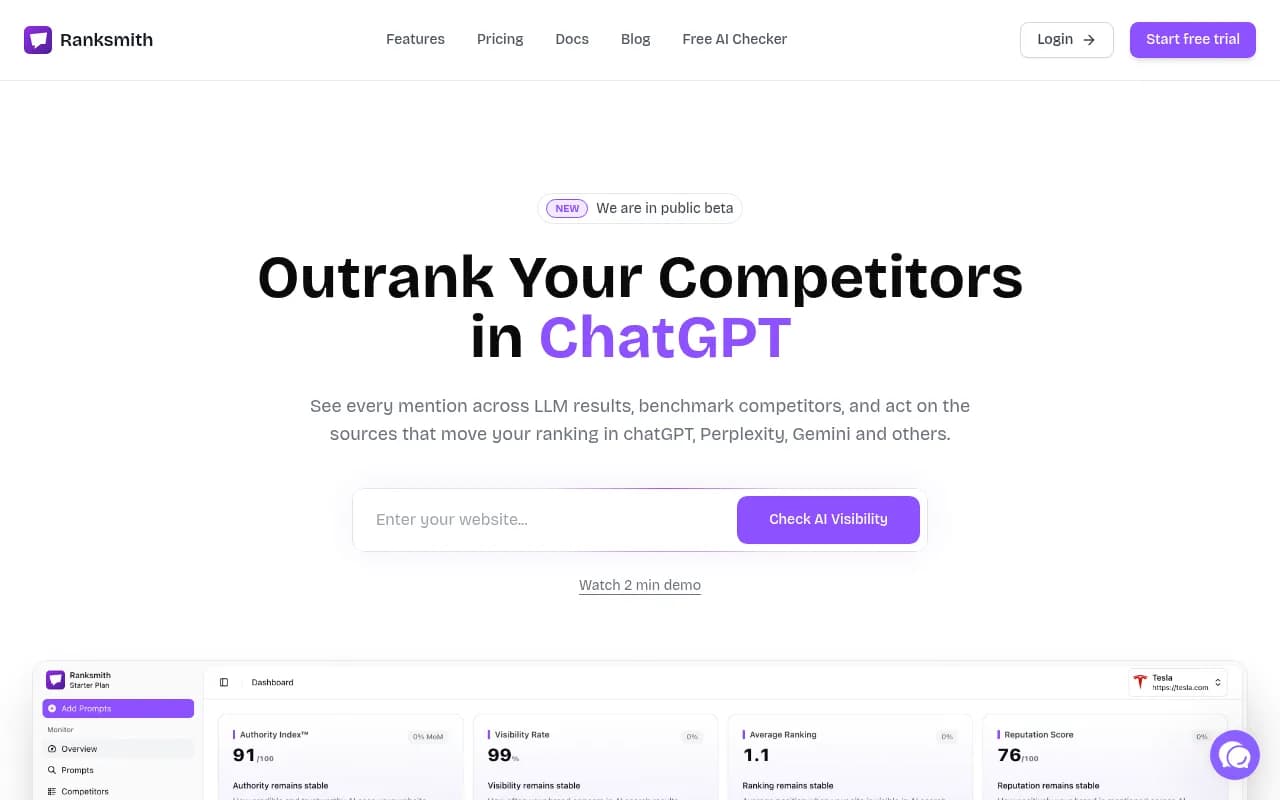
The core value proposition is visibility into AI search results. You add prompts (questions your buyers would ask an AI), specify competitors, pick countries and models, and Ranksmith checks those prompts on a rolling schedule. It parses every response for brand mentions, position, links, sentiment, and citations, then rolls that data into KPIs like AI Authority Index, AI Visibility Rate, Average AI Ranking, Reputation Score, and Share of Voice. The dashboard shows trends over time and flags where competitors are winning.
This is useful context -- knowing you're invisible for "best email marketing tool for Shopify" while a competitor ranks #2 is valuable intel. But Ranksmith doesn't tell you why you're invisible or what content to create to fix it. It surfaces the sources competitors are getting cited from (G2, Reddit, LinkedIn, press) and suggests you "execute targeted outreach, community engagement, or PR campaigns," but the actual work of closing those gaps is left to you. There's no content generation, no gap analysis that shows which topics or angles your site is missing, and no guidance on what to write.
Prompt Prioritization and Performance Scoring
Ranksmith's standout feature is its prompt performance scoring system. Every tracked prompt gets a score that blends current position, mention rate, and link rate across the models you're monitoring. You can filter by category, model, region, and sort by score to identify "quickest wins" -- prompts where you're close to ranking but not quite there yet. This is smarter than just tracking everything equally and hoping for movement.
The platform also offers AI-suggested prompts based on your industry and website, or you can import your own list. You tag prompts by model, category, and topic to create a priority queue. This organizational layer is helpful for teams managing dozens of prompts across multiple products or regions -- you're not drowning in a flat list.
But the scoring is only as useful as your ability to act on it. If a prompt scores high because you're mentioned 40% of the time but never linked, Ranksmith will tell you that. It won't tell you which page to optimize, what content to add, or how to structure an article so AI models start linking to you. You're left to reverse-engineer the fix yourself.
Competitor Intelligence and Share of Voice
Ranksmith's competitor tracking is genuinely strong. You can manually add rivals or let the platform surface companies that are frequently co-mentioned with your brand in LLM responses. Each competitor gets a relevance score, average rank, mention count, sentiment breakdown, and top citations. The benchmark table shows mentions, average ranking, visibility %, share of voice %, and sentiment side-by-side for every tracked domain.
Share of voice tracking over time is particularly useful for measuring campaign impact. If you launch a PR push or publish a batch of new content, you can watch your SOV trend upward (or not) and see which competitors lost ground. The platform also identifies the sources most often cited when competitors appear -- review sites, Reddit threads, LinkedIn posts, media mentions -- so you know where to focus outreach or content efforts.
The automatic rival discovery is a nice touch. You don't have to guess who you're competing with in AI search -- Ranksmith shows you based on actual co-mention frequency. This surfaces competitors you might not have considered, especially in crowded categories where dozens of brands vie for the same prompts.
Still, this is all descriptive analytics. You see the battlefield, but you don't get a battle plan. Ranksmith doesn't analyze why a competitor is winning a specific prompt or what content structure they're using that you're not. It just shows you the gap.
Multi-Model Coverage and Regional Tracking
Ranksmith monitors ChatGPT, Perplexity, Gemini, Claude, and Grok across all plans. Google AI Overview is Enterprise-only ($549/mo), which is a significant limitation -- Google AI Overviews are often the highest-traffic AI search surface, and locking it behind the top tier means smaller teams miss critical visibility data.
You can scope monitoring by country where supported, so you see regional differences in how AI models respond. This matters for global brands or companies with strong regional competitors. A prompt might surface your brand in the US but not in the UK, and Ranksmith will show that split.
Data refresh happens on an automated schedule -- daily on all plans according to the pricing page, though the FAQ mentions "daily or weekly depending on your plan" (the inconsistency suggests the product is still stabilizing). The dashboard updates key stats every few minutes, so you're not waiting hours for new data to populate.
One gap: Ranksmith doesn't track as many models as Promptwatch, which monitors 10+ AI engines including Meta AI, DeepSeek, Mistral, and Copilot. If you need comprehensive coverage across the full LLM landscape, Ranksmith's five-model limit is restrictive.
Source Intelligence and Citation Tracking
Ranksmith extracts citations from AI responses and attributes them back to the sources that influence rankings. You see which URLs, Reddit threads, YouTube videos, and domains are being cited when your brand (or a competitor) appears. The platform groups these by source type -- review sites, communities, media, etc. -- and surfaces the most frequently cited sources per competitor.
This is valuable for prioritizing where to invest effort. If G2 reviews consistently drive mentions for competitors but you have no G2 presence, that's a clear action item. If Reddit threads about your category are being cited heavily, you know to engage there. If a specific press outlet is cited often, you can pitch them.
But again, Ranksmith stops at identification. It doesn't track whether AI crawlers are actually visiting your site, how often they return, or what errors they encounter. It doesn't show you which of your pages are being read by AI models or which pages are being ignored. Promptwatch offers AI crawler logs that surface this data in real time, so you can fix indexing issues and optimize the pages AI models actually care about. Ranksmith has no equivalent.
Analytics and Reporting
The dashboard tracks AI Authority Index (a composite score), AI Visibility Rate (how often you're mentioned), Average AI Ranking (your typical position when mentioned), and Reputation Score (sentiment analysis). You get trend lines for each metric, share of voice over time, and breakdowns by model and competitor.
The analytics are clean and easy to parse. You can filter by date range, model, category, and prompt to drill into specific segments. The interface is modern and responsive -- no clunky legacy UI here.
What's missing: data export and API access. The FAQ admits "data export is not available but we are working on providing that functionality soon." For agencies managing multiple clients or teams that need to pipe data into BI tools, this is a dealbreaker. You're locked into Ranksmith's dashboard with no way to build custom reports or integrate with existing workflows. Promptwatch offers Looker Studio integration and a full API, so you can export data and build on top of the platform.
Email alerts are available on all plans, so you get notified when visibility changes. But there's no mention of Slack integration, webhook support, or other real-time notification channels.
Who Is Ranksmith For
Ranksmith is built for small to mid-sized marketing teams (1-10 people) at B2B SaaS companies, agencies, or e-commerce brands who want to understand their AI search visibility but don't have the budget or need for a full optimization platform. If you're a solo founder or small team just starting to think about AI search, Ranksmith gives you a clear picture of where you stand without overwhelming you with features.
It's particularly suited to teams that already have strong content and SEO operations in place. If you have writers, an SEO manager, and a content calendar, Ranksmith's insights can inform what you build next. You see the gaps, then your team fills them using existing processes.
It's not ideal for teams that need help creating the content that ranks in AI search. If you don't have in-house writers or you're struggling to figure out what to publish, Ranksmith won't solve that problem. It also won't work well for agencies managing dozens of clients -- the lack of data export, API access, and white-label reporting makes it hard to scale.
Companies in highly competitive categories (marketing tools, CRM, project management, HR software) will find Ranksmith useful for benchmarking but frustrating when it comes to execution. You'll see 10 competitors ahead of you on key prompts, but you won't get a roadmap for catching up.
Pricing and Value
Ranksmith offers three plans:
Starter ($69/mo): 1 website, 25 prompts, 5 competitors, ChatGPT + Perplexity only, 6 months historical data, email support
Pro ($149/mo): 2 websites, 60 prompts, 10 competitors, ChatGPT + Perplexity + Gemini, 12 months historical data, email + Discord support
Enterprise ($549/mo): 4 websites, 150 prompts, 20 competitors, all 5 models + Google AI Overview, 24 months historical data, email + Discord + dedicated rep
All plans include a 7-day free trial with no credit card required. Annual billing saves 20%.
The pricing is competitive with other monitoring-only tools like Otterly.AI ($29-$189/mo) and Peec.ai (~$95-$212/mo), but it's significantly cheaper than full optimization platforms. Promptwatch starts at $99/mo and includes content generation, crawler logs, and traffic attribution -- features Ranksmith doesn't offer at any price point.
For small teams on a tight budget, Ranksmith's Starter plan is accessible. But the two-model limit (ChatGPT + Perplexity) means you're missing Gemini, Claude, and Grok -- a significant blind spot. The Pro plan at $149/mo adds Gemini but still excludes Claude and Grok, which are increasingly important as Claude gains enterprise adoption and Grok grows on X.
The Enterprise plan at $549/mo is expensive for what you get. You're paying for more prompt slots and Google AI Overview access, but you're still not getting optimization tools, content generation, or advanced analytics. At that price point, Promptwatch's Business plan ($579/mo) offers far more capability -- 5 sites, 350 prompts, 30 AI-generated articles per month, crawler logs, and traffic attribution.
Strengths
Prompt performance scoring -- The scoring system that blends position, mention rate, and link rate is genuinely useful for prioritizing which prompts to focus on first. Most competitors just show raw data without helping you decide what matters.
Automatic competitor discovery -- Surfacing rivals based on co-mention frequency is smarter than forcing you to guess. You see who you're actually competing with in AI search, not just who you think you're competing with.
Clean, modern interface -- The dashboard is easy to navigate and visually clear. No learning curve, no clunky legacy UI.
Share of voice tracking -- Watching your SOV trend over time and seeing which competitors are gaining or losing ground is valuable for measuring campaign impact.
Source intelligence -- Identifying which citations drive rankings gives you a starting point for outreach and content strategy.
Limitations
No content generation or gap analysis -- Ranksmith shows you the problem but doesn't help you fix it. Promptwatch includes an AI writing agent that generates articles grounded in citation data, prompt volumes, and competitor analysis. Ranksmith has nothing comparable.
No AI crawler logs -- You can't see which pages AI models are actually reading, how often they return, or what errors they encounter. Promptwatch offers real-time crawler logs so you can fix indexing issues and optimize the pages that matter.
No traffic attribution -- Ranksmith doesn't connect visibility to actual traffic or revenue. You can't see if improved AI rankings are driving visitors to your site. Promptwatch offers traffic attribution via code snippet, GSC integration, or server log analysis.
Limited model coverage -- Five models (six on Enterprise) is less than Promptwatch's 10+ model coverage, which includes Meta AI, DeepSeek, Mistral, and Copilot.
No data export or API -- You're locked into Ranksmith's dashboard with no way to build custom reports or integrate with BI tools. This is a dealbreaker for agencies and larger teams.
Google AI Overview locked behind Enterprise -- The highest-traffic AI search surface is only available on the $549/mo plan, which prices out smaller teams.
Bottom Line
Ranksmith is a solid monitoring dashboard for small teams who want to understand their AI search visibility without committing to a full optimization platform. The prompt performance scoring, competitor benchmarking, and source intelligence are genuinely useful, and the interface is clean and easy to use. But it's a descriptive tool, not a prescriptive one -- it shows you the gaps but leaves you to figure out how to close them.
For teams that need help creating content, tracking AI crawler behavior, or connecting visibility to revenue, Promptwatch is the stronger choice. It offers everything Ranksmith does (monitoring, competitor tracking, source analysis) plus the optimization tools that actually move the needle: content gap analysis, AI content generation, crawler logs, and traffic attribution. At similar price points, Promptwatch delivers far more capability.
Best use case: Small B2B SaaS or e-commerce teams with existing content operations who want a simple dashboard to track AI search performance and benchmark competitors, without needing advanced optimization features.
Tags:
Frequently asked questions
What is Ranksmith and what does it do?
How much does Ranksmith cost?
Does Ranksmith offer a free plan or free trial?
Which AI models does Ranksmith monitor?
What is the difference between Ranksmith and Promptwatch?
Who is Ranksmith best suited for?
What metrics does Ranksmith track for AI search visibility?
Does Ranksmith help create content to improve AI search rankings?
Similar and alternative tools to Ranksmith