Key takeaways
- Ranksmith and AnyTrack are not competing products -- they solve completely different problems. Choosing between them is really about figuring out which problem you actually have.
- Ranksmith tracks how your brand appears in AI-generated search results (ChatGPT, Perplexity, Gemini, Grok, Claude). AnyTrack tracks whether your paid ads are converting and routes that data back to Meta, Google, and TikTok.
- Ranksmith starts at $69/mo; AnyTrack starts at $100/mo. Both have free trials, but Ranksmith's is 7 days vs AnyTrack's 14 days.
- If your concern is "are we showing up when people ask ChatGPT about our category?", Ranksmith is the answer. If your concern is "are our Facebook ads actually driving sales?", AnyTrack is the answer.
- Neither tool replaces the other. Many marketing teams could justify running both simultaneously.
- Ranksmith is still in public beta, which means the product is evolving fast -- useful to know before committing to an annual plan.
Overview
Ranksmith
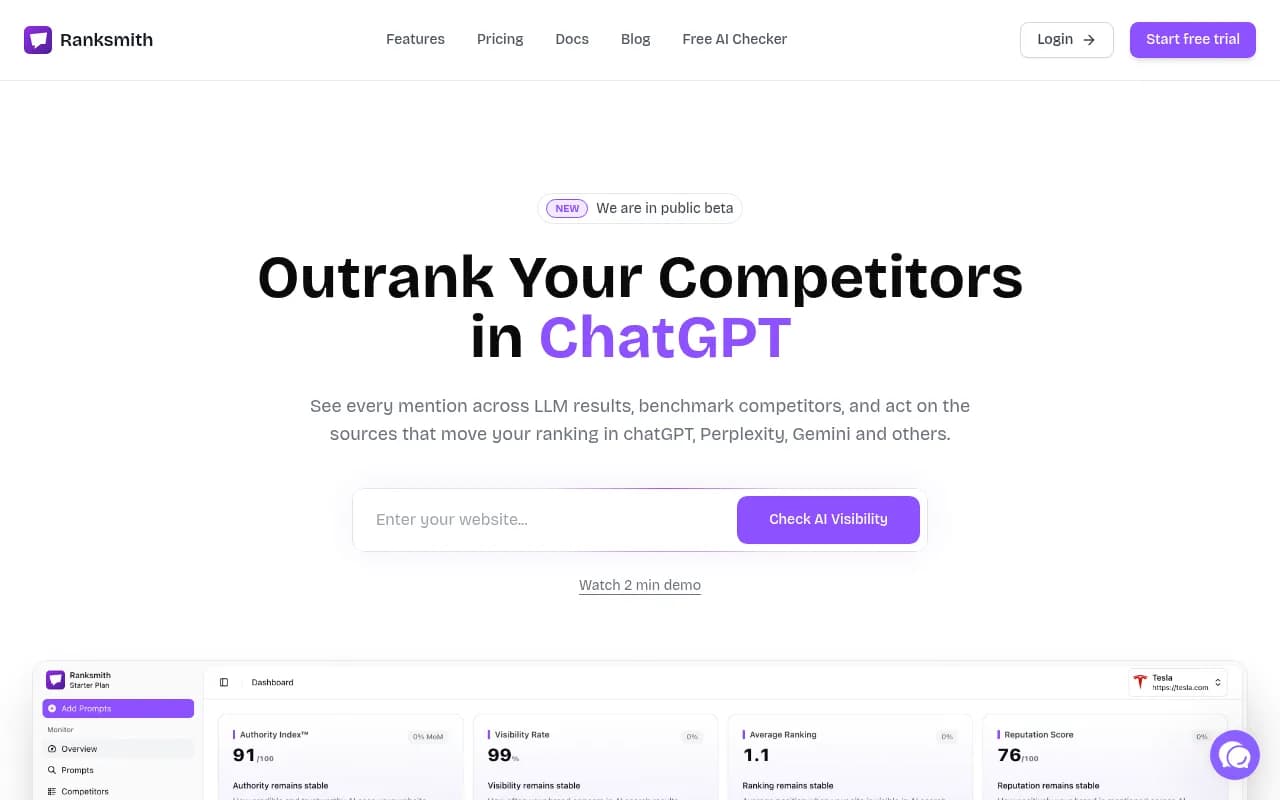
Ranksmith is a GEO (Generative Engine Optimization) platform built for tracking and improving brand visibility in AI search engines. It monitors how your brand appears across ChatGPT, Perplexity, Gemini, Grok, and Claude -- measuring things like mention rate, average position, sentiment, and share of voice. The platform also surfaces the citation sources that influence your rankings (think G2, Reddit, LinkedIn, press) and maps out which ones to target. It's aimed at SEO teams, content marketers, and brand managers who want to understand and improve their presence in AI-generated answers.
The product is currently in public beta, which is worth flagging. That means the feature set is actively expanding, but you may encounter rough edges.
AnyTrack
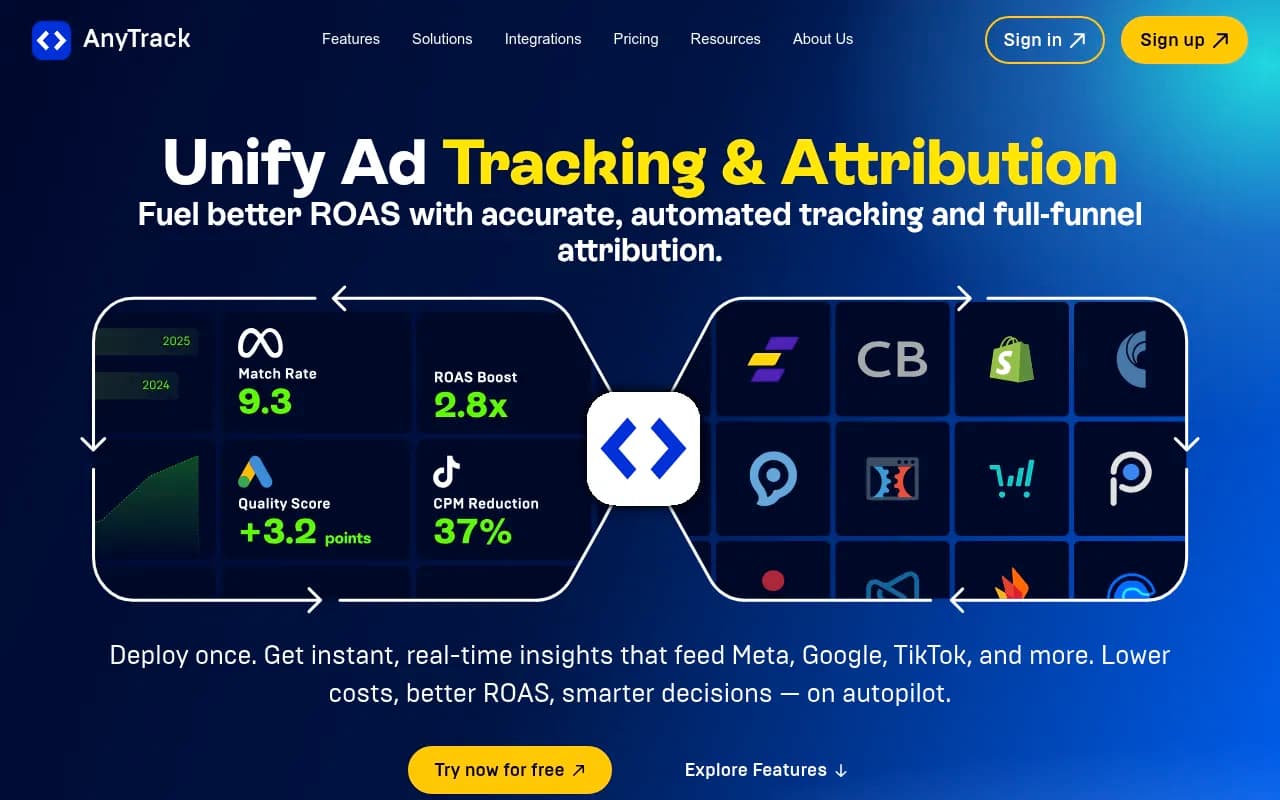
AnyTrack is a conversion tracking and attribution platform. Its core job is to capture every customer touchpoint -- across eCommerce, affiliate funnels, and lead-gen -- and feed that enriched first-party data to ad platforms like Meta, Google, and TikTok via their Conversion APIs. The pitch is that browser pixels miss 20-30% of conversions due to ad blockers and iOS privacy changes; AnyTrack's server-side tracking recovers those lost signals. It's built for performance marketers, media buyers, affiliate marketers, and eCommerce brands that live and die by ROAS.
No code required is a genuine selling point here -- setup is tag-based, and the platform handles the routing automatically.
Side-by-side comparison
| Feature | Ranksmith | AnyTrack |
|---|---|---|
| Primary use case | AI search visibility tracking | Conversion tracking & ad attribution |
| Target user | SEO/content teams, brand managers | Performance marketers, media buyers, affiliates |
| Free trial | 7 days, no credit card | 14 days |
| Starting price | $69/mo | $100/mo |
| Top-tier price | $549/mo (Enterprise) | $300/mo (Advance) |
| Annual discount | 20% | Not specified |
| AI model monitoring | ChatGPT, Perplexity, Gemini, Grok, Claude | None |
| Conversion tracking | No | Yes (server-side + pixel) |
| Ad platform integrations | None | Meta, Google, TikTok, and more |
| Competitor benchmarking | Yes (share of voice, position, sentiment) | No |
| Citation/source analysis | Yes | No |
| No-code setup | Partial (prompt import) | Yes (tag-based) |
| Affiliate network support | No | Yes |
| Cross-domain tracking | No | Yes |
| Public beta status | Yes | No (mature product) |
| API access | Not confirmed | Yes (advanced tier) |
Head-to-head feature deep-dive
Core purpose and problem solved
This is where the comparison gets a bit unusual. Ranksmith and AnyTrack don't compete for the same budget line -- they sit in entirely different parts of a marketing stack.
Ranksmith answers: "Is our brand showing up when people ask AI engines about our category, and how do we improve that?" It's a visibility and brand presence tool for the AI search era.
AnyTrack answers: "Are our paid campaigns actually driving conversions, and are we feeding the right signals back to our ad platforms?" It's a data infrastructure tool for performance marketing.
Verdict: There's no head-to-head winner here because they're not solving the same problem. The "right" choice depends entirely on which question keeps you up at night.
Tracking capabilities
Ranksmith tracks brand mentions, average position, visibility rate, sentiment, and share of voice across LLM responses. It parses every AI-generated answer to detect where your brand appears, how it's framed, and which sources are cited. You can filter by model, region, and category. The "AI Authority Index" is a composite score that rolls these signals into a single number.
AnyTrack tracks conversion events across the entire customer journey -- clicks, form fills, purchases, subscription starts. It uses a combination of first-party cookies, server-side APIs (Meta CAPI, Google Enhanced Conversions, TikTok Events API), and cross-domain tracking to stitch together journeys that would otherwise break. It also handles affiliate network postbacks automatically.
| Tracking dimension | Ranksmith | AnyTrack |
|---|---|---|
| LLM brand mentions | Yes | No |
| Sentiment analysis | Yes | No |
| Share of voice | Yes | No |
| Conversion events | No | Yes |
| Server-side tracking | No | Yes |
| Cross-domain attribution | No | Yes |
| Affiliate postbacks | No | Yes |
| Ad platform signal routing | No | Yes |
Verdict: Completely different tracking paradigms. Ranksmith tracks perception in AI; AnyTrack tracks behavior in funnels.
Competitor intelligence
Ranksmith has a dedicated competitor benchmarking module. You can track any rival domain across LLM results -- mentions, average ranking, share of voice, and sentiment -- and see where competitors are getting cited that you're not. It also claims to detect new entrants automatically, which is a nice touch for fast-moving categories.
AnyTrack has no competitor intelligence features. It's focused entirely on your own conversion data.
Verdict: Ranksmith wins this category by default -- it's a core part of the product. AnyTrack doesn't play here.
Content and optimization guidance
Ranksmith maps citation sources (G2, Reddit, LinkedIn, press mentions) to your visibility metrics and recommends specific outreach or content plays. The idea is that you can see which third-party sources are driving AI citations for competitors, then target those same sources. It also suggests prompts to track based on your category.
AnyTrack doesn't do content optimization. Its "optimization" is about improving ad signal quality -- better data in means better algorithmic optimization out. That's a different kind of optimization entirely.
Verdict: Ranksmith is the clear choice if you want guidance on what content or PR moves to make. AnyTrack doesn't touch this.
Integrations and ecosystem
Ranksmith integrates with the AI models it monitors (ChatGPT, Perplexity, Gemini, Grok, Claude). Beyond that, the integration story is thin -- there's no mention of CRM, analytics, or ad platform connections.
AnyTrack's integration catalog is extensive: Meta (Facebook/Instagram), Google Ads, TikTok, Taboola, Outbrain, plus dozens of affiliate networks (ClickBank, ShareASale, Impact, CJ, etc.) and eCommerce platforms (Shopify, WooCommerce). This is a mature integration layer built for performance marketing workflows.
Verdict: AnyTrack has a much deeper integration ecosystem, but it's purpose-built for paid marketing. Ranksmith's integrations are appropriate for its narrower focus.
Ease of setup
Ranksmith's setup involves defining your prompts (either importing your own or using AI-suggested ones), tagging them by model and category, and letting the platform run. It's not technically complex, but you do need to think carefully about which prompts actually matter for your business.
AnyTrack is explicitly no-code. You install a tracking tag, connect your ad accounts, and the platform handles the rest -- including routing conversion data to the right APIs. For performance marketers who've wrestled with pixel setup and server-side tracking configurations, this is a genuine time-saver.
Verdict: AnyTrack is probably faster to get value from on day one. Ranksmith requires more strategic thinking upfront about which prompts to track.
Reporting and analytics
Ranksmith's reporting centers on AI-specific KPIs: Visibility Rate, Average AI Ranking, Reputation Score, AI Authority Index. You get trend lines, share of voice breakdowns, and source-level attribution. The dashboard is designed to show you what changed and why.
AnyTrack's reporting covers ROAS, CPA, conversion rates, and funnel performance across channels. It's built for media buyers who need to see campaign profitability at a glance and justify ad spend.
Verdict: Both have solid reporting for their respective domains. Neither overlaps with the other.
Pricing comparison
| Plan | Ranksmith | AnyTrack |
|---|---|---|
| Entry | $69/mo (Starter: 25 prompts, 2 models) | $100/mo (Starter: 100k sessions, 1 site) |
| Mid-tier | $149/mo (Growth: 50 prompts, 4 models) | $150/mo (Personal: 500k sessions, 3 sites) |
| Upper-mid | $299/mo (Pro: 100 prompts, 5 models) | $300/mo (Advance: 3M sessions, 10 sites) |
| Top tier | $549/mo (Enterprise: 150 prompts, 6 models) | Custom/not listed |
| Annual discount | 20% | Not confirmed |
| Free trial | 7 days, no credit card | 14 days |
Ranksmith is cheaper at entry level ($69 vs $100), and the pricing scales by prompt volume and model count. AnyTrack scales by session volume and site count -- a very different dimension. At mid-tier, they're almost identical in price ($149 vs $150), which is a coincidence worth noting.
Pros and cons
Ranksmith
Pros:
- Tracks brand visibility across 5 major AI engines in one place
- Competitor benchmarking with share of voice and sentiment is genuinely useful
- Citation source mapping tells you where to focus PR and content efforts
- Cheaper entry point ($69/mo) with no credit card required for trial
- Prompt prioritization by performance score helps focus effort
Cons:
- Still in public beta -- expect some instability and missing features
- No conversion tracking or ad platform integration
- 7-day trial is short for a tool that takes time to show trends
- Limited integration ecosystem outside of the AI models it monitors
- Prompt and model limits at lower tiers can feel restrictive
AnyTrack
Pros:
- Genuinely no-code setup -- fast to deploy
- Server-side tracking recovers conversions that pixels miss
- Extensive ad platform and affiliate network integrations
- 14-day free trial gives more time to evaluate
- Mature product with a stable, well-documented feature set
- Scales well for agencies managing multiple client sites
Cons:
- No AI search visibility features whatsoever
- Starts at $100/mo, which is steep for solo marketers
- Session-based pricing can get expensive for high-traffic sites
- No competitor intelligence or brand monitoring
- Doesn't help with organic or AI-driven traffic at all
Who should pick which tool
Pick Ranksmith if:
- You want to know how your brand appears in ChatGPT, Perplexity, or Gemini responses
- You're running a GEO or AEO strategy and need data to back it up
- You want to benchmark competitors in AI search results
- You're an SEO or content team trying to understand the AI search landscape
- You want to identify which citation sources (Reddit, G2, press) to target
Pick AnyTrack if:
- You run paid ads on Meta, Google, or TikTok and need accurate conversion data
- You're an affiliate marketer connecting ad spend to network commissions
- You're losing conversions to ad blockers and iOS privacy restrictions
- You manage multiple eCommerce or lead-gen sites and need unified attribution
- You want to feed better signals to ad platform algorithms to improve ROAS
Pick both if:
- You're a growth-focused brand that cares about both AI search presence and paid ad performance -- these tools genuinely complement each other with zero overlap.
Final verdict
Ranksmith and AnyTrack are tools for different jobs. Comparing them is a bit like comparing a GPS to a fuel gauge -- both matter, neither replaces the other. If your priority is understanding and improving how your brand shows up in AI-generated answers, Ranksmith is the right tool. If your priority is recovering lost conversions and feeding better data to your ad platforms, AnyTrack is the right tool. The only real decision is which problem is more urgent for your business right now.
One thing worth knowing: if you're investing in AI search visibility and want to go deeper than Ranksmith's monitoring, Promptwatch covers the full optimization loop -- from finding content gaps to generating AI-optimized articles to tracking the results. It's worth comparing if you're evaluating the GEO space seriously.
