Key takeaways
- Ranksmith is far more affordable at entry level ($69/mo vs $295/mo self-serve for AthenaHQ), making it the obvious pick for smaller teams or those just getting started with GEO.
- AthenaHQ covers 8+ AI models out of the box; Ranksmith caps you at 2 models on its cheapest plan and 6 on Enterprise.
- Both tools are primarily monitoring and analysis platforms -- neither generates content for you the way a full-stack GEO platform would.
- Ranksmith's source-action workflow (identify which citations move rankings, then execute outreach) is a genuine differentiator for teams that want tactical plays, not just dashboards.
- AthenaHQ has a stronger enterprise pedigree (Coinbase, ZoomInfo, PagerDuty as clients; featured in Forbes and WSJ) and is better suited to large marketing teams that need executive reporting.
- Neither tool offers AI crawler logs, Reddit/YouTube tracking, or traffic attribution -- capabilities worth knowing about if you need the full picture.
Overview
Ranksmith
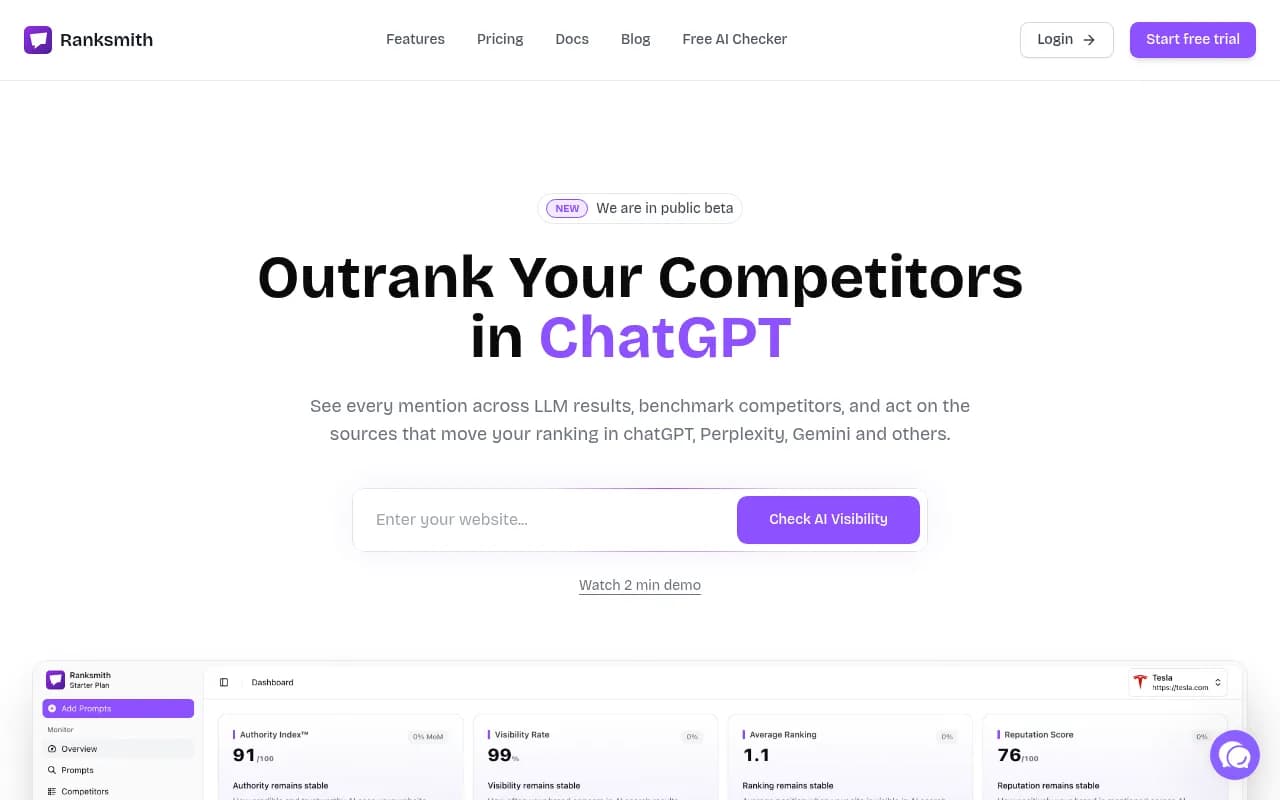
Ranksmith is a GEO platform currently in public beta, built around a clear idea: turn LLM results into a growth channel with measurable KPIs. It tracks brand mentions, position, sentiment, and citations across ChatGPT, Perplexity, Gemini, Grok, and Claude, then maps those findings to specific action plays -- things like "publish on G2", "engage this Reddit thread", or "pitch this press angle". The prompt prioritization system is a nice touch: it scores every tracked prompt by a blend of current position, mention rate, and link rate so you know where to focus first.
It's a lean, focused product. The UI looks clean from the demo, and the 7-day no-credit-card trial means you can actually test it before committing.
AthenaHQ

AthenaHQ positions itself as an end-to-end AEO and GEO platform for commercial and enterprise teams. It covers 8+ LLMs, includes automated content optimization recommendations, and has built out role-specific dashboards for GEO managers, CMOs, SEO teams, PR, and content marketing. The client list (Coinbase, ZoomInfo, SoFi, PagerDuty) signals it's aimed at larger organizations with dedicated marketing functions.
The "State of AI Search 2026" report they published is a sign of a team investing in thought leadership, not just product. AthenaHQ has been featured in Forbes and the Wall Street Journal, and came out of Y Combinator -- context that matters if you're evaluating vendor stability.
Side-by-side comparison
| Feature | Ranksmith | AthenaHQ |
|---|---|---|
| Starting price | $69/mo | $295/mo (self-serve) / $95/mo annual |
| Free trial | 7-day, no credit card | No trial; free audit available |
| AI models covered | Up to 6 (Enterprise) | 8+ |
| Prompts (entry plan) | 25 | Not publicly specified |
| Competitor tracking | Yes -- share of voice, position, sentiment | Yes -- competitive benchmarking |
| Citation/source analysis | Yes -- maps citations to action plays | Yes |
| Content generation | No | Automated recommendations only |
| Prompt prioritization | Yes -- performance score per prompt | Not prominently featured |
| Executive dashboards | Basic | Yes -- CMO-level reporting |
| Role-based workflows | No | Yes (GEO, CMO, SEO, PR, Content) |
| AI crawler logs | No | No |
| Reddit/YouTube tracking | No | No |
| Traffic attribution | No | No |
| Annual billing discount | 20% | Yes (drops to ~$95/mo) |
| Public beta status | Yes | No (generally available) |
| Notable clients | Not listed | Coinbase, ZoomInfo, SoFi, PagerDuty |
Head-to-head feature deep-dive
Pricing and accessibility
Ranksmith is the more accessible tool by a wide margin at entry level. $69/mo gets you 25 prompts and 2 AI models -- enough to start tracking a focused set of queries. The 7-day trial with no credit card is a genuine low-friction way to test the product.
AthenaHQ's self-serve pricing at $295/mo is a significant jump. The annual plan at $95/mo is much more competitive, but that requires a yearly commitment upfront. If you're not ready to lock in, you're paying 3x more per month than Ranksmith's starter.
For teams with budget and a clear mandate to invest in GEO, AthenaHQ's pricing is defensible. For everyone else, Ranksmith's entry point is hard to argue with.
Verdict: Ranksmith wins on price flexibility. AthenaHQ's annual rate is competitive but requires commitment.
AI model coverage
| Plan | Ranksmith models | AthenaHQ models |
|---|---|---|
| Entry | 2 | 8+ |
| Mid-tier | 4 (estimated) | 8+ |
| Enterprise | 6 | 8+ |
AthenaHQ covers 8+ models across all plans. Ranksmith starts at just 2 models on the Starter plan, which is a real limitation if you care about Claude or Grok visibility from day one. You need to upgrade to get broader coverage.
That said, for most brands, ChatGPT and Perplexity drive the majority of AI search traffic right now. Two models might be enough to start.
Verdict: AthenaHQ covers more models at every tier. Ranksmith's lower tiers are limiting if multi-model coverage matters to you.
Monitoring and analytics
Both tools track the core metrics: brand mentions, average position, share of voice, and sentiment. Ranksmith adds an "AI Authority Index" and "AI Visibility Rate" as composite scores, plus trend deltas over time. The prompt performance scoring -- which blends position, mention rate, and link rate -- is a genuinely useful prioritization tool that I haven't seen done quite this way elsewhere.
AthenaHQ's analytics lean toward executive reporting. The CMO dashboard and ROI tracking for AI optimization efforts suggest it's built for teams that need to justify spend upward, not just track metrics internally.
Verdict: Roughly equal on core monitoring. Ranksmith's prompt prioritization is more tactical; AthenaHQ's dashboards are better for executive reporting.
Competitor intelligence
Ranksmith makes competitor tracking a centerpiece feature. You can track mentions, positions, share of voice, and sentiment for any competitor across LLMs, and the platform claims to automatically surface new entrants -- which is useful in a fast-moving space where new competitors appear constantly.
AthenaHQ includes competitive benchmarking as part of its broader platform, but it's positioned more as one component of the overall GEO workflow rather than a standalone feature.
Verdict: Ranksmith edges ahead here -- competitor tracking feels more central to the product and more detailed.
Source and citation analysis
This is where Ranksmith does something interesting. It doesn't just show you which sources AI models cite -- it maps those citations to specific action plays. "This G2 review is influencing your ranking; here's how to act on it." That's a step beyond pure monitoring.
AthenaHQ also does citation source analysis and mentions link building as a use case, but the action-mapping layer isn't as explicitly featured.
Verdict: Ranksmith's source-to-action workflow is more developed. If you want to know what to do next, not just what's happening, Ranksmith has a clearer answer.
Content optimization
Neither tool generates content for you. Ranksmith provides strategy recommendations (which channels to target, which sources to engage) but stops short of writing anything. AthenaHQ offers "automated content optimization recommendations" -- which sounds like it tells you what to change, but doesn't write the changes itself.
If content generation is important to your workflow, it's worth knowing that platforms like Promptwatch go further -- the built-in AI writing agent generates articles and comparisons grounded in real citation data, specifically engineered to get cited by AI models.

Verdict: AthenaHQ has a slight edge on content recommendations. Neither tool generates content.
Team and workflow features
AthenaHQ has clearly invested in role-based workflows: separate views and toolkits for GEO managers, CMOs, SEO teams, PR, and content marketing. If you have a 10-person marketing team where different people own different channels, this structure helps.
Ranksmith's website mentions team collaboration (inviting team members) but doesn't show the same depth of role-based tooling.
Verdict: AthenaHQ is better for larger teams with distinct roles. Ranksmith is fine for smaller teams or solo operators.
Pricing comparison
| Plan | Ranksmith | AthenaHQ |
|---|---|---|
| Free trial | 7 days, no credit card | Free audit only |
| Entry | $69/mo (25 prompts, 2 models) | $295/mo self-serve |
| Annual entry | ~$55/mo (20% discount) | ~$95/mo |
| Mid-tier | Not publicly listed | Not publicly listed |
| Enterprise | $549/mo (150 prompts, 6 models) | Custom pricing |
| Annual discount | 20% | Yes (significant) |
The pricing gap at entry level is stark. Ranksmith at $69/mo vs AthenaHQ at $295/mo is a 4x difference. On annual billing, AthenaHQ closes that gap considerably ($95/mo vs ~$55/mo), but you're still paying more and committing to a year.
Pros and cons
Ranksmith
Pros:
- Very accessible entry price ($69/mo, 7-day free trial)
- Prompt prioritization scoring is genuinely useful for focusing effort
- Source-to-action mapping gives tactical direction, not just data
- Automatic competitor discovery is a nice touch
- No credit card required to trial
Cons:
- Only 2 AI models on the Starter plan -- a real limitation
- Still in public beta, so expect some rough edges
- No content generation
- No AI crawler logs or traffic attribution
- Smaller client base and less established than AthenaHQ
AthenaHQ
Pros:
- 8+ AI models covered at all tiers
- Strong enterprise client list (Coinbase, ZoomInfo, SoFi)
- Role-based dashboards for different team functions
- Y Combinator-backed with media coverage (Forbes, WSJ)
- Automated content optimization recommendations
- Generally available (not beta)
Cons:
- $295/mo self-serve is expensive for smaller teams
- No free trial -- only a free audit
- Annual commitment required to get competitive pricing
- No content generation (recommendations only)
- No AI crawler logs, Reddit tracking, or traffic attribution
Who should pick which tool
Pick Ranksmith if:
- You're a small team or solo marketer with a limited budget
- You want to test AI visibility tracking before committing to a year-long contract
- Competitor intelligence and source-action mapping are your primary use cases
- You're comfortable with a beta product and want to get in early
Pick AthenaHQ if:
- You're at a mid-size or enterprise company with a dedicated marketing team
- You need role-based dashboards that different team members can own
- Multi-model coverage (8+ LLMs) matters from day one
- You need a stable, generally available product with an established vendor
- Executive-level reporting and ROI tracking are requirements
Final verdict
These two tools are aimed at different buyers. Ranksmith is a lean, affordable, tactically-focused GEO tracker that's genuinely good value for smaller teams -- the prompt prioritization and source-action mapping set it apart from basic monitoring tools. AthenaHQ is a more mature, enterprise-oriented platform with broader model coverage and better team workflow support, but you pay for it.
If budget is tight or you're just starting out with GEO, Ranksmith is the easier entry point. If you're running a larger marketing operation and need something battle-tested with executive reporting, AthenaHQ justifies the higher price. Neither tool covers the full optimization loop -- monitoring is what both do best.