Key takeaways
- Otterly.AI is the cheapest entry point ($29/mo) and works well for basic monitoring across ChatGPT, Perplexity, and Copilot -- but it stops at showing you data.
- Goodie focuses on brand monitoring and optimization recommendations, with a clean interface suited to smaller teams.
- Promptwatch is the only one of the three that closes the full loop: find visibility gaps, generate content engineered to get cited, then track whether it worked.
- If you just want to know whether your brand shows up in AI answers, any of these will help. If you want to actually improve your position, Promptwatch is the only option here built for that.
- Pricing ranges from $29/mo (Otterly.AI) to $99/mo (Promptwatch Essential) -- the gap is real, but so is the difference in what you get.
The AI search monitoring space has exploded. There are now well over 100 tools claiming to track your brand across ChatGPT, Perplexity, Gemini, and the rest. Most of them do roughly the same thing: run your prompts, show you whether you appeared, and hand you a dashboard.
That's useful. But it's also where most tools stop.
This comparison focuses on three tools that come up constantly in practitioner conversations: Goodie, Otterly.AI, and Promptwatch. They're aimed at similar audiences -- marketing teams, SEO professionals, and agencies trying to understand and improve AI search visibility -- but they're built around very different ideas of what "helping you" actually means.
Let's get into it.
What problem are we actually solving?
Before comparing tools, it's worth being precise about the problem.
When someone asks ChatGPT "What's the best project management tool for remote teams?" and your product isn't mentioned, you lost that conversation. There's no click to track, no session in Google Analytics, no referral URL. The decision happened inside the AI, and you had zero visibility into it.
AI brand tracking tools exist to surface that blind spot. They run queries across LLMs, record whether your brand appeared, measure your share of voice against competitors, and (in some cases) tell you what to do about it.
The "in some cases" is where these three tools diverge significantly.
Otterly.AI: the accessible starting point
Otterly.AI is consistently described as the most affordable entry point in this category, and that reputation is earned. At $29/month, it's genuinely cheap for what it does.

The core offering is prompt-based monitoring across ChatGPT, Perplexity, Google AI Overviews, Gemini, and Copilot. You set up prompts relevant to your brand and category, and Otterly tracks whether you appear in the responses. You get share of voice metrics, sentiment analysis, and competitor comparisons.
For a solo marketer or a small team dipping their toes into AI visibility for the first time, it's a reasonable place to start. The interface is clean, setup is quick, and the data is legible without needing a tutorial.
Where it gets limiting: Otterly is fundamentally a monitoring tool. It shows you what's happening but doesn't have meaningful tools to help you change it. There's no content gap analysis, no built-in content generation, no crawler logs to understand how AI bots interact with your site, and no traffic attribution to connect AI visibility to actual revenue.
If your question is "am I showing up?" Otterly answers it. If your question is "how do I show up more?" you're mostly on your own.
Otterly.AI pricing:
- Starter: $29/mo
- Growth: $99/mo
- Pro: $199/mo
Goodie: monitoring with a cleaner UX focus
Goodie (higoodie.com) is a newer entrant in the AI brand monitoring space, positioned around making AI visibility tracking accessible and actionable for marketing teams.
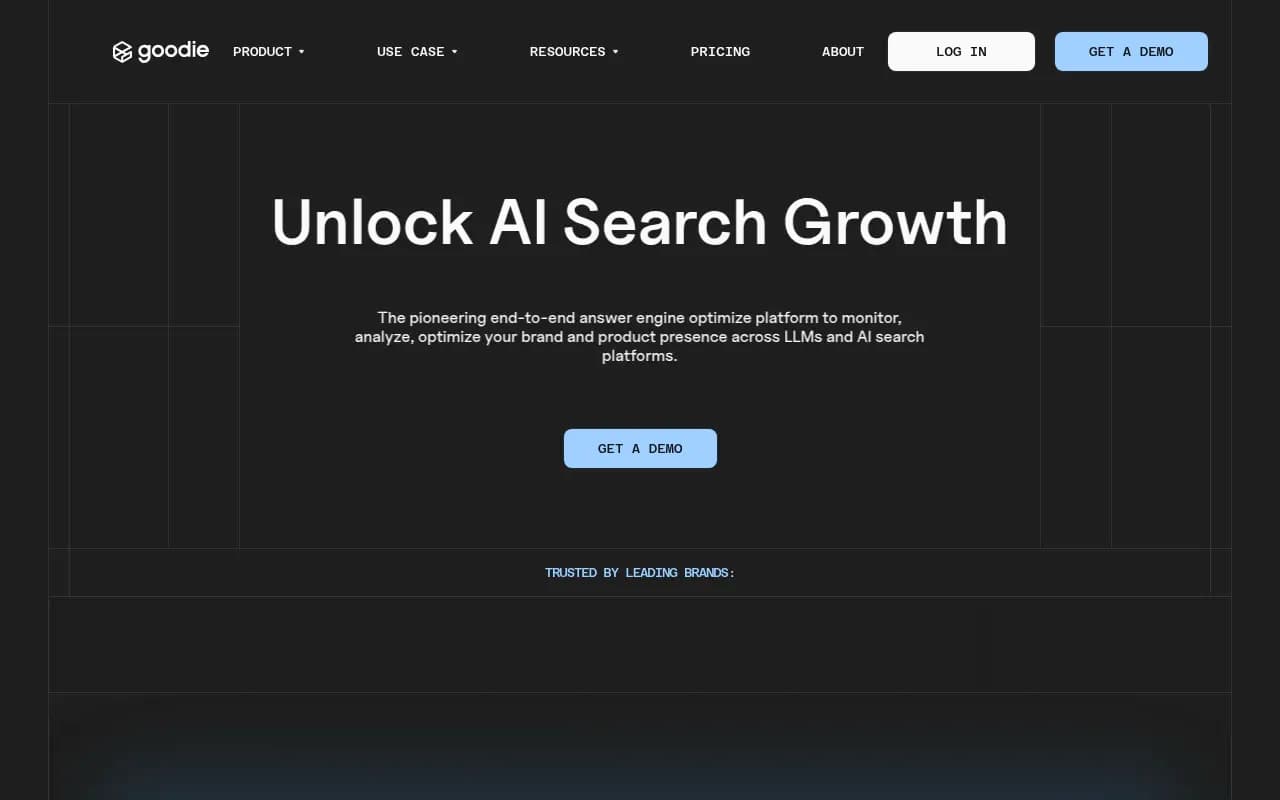
The tool monitors brand mentions across major LLMs and AI search engines, surfaces how your brand is described, and flags sentiment shifts. It's built with a clean, modern interface that makes it easier to digest than some of the more data-heavy platforms.
Goodie does push slightly further than pure monitoring -- it surfaces optimization suggestions based on what it finds. If your brand is missing from certain query types, it can point that out. But the suggestions tend to be directional rather than prescriptive: "you're underrepresented in queries about X" rather than "here's the specific content you need to create."
For teams that want a polished monitoring experience and some guidance on where to focus, Goodie is worth evaluating. It's particularly well-suited to brand and comms teams who want to understand their AI presence without getting deep into technical SEO workflows.
The main limitation is similar to Otterly's: the platform is built around observation. The gap between "here's what's happening" and "here's how to fix it" is still largely left to the user.
Promptwatch: monitoring plus the full optimization loop
Promptwatch sits in a different category from the other two, even though it's often compared to them. The distinction is that Promptwatch is built around doing something with the data, not just collecting it.

The platform monitors 10 AI models -- ChatGPT, Perplexity, Claude, Gemini, Google AI Overviews, Google AI Mode, Grok, DeepSeek, Copilot, and Mistral -- and tracks brand mentions, share of voice, sentiment, and competitor positioning across all of them. That's already broader coverage than Otterly or Goodie.
But the part that separates it is what happens after you see the data.
The action loop
Promptwatch's Answer Gap Analysis shows you exactly which prompts your competitors are visible for that you're not. Not just "you're missing from some queries" -- it identifies the specific questions, topics, and angles where AI models want answers but can't find them on your site.
From there, the built-in AI writing agent generates content -- articles, listicles, comparisons -- grounded in real citation data. Promptwatch has analyzed over 880 million citations to understand what actually gets cited by AI models, and the content generation reflects that. It's not generic SEO content; it's written to match the patterns that make AI models want to reference a source.
Then you track whether it worked. Page-level tracking shows which of your pages are being cited, by which models, and how often. Traffic attribution (via a code snippet, Google Search Console integration, or server log analysis) connects AI visibility to actual website traffic and revenue.
That cycle -- find gaps, create content, measure results -- is what makes Promptwatch an optimization platform rather than a tracker.
Additional capabilities worth noting
A few things Promptwatch does that the others don't:
- AI Crawler Logs: Real-time logs of when AI crawlers (ChatGPT, Claude, Perplexity, etc.) visit your site, which pages they read, and what errors they hit. This is genuinely rare -- most monitoring tools have no visibility into crawler behavior at all.
- Prompt Intelligence: Volume estimates and difficulty scores for each prompt, plus query fan-outs showing how one question branches into sub-queries. This lets you prioritize high-value, winnable prompts instead of guessing.
- Reddit and YouTube tracking: AI models frequently cite Reddit threads and YouTube videos. Promptwatch surfaces which discussions are influencing AI recommendations -- a channel most competitors ignore.
- ChatGPT Shopping tracking: Monitors when your brand appears in ChatGPT's product recommendation carousels.
- Multi-language and multi-region: Monitor AI responses in any language, from any country, with customizable personas.
Promptwatch pricing:
- Essential: $99/mo (1 site, 50 prompts, 5 articles/mo)
- Professional: $249/mo (2 sites, 150 prompts, 15 articles/mo, crawler logs, city/state tracking)
- Business: $579/mo (5 sites, 350 prompts, 30 articles/mo)
- Agency/Enterprise: custom pricing
Free trial available. Annual billing discounts apply.
Head-to-head comparison
| Feature | Otterly.AI | Goodie | Promptwatch |
|---|---|---|---|
| AI models monitored | 5 (ChatGPT, Perplexity, Gemini, Copilot, Google AI) | Major LLMs | 10 (ChatGPT, Perplexity, Claude, Gemini, Grok, DeepSeek, Copilot, Mistral, Google AI Overviews, Google AI Mode) |
| Brand mention tracking | Yes | Yes | Yes |
| Share of voice | Yes | Yes | Yes |
| Sentiment analysis | Yes | Yes | Yes |
| Competitor monitoring | Yes | Yes | Yes |
| Content gap analysis | No | Partial (directional) | Yes (specific prompts and topics) |
| Built-in content generation | No | No | Yes (AI writing agent, citation-grounded) |
| AI crawler logs | No | No | Yes |
| Prompt volume/difficulty scores | No | No | Yes |
| Reddit/YouTube tracking | No | No | Yes |
| ChatGPT Shopping tracking | No | No | Yes |
| Traffic attribution | No | No | Yes (snippet, GSC, server logs) |
| Multi-language/region | Limited | Limited | Yes |
| Starting price | $29/mo | Contact for pricing | $99/mo |
| Best for | Budget monitoring | Brand/comms teams | Teams that want to improve, not just observe |
Which tool should you actually use?
The honest answer depends on what you're trying to accomplish.
Choose Otterly.AI if you're just getting started with AI visibility monitoring, you have a tight budget, and your main goal is understanding whether your brand appears in AI answers. It's the lowest-friction way to get data in front of you. Just know that you'll likely outgrow it once you want to act on what you find.
Choose Goodie if you're a brand or communications team that wants clean, digestible monitoring with some directional guidance. The UX is well-designed and it's less overwhelming than more data-heavy platforms. It's a reasonable middle ground for teams that aren't ready to go deep on content optimization.
Choose Promptwatch if you're serious about improving your AI search visibility, not just measuring it. The gap analysis, content generation, and traffic attribution make it the only tool here that actually helps you move the needle. The $99/mo entry point is higher than Otterly's $29, but you're getting a fundamentally different product -- one that's built to generate ROI, not just reports.
For agencies managing multiple clients, Promptwatch's agency/enterprise tier and Looker Studio integration make it the most scalable option by a significant margin.
A note on the broader market
These three tools exist in a market that's grown from a handful of products to 150+ in roughly two years. Most of what's out there is monitoring-only -- dashboards that show you data and leave you to figure out what to do with it.
The tools that will matter long-term are the ones that close the loop between insight and action. Right now, that's a short list.
If you want to explore other options in this space, a few worth knowing about:
- Peec AI for multi-language, agency-style tracking across global markets

- AthenaHQ for sentiment-focused monitoring, particularly useful for CPG brands

- Profound for enterprise teams with compliance requirements and larger budgets

- Scrunch AI for AEO optimization at higher content volumes
But for the specific comparison at hand -- Goodie, Otterly.AI, and Promptwatch -- the differentiation is clear. Otterly gets you in the door cheaply. Goodie gives you a polished monitoring experience. Promptwatch is the only one built around the idea that visibility data is only useful if it leads to action.
Bottom line
AI search is where a growing share of purchasing decisions start. If your brand isn't appearing in ChatGPT's answer when someone asks about your category, that conversation happened without you -- and traditional analytics won't tell you it happened at all.
All three tools here address that blind spot. The question is whether you want to see the problem or solve it.
Monitoring is a start. Optimization is the point.