Goodie Review 2026
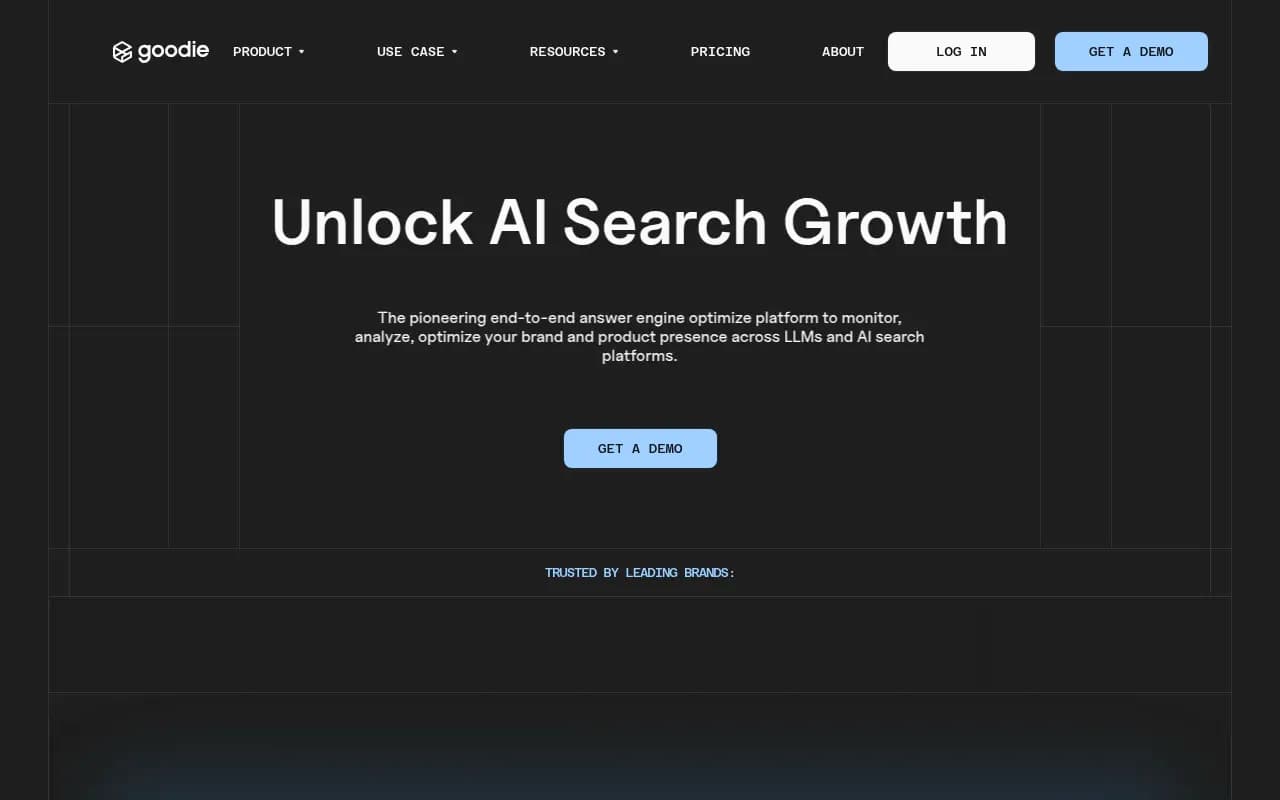
Goodie is an end-to-end AEO platform that helps brands monitor, research, and optimize their visibility across ChatGPT, Gemini, Perplexity, Claude, and 8+ other AI models. Built for enterprise marketing teams and agencies seeking measurable AI search growth.
Key takeaways
- Goodie is a full-cycle AEO (Answer Engine Optimization) platform covering prompt research, visibility monitoring, content optimization, and attribution -- not just a monitoring dashboard
- Lacks several capabilities that Promptwatch offers, including prompt volume/difficulty scoring, query fan-outs, Reddit and YouTube source tracking, and a built-in AI writing agent grounded in citation data
- Pricing is quote-based with no public tiers, which makes it harder to evaluate without a sales call
- Strong enterprise focus with SOC 2 compliance, multi-market support, and a notable Agentic Commerce Suite for AI shopping tracking (including Amazon Rufus)
- Best suited for mid-market to enterprise brands in retail, fintech, SaaS, and travel that want a managed, full-service AEO approach
Goodie (marketed at higoodie.com) is an Answer Engine Optimization platform built for brands that want to show up when customers search through AI tools rather than traditional search engines. The company positions itself as an "end-to-end" solution, covering the full cycle from prompt research through to revenue attribution. It tracks 11 AI models including ChatGPT, Gemini, Perplexity, Claude, Google AI Overviews, Google AI Mode, Meta AI, Microsoft Copilot, DeepSeek, Grok, and notably Amazon Rufus -- the last of which is a differentiator most competitors haven't addressed yet.
The platform appears to have launched in earnest around late 2025 and early 2026, based on the dates of its blog content and case study publications. It's already working with recognizable brands like Dermalogica, SteelSeries, and UK wealth manager Rathbones, and has published case studies showing concrete results: a 127% increase in AI conversions for Dermalogica, a 3.2x AI search conversion increase for SteelSeries in six months, and a 335% traffic increase from AI sources for growth agency NoGood. Those are strong early proof points, though they come from Goodie's own marketing materials.
The target audience is broad on paper -- startup founders, CMOs, SEO specialists, PR teams -- but the platform's enterprise-grade architecture, SOC 2 compliance, and quote-based pricing suggest the real sweet spot is mid-market to enterprise brands and agencies managing multiple clients or complex product catalogs.
Key features
Prompt research Goodie's research module is designed to surface the actual prompts customers use when querying AI models. This goes beyond keyword research -- it's about understanding how people phrase questions to ChatGPT or Perplexity when looking for products or services in your category. The platform claims to identify high-volume, high-intent prompt opportunities, though it's not clear from public information whether it provides numerical volume estimates or difficulty scores the way traditional keyword tools do. This is a meaningful gap compared to some competitors.
Visibility monitoring The core monitoring layer tracks brand mentions, citations, and sentiment across all 11 supported AI models. You can see where your brand appears in AI-generated responses, how often you're cited versus competitors, and whether the sentiment around those mentions is positive or negative. Competitive share-of-voice tracking is included, letting you benchmark your AI presence against specific rivals. The dashboard appears to offer model-by-model breakdowns, which is useful given how differently ChatGPT and Perplexity, for example, tend to cite sources.
Optimization actions Rather than just showing you data, Goodie generates a prioritized playbook of what to fix. This is where it tries to move beyond pure monitoring. The platform identifies gaps between your current visibility and where you should be, then recommends specific actions across owned content and earned media. How automated or manual this process is in practice isn't fully clear from public documentation, but the framing suggests it's more of a guided recommendations system than a fully automated optimization engine.
AEO Writer Goodie includes a content generation tool specifically designed to produce content that AI models will cite. It claims to maintain brand voice while meeting the structural and authority standards that LLMs prefer. This is a meaningful feature -- most AEO monitoring tools don't include content generation at all. That said, the depth of this tool compared to writing agents that are grounded in real citation data (tracking which specific sources AI models actually pull from) is hard to assess without hands-on access.
Agentic Commerce Suite This is probably Goodie's most distinctive feature. It tracks how products appear in AI shopping experiences across ChatGPT, Amazon Rufus, and Perplexity. As AI agents increasingly handle product discovery and purchase decisions, this kind of tracking becomes genuinely valuable for e-commerce and retail brands. Amazon Rufus coverage in particular is rare among AEO platforms. For brands selling on Amazon or competing in AI-powered shopping carousels, this is a real differentiator.
Crawlers & Agents Goodie monitors how AI crawlers interact with your website -- which pages they visit, what errors they encounter, and how frequently they return. This technical layer helps identify indexing issues that might be preventing AI models from discovering or citing your content. It's a feature that many monitoring-only competitors skip entirely, and it's important because a brand can have great content but still be invisible in AI search if crawlers can't access it properly.
Analytics & Attribution The attribution module connects AI visibility to actual business outcomes -- traffic, conversions, and revenue. This closes the loop between "we're being cited more" and "that citation is driving measurable growth." The platform mentions connecting visibility to revenue, which suggests some form of traffic attribution, though the specific implementation (code snippet, GSC integration, server logs) isn't detailed publicly.
Multi-market and multi-language support Goodie supports global brands with multi-language and multi-region monitoring. For enterprise brands operating across multiple markets, this is table stakes, but it's worth noting that not all AEO platforms handle this well.
White-label reporting for agencies Agencies get multi-domain dashboards and white-label reporting, which makes Goodie viable for managing multiple client accounts. Automated research workflows are also mentioned, though the depth of automation isn't specified.
Who is it for
Goodie's clearest fit is enterprise marketing and SEO teams at brands where AI search visibility is becoming a board-level concern. Think a global skincare brand like Dermalogica trying to ensure ChatGPT recommends their products, or a fintech company like a wealth manager wanting to appear authoritatively when users ask Perplexity about investment options. The SOC 2 compliance and enterprise-grade architecture signal that Goodie is built to handle the security and scale requirements that large organizations demand.
For e-commerce and retail brands specifically, the Agentic Commerce Suite makes Goodie worth a serious look. If your products are being discovered through Amazon Rufus or ChatGPT's shopping features, you need visibility into that channel -- and most AEO tools don't offer it. Gaming brand SteelSeries becoming "the most retrieved gaming brand across 3 major LLMs" in six months is a compelling case study for this use case.
Digital agencies managing AI search for multiple clients are another strong fit. The multi-domain dashboards and white-label reporting reduce the operational overhead of running AEO programs across a client portfolio.
Who should probably look elsewhere: small businesses or solo marketers who need self-serve, transparent pricing and don't want to go through a sales process. The quote-based pricing model and demo-first onboarding suggest Goodie isn't optimized for quick, low-friction sign-ups. Startups with limited budgets would likely find the platform inaccessible or over-engineered for their needs.
Integrations and ecosystem
Goodie's public documentation doesn't detail a specific list of third-party integrations, but the platform mentions analytics and attribution capabilities that imply some form of connection to web analytics tools. The Crawlers & Agents feature suggests server log analysis or similar technical integrations for monitoring AI bot activity.
The Agentic Commerce Suite's coverage of Amazon Rufus implies some level of data pipeline into Amazon's ecosystem, though the mechanics aren't publicly documented. For agencies, the white-label reporting suggests export capabilities, but whether this extends to a full API or Looker Studio integration isn't confirmed.
No browser extension or mobile app is mentioned. The platform appears to be entirely web-based, which is standard for enterprise AEO tools.
Pricing and value
Goodie uses quote-based pricing with no public tiers. The website directs all prospective customers to request a demo, and third-party sources confirm there are no fixed public price points. This is common for enterprise software but makes it difficult to evaluate value without engaging the sales team.
Based on the enterprise positioning, SOC 2 compliance, and the caliber of brands in their case studies, Goodie is almost certainly not a budget tool. Expect pricing to be in the range of several hundred to several thousand dollars per month depending on the number of brands, prompts, and features required.
For comparison, Promptwatch's public pricing starts at $99/month for a single site with 50 prompts, scaling to $579/month for five sites and 350 prompts. Goodie's lack of transparent pricing makes direct comparison impossible, but the enterprise focus suggests it targets a different (higher) price bracket.
Strengths and limitations
What Goodie does well:
- The Agentic Commerce Suite with Amazon Rufus tracking is genuinely rare and valuable for retail and e-commerce brands
- SOC 2 compliance and enterprise-grade architecture make it viable for large organizations with strict security requirements
- The closed-loop framework (Research, Monitor, Action, Measure) is well-structured and goes beyond pure monitoring
- Published case studies with specific, quantified results give it more credibility than platforms that only show logos
- Broad model coverage including Amazon Rufus, which most competitors haven't addressed
Limitations and honest gaps:
- No public pricing makes it hard to evaluate without a sales call, which creates friction for teams doing independent research
- Compared to Promptwatch, Goodie appears to lack prompt volume and difficulty scoring, query fan-outs, and Reddit/YouTube source tracking -- all of which help prioritize which prompts to target and understand where AI models are pulling their citations from
- The AEO Writer's depth is unclear. Promptwatch's AI writing agent is grounded in 880M+ analyzed citations, which means content recommendations are tied to what AI models actually cite. Goodie's content generation approach isn't documented at that level of specificity
- No mention of AI traffic attribution via server log analysis or a code snippet approach, which limits the ability to connect AI visibility to actual site traffic at a granular level
- The self-serve path doesn't exist -- everything goes through a demo request, which slows down evaluation for teams that prefer to explore before talking to sales
Bottom line
Goodie is a serious AEO platform with a well-designed feature set, strong enterprise credentials, and real case study results. For large retail, fintech, or SaaS brands that need AI shopping tracking (especially Amazon Rufus), SOC 2 compliance, and a managed onboarding experience, it's worth evaluating. The Agentic Commerce Suite in particular fills a gap that most competitors haven't addressed.
That said, teams that want transparent pricing, self-serve access, prompt-level intelligence (volume scores, difficulty, query fan-outs), Reddit and YouTube source tracking, and a content generation tool grounded in real citation data will find Promptwatch a more complete and accessible option. Goodie monitors and guides -- Promptwatch monitors, analyzes, and helps you create content engineered to rank in AI search.
Best for: Enterprise brands and agencies in retail, fintech, or SaaS that need AI shopping visibility (including Amazon Rufus) and are comfortable with a sales-led evaluation process.
Tags:
Frequently asked questions
What is Goodie (higoodie.com)?
How much does Goodie cost?
Which AI models does Goodie track?
Is Goodie suitable for agencies?
How does Goodie compare to Promptwatch?
Does Goodie have a free trial?
Similar and alternative tools to Goodie