Weberlo Review 2026
Weberlo is a cookieless server-side attribution platform that helps digital marketers recover up to 60% of lost conversion data caused by iOS privacy updates and cookie deprecation. Built for performance marketers running paid campaigns, it tracks the full customer journey, sends accurate conversion
Summary
- Solves iOS tracking loss: Server-side tracking bypasses browser restrictions that cause pixel-based tools to miss up to 60% of conversions
- Sends conversions to ad platforms: Feeds accurate data back to Meta, Google, TikTok for better optimization and lower CPAs (clients see 20% average reduction)
- Built-in deduplication: Matches sales to bank deposits including refunds and recurring payments -- no double-counting or phantom conversions
- Lacks content optimization: Monitoring-only tool with no gap analysis, AI content generation, or traffic attribution features that Promptwatch offers for AI search visibility
- Best for: Performance marketers and agencies running paid campaigns who need accurate attribution despite privacy restrictions
Weberlo is a server-side attribution platform built to solve one specific problem: the collapse of browser-based conversion tracking. When Apple rolled out iOS privacy updates and Google started phasing out third-party cookies, traditional pixel tracking broke. Marketers started seeing 40-60% of their conversions disappear from dashboards -- not because sales stopped happening, but because browsers stopped reporting them. Weberlo routes tracking through your server instead of the user's browser, capturing conversions that pixels miss and feeding that data back to ad platforms so they can optimize properly.
The company targets performance marketers, agencies, and ecommerce brands running paid campaigns on Meta, Google, TikTok, and similar platforms. If you're spending $10k+/month on ads and your pixel data looks incomplete (iOS users converting but not showing up, attribution windows shrinking, ROAS numbers that don't match Stripe), Weberlo is built for you. It's not a general analytics tool -- it's specifically designed to fix attribution for paid media buyers.
How server-side tracking actually works
Traditional pixel tracking relies on JavaScript running in the user's browser. When someone buys something, the pixel fires an event to Meta or Google saying "conversion happened." But iOS blocks most of these requests. Safari's Intelligent Tracking Prevention kills cookies after 7 days. Firefox blocks third-party trackers by default. Chrome is phasing them out entirely. The result: your ad platforms don't see conversions, so they optimize toward the wrong audiences and waste your budget.
Weberlo flips this model. Instead of tracking in the browser, it tracks on your server. When a user visits your site, Weberlo's script captures their click ID (fbclid, gclid, ttclid, etc.) and stores it server-side. When they convert, your server sends the conversion event directly to the ad platform's API -- no browser involved, no tracking restrictions applied. The ad platform gets the data it needs, your attribution stays accurate, and your campaigns optimize correctly.
This isn't theoretical. Weberlo's site claims clients see a 20% average decrease in CPA after switching. The reason: ad platforms finally have enough conversion data to target properly. Instead of optimizing on 40% of your actual conversions (the ones pixels catch), they optimize on 90%+ (what server-side tracking captures). Better data means better targeting, which means lower costs and higher ROAS.
Conversion API integrations
Weberlo sends conversion data back to ad platforms via their official APIs. Supported integrations include:
- Meta Conversions API (CAPI): Sends purchase, lead, and custom events directly to Meta. Bypasses iOS restrictions entirely. Improves event match quality scores which Meta uses to determine data reliability.
- Google Ads Enhanced Conversions: Sends hashed customer data (email, phone) to Google for better attribution matching. Works alongside Google's pixel for maximum coverage.
- TikTok Events API: Feeds conversion data to TikTok's algorithm so it can optimize toward actual buyers instead of just clickers.
- Snapchat CAPI: Same concept -- server-side events for better attribution on Snapchat ads.
Each integration is designed to complement (not replace) existing pixels. You keep your pixel running for browser-based tracking, and Weberlo fills in the gaps with server-side data. The platforms deduplicate events automatically using event IDs, so you don't double-count conversions.
Built-in deduplication for purchases
One problem with multi-touch attribution: double-counting. If a user clicks a Facebook ad, then a Google ad, then buys, both platforms might claim the sale. Weberlo's deduplication engine solves this by matching conversions to actual bank deposits. It integrates with Stripe, PayPal, and other payment processors to pull transaction data, then cross-references that with tracked conversions. If a sale shows up twice (once from Meta pixel, once from server-side tracking), Weberlo merges them into a single event.
It also handles refunds and recurring payments. If someone refunds an order, Weberlo updates the conversion data so your ROAS calculations stay accurate. If someone subscribes and pays monthly, Weberlo tracks each payment as a separate event tied to the original acquisition source. This level of detail is rare -- most attribution tools stop at the initial purchase and ignore what happens after.
The result: the metrics you see in Weberlo match what's in your bank account. No phantom conversions, no missing sales, no confusion about which channel actually drove revenue.
Full customer journey tracking
Weberlo tracks every touchpoint from first visit to final purchase and beyond. When someone lands on your site, Weberlo logs the source (organic search, paid ad, email, direct), the UTM parameters, the landing page, and the click ID. As they browse, it tracks page views, button clicks, form submissions, and other interactions. When they convert, it ties the conversion back to the original source and shows you the entire path they took.
This is useful for understanding multi-touch attribution. Maybe someone clicks a Facebook ad, doesn't buy, comes back via Google search a week later, and converts. Traditional last-click attribution gives Google all the credit. Weberlo shows you both touchpoints so you can see how channels work together. You can assign credit using first-click, last-click, linear, or custom models.
The customer journey view also tracks lifetime value. After someone makes their first purchase, Weberlo continues monitoring their activity -- repeat purchases, subscription renewals, upsells. You can see LTV by acquisition source, which helps you decide where to allocate budget. If Facebook customers have a $200 LTV and Google customers have a $400 LTV, you know to shift spend toward Google even if Facebook has a lower initial CPA.
Organic attribution with UTM tracking
Weberlo isn't just for paid ads. It tracks all traffic sources using UTM parameters. If you're running email campaigns, influencer partnerships, podcast sponsorships, or any other channel that uses UTM tags, Weberlo captures those visits and attributes conversions accordingly. You can create custom channels (e.g. "Podcast" or "Affiliate") and group UTM sources however you want.
This is helpful for understanding the full marketing mix. Paid ads might drive 60% of revenue, but if organic search drives another 20% and email drives 10%, you need to see all of it in one place. Weberlo's dashboard shows revenue, conversions, and ROAS by channel so you can compare performance across the board.
One limitation: Weberlo doesn't track organic search keywords or show which specific queries drove traffic. It knows someone came from Google organic, but not what they searched for. For that, you'd need Google Search Console or a traditional SEO tool.
5-minute setup (mostly accurate)
Weberlo markets itself as "plug and play" with a 5-minute setup. Here's what that actually involves:
- Add Weberlo's tracking script to your site (one line of code in the header)
- Connect your ad accounts (Meta, Google, TikTok) via OAuth
- Connect your payment processor (Stripe, PayPal) for transaction data
- Set up conversion events (purchase, lead, signup, etc.)
- Configure UTM parameters for organic tracking
For a basic setup (just tracking purchases from Meta ads), 5 minutes is realistic. For a full setup with multiple ad platforms, custom events, and UTM tracking, expect 20-30 minutes. The interface is straightforward -- no coding required beyond pasting the tracking script. If you're using Shopify, WooCommerce, or another popular platform, Weberlo has native integrations that simplify setup further.
One thing to note: server-side tracking requires a custom tracking domain (e.g. track.yourdomain.com) to avoid ad blockers. Weberlo provides this as part of the setup, but you'll need to add a DNS record to your domain. Not complicated, but it's an extra step.
Dashboard and reporting
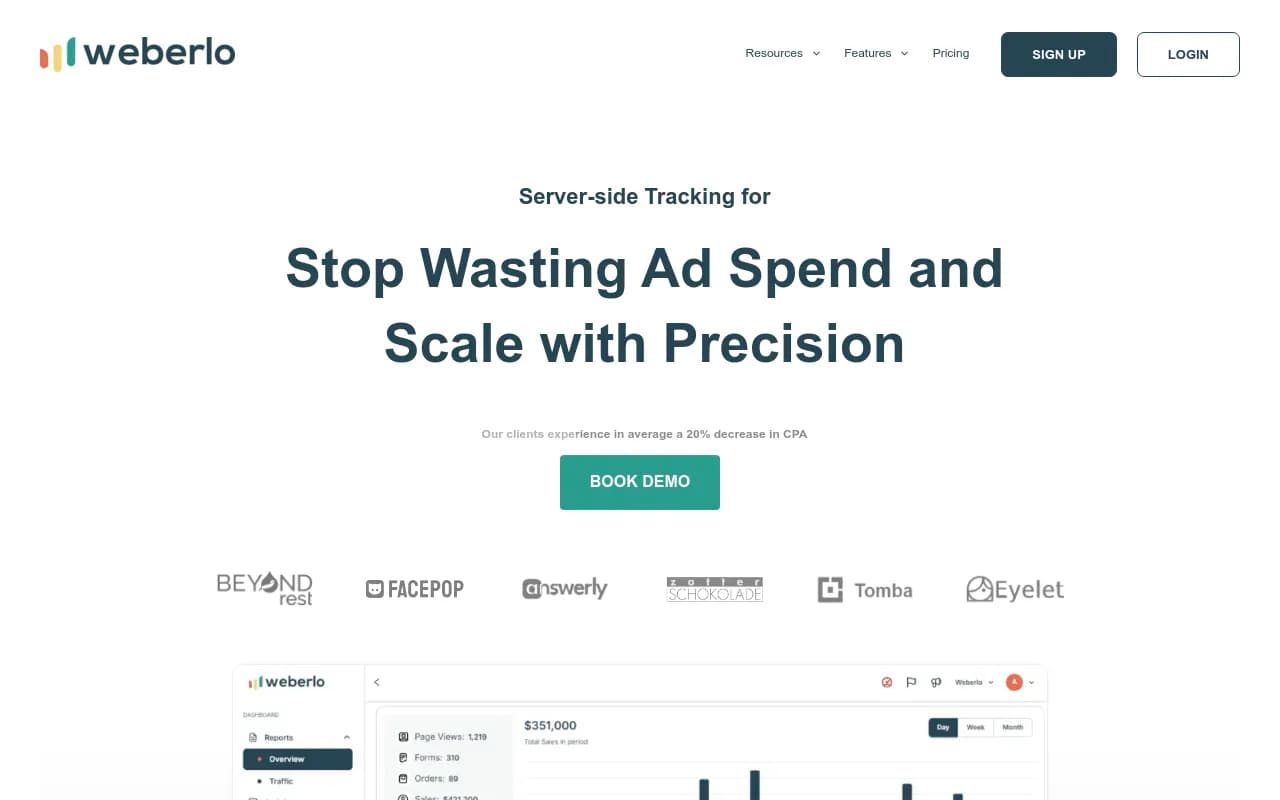
Weberlo's dashboard shows key metrics at a glance: total revenue, conversions, ROAS, CPA, and traffic by source. You can filter by date range, channel, campaign, or UTM parameter. The ads table breaks down performance by platform and campaign, showing spend, revenue, ROAS, and conversion count for each.
The customer journey view is more detailed. Click on any customer and you'll see their full activity timeline -- every page they visited, every ad they clicked, every purchase they made. This is useful for understanding behavior patterns and identifying drop-off points.
Reporting is basic but functional. You can export data to CSV or connect Weberlo to Google Sheets for custom reports. There's no built-in dashboard builder or advanced visualization tools. If you need complex reporting, you'll likely export data and build dashboards in Looker Studio, Tableau, or similar tools.
Who is Weberlo for
Weberlo is built for performance marketers and agencies running paid campaigns. Specifically:
- Ecommerce brands spending $10k+/month on ads: If you're running Meta, Google, or TikTok campaigns and seeing attribution gaps (iOS users converting but not showing up in dashboards), Weberlo fixes that. The 20% CPA reduction claim is most relevant here.
- Agencies managing multiple clients: Weberlo supports multiple workspaces, so you can track attribution for 10+ clients in one account. The deduplication and LTV tracking features help you prove ROI to clients.
- SaaS companies with long sales cycles: If your customers take weeks or months to convert, Weberlo's multi-touch attribution shows which touchpoints mattered. The LTV tracking is also useful for subscription businesses.
Weberlo is NOT for:
- Content marketers focused on organic traffic: Weberlo tracks organic visits via UTM parameters, but it doesn't provide keyword data, backlink analysis, or content optimization tools. For that, you'd need an SEO platform.
- Brands not running paid ads: If you're purely organic (SEO, social, email), Weberlo's core value (server-side conversion tracking for ad platforms) doesn't apply. You'd be better off with Google Analytics or a similar tool.
- Small businesses with <$5k/month ad spend: Weberlo's pricing starts at $99/month, which is reasonable for larger budgets but might not make sense if you're only spending a few thousand dollars on ads. The ROI improvement needs to justify the cost.
Integrations and ecosystem
Weberlo integrates with:
- Ad platforms: Meta (Facebook/Instagram), Google Ads, TikTok, Snapchat. Sends conversion data via official APIs.
- Payment processors: Stripe, PayPal. Pulls transaction data for deduplication and LTV tracking.
- Ecommerce platforms: Shopify, WooCommerce. Native integrations for easier setup.
- Analytics tools: Google Analytics (via GTM), Google Sheets (for reporting).
No API is publicly documented, so custom integrations aren't an option. Weberlo is designed as a turnkey solution -- you use the integrations they provide, or you don't use it. This is fine for most users, but if you need to connect Weberlo to a proprietary CRM or custom data warehouse, you're out of luck.
No mobile app. Everything happens in the web dashboard.
Pricing and value
Weberlo offers three pricing tiers:
- Free: 2,000 page views/month, $2,000 in tracked sales/month. Includes ad tracking, custom channels, custom tracking domain, some integrations, live chat support. Good for testing or very small sites.
- Starter: $99/month. Likely increases page view and sales limits (exact numbers not specified on the site). Includes all Free features plus more integrations.
- Business: Pricing not listed. Presumably for high-volume users or agencies managing multiple clients.
The Free plan is generous enough to test Weberlo properly. If you're doing $2k/month in sales, you can see whether server-side tracking improves your attribution before committing to a paid plan. The $99/month Starter plan is reasonable for small-to-mid-size ecommerce brands. If you're spending $10k/month on ads and Weberlo reduces your CPA by 20%, that's a $2k/month savings -- easily justifies the $99 cost.
No annual billing discount is mentioned. Free trial details aren't specified, but the Free plan effectively serves as a trial.
Compared to competitors like Triple Whale ($129/month), Hyros ($199/month), or Northbeam ($500+/month), Weberlo is on the lower end of the pricing spectrum. It's not as feature-rich as those tools (no cohort analysis, no predictive analytics, no advanced attribution modeling), but it covers the core use case (server-side tracking and conversion API integration) at a lower price point.
Strengths
- Solves a real problem: iOS tracking loss is a genuine issue for paid media buyers. Weberlo's server-side approach directly addresses it.
- Conversion API integrations: Sending data back to ad platforms is the key feature. Most analytics tools just show you data -- Weberlo actively improves your ad performance by feeding better data to Meta, Google, and TikTok.
- Deduplication and LTV tracking: Matching conversions to bank deposits and tracking repeat purchases is more thorough than most attribution tools.
- Affordable pricing: $99/month is accessible for small-to-mid-size brands. The Free plan is a real trial, not a gimmick.
- Fast setup: For basic use cases (tracking purchases from Meta ads), setup is genuinely quick. No complex configuration required.
Limitations
- Basic reporting: The dashboard shows key metrics, but there's no advanced visualization, cohort analysis, or predictive modeling. If you need deep analytics, you'll export data and build reports elsewhere.
- No API: Custom integrations aren't possible. You're limited to the platforms Weberlo supports.
- Limited organic tracking: Weberlo tracks organic traffic via UTM parameters, but it doesn't provide keyword data, backlink analysis, or content optimization tools. For SEO, you'd need a separate platform.
- Not a full analytics suite: Weberlo is focused on attribution for paid ads. It doesn't replace Google Analytics for general site analytics, and it doesn't offer session replay, heatmaps, or user behavior analysis.
- Missing AI search visibility features: Unlike Promptwatch, Weberlo doesn't track brand presence in AI search engines (ChatGPT, Perplexity, Claude), provide content gap analysis, or offer AI content generation. If your goal is optimizing for AI visibility, Weberlo isn't the right tool.
Bottom line
Weberlo is a solid choice for performance marketers and agencies running paid campaigns who need accurate attribution despite iOS restrictions and cookie deprecation. The server-side tracking approach works, the Conversion API integrations improve ad performance, and the pricing is reasonable. If you're spending $10k+/month on Meta, Google, or TikTok ads and your pixel data looks incomplete, Weberlo will likely pay for itself by reducing your CPA.
It's not a full analytics suite, and it won't replace Google Analytics or your SEO tools. It's a specialized attribution platform designed to solve one problem well: making sure your ad platforms get the conversion data they need to optimize properly. For that specific use case, it's a strong option at a fair price.
Frequently asked questions
What is Weberlo and what does it do?
How much does Weberlo cost?
Does Weberlo have a free plan?
Who is Weberlo best for?
How does Weberlo help with iOS tracking issues?
What ad platforms does Weberlo integrate with?
Does Weberlo prevent duplicate conversion tracking?
How much can Weberlo reduce customer acquisition costs?
Similar and alternative tools to Weberlo