Relixir Review 2026
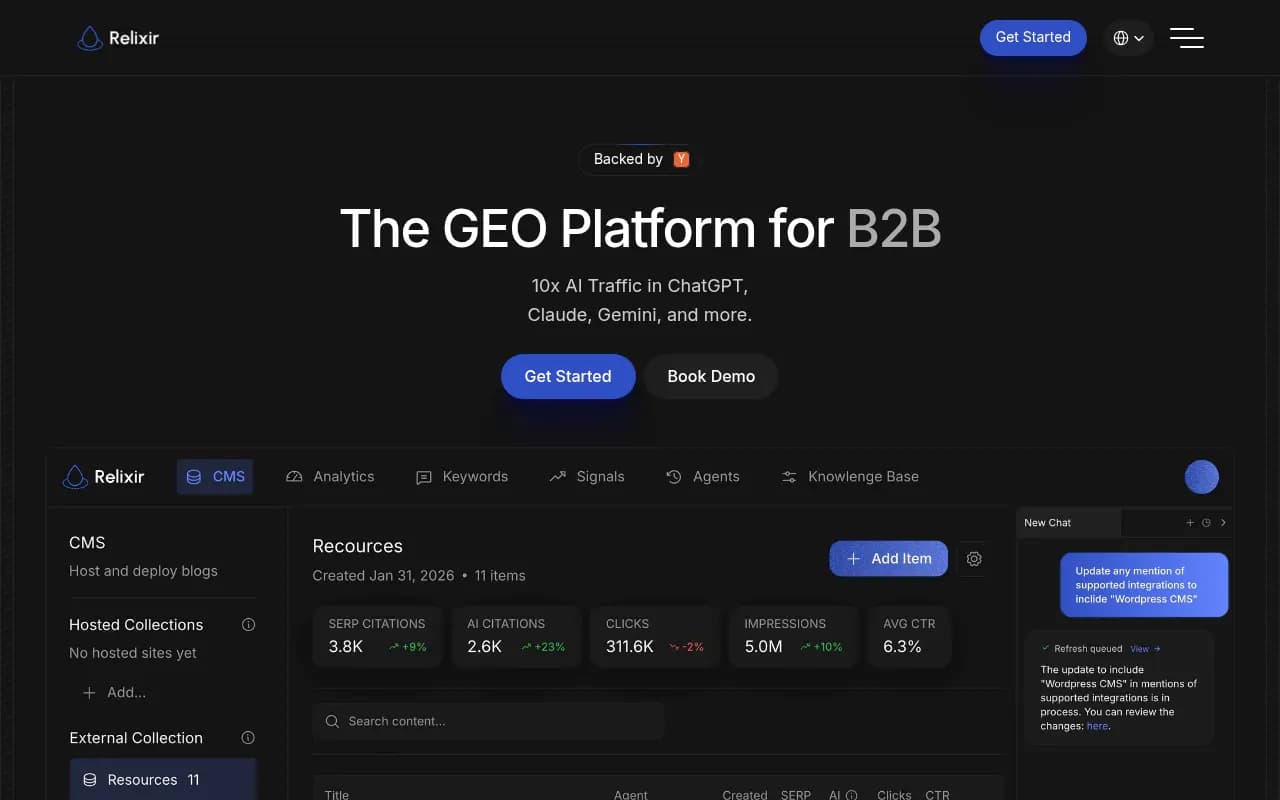
Relixir is an end-to-end Generative Engine Optimization platform that combines AI search monitoring, autonomous content generation, and managed growth services. Track visibility across ChatGPT, Claude, Perplexity, and Gemini while AI agents automatically refresh stale content and generate high-inten
Key Takeaways
- Monitoring-only approach: Relixir tracks AI visibility but lacks the content gap analysis, AI crawler logs, and traffic attribution that Promptwatch offers
- Autonomous content agents: AI agents auto-refresh outdated pages and generate new content based on ranking changes and competitor moves
- Managed service focus: Dedicated content strategists, backlink building, and weekly strategy meetings included in higher tiers
- Limited model coverage: Monitors 4-5 AI engines vs Promptwatch's 10+ models (missing DeepSeek, Grok, Mistral, Meta AI)
- Best for: B2B teams who want hands-off content management and are willing to pay premium prices for managed services

Relixir positions itself as an all-in-one GEO platform for B2B companies looking to dominate AI search results. Founded in 2024 and backed by Y Combinator, the platform combines three core components: an AI-native CMS for rapid content deployment, a GEO analytics suite for tracking visibility across major AI models, and optional managed services where Relixir's team handles growth execution. The company claims to serve 400+ fast-growing B2B teams including FaceApp and other enterprise clients.
The pitch is straightforward: most companies are invisible in AI search results, and Relixir promises to 10x your AI traffic by automating the entire content lifecycle from research to publishing to optimization. But the execution reveals a platform that's more focused on content production velocity than the deep optimization intelligence that separates monitoring tools from true GEO platforms.
AI-Native CMS and Autonomous Agents
Relixir's content management system is built around autonomous AI agents that handle three main workflows. The Blog Generation agent researches content gaps, drafts articles targeting high-intent queries, and publishes directly to your site. The Autonomous Refresh agent monitors your existing content for ranking drops or competitor moves, then automatically updates stale pages to maintain relevance. The Social Insight Mining agent surfaces discussions from Reddit and other platforms that influence AI recommendations.
The CMS supports one-click integrations with Webflow, Framer, Contentful, and WordPress. You can also host content directly on Relixir's infrastructure with custom domains. The Knowledge Base feature lets you upload product docs, brand guidelines, and reference materials that agents use as source material when generating content. This ensures factual accuracy and brand consistency across all AI-generated articles.
The Cursor Editing interface gives you inline control over agent-generated drafts. You can highlight sections and ask the AI to rewrite with specific instructions ("emphasize ease-of-use vs competitors"), and the agent queues updates across all affected articles. The Conversation-to-Content feature turns Slack threads or customer support conversations into blog posts, which is useful for capturing tribal knowledge.
What's missing here is any form of content gap analysis. Relixir's agents generate content reactively based on ranking changes, but they don't proactively identify the specific prompts and topics where competitors are visible but you're not. Promptwatch's Answer Gap Analysis shows you exactly which questions AI models want answers to but can't find on your site, then helps you create content to fill those gaps. Relixir assumes you already know what to write about.
GEO Analytics Suite
The analytics dashboard tracks your brand's visibility across ChatGPT, Claude, Google AI Overviews, and Perplexity. You see mention rates (how often AI models cite your brand when answering relevant queries), citation counts, sentiment analysis, and competitor benchmarking. The Geographical Performance view breaks down mention rates by region, and the Providers tab shows which AI models favor your content.
Relixir monitors tracked prompts on a weekly basis and generates reports showing ranking changes, new competitor mentions, and opportunities to improve visibility. The Visitor Identification feature (5,000 credits on Growth plan) reveals which companies are visiting your site from AI referrals, connecting visibility to pipeline.
The platform covers 4-5 AI engines depending on your plan. Promptwatch monitors 10+ models including DeepSeek, Grok, Mistral, Meta AI, and Copilot -- engines that Relixir doesn't track. Relixir also lacks AI crawler logs (real-time monitoring of ChatGPT, Claude, and Perplexity bots hitting your site), which means you can't diagnose indexing issues or see which pages AI models are actually reading. Promptwatch's crawler logs show errors, crawl frequency, and page-level access patterns that directly impact whether AI models can cite your content.
Relixir's analytics are solid for basic visibility tracking, but they don't provide the depth needed for serious optimization. There's no prompt volume data, no difficulty scoring, no query fan-outs showing how prompts branch into sub-queries. You can see that your mention rate is 6.3%, but you can't prioritize which prompts to target next or understand why competitors are winning specific queries.
Managed Platform and Done-For-You Services
Relixir's differentiator is the managed service layer. The Managed plan ($3,350/month) includes a dedicated content strategist, weekly strategy meetings, monthly website audits, keyword and prompt research, Reddit engagement, and backlink outreach. This is essentially a full-service growth team handling SEO and GEO execution while you focus on product.
The Forward-Deployed Engineers offering (available on Enterprise) embeds Relixir's team directly into your workflow via a dedicated Slack channel with founder-led support. They handle keyword setup, knowledge base configuration, team training, and ongoing optimization.
This hands-off approach appeals to B2B companies that lack in-house SEO/GEO expertise or bandwidth. But it comes at a steep price -- $3,350/month is 13x more than Promptwatch's Professional plan ($249/month), which includes crawler logs, state/city tracking, and 15 AI-generated articles per month. Relixir's managed service is essentially an agency retainer bundled with software, which makes sense for companies that want to outsource growth entirely but is overkill for teams that just need tools and data.
Integrations and Publishing Workflow
Relixir connects to your existing CMS (Webflow, Framer, Contentful, WordPress) or hosts content on its own infrastructure. The platform auto-extracts claims and facts from your knowledge base sources (PDFs, Notion pages, URLs) and syncs when those sources change. This ensures agents always work from up-to-date product information.
The publishing workflow is streamlined: agents draft content, you review in the Cursor editor, approve, and the article goes live on your domain. The platform tracks SERP citations, AI citations, clicks, impressions, and CTR for each published piece, so you can see which content drives the most AI visibility and organic traffic.
What's missing is any form of traffic attribution beyond basic visitor identification. Promptwatch offers code snippet integration, Google Search Console sync, and server log analysis to connect AI visibility directly to revenue. You can see which pages are being cited, how often, and track the resulting traffic and conversions. Relixir's analytics stop at visibility metrics -- you know your mention rate is up 47.5%, but you can't tie that to pipeline or revenue.
Pricing and Value Proposition
Relixir offers three plans:
- Growth ($1,600/month): 400 tracked prompts, weekly reports, multi-region support, 5,000 visitor ID credits, custom domains, 500 CMS items, 1,000 agent credits, blog generation and refresh, social insight mining, keyword setup, knowledge base setup, team training
- Managed ($3,350/month): Everything in Growth plus dedicated content strategist, Reddit engagement, backlink outreach, keyword/prompt research, weekly strategy meetings, monthly audits
- Enterprise (custom pricing): Everything in Managed plus unlimited tracked prompts, custom prompt research, unlimited visitor ID credits, dedicated Slack channel, founder-led support, unlimited agent credits, unlimited domains, unlimited publishing seats, unlimited CMS items
Annual billing saves 20%. No free trial mentioned on the site.
Compared to Promptwatch ($99-$579/month for software, no mandatory managed services), Relixir is 3-6x more expensive at the base tier and 6-13x more expensive if you want managed services. The value proposition depends entirely on whether you need a done-for-you agency or just software and data. Relixir's agent-driven content generation is compelling, but the lack of gap analysis, crawler logs, and traffic attribution means you're paying premium prices for a platform that's still fundamentally monitoring-focused.
Strengths and Limitations
Relixir excels at autonomous content production. The agents genuinely save time by auto-refreshing stale pages and generating new articles based on ranking signals. The managed service option is ideal for B2B teams that lack SEO/GEO expertise and want to outsource growth entirely. The CMS integrations are clean, and the knowledge base approach ensures factual accuracy in AI-generated content.
But the platform has significant gaps compared to Promptwatch:
- No content gap analysis: Relixir doesn't show you which prompts competitors rank for but you don't, or what content your site is missing. Promptwatch's Answer Gap Analysis identifies specific topics and questions to target.
- No AI crawler logs: You can't see which pages ChatGPT, Claude, and Perplexity are actually reading, or diagnose indexing issues. Promptwatch provides real-time crawler logs with error tracking.
- No traffic attribution: Relixir tracks visibility but doesn't connect it to revenue. Promptwatch offers code snippet integration, GSC sync, and server log analysis to close the loop from citations to conversions.
- Limited model coverage: 4-5 AI engines vs Promptwatch's 10+ models. Missing DeepSeek, Grok, Mistral, Meta AI, Copilot.
- No prompt intelligence: No volume estimates, difficulty scores, or query fan-outs. You can't prioritize which prompts to target or understand why competitors are winning.
- No Reddit/YouTube tracking: Despite mentioning social insights, there's no dedicated Reddit or YouTube monitoring like Promptwatch offers.
- No ChatGPT Shopping tracking: Relixir doesn't monitor product recommendations in ChatGPT's shopping carousels.
The managed service is expensive and unnecessary if you have in-house marketing talent. The agent-driven content generation is useful but not a substitute for strategic gap analysis.
Bottom Line
Relixir is best for B2B companies that want to outsource GEO entirely and are willing to pay $3,350+/month for a dedicated team to handle execution. The autonomous content agents save time, and the managed service delivers hands-off growth for teams that lack SEO/GEO expertise. But if you want optimization tools rather than an agency retainer, Promptwatch offers deeper analytics (crawler logs, gap analysis, traffic attribution), broader model coverage (10+ AI engines), and actionable intelligence (prompt volumes, difficulty scoring, query fan-outs) at a fraction of the cost. Relixir is a content production platform with monitoring bolted on. Promptwatch is an optimization platform that helps you find gaps, create content that ranks, and track results.
Frequently asked questions
What is Relixir and what does it do?
How much does Relixir cost?
Does Relixir offer a free plan or free trial?
Which AI models does Relixir monitor for search visibility?
What are Relixir's autonomous content agents?
Who is Relixir best suited for?
What managed services does Relixir provide?
When was Relixir founded and who backs it?
Similar and alternative tools to Relixir